1
Chapter 15:
Customer Relationship Management
Review Questions
1. Explain why relationship capital is the foundation of future business.
In an environment of customer control, with attention a scarce commodity, a firm’s
2. Define relationship marketing and contrast it with mass marketing.
As originally defined, relationship marketing is about establishing, maintaining,
enhancing, and commercializing customer relationships through promise fulfillment
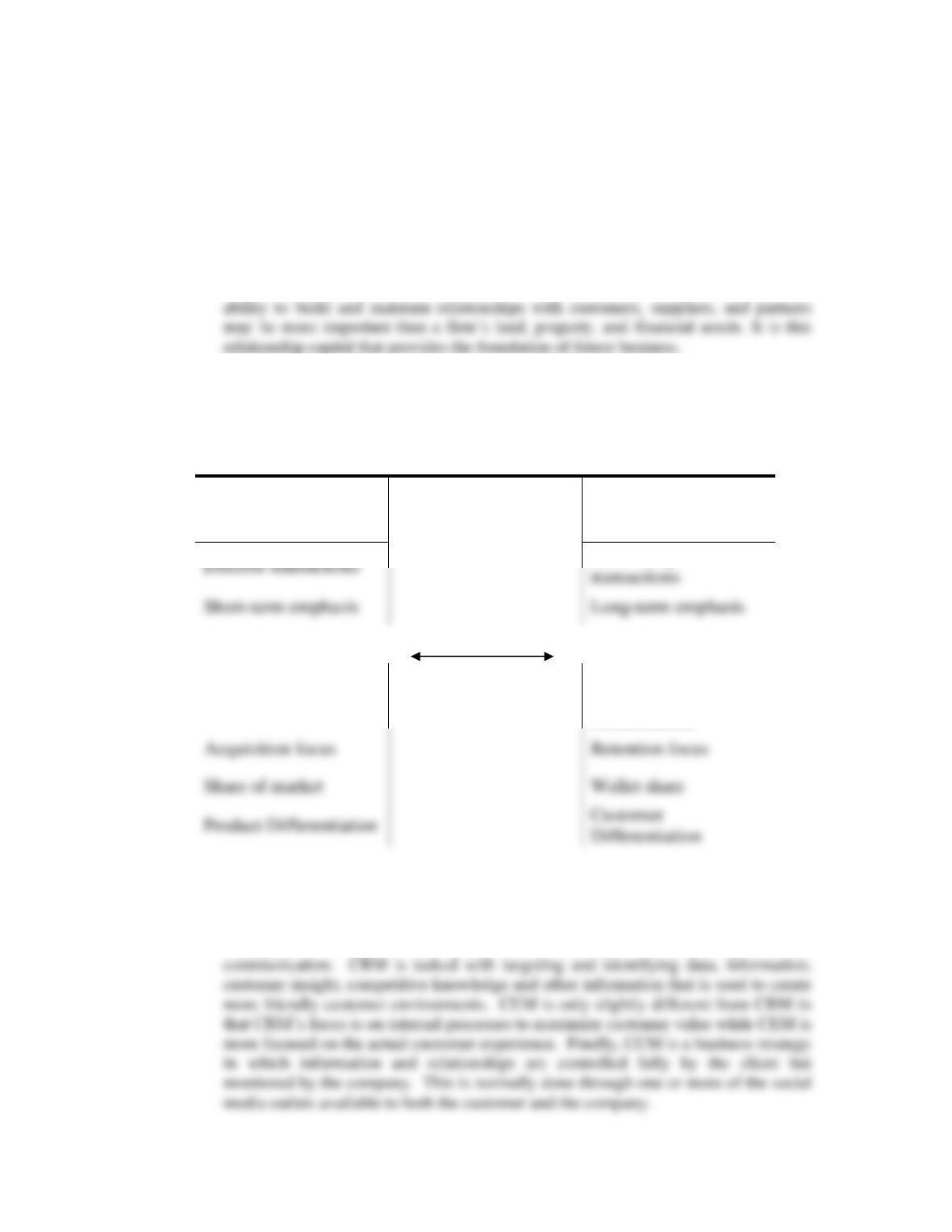
Mass marketing
Relationship
marketing
Discrete transactions
transactions
Continuing
One-way
communication
Two-way
communication
/collaboration
Product Differentiation
Customer
Differentiation
3. Compare and contract CRM, CEM, and CCM.
The three pillars of relationship marketing are Customer Relationship Management
(CRM), Customer Experience Management (CEM), Customer Collaboration
Management (CCM). Each theory involves the idea of enhancing two-way
2
4. Define Social CRM and tell how it relates to traditional CRM.
Social CRM (CRM 2.0) retains all the tenets of CRM 1.0, however, it adds social
5. What are the main benefits of CRM?
6. Why do companies use sales force automation and marketing automation?
“Increase your sales, not your sales force.” This is the claim of sales force automation
software (SFA). Used primarily in the B2B market, SFA allows salespeople to build,
7. What are the nine building blocks of CRM?
1. CRM Vision: Leadership, value proposition
2. CRM Strategy: Objectives, target markets
8. What are the five levels of relationship intensity and why do e-marketers strive to
move customers to the top level?
The five levels of relationship intensity are Advocacy, Community, Connected,
Identity, Awareness.
9. Why do e-marketers see social media as an important aspect of CRM?
Customers have replaced word-of-mouth communication with social media
10. What are the advantages to CRM-SCM integration? Give an example.
CRM usually refers to “front–end” operations. This means that firms work to create
11. What are the six stages in the customer care life cycle?
12. Explain how data mining, real-time profiling, collaborative filtering, and
outgoing e-mail help firms customize offerings.
Data mining involves the extraction of hidden predictive information in large
databases through statistical analysis. A firm can then create profiles from this
4
13. How are company-side and client-side customization tools different? Explain
your answer.
Users are generally unaware that marketers are collecting data and using Company-
14. What are the ten rules of CRM success, according to Reservoir Partners?
1. Recognize the customer’s role
2. Build a business case
Discussion Questions
15. The Best Buy Story. Explain how Best Buy practiced the three relationship
marketing pillars.
Customer relationship management (CRM) is the process of targeting, acquiring,
transacting, servicing, retaining, and building long-term relationships with customers
that add value to both the organization and to the customer. Best Buy practiced CRM
5
16. The Best Buy Story. What additional CRM techniques do you think Best Buy
could use to step it up even more and increase sales in the process?
Answers will vary, as this is an opinion-based question. However, Best Buy should
consider expanding its use of Social Customer Relationship Management (CRM 2.0).
17. Explain the difference between wallet share and share of market.
Wallet share, often called share of customer or share of mind, differentiates
individual customers based on need rather than differentiating products for target
18. Describe the differences among the three pillars of relationship marketing.
The three pillars of relationship marketing are Customer Relationship Management
(CRM), Customer Experience Management (CEM), Customer Collaboration
6
19. Do you agree with the idea that Social CRM is simply an extension of CRM 1.0,
or do you think it is different enough to spawn an entire new field? Explain.
20. If good relationship marketing means firing a company’s least-profitable or
most-costly customers, suggest how it might be accomplished without causing
them to criticize the company to their friends.
It is usually not a good idea to fire customers, however, high cost customers can be
discouraged through various means. Companies try to keep customers because
21. Explain how the customer benefits from SCM-CRM integration.
Customer relationship management (CRM) usually refers to “front–end” operations.
This means that firms work to create satisfying experiences at all customer touch
points: telephone calls to customer service reps, in-person visits to stores, e-mail
7
22. Do you agree with the statement that the customer’s goal in relationship
marketing is choice reduction? Are consumers really such creatures of habit?
Why or why not?
Being a consumer can be difficult because of constant bombardment by marketing
communications and unlimited product choices. This suggests that consumers want to
23. Which tools do you think are more powerful for building relationships—
company-side tools or client-side tools? Why?
Both methodologies are very powerful. Whether either is more powerful than the
other is dependent on what firms value. Users are generally unaware that marketers
24. Compare and contrast the concept of differentiating customers with that of
differentiating products.
Both are needed to compete aggressively in a highly commodified Internet market.

8
25. As a consumer, would you be more likely to buy from a Web site displaying the
TRUSTe seal and logo than from a competing Web site without the TRUSTe
affiliation? Explain your answer.
The relative level of trust and comfort with using Internet technologies will