CHAPTER 14
Branding and Packaging
TEACHING RESOURCES QUICK REFERENCE GUIDE
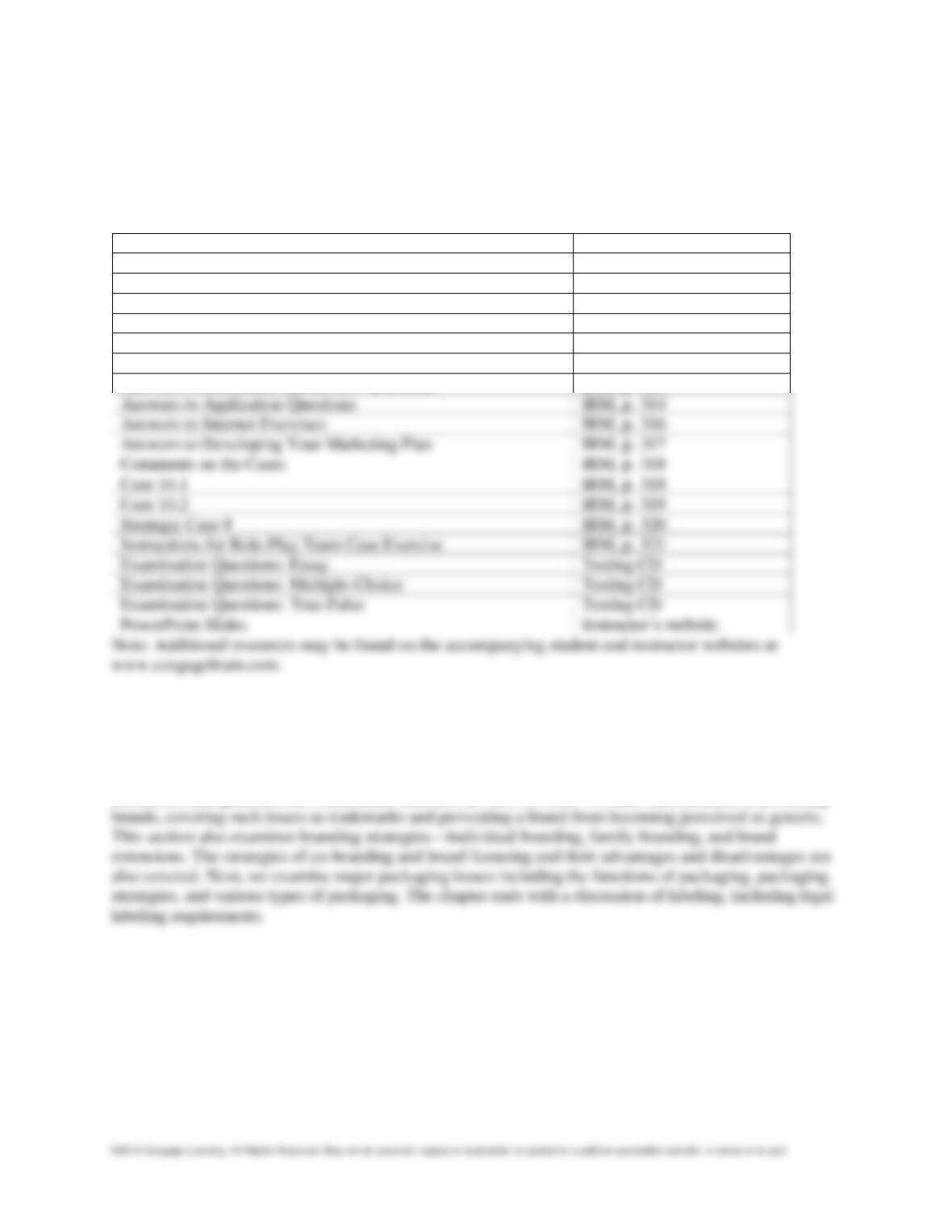
Resource
Location
Purpose and Perspective
IRM, p. 295
Lecture Outline
IRM, p. 296
Discussion Starters
IRM, p. 305
Class Exercises
IRM, p. 306
Chapter Quiz
IRM, p. 308
Semester Project
IRM, p. 309
Answers to Discussion and Review Questions
IRM, p. 310
Answers to Application Questions
IRM, p. 314
Answers to Internet Exercises
IRM, p. 316
Answers to Developing Your Marketing Plan
IRM, p. 317
Comments on the Cases
IRM, p. 318
Case 14.1
IRM, p. 318
Case 14.2
IRM, p. 319
Strategic Case #
IRM, p. 320
Instructions for Role-Play Team Case Exercise
IRM, p. 321
Examination Questions: Essay
Testing CD
Examination Questions: Multiple-Choice
Testing CD
Examination Questions: True-False
Testing CD
PowerPoint Slides
PURPOSE AND PERSPECTIVE
This chapter defines and discusses branding, packaging, and labeling. It begins with a discussion of the
value of branding and then moves on to discuss brand loyalty, which includes three levels: brand
recognition, brand preference, and brand insistence. Brand equity, types of brands (manufacturer, private
distributor, and generic), and brand name selection are also covered. We deal with methods of protecting
296 Chapter 14: Branding and Packaging
LECTURE OUTLINE
I. Branding
A. A brand is a name, term, symbol, design, or other feature that identifies one seller’s good or
service as distinct from those of other sellers.
1. A brand name is that part of a brand that can be spoken, including letters, words, and
numbers; a brand name is often a product’s only distinguishing characteristic.
B. Value of Branding
1. The value to buyers includes:
a. Brands help customers identify specific products that they like and do not like, which
facilitates the purchase of those items that satisfy individual needs.
2. The value to sellers includes:
a. Sellers’ brands identify each firm’s products, which makes repeat purchasing easier for
consumers.
3. There is a cultural dimension to branding.
a. Most brand experiences are individual, and each consumer confers his or her own social
meaning onto brands.
C. Brand Loyalty
Chapter 14: Branding and Packaging 297
1. Brand loyalty is a customer’s favorable attitude toward a specific brand.
a. A strong brand loyalty increases the likelihood that a consumer will consistently purchase
this brand when the need arises.
2. There are three degrees of brand loyalty.
a. Brand recognition occurs when a customer is aware that a brand exists and views it as
an alternative to purchase if his or her brand is unavailable or if the other available brands
are unfamiliar to the customer.
lengths to acquire it.
3. Brand loyalty seems to be on the decline, in part to marketers’ increased reliance on sales,
coupons, and other promotions, and in part to the array of similar products from which
customers can choose.
4. Although brand loyalty is a challenge to build, it makes a significant contribution to a
sustainable competitive advantage.
D. Brand Equity
1. Brand equity is the marketing and financial value associated with a brand’s market strength.
2. Brand equity includes proprietary brand assets, such as patents and trademarks, as well as
brand name awareness, brand loyalty, perceived brand quality, and brand association.
a. Recognition of a brand leads to familiarity, and familiar brands are more likely to be
viewed as reliable and of higher quality. A familiar brand is more likely to be in a buyer’s
consideration set.
3. Although brand equity is difficult to measure, it represents the value of a brand to an
organization. An organization may pay a premium to purchase a brand from another company
because it is less risky than developing its own.
298 Chapter 14: Branding and Packaging
E. Types of Brands
1. Manufacturer brands are initiated by producers and ensure that producers are identified
with their products at the point of purchase.
2. Private distributor brands (also called private brands, store brands, or dealer brands) are
initiated and owned by resellers; manufacturers are not identified on the products.
a. Help retailers and wholesalers develop more efficient promotion, generate higher gross
margins, and change store images.
d. Competition between manufacturer brands and private distributor brands (sometimes
called “the battle of the brands”) is ongoing.
(1) To compete against private brands, some manufacturer brand makers have stopped
e. Some private brands are produced by companies that specialize in making only private
distributor brands, while other private brands are made by producers of manufacturer
brands.
(1) Both find producing private distributor brands appealing.
capacity during periods when its own brands are at nonpeak production.
3. Generic brands indicate only a product category and do not include a company name or
other identifying terms.
a. Generic brands are usually sold at lower prices than are comparable branded items.
F. Selecting a Brand Name
1. Marketers should consider a number of factors when selecting a brand name.
a. The name should be easy for customers to say, spell, and recall.
Chapter 14: Branding and Packaging 299
2. Brand names can be created from single or multiple words, initials, numbers, or combinations
of these.
3. To avoid terms that have negative connotations, marketers sometimes use fabricated words
that have no meaning.
5. Even though branding considerations apply to both goods and services, there are some special
dimensions of service branding.
a. The brand name of a service is usually the same as the company name.
G. Protecting a Brand
1. Marketers should design a brand name that they can protect easily through registration.
2. Generic brands are not protectable; surnames and geographic, descriptive, or functional
5. A marketer must guard against letting a brand name become a generic term used to refer to a
general product category because generic terms cannot be protected as exclusive brand
names.
a. Firms can spell the name with a capital letter.
b. They can use the name as an adjective to modify the name of the general product class.
300 Chapter 14: Branding and Packaging
H. Branding Strategies
1. Before establishing branding strategies, the firm must decide whether to brand its products at
all.
a. When an organization’s product is homogeneous and similar to competitors’ products, it
2. If a firm chooses to brand its products, it may opt for one or more branding policies.
a. Individual branding is a strategy in which each product is given a different name.
(1) A major advantage of individual branding is that when an organization introduces a
c. A brand extension occurs when a firm uses one of its existing brands to brand a new
product in a different product category.
(1) A brand extension should not be confused with a line extension, which involves
3. Branding policy is influenced by the number of products and product lines produced by the
firm, the characteristics of its target markets, the competing products available, and the firm’s
resources.
I. Co-Branding
1. Co-branding is the use of two or more brands on one product; marketers employ co-
branding to capitalize on the brand equity of multiple brands.
2. When a co-branded product is unsuccessful, both brands are implicated in the product failure.
Chapter 14: Branding and Packaging 301
3. To gain customer acceptance, the brands involved must represent a complementary fit in the
minds of buyers.
J. Brand Licensing
1. Brand licensing is an agreement in which a company permits another organization to use its
brand on other products for a licensing fee.
II. Packaging
A. Packaging involves the development of a container and a graphic design for a product. It can be a
vital part of a product and can influence customers’ attitudes toward the product.
B. Packaging Functions
1. Packaging protects the product and maintains its functional form by reducing damage that
could affect its usefulness and increase costs.
can evoke an emotional response.
C. Major Packaging Considerations
1. A major consideration is cost; buyers have shown a willingness to pay more for improved
packaging, but there are limits.
2. Developing tamper-resistant packaging is very important for some products.
3. Marketers should consider how much consistency among their package designs is desirable.
a. If a firm’s products are unrelated or aimed at vastly different target markets, no
4. Marketers must consider the package’s promotional role.
a. A firm can create desirable images and associations through color, design, shape, and
302 Chapter 14: Branding and Packaging
c. To develop a package that has definite promotional value, a designer must consider size,
shape, texture, color, and graphics.
(1) Beyond the obvious minimal limitation that the package must be large enough to hold
5. Packaging must also meet the needs of resellers; wholesalers and retailers consider whether a
package facilitates transportation, storage, and handling.
convenience.
D. Packaging and Marketing Strategies
1. Packaging can be a major component of a marketing strategy.
a. A new cap or closure, a better box or wrapper, or a more convenient container size may
2. Altering the Package
a. Marketers alter packaging for a number of reasons in addition to recognizing that the
3. Secondary-Use Packaging
a. A secondary-use package is one that can be reused for purposes other than its initial use.
b. Secondary-use packages can be viewed by customers as adding value to products.
4. Category-Consistent Packaging
a. Category-consistent packaging is used to package products in line with the packaging
5. Innovative Packaging
a. Innovative packaging such as a unique cap, design, applicator, or other feature will
Chapter 14: Branding and Packaging 303
6. Multiple Packaging
a. Marketers sometimes package products in twin packs, tri-packs, six-packs, or other forms
of multiple packaging.
7. Handling-Improved Packaging
a. Packaging may be changed to make it easier to handle in the distribution channel.
E. Criticisms of Packaging
1. Some packages suffer from functional problems; they do not work well or are inconvenient.
2. Much packaging criticism focuses on safety problems such as packages with sharp edges or
III. Labeling
A. Labeling is closely related to packaging and is used for promotional and legal purposes.
1. Labels carry varying amounts of information.
2. A label can be part of the package itself or a separate feature attached to the package.
304 Chapter 14: Branding and Packaging
5. Labels can facilitate the identification of a product by displaying the brand name in
combination with a unique graphic design.
6. By drawing attention to products and their benefits, labels can strengthen an organization’s
promotional efforts by highlighting the offer of a discount or a larger package size at the
same price, or information about a new or improved product feature.
7. Federal laws and regulations specify information that must be included on labels of certain
products.
a. Garments must be labeled with the name of the manufacturer, country of manufacture,
fabric content, and cleaning instructions.
(1) Any food product for which a nutritional claim is made must have nutrition labeling.
(2) Information on food labels must include the number of servings per container,
serving size, number of calories per serving, number of calories derived from fat,
B. Despite legislation to make labels as accurate and informative as possible, questionable labeling
practices persist.
C. Consumers who are committed to making environmentally responsible purchasing decisions are
sometimes fooled by labels. Several manufacturers have been accused of “greenwashing”

Chapter 14: Branding and Packaging 305
DISCUSSION STARTERS
Discussion Starter 1: Virtual Branding
ASK: Have you ever played a virtual reality game, such as the SIMS or Second Life?
ASK: What is the benefit of marketing in virtual worlds?
Virtual worlds allow firms to interact with consumers in new ways. This allows consumers to see brands
Discussion Starter 2: Brand Equity
ASK: What firm do you think is consistently in the top 10 global brands based on brand value?
The answer is Coca-Cola. In 2012, Coca-Cola was ranked 6th for brand value on Millward Brown’s Top
ASK: What do you think contributes to Coca-Cola’s ability to remain on top of such lists?
Coca-Cola’s global presence is clearly the most important factor. Other elements are a globally
Discussion Starter 3: Brand Image, Brand Packaging, and Brand Evolution
After viewing the evolution of both Pepsi and Coke clips, ask the students which of the two video clips
Discussion Starter 4: Packaging Matters
ASK: Do you think you can judge a product by the package?
Often a unique package can have dramatic impact on a product’s appeal and, thus, on its sales. Every
306 Chapter 14: Branding and Packaging
CLASS EXERCISES
Class Exercise 1: Functions of Packaging
The purpose of this exercise is to reinforce an understanding of brand components and policies and the
functions of packaging.
Prompts for students:
1. Look at the nearest snack food wrapper or soft drink container and identify the
a. brand name.
b. brand mark.
c. trademark.
d. trade name.
2. Using the wrapper or container, explain how packaging performs three functions: protection,
convenience, and communication.
3. Is the manufacturer of the product using individual branding, family branding, or brand
extensions?
4. You work for a firm that is introducing a new chocolate candy bar that contains an extra amount
of caffeine. Develop a brand name that
a. is easy for customers to say, spell, and recall.
b. positively suggests uses and special characteristics.
c. indicates major product benefits.
d. can be protected easily through registration.
Answers:
1. Students often get these components mixed up, particularly the first two. Coke cans offer a good
chance to explain the difference between the brand name Coca-Cola and the script design that makes
Chapter 14: Branding and Packaging 307
Class Exercise 2: Packaging and Brand Success
In this chapter you have learned about the various elements that contribute to building brands, including
packaging.
Consider the following brands: Oreo, Altoids, The Gap, and Absolut Vodka. Discuss the following
questions in relation to each brand:
1. What elements have contributed to the success of the brand?
Class Exercise 3: Brand Equity
Recommended as a group activity.
In this chapter you were introduced to the concept of brand equity. In this exercise you will explore what
contributes to, and devalues, brand equity.
Step 1: Choose five brands (include one undesirable brand) that all members of your group are familiar
with.
308 Chapter 14: Branding and Packaging
CHAPTER QUIZ
1. Choosing appropriate colors for packaging best serves to enhance the _____ function of packaging.
a. convenience
b. safety
c. cost effectiveness
d. protection
e. promotional
2. The type of brand that has seen a significant decrease in popularity in recent decades is
a. generic.
b. manufacturer.
c. private label.
d. distributor.
e. store brand.
3. Which of the following is not a result of General Mills’ use of the Pillsbury Doughboy?
4. The Nike swoosh that is prominent on all of the firm’s packaging, products, and advertising is a
a. trade character.
b. brand.
c. trade name.
d. brand mark.
e. brand design.