
Instructor Manual
Lamb/Hair/McDaniel, MKTG 13E, 9780357127810; Chapter 14: Retailing
Table of Contents
Purpose and Perspective of the Chapter …………………………………………………………………………. 2
Cengage Supplements …………………………………………………………………………………………………… 2
Learning Outcomes ……………………………………………………………………………………………………….. 3
Complete List of Chapter Activities and Assessments ……………………………………………………… 3
Key Terms ……………………………………………………………………………………………………………………… 5
What’s New in This Chapter ……………………………………………………………………………………………. 8
Chapter Outline …………………………………………………………………………………………………………….. 8
Discussion Questions …………………………………………………………………………………………………… 18
Additional Activities and Assignments …………………………………………………………………………… 19
Additional Resources ……………………………………………………………………………………………………. 25
External Videos or Playlist ……………………………………………………………………………………………………….. 25
Appendix …………………………………………………………………………………………………………………….. 27
Generic Rubrics ……………………………………………………………………………………………………………………… 27
Standard Writing Rubric …………………………..……………………………………………………………………………… 27
Standard Discussion Rubric ……………………………………………………………………………………………………… 28
Purpose and Perspective of the Chapter
The purpose of this chapter is to explain the importance of the retailer, responsible for
activities related to the sale of goods and services, within the channel and the U.S.
economy. Retail establishments can be classified according to ownership, level of service,
product assortment, and price. Nonstore retailing enables customers to shop without
visiting a physical store location. Today, most retail stores remain operationally and
Cengage Supplements
The following product-level supplements provide additional information that may help you
in preparing your course. They are available in the Instructor Resource Center.
• Transition Guide (provides information about what’s new from edition to edition)
• Educator’s Guide (describes assets in the platform with a detailed breakdown of
activities by chapter with seat time)
Learning Outcomes
The following learning outcomes are addressed in this chapter:
14–1 Explain the importance of the retailer within the channel and the U.S. economy
14–2 List and understand the different types of retailers
14–3 Explain why nonstore retailing is on the rise, and list the advantages of its different
forms
Complete List of Chapter Activities and Assessments
For additional guidance refer to the Teaching Online Guide.
Chapter
Learning
Objective
PPT slide
Activity/Assessment
Duration
Certification
Standard
N/A
MindTap: Why Does
Retailing Matter to Me?
5 minutes
BUSPROG:
Reflective
Thinking
DISC: Customer
14–1 – 14–
2
MindTap: Learn It 14-1
and 14-2: The
Importance of Retailing
and Types of Retailers
and Retail Operations
10 minutes
BUSPROG:
Analytic
DISC:
Marketing Plan
The Rise of Nonstore
Retailing
Analytic
DISC:
Promotion
14-5
MindTap: Learn It 14-5:
Executing a Retail
Marketing Strategy
5 minutes
BUSPROG:
Analytic
DISC: Strategy
7
and 14-7: Retailing
Decisions for Services
Product/Services Failures
Analytic
DISC: Strategy
14–1 – 14–
8
MindTap: Assignment
25 minutes
BUSPROG:
Analytic
Marketing Plan
14–1 – 14–
8
MindTap: Case Activity
15 minutes
BUSPROG:
Analytic
DISC: Strategy
14-2
17
Knowledge Check 1 in
PPT
5-10 minutes
BUSPROG:
Communication
DISC: Pricing
14-3
22
Knowledge Check 2 in
PPT
10 minutes
BUSPROG:
Analytic
DISC:
Promotion
Promotion
14-7
48
Knowledge Check 3 in
10 minutes
BUSPROG:
DISC: Customer
14-8
53
Discussion 1 in PPT
10-15 minutes
BUSPROG:
Analytic
DISC:
Promotion
[return to top]
Key Terms
atmosphere: the overall impression conveyed by a store’s physical layout, decor, and
surroundings.
big data analytics: the process of discovering patterns in large data sets for the purposes
of extracting knowledge and understanding human behavior.
brand cannibalization: the reduction of sales for one brand as the result of the
introduction of a new product or promotion of a current product by another brand.
category killer: a large discount store that specializes in a single line of merchandise and
becomes the dominant retailer in its category.
direct marketing (DM): techniques used to get consumers to make a purchase from their
home, office, or other nonretail setting.
direct retailing: the selling of products by representatives who work door to door, office to
office, or at home sales parties.
discount store: a retailer that competes on the basis of low prices, high turnover, and high
franchisor: the originator of a trade name, product, methods of operation, and the like
that grants operating rights to another party to sell its product.
full-line discount store: a discount store that carries a vast depth and breadth of product
within a single product category.
gross margin: the amount of money the retailer makes as a percentage of sales after the
cost of goods sold is subtracted.
online retailing (e-tailing): a type of shopping available to consumers with personal
computers and access to the Internet.
restaurant: a retailer that provides both tangible products—food and drink— and valuable
services—food preparation and presentation.
retail channel omnification: the reduction of multiple retail channel systems into a single,
unified system for the purpose of creating efficiencies or saving costs.
other through a digital marketplace.
shop-at-home television network: a specialized form of direct response marketing
whereby television shows display merchandise, with the retail price, to home viewers.
shopper analytics: searching for and discovering meaningful patterns in shopper data for
the purpose of fine-tuning, developing, or changing market offerings.
telemarketing: the use of the telephone to sell directly to consumers.
used goods retailer: a retailer whereby items purchased from one of the other types of
retailers are resold to different customers.
warehouse club: a large, no- frills retailer that sells bulk quantities of merchandise to
customers at volume discount prices in exchange for a periodic membership fee.
[return to top]
What’s New in This Chapter
The following elements are improvements in this chapter from the previous edition:
• Additional material on fashion industry
• New content on evolving merchandise mix of established retailers
• New content on emerging pickup and delivery options, including last-mile delivery
• New content on expansion of vending/kiosks to higher end products
[return to top]
Chapter Outline
In the outline below, each element includes references (in parentheses) to related content. “LO
CH–##” refers to the chapter learning outcome; “PPT Slide #” refers to the slide number in the
PowerPoint deck for this chapter (provided in the PowerPoints section of the Instructor Resource
Center); and, as applicable for each discipline, accreditation or certification standards (“DISC”).
Introduce Chapter 14 and review the learning outcomes. (PPT Slide 2).
1. The Importance of Retailing (LO 14-1, PPT Slide 3, DISC: Promotion)
a. Retailing represents all the activities directly related to the sale of goods and
exciting ways to interact with customers.
b. In the United States, the retail industry:
• Generates 5.9 percent of gross domestic product (GDP), which equates to
2. Types of Retailers and Retail Operations (LO 14-2, PPT Slide 6, DISC: Promotion)
a. Retail establishments can be classified in several ways, including type of ownership,
level of service, product assortment, and price.
b. Ownership Arrangement: Retail ownership takes one of three forms:
• Independent retailer – a retailer owned by a single person or partnership and
not operated as part of a larger retail institution
c. Worldwide, independent retailers are the most common type of retailer. A chain
store has a home office that handles operations across all locations. Examples
include Target and Starbucks. Under a franchise arrangement, a franchisor
d. Level of Service: The service levels that retailers provide range from full service to
self-service.
• Full service: customer is provided with very high or customized service levels,
e. Product Assortment: Retailers can be categorized by the width and depth of their
f. Price: Traditional department stores and specialty stores typically charge the full
“suggested retail price.” Discounters, factory outlets, and off-price retailers use low
prices and discounts to lure shoppers. The gross margin is the amount of money a
retailer makes as a percentage of sales after the cost of goods sold is subtracted.
g. Today, prices in any store format might vary not just from day to day, but from
location, and browsing history to adjust prices, meaning different consumers may
be paying different prices for the same product.
h. Types of In-Store Retailers: Traditionally, retailers fall into one of several distinct
types of retail stores, although the lines of distinction have begun to blur.
• Department store – a store housing several departments under one roof
• Specialty store – a retail store specializing in a given type of merchandise
• Supermarket – a large, departmentalized, self-service retailer that specializes in
food and some nonfood items
merchandise
• Specialty discount store – a retail store that offers a nearly complete selection
of single-line merchandise and uses self-service, discount prices, high volume,
and high turnover
• Category killer – a large discount store that specializes in a single line of
3. The Rise of Nonstore Retailing (LO 14-3, PPT Slide 18, DISC: Promotion)
a. Broad changes in culture and society, especially technological advancements, have
led to nonstore retailing, which is currently growing faster than in-store retailing.
Nonstore retailing enables customers to shop without visiting a store. This adds a
level of convenience for customers. Many grocery stores have responded by
from their home, office, or other nonretail setting
• Telemarketing – the use of the telephone to sell directly to consumers
• Direct mail – the delivery of advertising or marketing material to recipients of
b. Microtargeting is the use of direct marketing techniques to identify potential
customers with greater precision based on detailed data analytics of census data,
lifestyle patterns, financial information, and past purchase and credit history. It can
be used to target the right customers with direct mail and is an effective tool for
online retailing.
4. Retail Operations Models (LO 14-4, PPT Slide 23, DISC: Promotion)
a. The retail formats covered so far are co-aligned with unique operating models that
guide the decisions made by their managers. Each operating model can be
summarized as a set of guiding principles, specifically when dealing with inventory.
For example, off-price retailers deemphasize customer service and product
b. This has led to the emergence of hybrid retail operating models. Some online
retailers are using a mass-merchandising inventory strategy. They offer high-quality
products and excellent customer service but never replenish specific inventory
items that are sold. Once a product sells out, a new one replaces it, allowing for a
Example: Nordstrom unveiled a new concept store in West Hollywood called
c. Online-only retailers have no physical retail store space for displaying and selling
merchandise. They can showcase items in an almost-free space to customers
5. Executing and Retail Marketing Strategy (LO 14-5, PPT Slide 29, DISC: Marketing Plan)
a. Retail managers develop marketing strategies based on the goals established by
stakeholders and company leadership. Strategic retailing goals typically focus on
b. Defining a Target Market: The first task in developing a retail strategy is to define
the target market. Successful retailing has always been based on knowing the
customers’ desires and preferences, which can change over time. Target markets in
c. Choosing the Retailing Mix: The second tactical decision in retail management is
choosing the retailing mix, which consists of six Ps: the four Ps of the marketing
mix (product, promotion, place, and price) plus presentation and personnel (see
Exhibit 14.2).

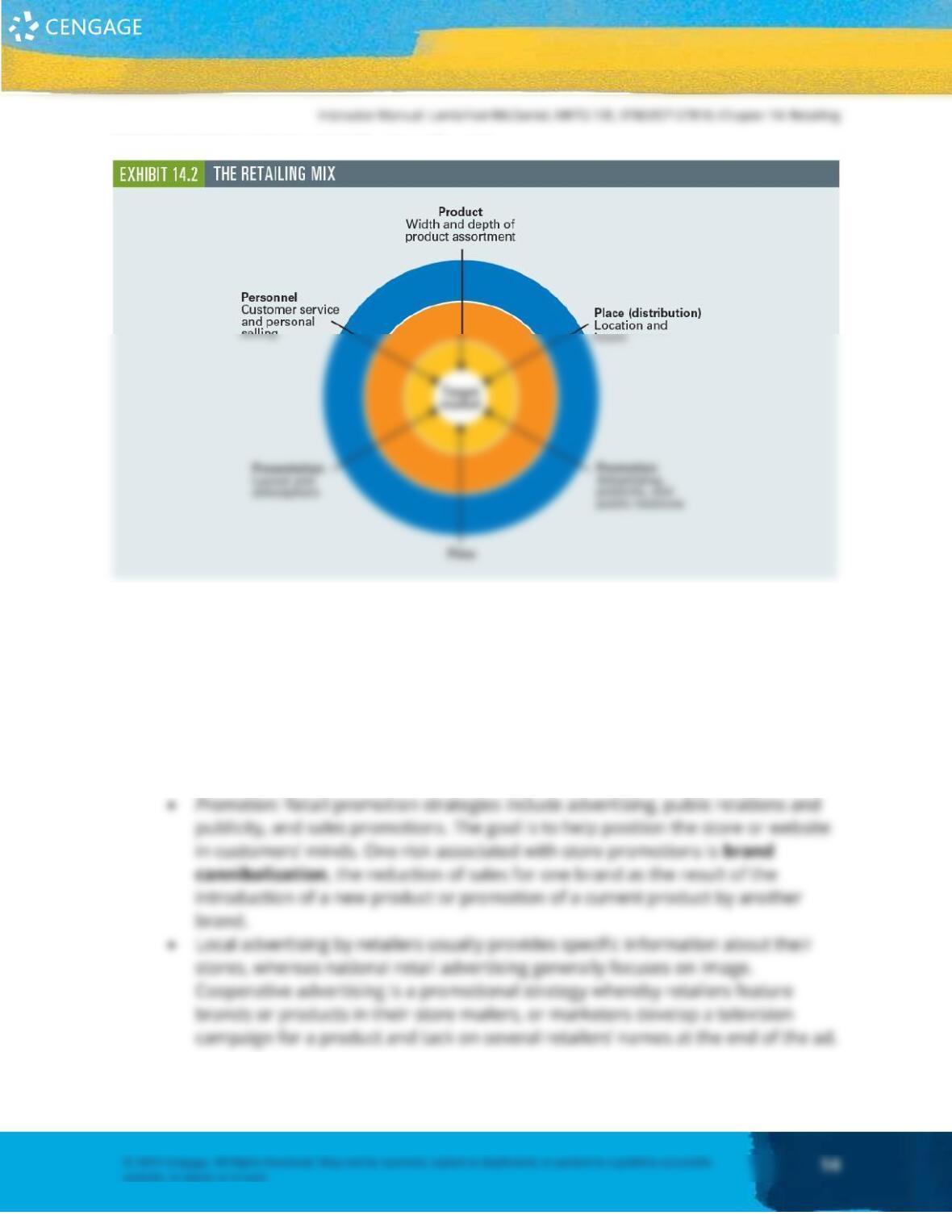
PRESENTATION VISUAL: 14.2 The Retailing Mix
• Product: The first element in the retailing mix is the product offering, also called
the “product assortment” or “merchandise mix.” Although price, store/website
design, displays, and service are important to customers in determining where
to shop, the most critical factor is merchandise selection. Developing a product
offering is essentially a question of the width and depth of the product
assortment, which is the most important factor to consumers. After determining
what products will satisfy target customers’ desires, retailers must find sources
of supply, evaluate the products, and negotiate prices.
Example: Retailer JC Penney recently collaborated with the American television
series “Project Runway” in a cooperative advertising campaign. For the