partnership, JCPenney brought exclusive “Project Runway” merchandise into its
stores to strategically enhance their assortment of apparel, and to better fit the
desires of women assembling a stylish wardrobe. In return, JC Penney was
named the exclusive retailer for seasons 16 and 17 of the “Project Runway”
series.
• Place: The choice of physical location is important because the retailer is making
a large, semipermanent commitment of resources. The physical location will
d. Freestanding units are increasing in popularity as brick-and-mortar retailers strive to
make their stores more convenient to access, more enticing to shop, and more
profitable. To be successful, freestanding stores should become destination stores,
which consumers seek out and purposely plan to visit. Retailers may also decide to
locate in shopping centers. Types of shopping centers include:
• Strip centers are typically located along busy streets and usually include a
supermarket, a variety store, and perhaps a few specialty stores.
e. Shopping malls are slowly being replaced with online retail. Research has shown
that to succeed, malls need to focus on transforming into consumer engagement
spaces, which are based upon the rising demand for things to do rather than things
to buy or own.
• Price: The right price is critical to ensure sales. Because retail prices are usually
based on the cost of the merchandise, an essential part of pricing is efficient and
timely buying. Another pricing strategy is “value–based pricing,” which focuses on
the value of the product to the customer more than the cost of the product to
the supplier. Price is also a key element in a retail store’s positioning strategy.
• Merchandise type and density: A prestigious retailer carries the best brand names
and displays them in a neat, uncluttered arrangement. Discounters and off-price
retailers often carry seconds or out-of-season goods crowded into small spaces
and organized by category.
• Fixture type and density: Fixtures can be elegant or trendy. They should be
consistent with the general atmosphere the store is trying to create.
• Sound: Music in particular can control the pace of the store traffic, create an
image, and attract or direct the shopper’s attention.
f. The layout is the internal design and configuration of a store’s fixtures and
products. The goal is to use all of the store’s space effectively, including aisles,
fixtures, merchandise displays, and nonselling areas. In addition to making
• Personnel: Sales personnel provide their customers with the amount of service
prescribed by the retail strategy of the store. Retail salespeople must be able to
persuade customers that what they are selling is what the customer needs.
g. Enacting Shopper Marketing: Shopper marketing focuses on understanding how
one’s target consumers behave as shoppers, in different channels and formats, and
leveraging this intelligence to generate sales or other positive outcomes.
Manufacturers and retailers use shopper analytics to search for and discover
meaningful patterns in shopper data for the purpose of fine-tuning, developing, or
6. Retailing Decisions for Services (LO 14-6, PPT Slide 44, DISC: Promotion)
a. Distribution in the service sector is difficult to visualize, but the same skills,
techniques, and strategies used to manage inventory can also be used to manage
service inventory, such as hospital beds, bank accounts, or airline seats. The quality
of the planning and execution of distribution can have a major impact on costs and
customer satisfaction. Service distribution focuses on four main areas:
• Minimizing the amount of time customers wait in line
7. Addressing Retail Product/Service Failures (LO 14-7, PPT Slide 46, DISC: Customer)
a. All retailers inevitably disappoint a subset of their customers either by design (no
8. Retailer and Retail Customer Trends and Advancement (LO 14-8, PPT Slide 49, DISC:
Customer)
a. Retailers are constantly innovating. Current general trends include the use of
purchase and shopping data to better understand customer wants and needs and
and age group so that appropriate promotions and information can be sent to
the customer
• Conversational artificial intelligence used to power voice-assisted technology
(e.g., Alexa, Siri, or Google Home) to provide world-class service, complete with
AI-driven recommendations and on-demand customer support
Example: Dillard’s Target, and Walmart use big data analytics to determine which
b. Future Developments in Retail Management: A retailing trend with great growth
potential is the leveraging of technology to increase touchpoints with customers and
responsible for delivering on customer demand regardless of where it originated.
c. Click-and-collect is the practice of buying something online and then traveling to a
physical store location to take delivery of the merchandise. Customers benefit from
[return to top]
Discussion Questions
You can assign these questions several ways: in a discussion forum in your LMS; as whole-
class discussions in person; or as a partner or group activity in class. A generic discussion
rubric is provided in the Appendix.
1. Discussion: (LO 14-1, PPT Slides 4-5) Duration 5-10 minutes.
a. Kick off the chapter’s presentation by inviting students to share personal
experiences with retail jobs and retailers:
• How many currently work in retail? How many have in the past?
• How many have made a purchase from a retailer in the last week? What qualities
made it a positive or negative experience?
i. Students’ answers will vary. It is likely that many students have worked in
2. Discussion: (LO 14-8, PPT Slides 53–54) Duration 5-10 minutes.
a. Many retailers are now using big data analytics, beacons, facial recognition, and the
like, both for in-store and online retail selling and marketing. Encourage students to
discuss these tactics by answering the following questions:
• How do you feel about the use of these tools?
• Do you see the use of these technological advancements as welcome
[return to top]
Additional Activities and Assignments
A generic discussion and writing rubric is provided in the Appendix.
1. Activator Exercise: Surviving the Amazon (LO 14-1)
Purpose: To get students thinking strategically about the decisions retailers make.
Classroom Format: Small group discussion, then class presentations (Estimated Time:
20-30 minutes)
1. Divide students into groups of three or four, and read them the following
statement:
“Amazon.com is one of the largest retailers in the U.S. – even though it is almost entirely
2. Tell students that their team has been hired by the retail industry to provide
3. Have students address the following questions:
• What are Amazon’s advantages over traditional, physical retailers that sell
groceries, household goods, electronics, books, etc.?
4. After providing time for students to strategize, ask groups to present their findings
to the class.
Online Format: Written discussion board posts with responses (Estimated Time: 25-35
minutes)
1. Use the following prompt to facilitate this activity in a discussion board:
“Amazon.com is one of the largest retailers in the U.S. – even though it is almost entirely
online. Many big brands and big retailers are feeling the heat from Amazon’s competitive
traditional retailers to compete.”
Imagine that you’ve been hired by the retail industry to provide analysis and strategic
recommendations for surviving this aggressive competition from Amazon. Write a post
addressing the following questions:
• What are Amazon’s advantages over traditional, physical retailers that sell groceries,
household goods, electronics, books, etc.?
2. Have students respond to their classmates’ posts, ask questions, and offer
constructive feedback on their analysis.
Additional questions for a classroom or discussion board: How can other online
retailers better compete against Amazon?
Result: Student strategies will typically cover the types of strategies discussed in this
2. Classroom activity (LO 14-2)
Format: This activity can be facilitated in both a classroom and an online environment.
Instructions for how to facilitate the activity in the classroom and online are provided
below. (Estimated time: 5-10 minutes)
Classroom Format: Divide students into groups and give them the following list of
retailers. Ask them to categorize each one based on the descriptions provided in this
section. Then ask them to provide one example of a retailer that blurs the lines and
functions as two or more of these types of retailers. Ask them to share their
Online Format: If you’re delivering your course online, you can have students do this
on their own and have them post their answers in a discussion board. Use the following
prompt to facilitate this activity:
Using the list of retailers below, categorize each one based on the descriptions provided in
this section. Then provide one example of a retailer that blurs the lines and functions as two
In responding to your classmates’ posts, evaluate whether their categorizations meet the
criteria described in the text and offer constructive feedback as needed.
3. Class activity (LO 14-3)
Format: This activity can be facilitated in both a classroom and an online environment.
Instructions for how to facilitate the activity in the classroom and online are provided
below. (Estimated time: 10-20 minutes)
Classroom Format: Divide students into small groups of three or four. Instruct each
member of the group to share a recent experience of a nonstore purchase. Have the
Online Format: If you’re delivering your course online, you can have students do this
on their own and have them post their answers in a discussion board. Use the following
prompt to facilitate this activity:
Write a post describing a recent experience of a nonstore purchase you have personally
4. Class activity (LO 14-4)
Format: This activity can be facilitated in both a classroom and an online environment.
Instructions for how to facilitate the activity in the classroom and online are provided
below. (Estimated time: 10-20 minutes)
Classroom Format: Divide students into small groups of three or four. Instruct groups
to choose a consumer product, product line, or product mix they would like to sell.
Online Format: If you’re delivering your course online, you can have students do this
on their own and have them post their answers in a discussion board. Use the following
prompt to facilitate this activity:
Choose a consumer product, product line, or product mix you would like to sell. After
5. Class activity (LO 14-5)
Format: This activity can be facilitated in both a classroom and an online environment.
Instructions for how to facilitate the activity in the classroom and online are provided
below. (Estimated time: 15-25 minutes)
Classroom Format: Divide students into small groups of three or four. Instruct each
group to select a retail brand they’d like to work with, such as clothing, electronics, or
Online Format: If you’re delivering your course online, you can have students do this
on their own and have them post their answers in a discussion board. Use the following
prompt to facilitate this activity:
Select a retail brand you’d like to work with, such as clothing, electronics, or vehicles. Then,
6. Class activity (LO 14-7)
Format: This activity can be facilitated in both a classroom and an online environment.
Instructions for how to facilitate the activity in the classroom and online are provided
below. (Estimated time: 10-20 minutes)
Classroom Format: Divide students into small groups of three or four. Have students
imagine they are the managers of a toy store during the biggest winter holiday of the
year. The district manager has just informed them that they have run out of the most
Online Format: If you’re delivering your course online, you can have students do this
on their own and have them post their answers in a discussion board. Use the following
prompt to facilitate this activity:
Imagine you are the manager of a toy store during the biggest winter holiday of the year. The
district manager has just informed you that you’ve run out of the most popular toy of the
season, and you won’t be getting any more in stock for weeks. It’s up to you to develop a plan
7. Additional Activity: It’s in the Atmosphere (LO 14-5)
Purpose: To help your students identify the components of an effective retail
atmosphere.
Background: While we all respond—positively or negatively—to the atmosphere of
retail stores, many students have not given thought to the elements that create that
Classroom Format: Divide the class into small groups of three or four. Then, direct
them to follow these steps:
2. Choose one of the types of businesses listed below. Describe how you would design
the atmosphere for the business selected. Consider everything from decorations, to
layout, to scent, to furnishings, to signage, to color, to music.
3. Have each group present their ideas to the class and ask the class to provide
feedback. What elements seem most effective?
1. Use the following prompt to facilitate this activity in a discussion board:
Choose one of the types of businesses listed below. How would you design the
atmosphere for the business you’ve selected? Consider everything from decorations, to
2. Have students respond to their classmates’ posts, provide constructive feedback on
their ideas, and suggest additional possibilities. What elements seem most effective?
How important is atmosphere?
Additional Questions for Reflection:
• How important is atmosphere in a retail setting?
8. Online Research Activity (LO 14-8)
Visit the website of one of the retailers’ trade associations, such as the National Retail
Federation (NRF) or the Retail Industry Leaders Association (RILA), and review the
information provided. Write a one-page report on the state of the retail industry and
the benefits of being an association member. Based on your findings, describe some of
on current trends and challenges facing retailers in today’s business environment.
[return to top]
Additional Resources

Appendix
Generic Rubrics
Providing students with rubrics helps them understand expectations and components of
assignments. Rubrics help students become more aware of their learning process and
progress, and they improve students’ work through timely and detailed feedback.
Customize these rubrics as you wish. The writing rubric indicates 40 points and the
discussion rubric indicates 30 points.
Standard Writing Rubric
Criteria
Meets Requirements
Needs Improvement
Incomplete
Content
The assignment clearly and
comprehensively
addresses all questions in
the assignment.
15 points
The assignment partially
addresses some or all
questions in the
assignment.
8 points
The assignment does not
address the questions in
the assignment.
0 points
Research
The assignment is based
upon appropriate and
adequate academic
literature, including peer
reviewed journals and
other scholarly work.
5 points
The assignment is based
upon adequate academic
literature but does not
include peer reviewed
journals and other
scholarly work.
3 points
The assignment is not
based upon appropriate
and adequate academic
literature and does not
include peer reviewed
journals and other
scholarly work.
0 points
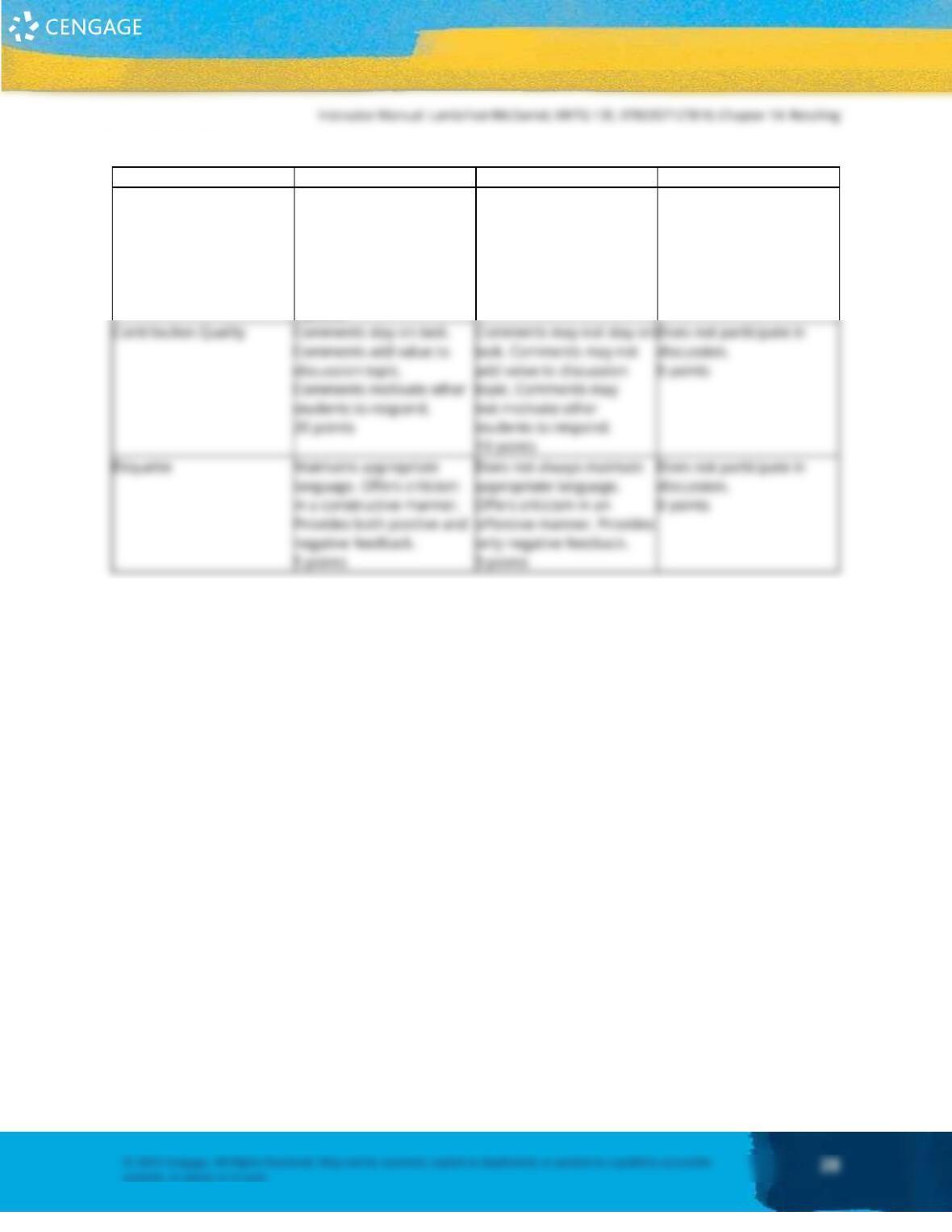
Standard Discussion Rubric
Criteria
Meets Requirements
Needs Improvement
Incomplete
Participation
Submits or participates in
discussion by the posted
deadlines. Follows all
assignment. instructions
for initial post and
responses.
Does not participate or
submit discussion by the
posted deadlines. Does not
follow instructions for
initial post and responses.
3 points
Does not participate in
discussion.
0 points