CHAPTER 14
TIME, TERRITORY, AND SELF-MANAGEMENT: KEYS TO SUCCESS
COMMENTS ON CHAPTER 14 SALES APPLICATION QUESTIONS
1. Traveling can be a large part of a salesperson‘s job. This means time not spent in the office. Thus,
technology can be an efficient tool for communication. Efficiency can be maximized by CRM
2. A “sales territory” comprises a group of customers or a geographical area assigned to a salesperson.
Please see chapter for why firms establish or do not establish territories.
3. Please see Exhibit 14.3 for elements of territory management.
4. The undifferentiated selling approach says that you sell all customers the same. The account
5. A. Break-even for a year would be:
Sales = $500,000
Cost of goods sold = – 325,000
$175,000
B. Break-even for the day is:
If the salesperson works 48 out of 52 weeks or 240 days each year, works 5 days a week, 8
hours a day and makes 5 calls per day, there are 1920 working hours per year (240 x 8 = 1920)
C. Break-even each sales call: $83.25 = ($416.05 5)
6. The key account refers to where the loss of this customer would substantially affect the territory‘s
sales and profits.
7. These are seven basic factors to consider in call allocation:
• Number of accounts in the territory.
8. The customer sales planning is where the “tire hits the road.” It is what all salespeople are trained to
do.
9. Scheduling refers to establishing a fixed time (day and hour) when the salesperson will be at a
COMMENTS ON CASES
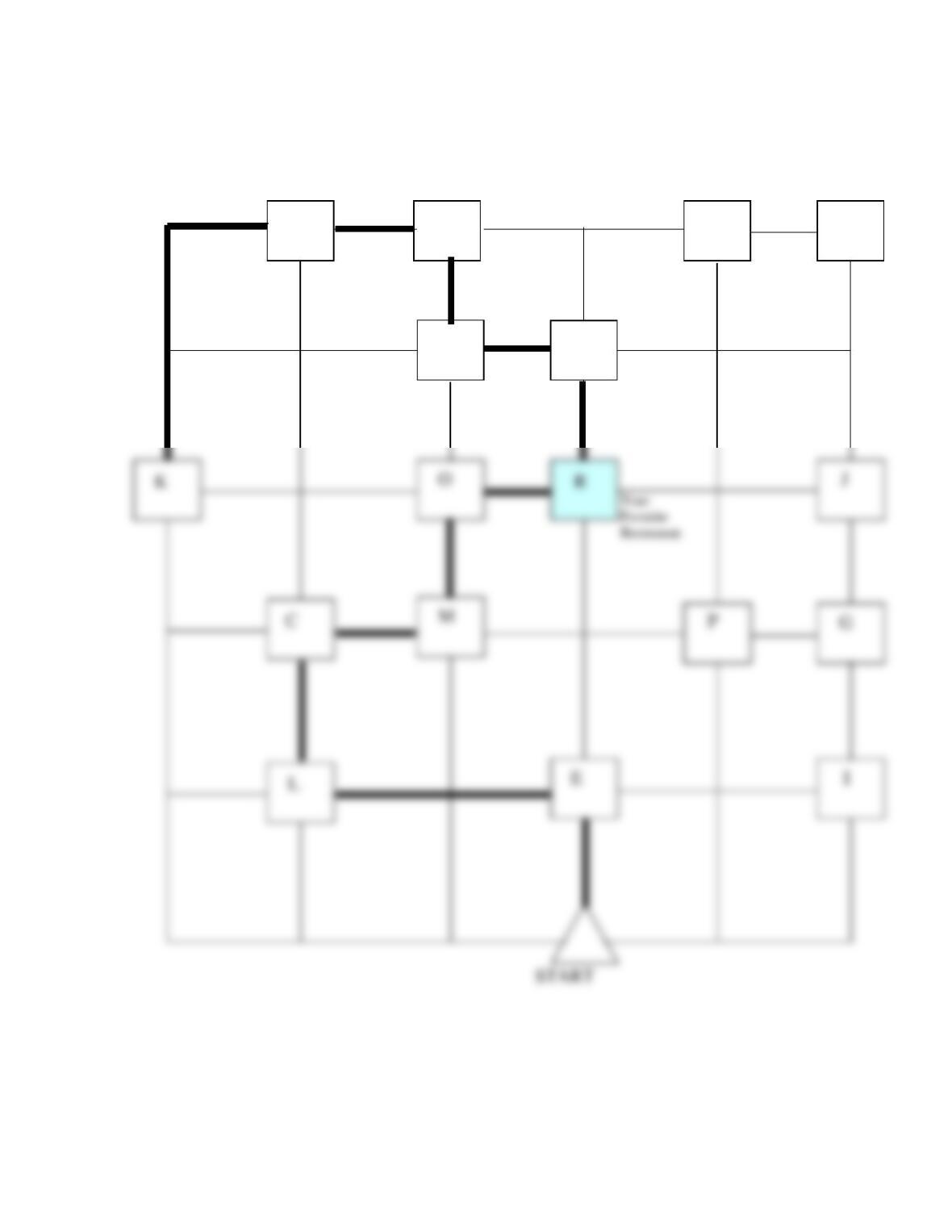
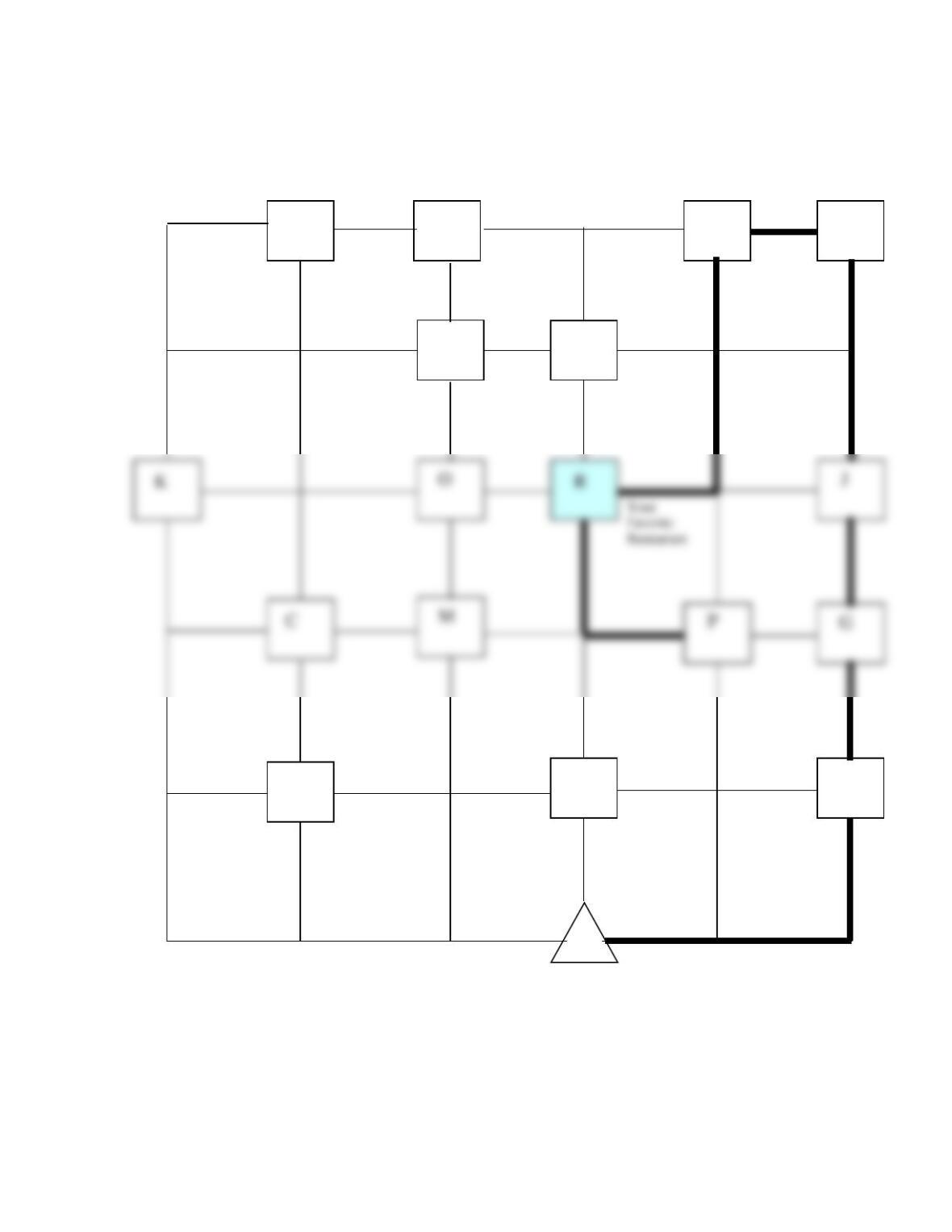
Case 14-1: Your Selling Day: A Time and Territory Game
First Day
Customer Sales Travel Sales Time
Number = Potential Time + Time = (Minutes)
Home
7 = $ 4,000 3 x 15 + 30 = 75
3 = 6,000 3 x 15 + 30 = 75
15 = 8,000 2 x 15 + 30 = 60
Second Day
Customer Sales Travel Sales Time
Number = Potential Time + Time = (Minutes)
Home
1 = $ 4,000 2 x 15 + 30 = 60
9 = 1,000 1 x 15 + 30 = 45
4 = 2,000 2 x 15 + 30 = 60
Day 1
D
F
H
A
B
N
O
J
E
I
L
START
Day 2
D
F
H
A
B
N
E
I
L
START
O
J
Traveling Salesperson Problem
Instructor: An industrial engineering master’s student working for me says that this
exercise is a classic in his major. IE people specialize in scheduling. I asked him to explain
it to you. This is what he said about the exercise. NOTE: this explanation is for your
background only. It does NOT apply to this exercise.
The Traveling Salesperson Problem (TSP) is a deceptively simple combinatorial problem. It can
be stated very simply. A salesperson spends his time visiting “n” cities (or nodes) cyclically. In
one tour, he visits each city just once, and finishes up where he started. In what order should he
visit them to minimize the distance traveled?
You are a salesperson, and you must visit 20 cities spread across North America. You must visit
each city once and only once. The question is this: In what order should you visit them to
minimize the total distance that you have to travel?
The answer is that there is no simple answer. Reasonable people will make a reasonable choice
and accept a reasonably short path.
However, there is only one way to find the absolute shortest path, and that is to write down every
possible ordering of cities, compute the distance for each of those orderings, and pick the
shortest one.
How many orderings are there? They can be counted this way:
Case 14-2: Sally Malone‘s District: Development of an Account Segmentation Plan
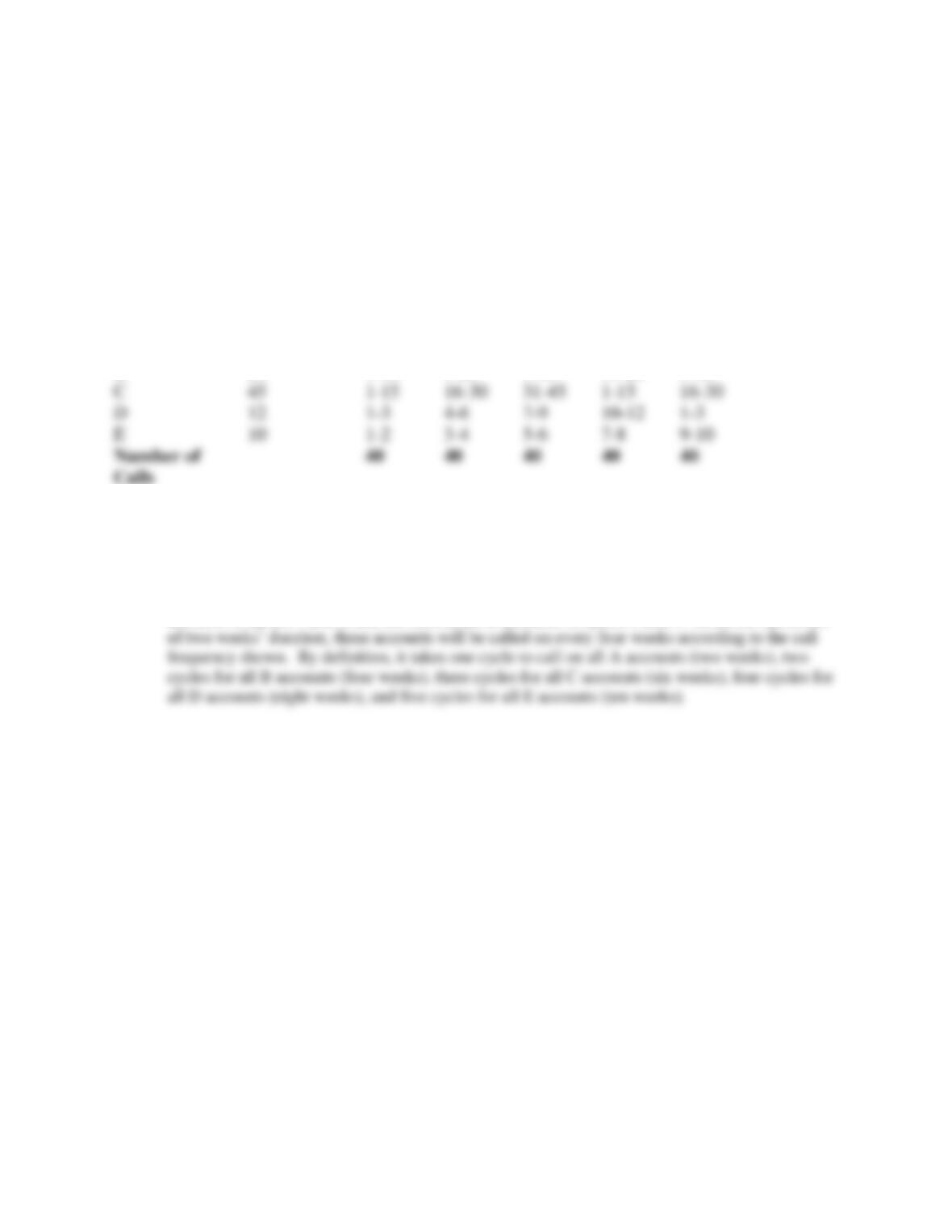
1. Develop a table showing a salesperson‘s call cycle using the given call frequency patterns.This table
shows how the call cycles for this example (territory) will be made up.
Call Cycles
Account
Number of
Cycle
Cycle
Cycle
Cycle
Cycle
Classification
Accounts
1
2
3
4
5
A
10
1-10
1-10
1-10
1-10
1-10
B
20
1-10
1-20
1-10
11-20
1-10
2. Discuss why this should be done:
It may be seen from this schedule that all A accounts are called on in every cycle, the first ten B
accounts in cycles 1 and 3, and the second ten B accounts in cycles 2 and 4. Since the cycles are
C
45
1-15
16-30
31-45
1-15
16-30
D
12
1-3
4-6
7-9
10-12
1-3
E
10
1-2
3-4
5-6
7-8
9-10
Calls