Chapter 14: Pricing Strategies
CHAPTER SUMMARY AND LEARNING OBJECTIVES
LO14.1 Explain how price elasticity affects potential demand for a product.
The concept of elasticity explains why consumer purchasing patterns vary for certain products,
but not for others, when price goes up or down.
LO14.2 Compare the primary types of forecasting methods used to determine demand.
LO14.3 Contrast the three primary competitive pricing strategies.
Firms choose among skimming, penetration, and competitive pricing strategies based on their
overall marketing strategies and organizational objectives.
LO14.4 Outline three types of pricing tactics used by marketers.
LO14.5 Explain how price affects consumer perceptions of quality.
LO14.6 Describe the legal constraints on pricing.
Pricing decisions in the United States must conform with various laws and regulations imposed
by federal, state, and local governments.
Chapter 14: Pricing Strategies
ACTIVATOR EXERCISE: Identifying Pricing Strategies
Purpose: To orient students to different pricing strategies.
Format: Small group research, then group discussion.
Time: 20–30 minutes, depending on format.
Activity: Ask students to visit the following websites and try to describe their pricing strategies
in plain-spoken terms. Students aren’t being asked to identify a particular strategy as it appears
in this chapter, because they likely haven’t read it yet. Instead, they should ask, “What is this
company trying to accomplish with this particular price?”
Result: Students will be able to apply some of the concepts from the previous chapter, but will
also notice some more specific concepts. Again, they can state their findings in plain language
without concern for getting the strategies “right.” For instance, LG’s price is really high for the
Chapter 14: Pricing Strategies
LECTURE OUTLINE
14-1 How Price Affects Demands
The concepts learned in Chapter 13 influence how marketers approach the process of setting
prices. But because pricing is such a dynamic and impactful component of the marketing mix,
there are a number of other influences and strategies that marketers must consider when
making pricing decisions. We’ll discuss those in this chapter, starting with a more thorough
discussion of the relationship between supply and demand.
Supply refers to the amounts of a product that will be offered for sale at different prices during a
specified period.
Example: If most people will pay $20 for a pair of shoes, there might be only one
supplier willing to manufacture and sell shoes at that price. However, if most people will
Discussion questions: Housing is one example where we see how prices can be influenced
by supply and demand. What are other examples?
Possible answers: Tickets to concerts or sporting events, air conditioners (depending on the
weather), the stock market.
Price Elasticity
Elasticity is the measure of the responsiveness of purchasers to price changes. The price
Chapter 14: Pricing Strategies
Determinants of Elasticity
Discussion questions: What are some products for which you are highly sensitive to price
changes? Why?
What are some products for which you are NOT very sensitive to price changes? Why?
Elasticity also depends on the portion of a person’s budget spent on a product.
Key Takeaway: Marketers must be sensitive to the state of supply and demand in a market
when making pricing decisions. They must also consider the elasticity of pricing within
their product category when considering price changes.
Estimated time: 10 minutes
14-2 Forecasting Demand
Forecasts of future demand play major roles in new product decisions, production scheduling,
financial planning, inventory planning, and other business considerations.
estimate demand in the larger market.
Qualitative Methods
Jury of Executive Opinion
The technique called the jury of executive opinion combines and averages the outlooks of top
executives from such areas as marketing, finance, and production.
Chapter 14: Pricing Strategies
Sales Force Composite
The sales force composite technique develops forecasts based on the belief that organization
members closest to the marketplace—those with specialized product, customer, and
competitive knowledge—offer the best insights concerning short-term future sales.
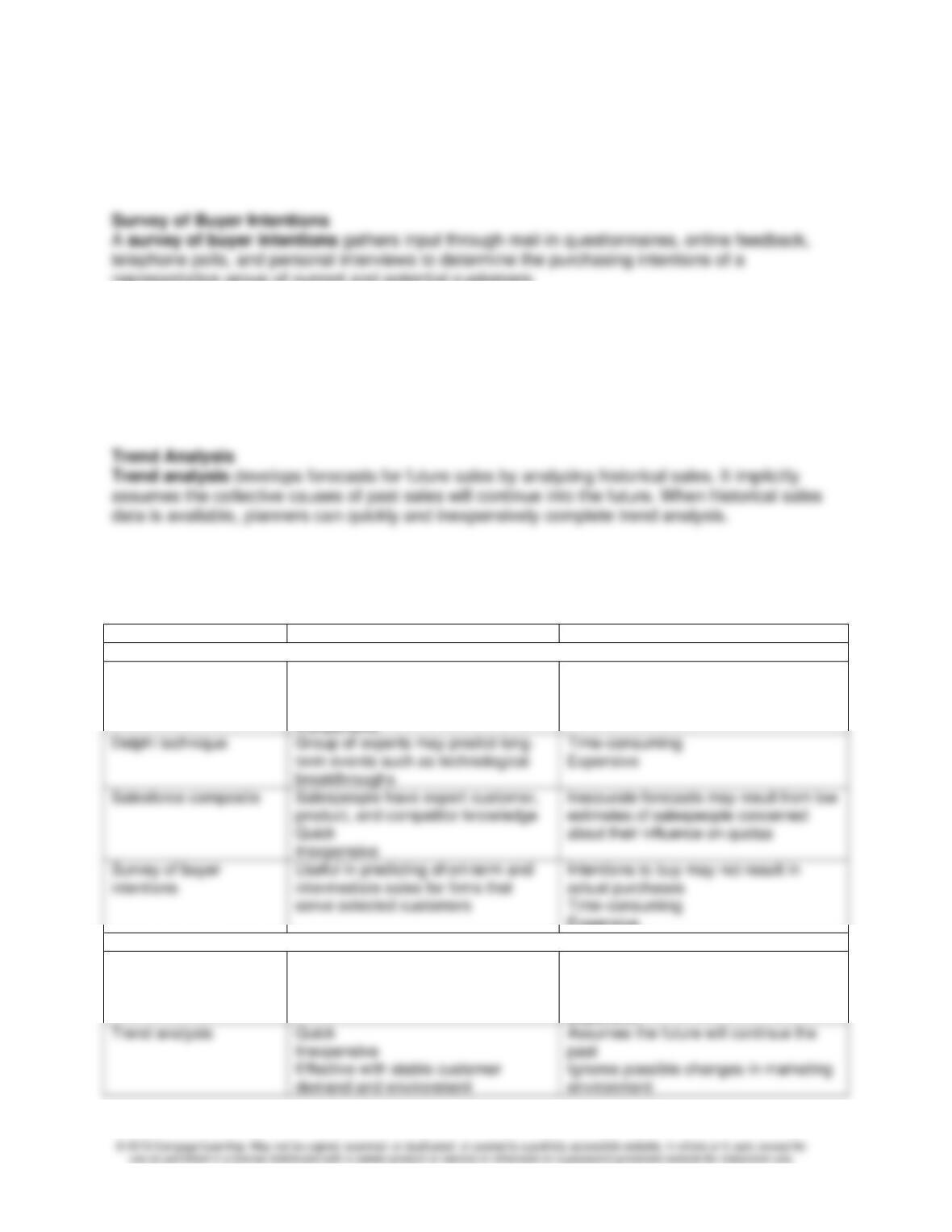
representative group of current and potential customers.
Quantitative Methods
Test Marketing
Test marketing frequently helps planners assess consumer responses to new-product
offerings. The procedure typically begins by establishing one or more test markets to gauge
consumer responses to a new product under actual marketplace conditions.
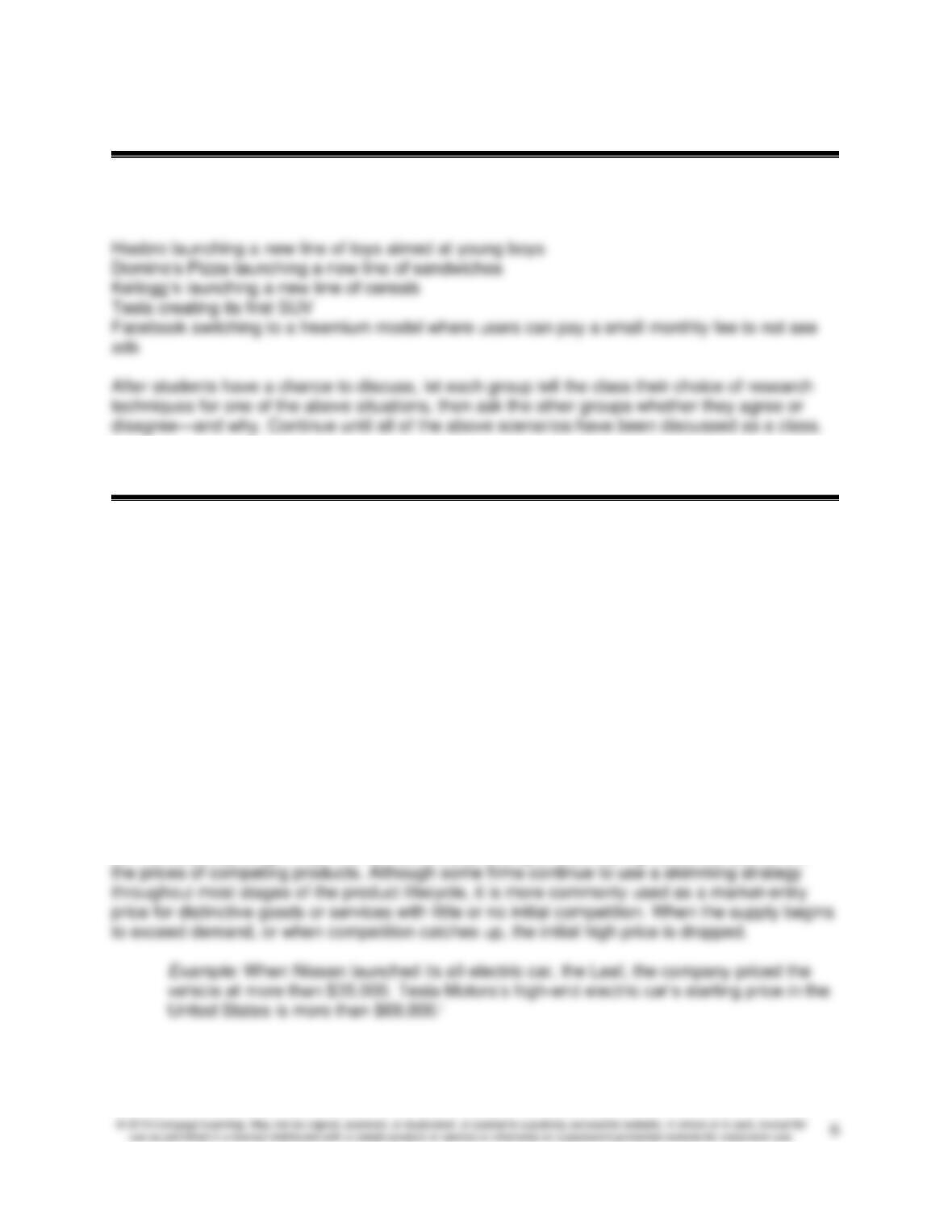
PRESENTATION VISUAL: MindTap Exhibit 14.1 showing the benefits and limitations of
various forecasting methods
Techniques
Benefits
Limitations
Qualitative Methods
Jury of executive
opinion
Opinions come from executives in
many different departments
Quick
Inexpensive
Delphi technique
Group of experts may predict long–
term events such as technological
breakthroughs
Time-consuming
Expensive
Salesforce composite
Salespeople have expert customer,
Quick
Inexpensive
Inaccurate forecasts may result from low
Managers may lack background
knowledge and experience to make
meaningful predictions
Expensive
Quantitative Methods
Test market
Provides realistic information on
actual purchases rather than on
intent to buy
Alerts competition to new-product
plans
Time-consuming
Expensive
demand and environment
environment
Chapter 14: Pricing Strategies
Classroom activity: Divide students into small groups and ask them to choose the best
research techniques for each of the following situations. They should provide reasons for their
answers.
Note: Students should utilize the information in Exhibit 14.1 to help justify their answers, but can
also provide additional support of their own.
Key Takeaway: Forecasting methods fall into two broad categories: qualitative and
quantitative forecasting, each with their own benefits and limitations.
Estimated time: 15–45 minutes (depending on whether you facilitate the classroom activity)
14-3 Pricing Strategies
Pricing objectives represent the firm’s priorities when setting prices, such as reaching a certain
sales volume, directly addressing competition, or communicating prestige. Once objectives are
set, pricing strategies can more specifically guide marketers toward the selection of a price. In
general, firms can choose from three pricing strategies: skimming, penetration, and
competitive pricing.
Skimming Pricing Strategies
Derived from the expression “skimming the cream,” skimming pricing strategies are also known
as market-plus pricing. They involve intentionally setting a relatively high price compared with
Chapter 14: Pricing Strategies
Discussion question: Besides jewelry, what are some other examples of categories, brands,
or products that seem to utilize skimming pricing?
Penetration Pricing Strategy
A penetration pricing strategy sets a low price as a major marketing weapon. Marketers often
Discussion question: Besides cable and internet providers (examples mentioned in MindTap),
what are some other examples of categories, brands, or products that seem to utilize
penetration pricing?
Competitive Pricing Strategy
Organizations know that a price war can hurt everyone in the industry, so their overall objective
is to maintain competitive parity. Based on that objective, their specific pricing strategy is to
Classroom activity: Divide students into pairs or small groups. Ask them to brainstorm all of
the ways—besides price—that you could enhance the quality or perception of the following
products—without drastically increasing your costs.
Frozen pizza
Athletic shoes
Chapter 14: Pricing Strategies
14-4 Pricing Tactics
Once a firm has established its overall pricing strategy, it can support that strategy by utilizing
specific pricing tactics such as psychological pricing, product-line pricing, and promotional
pricing.
Psychological Pricing
Psychological pricing applies the belief that certain prices or price ranges make products more
Discussion questions: What are some examples of companies or products that use prestige
pricing? Note that this is different than skimming, which is typically temporary and for newer
products. Prestige pricing is typically used to support a prestige brand objective over the long
term.
Another psychological pricing technique that can be used for any product is odd pricing. In odd
pricing, marketers set prices at odd numbers just under round numbers. Many people assume
that a price of $9.95 is more appealing to consumers than $10, supposedly because buyers
interpret it as $9 plus change.
Product-Line Pricing
Product-line pricing is the practice of setting a limited number of prices for a selection of
Classroom activity: In small groups, have students research examples of product-line pricing.
Note: Examples are common in categories such as electronics, apparel, autos, and airlines
(using the different classes).
Promotional Pricing
In promotional pricing, a lower-than-normal price is used as a temporary ingredient in a firm’s
marketing strategy. In other words, it’s a short-term version of penetration pricing.
Chapter 14: Pricing Strategies
by angry shoppers to restore its traditional price cuts.
ii
Retailers rely most heavily on promotional pricing. In one type of technique, stores offer loss
leaders: goods priced below cost to attract customers who, the retailer hopes, will also buy
regularly priced merchandise.
Discussion question: When was a time that you were drawn in to a retail store by a low price
on a product, then ended up either buying a more expensive version of that product or a bunch
of other products at the same time.
Estimated time: 15–25 minutes
14-5 Price and Perception of Quality
Price is often an important indicator of a product’s quality to prospective purchasers. Many
buyers interpret expensive products as high-quality products. Because prestige is often
associated with high price tags, manufacturers of some status brands go to great lengths to
prevent discounting. Science has confirmed just how impactful these perceptions can be.
A new type of prestige surrounds eco-friendly products. Many consumers are willing to pay
more for green products—those made with environmentally sustainable materials and
processes. These purchases make consumers feel good about what they are doing to help the
environment, which can support their self-concept.
Chapter 14: Pricing Strategies
Classroom activity: Divide students into pairs and have them discuss their pricing limits.
Specifically, for each of these products, at what price on the low-end you would begin to
question the quality of the product? And what price on the high-end would be too high, no
matter what you were told about the quality of the product?
Bottled water
Key Takeaway: Price is often an important indicator of a product’s quality to prospective
purchasers. The influence of price on perception of quality can exist at the high and low
end of the price scale.
Estimated time: 15–20 minutes
14-6 Pricing and the Law
Pricing decisions are influenced by a variety of legal constraints imposed by federal, state, and
Robinson-Patman Act
The Robinson-Patman Act (1936) was inspired by price competition triggered by the rise of
grocery store chains. This Depression-era law prohibits price discrimination when selling the
Unfair-Trade Laws
Most states supplement federal legislation with their own unfair-trade laws, which require
sellers to maintain minimum prices for comparable merchandise. Enacted in the 1930s, these
laws were intended to protect small specialty shops from loss-leader pricing tactics in which
chain stores might sell certain products below cost to attract customers.
Chapter 14: Pricing Strategies
Federal Trade Commission
The U.S. Federal Trade Commission (FTC) was created “To prevent business practices that are
anticompetitive or deceptive or unfair to consumers.” With the slogan “Protecting America’s
Consumers,” the FTC oversees enforcement of over 70 laws. While most of these laws don’t
relate specifically to pricing, they influence pricing in a number of ways.
Example: The Fair Packaging and Labeling Act can prevent a manufacturer from
overpricing a product by misrepresenting the quantity or identity of what’s being sold.
Discussion question: Share an example of when you witnessed or experienced unfair or
deceptive pricing practices?
Chapter 14: Pricing Strategies
LEARN IT TODAY . . . USE IT TOMORROW
VIGNETTE AND ACTIVITY
The opening vignette for Chapter 14 discusses Dollar General, the Tennessee-based chain of
discount retailers. In particular, the vignette explains Dollar General’s various pricing strategies
as a basis for building upon the general pricing concepts learned in the previous chapter.
Note: Answers to the chapter-ending activity can be discussed in class after the activity
due date.
Applying Pricing Strategies
Dollar General’s success is based on low prices for major national brands, a strategy well suited
to categories with highly elastic demand and standardized products. For less price-sensitive
consumers, however, a marketer must carefully weigh other factors before choosing a pricing
approach. Apply what you’ve learned to a business where brand image and the nature of
competition are critical pieces in the pricing puzzle.
Decision #1
Robin must decide on her overall pricing approach. She is a premium provider of food, but
operates in an extremely competitive environment, with many lower-priced alternatives. She
knows it’s important to establish a foothold in the market, then perhaps she can adjust pricing
later to increase margins. Which approach should she choose?
#1: Prestige objective, skimming strategy, psychological tactic
Chapter 14: Pricing Strategies
competition.
#2: Sales objectives, competitive strategy, and promotional tactic.
Correct Answer: A competitive strategy is a promising option. Demand for food cultivated by
Decision #2
Robin has been using promotional pricing tactics for a few months, with good results. But it’s not
sustainable and she must raise prices at some point, hopefully without seeing too big a drop-in
demand. Based on her research, demand is more inelastic during the summer tourist season,
but more elastic during the rest of the year. Which time of year would it be best for Robin to
experiment with raising prices?
#1: Summer season
Correct Answer: Good choice! If Robin raises prices during this time it’s less likely she’ll lose
Decision #3
Robin was researching some similar, competing restaurants and found one that offers food
options at three price points: a value menu; a menu of organic, sustainable options; and a
gourmet menu. Each had a fixed price point. That restaurant was busy and seemed to have
Decision #4
Oh no! After all the time and money she spent obtaining the buyer intention survey, Robin
learns the market research firm used defective data. Investors are giving her conflicting advice
Chapter 14: Pricing Strategies
about how to redo the demand forecast. The main problem is that Robin doesn’t have much
time or money to conduct this research.
Investor A recommends utilizing test markets to obtain a real-world assessment of her sales
potential. This will provide the most accurate data. But Investor B supports a salesforce
composite, which would tap into the expertise of her own successful staff. Which investor’s
approach is best?
#1: Test markets
Incorrect Answer: While realistic, test markets would be expensive and time-consuming. Robin
Chapter 14: Pricing Strategies
ADDITIONAL HOMEWORK/CLASSROOM ACTIVITIES
Pricing Strategies
Purpose: To underscore the pros and cons of each key pricing strategy.
Background: The three key pricing strategies are quite different, each offering the potential for
significant benefits and risks. This exercise is designed to help students understand the
tradeoffs among the three approaches.
Exercise: After you cover the pricing strategies, divide your class into three teams. Assign each
team one of the three strategies, and direct them to prepare an argument for why their strategy
makes sense for each of the following products:
• Educational games for children
• Streaming television
Questions for Discussion:
• How could you monitor the success of your pricing strategy?
• Would the promotional strategy be likely to differ for each pricing strategy? If so,
how? Why?
Personal Pricing Strategy
Purpose: To help students internalize the key elements of pricing strategy.
Background: Students often gain a visceral understanding of pricing when they apply the
strategies to themselves and their careers. This exercise gives them an opportunity to do so,
with the goal of attaining a deeper understanding of key considerations in the pricing decision.
Chapter 14: Pricing Strategies
should follow (penetration, skimming, or competitive)? Why? Issues to consider (you may want
to write these on the board):
• Who is their target market?
Questions for Reflection:
• What should you learn about each specific prospective employer before developing
your personal pricing strategy?
Penetration Pricing Strategy
Purpose: To explore the impact of penetration pricing.
Background: Every student has valuable consumer-side experience with pricing strategies.
This exercise is designed to harness that knowledge to help students better understand the
impact and implications of penetration pricing.
Relationship to Text: Penetration Pricing Strategy
Questions for Reflection:
• How much does pricing impact your choice of retailer? What are the other key
considerations?
Chapter 14: Pricing Strategies
• What role should the manufacturer of a product play in determining guidelines for
retail pricing? Why?
Internet Exercises—Pricing strategies
Say you’d like to go on a Caribbean cruise. Visit the Royal Caribbean website or other cruise
websites to price cruises at various times of the year—for example, summer vacation, spring
break week, and Thanksgiving week. Which cruises are the most and least expensive? Prepare
Ethics
Visit the website of a hotel chain with which you are familiar to learn if it gives any information
about additional surcharges. If consumers were informed about the charges ahead of time,
would you feel differently about them? Why or why not?
Chapter 14: Pricing Strategies
KEY TERMS
Supply: The amounts of a product that will be offered for sale at different prices during a
specified period.
Demand: The amounts of a product that consumers will purchase at different prices during a
specified time period.
Elasticity: The measure of the responsiveness of purchasers and suppliers to price changes.
Delphi technique: Qualitative forecasting method that gathers several rounds of feedback from
experts inside and outside the firm.
Salesforce composite: Qualitative forecasting method based on the combined sales estimates
of the firm’s salespeople.
Survey of buyer intentions: Qualitative forecasting method that samples opinions among
groups of current and potential customers concerning purchasing plans.
Trend analysis: Quantitative forecasting method that estimates future sales through statistical
analysis of historical sales patterns.
Chapter 14: Pricing Strategies
Promotional pricing: Pricing tactic in which a lower-than-normal price is used as a temporary
ingredient in a firm’s marketing strategy.
Loss leaders: Pricing tactic where goods are priced below cost to attract customers to stores in
hopes they will buy other merchandise at regular prices.