Chapter Fourteen
Channel Relationships and Supply Chains
Authors’ Comments
Marketing channels are among those few neglected topics in many basic marketing
courses. Students often express confusion, based on popular consumer myths, about
the value of middlemen, not fully recognizing the economic utility they provide. That
confusion is heightened by a common impression that “B2B” is something new–
Effective marketing channels and efficient business logistics systems are often the
elements of an offering that provide the winning edge in competitive situations. A
well-designed and well-developed marketing channel effectively provides, in a manner
and form acceptable to the customer, attributes in the offering that reach beyond the
core product. The logistics system, part of the channel design, delivers the core
product at the right time and place, again as determined by the customer.
Opening Vignette
The Apple Lisa
In preparing this chapter, we sought an updated opening vignette that would clearly
demonstrate the importance of channel design in serving a particular segment needs.
Eventually, we reverted back to the Apple Lisa, not only because it demonstrates what
Chapter 14: Channel Relationships and Supply Chains 2
Learning Objective
Understand the principles of market channel design and the delivery
of economic utility–form, time, place and possession−to customers.
The introduction defines some basic channel terms.
Primary participants
Consider describing, with intended humor, a consumer purchase
without the economic utility of a channel. I have used both of the
following successfully:
Scenario 1: The Aspirin−Imagine it’s 2 a.m. on a Sunday evening;
the end of a well-partied weekend. You (your students) go to your
medicine cabinet, reach for the bottle of aspirin; it doesn’t rattle.
(Who put the empty bottle back on the shelf? Better yet, who
used the last one without replacing the bottle? Blame it on
Scenario 2: The new car−You are going to buy a new car. There
isn’t a dealer network. All cars are purchased directly from the
manufacturer−lower price, right?
Without the dealer the following items are missing:
Chapter 14: Channel Relationships and Supply Chains 3
To buy the car, you must
Research the options, colors, etc. that you may want
Rent/borrow a friend’s car for a test drive
Marketing Channels create Economic Utility (PowerPoint 14.3)
Form
Time
Place
Possession
Channel Flows and Activities Create Value
Flows to the customer: Exhibit 14-2a (PowerPoint 14.8)
Learning Objectives
Understand value networks and the relationship to marketing
channels.
Chapter 14: Channel Relationships and Supply Chains 4
Understand classical vertical integration patterns and the value
network alternative.
Effective channel development is closely related to the “make or buy” decision
and vertical integration.
Vertical Integration
A firm may elect to own the elements of its supply chain beyond its
Vertical Integration provides many advantages, but also disadvantages
(PowerPoint 14.12)
+ –
Economies of scale Lack of flexibility
Functional Spinoff (PowerPoint 14.13)
Ancillary services are provided most efficiently by experts in each
service–a basic application of the principle of division of labor.
Exhibit 14-3 describes the competitive efforts of UPS and FedEx, two
examples of expert logistics providers serving other companies that
Value Networks are Marketing Channels: Exhibit 14-5 (PowerPoint 14.14)
The value network concept is analogous to functional spin-off, albeit for
creation of the offering rather than performance of ancillary services.
Chapter 14: Channel Relationships and Supply Chains 5
Learning Objective
Understand the fundamentals of business logistics and how these
principles are being applied in today’s global supply chains.
In business-to-business marketing, Industrial Distributors serve many of the
same functions as Merchant (full-service) wholesalers in consumer markets.
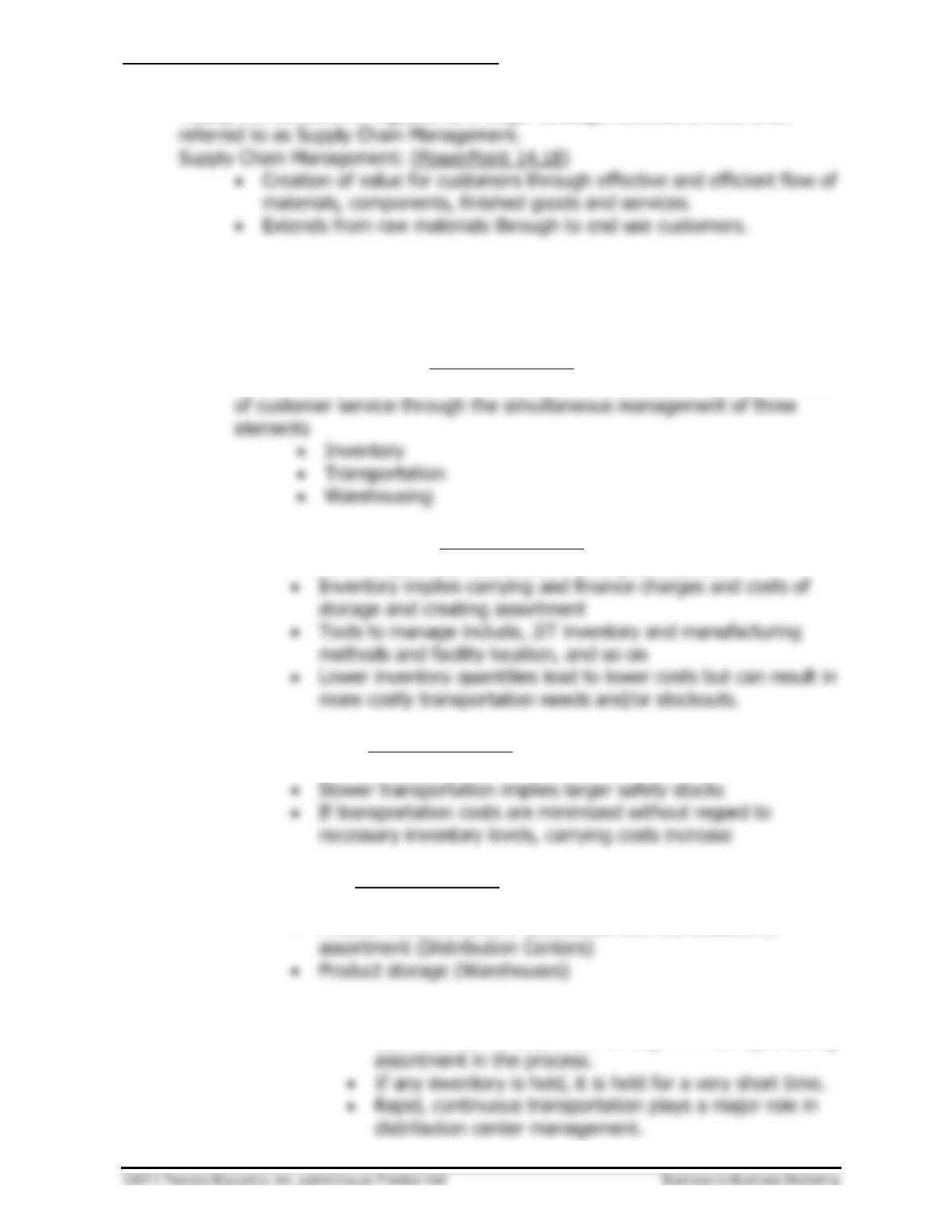
Exhibit 14-4–repeated here (also PowerPoint 14.16)
Supply Chain Management
The discussion of supply chain management is a shift from the rationale,
economic utility and design of marketing channels to the management of
movement, sorting and storage of goods.
Exhibit 14-4 Enhanced Customer Service−Distributors serve both
Buyers and Sellers
Seller Benefits
Buy and hold inventory
Combine supplier outputs (reduce
Buyer Benefits
Provide fast delivery
Provide market segment-based
Chapter 14: Channel Relationships and Supply Chains 6
Today, the elevation of logistics as a major strategic function is most often
(Authors’ Note: Over time, the following has been referred to as the Physical
Distribution Concept, the Business Logistic Concept and Supply Chain
Management. Regardless of the definition, the concept remains the same.)
Physical Distribution Concept (PowerPoint 14.19)
System design aimed at minimizing costs while maintaining a given level
Inventory Management (PowerPoint 14.20)
• Often largest cost associated with logistics system
Transportation (PowerPoint 14.21)
• Tradeoff of speed versus cost
Warehousing (PowerPoint 14.22)
Two primary functions of warehousing
• Product flow/movement–associated with the creation of
Distribution Centers
• Optimized to move product through the facility, creating
Chapter 14: Channel Relationships and Supply Chains 7
Warehouses:
• Optimized as storage and assortment creation
Logistics as a Competitive Edge (PowerPoint 14.23)
• As technology and product advantages become more fleeting,
Differentially Invisible (PowerPoint 14.24)
Customer should not be required to adapt to the vendor–the
Learning Objective
Recognize the importance of building channel relationships from the
view of providing economic utility and developing sustainable value
networks.
Channel Design
Different market segments will require different channel designs even though
the core product remains the same.
Chapter 14: Channel Relationships and Supply Chains 8
This channel function is to Reduce the Discrepancy of Assortment (PowerPoint
14.27).
An alternative definition is “to transform manufacturers’ assortment into
a market segment assortment.
When is it good practice to use distributors and when is it good practice not to
use distributors − summarized in Exhibit 14-6 (PowerPoint 14.28)
Channel Management
Selecting and Caring for Distributors (PowerPoint 14.29)
Power and Conflict
Bases of Power in Marketing Channels (PowerPoint 14.30)
• “Soft” Bases of Power
o Expertise
Channel Patterns and Control
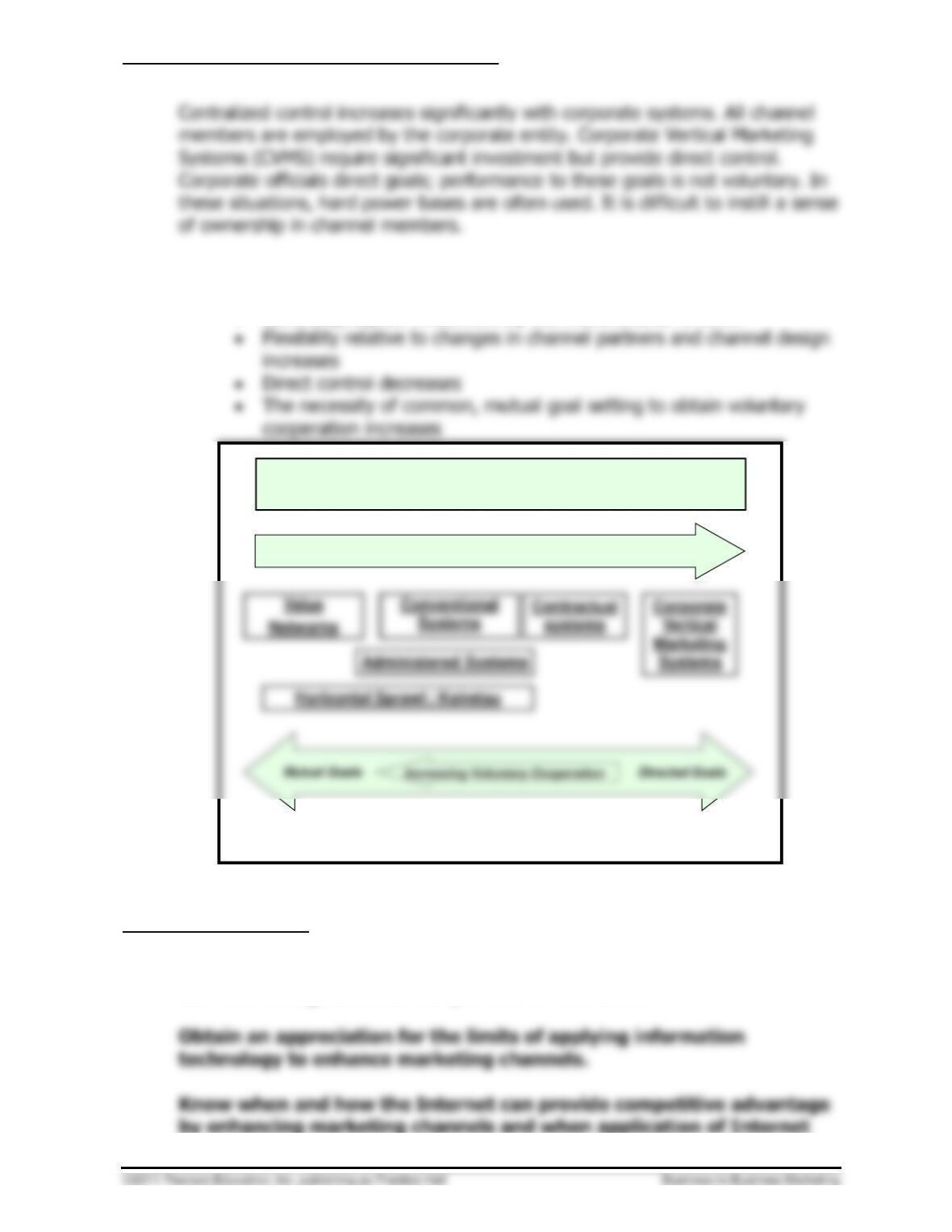
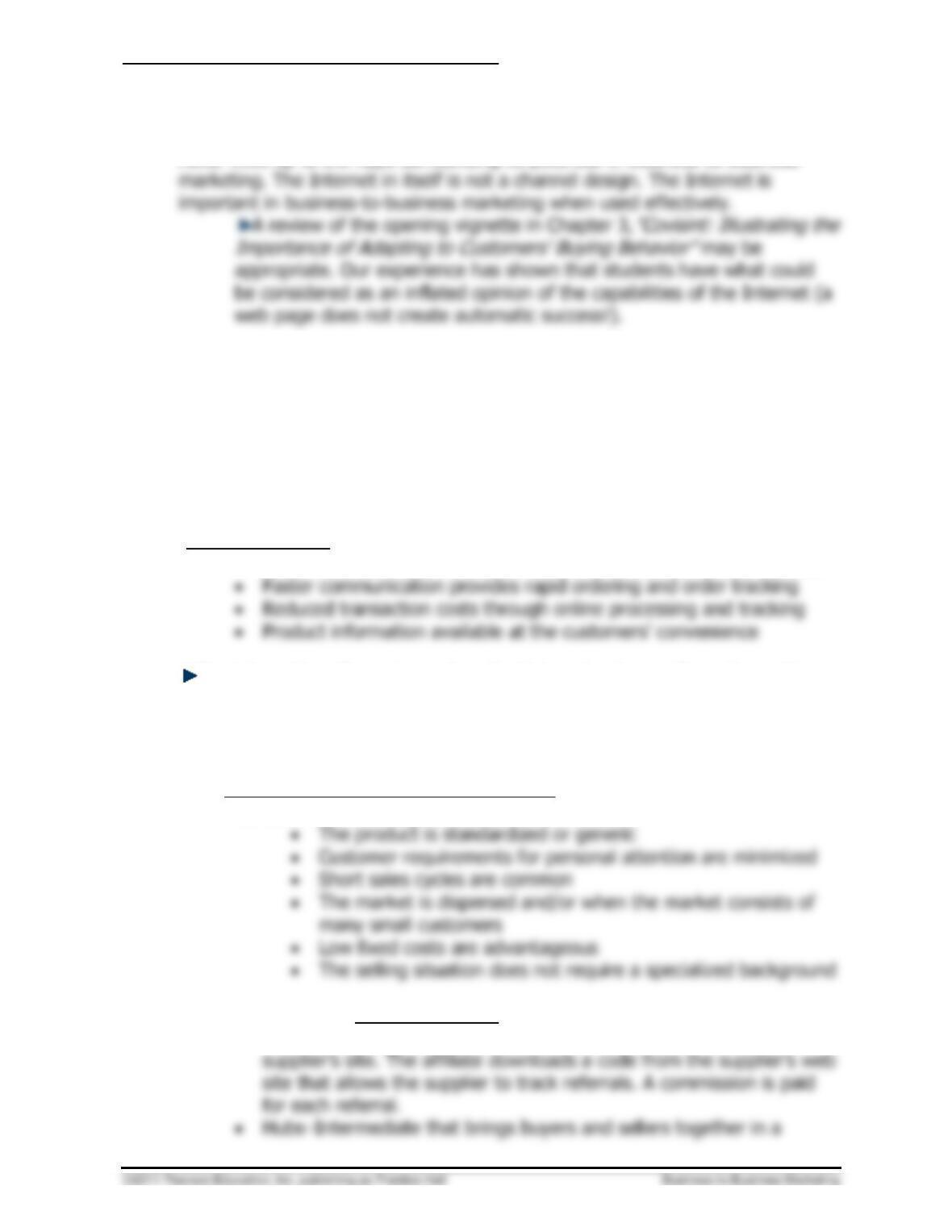
Exhibit 14-7 in the text is a detailed exhibit. PowerPoint 14.31 has been
provided, but it is difficult to read. Exhibit 14-7 has been simplified, as shown
below, for classroom projection. (PowerPoint 14.32)
Important considerations in presenting Vertical Marketing Systems are
In the exhibit, the span of the box representing each type is intended to
show that channel’s flexibility, control, influence and need for goal agreement
relative to the other channels.
Chapter 14: Channel Relationships and Supply Chains 9
As a channel design appears further to the left in the exhibit, the following
occurs:
• Generally, capital investment by the manufacturer is lower
Learning Objectives
Gain an understanding of how the Internet can enhance the value
that marketing channels can provide to customers.
by enhancing marketing channels and when application of Internet
Exhibit 14-7: Control and Cooperation in Vertical
Marketing Systems
Increasing centralized control
Chapter 14: Channel Relationships and Supply Chains 10
technologies will not provide a competitive advantage.
Though the Internet is just now becoming a player in consumer marketing, it
never lived up to the hype surrounding its potential in business-to-business
Covisint and other companies that formed to change the nature of business–to–
business channels never got to profitability. However, this does not mean that
Web-based technology has not had an impact on business–to-business
channels. Many companies have adopted technology that enables today’s agile
and efficient supply chains. This area continues to hold promise, though
planners and pundits now take a more realistic view of it.
Opportunities for business-to-business marketers through the use of the Web:
(PowerPoint 14.33)
• Better and faster channel flows − market data more readily available
Consider a class discussion on how the Internet enhances form, time, place
and possession utility.
The business conditions most appropriate for the Internet is not unlike the
manufacturers’ representative model presented in Chapter 12, Exhibit 12–11
(also PowerPoint 12.32 and PowerPoint 12.33)
Consider the following conditions:
New Channel Types (PowerPoint 14.34)
• Affiliates–link on a web site that refers to a product or service
Chapter 14: Channel Relationships and Supply Chains 11
Key Terms
administered channel intermediaries
affiliates
ancillary channel members
channel pattern
contractual channel
corporate vertical marketing system
form
functional spinoff
horizontal competition
house accounts
hubs
intensity of distribution
keiretsu
logistics
Chapter 14: Channel Relationships and Supply Chains 12
Answers to Questions for Review and Discussion
1. Does a company that markets directly to other companies have a channel?
Why or why not?
A company that markets directly to other companies operates within its own direct channel of
2. Why can channel structure differ between segments, even though the products
are the same?
Channel structure may differ between segments even with the same product because each
segment may have its own needs relative to the support levels offered by channel variations. As
3. Explain the four kinds of economic utility.
The four types of economic utility are:
4. When a channel provides financing to customers, what kind of economic utility
is it providing? Explain.
5. When a channel provides training for the customer’s personnel, what kind of
economic utility is being provided? Explain.
Chapter 14: Channel Relationships and Supply Chains 13
6. What does it mean for a channel to “reduce the discrepancy of assortment?”
A channel “reduces the discrepancy of assortment” by consolidating inventories from a selection
7. Why is carrying extra inventory so costly for suppliers or channel members?
Carrying extra inventory is expensive for suppliers or channel members because they take title
8. What are three reasons that a business-to-business marketer may want to
market through channel intermediaries rather than market directly?
Reasons a business–to-business marketer may want to market through channel intermediaries
9. Review the opening example of Apple and the Lisa computer. Using Exhibit 14–
2a, determine what path Apple used to get the Lisa to its market. Compare that
to the path you think may have been more appropriate.
The channel path that the Apple Lisa product offering used included a reseller (retailer) when,
10. What sort of risks does an industrial distributor share with the supplier?
Chapter 14: Channel Relationships and Supply Chains 14
11. Suppose that a start up company is offering an innovative product that
management hopes will establish a new product category. What forces will
tend to lead the company to market the product through channel intermediaries
rather than directly? What characteristics of an early market will tend to lead
the company to market the product directly to final customers?
The forces that will lead a start-up company to market through channel intermediaries may
12. What are key causes of channel conflict?
The key causes of channel conflict are usually associated with goal incompatibilities that can
13. What are the chief differences between an administered channel and a value
network?
The chief differences between an administered channel and a value network include control and
14. What kinds of value can be provided by web applications that manage channel
transactions?
The value that can be added with web applications that manage channel transactions include a
15. What kinds of value would channels provide that cannot be substantially
enhanced through web applications?

Chapter 14: Channel Relationships and Supply Chains 15
16. Using Exhibit 14-4 review the Apple Lisa and compare how well the factors
were addressed. Note how much better developed was the channel for the
iPhone in meeting customer needs as they pertained to “the way the customer
buys.”
Neither buyers nor sellers benefited from the Apple Lisa channel. The market for consumer–