1
Chapter 14
Consumption to Satisfaction
Learning Objectives
After studying this chapter, the student should be able to accomplish the following objectives.
14-1 Know the connections among consumption, value, and satisfaction.
14-3 Understand how emotions other than satisfaction can affect post-consumption behavior.
14-5 Avoid problems associated with typical satisfaction measures.
14-6 Describe ways that consumers dispose of products.
Lecture Example
A new study by McKinsey linked satisfaction with consistency and highlighted that companies
with a consistent value proposition and a clear way of offering it do much better. According to
the study, the companies that have the most satisfied consumers also report the tightest
distribution of responses. It revealed that among U.S. consumers, multi-category retailers have
the highest customer satisfaction ratings while subscription-based industries are struggling with
issues of customer satisfaction. Cost-driven cuts, made to service in the downturn due to
decreasing revenue, may be the reason attributed to the dismal state of customer satisfaction in
transaction-based services.
Lecture Outline with PowerPoint® Slides
LO 14-1: Know the connections among consumption, value, and satisfaction.
I. Consumption, Value, and Satisfaction
Consumption is at the heart of all consumer behavior. In the consumption process, consumers
use the product, service, or experience that they selected through the consumer decision-making
2
process. Ultimately, consumers use or experience products and receive value in return.
A. Consumption Leads to Value [Instructor PPT Slides 4]
The important role of consumption becomes apparent when one considers that without
consumption, there is no value. Consumption is the process that converts time, goods, ideas,
B. Consumption and Product Classification [Instructor PPT Slide 6]
Important differences exist for the consumption of durable and nondurable goods. Durable
goods are typically relatively expensive goods consumed over a long time period.
Dishwashers, furniture, automobiles, and many electronics like personal computers represent
durable goods. Nondurable goods are typically inexpensive and consumed quickly. Soft
drinks, pencils, and Kleenex are nondurable goods.
C. Situations and Consumer Reactions [Instructor PPT Slide 7]
The temporal factors, antecedent conditions, and physical environment are particularly
influential on the consumption experience. How, what, and when people consume is largely
dependent upon the environment that they are in.
For example, football fans enjoy tailgating, and numerous products are essential to convert the
occasion into value. Beer, burgers, and brats are standard fare at typical midwestern tailgates.
D. Consumption, Meaning, and Transference [Instructor PPT Slide 7]
3
Value depends on a process called meaning transference. Meaning transference begins with
culture. Value is affected largely by the meaning of goods, services, and experiences.
E. Consumption Outcomes and Emotion
Consumers choose products, services, and experiences that they believe will deliver value by
addressing their wants and needs. They anticipate good outcomes from their choices or else
they would have made a different choice. Emotions influence CB before, during, and after
F. Value in Experience [Instructor PPT Slide 8]
Often, marketing experts acknowledge that products alone cannot produce value. Rather, the
value comes from use of the service provided by the product, thus the idea of value in use.
Use is not always straightforward. Consumers, for example, anticipate what an authentic
French restaurant experience will be like based on cognitions that give the concept meaning
(i.e., schema), the meaning is either realized or not during a visit to a French restaurant, and
the evaluation of that experience in turn creates emotion and adjustments to meaning.
Q: Discuss examples to illustrate the term “meaning transference.”
LO 14-2: Discuss the relative importance of satisfaction and value in marketing and
consumer behavior.
II. Value and Satisfaction
Is satisfaction the key outcome variable for marketers and consumers? Ask students to consider
Exhibit 14.3. This chart plots scores for major retailers from the ACSI, which is the American
4
Consumer Satisfaction Index. [Instructor PPT Slide 10]
Managers acknowledge that initiatives that increase customer satisfaction do not always improve
top-line performance, a business term referring to sales growth.
A. What Is Consumer Satisfaction? [Instructor PPT Slide 11]
Customer satisfaction receives a lot of attention from consumer researchers and marketing
managers. However, different people may define satisfaction differently and this causes
confusion over the exact meaning.
Consumer satisfaction is a mild, positive emotional state resulting from a favorable appraisal
of a consumption outcome. Several points distinguish consumer satisfaction from other
important consumer behavior concepts:
• Consumer satisfaction is a post-consumption phenomenon because it is a reaction to an
outcome.
Other key consumer variables like expectations, quality, or attitude are generally more
relevant in explaining pre-consumption or even pre-purchase phenomena. Nevertheless,
managers consider consumer satisfaction important because they believe consumers’ word of
mouth, repeat purchases, and ultimately, consumer loyalty, correlate with reported customer
satisfaction.
B. What Is Consumer Dissatisfaction? [Instructor PPT Slide 11]
Consumer dissatisfaction can be defined as a mild, negative affective reaction resulting from
an unfavorable appraisal of a consumption outcome. Even though conceptually dissatisfaction
is an opposite concept to satisfaction, the fact that consumers react differently to negative
contexts means that dissatisfaction will explain behaviors that satisfaction cannot.
5
Q: As a consumer, have you ever experienced dissatisfaction with a product? Discuss.
LO 14-3: Understand how emotions other than satisfaction can affect post-consumption
behavior.
III. Other Post-Consumption Reactions [Instructor PPT Slide 12]
LO 14-4: Use expectancy disconfirmation, equity, and attribution theory approaches to
explain consumers’ post-consumption reactions.
IV. Theories of Post-Consumption Reactions [Instructor PPT Slide 13]
The actual outcomes of consumption are compared to expectations. If the event turns out to be
less than satisfying, perhaps the expectations were too high or the performance of the company
was too poor.
A. Expectancy/Disconfirmation
The most commonly accepted theory of consumer satisfaction is the
expectancy/disconfirmation theory. The basic disconfirmation model proposes that
consumers enter into a consumption experience with predetermined cognitive expectations of
consumption.
6
performance perceptions do not meet expectations, meaning performance is less than
expected, negative disconfirmation occurs. Negative disconfirmation leads to dissatisfaction.
Expectations [Instructor PPT Slide 15]
Expectations are pre-consumption beliefs concerning what will occur during an exchange
and/or consumption of a product. Consumer expectations have two components:
• The probability that something will occur
• An evaluation of that potential occurrence
Exhibit 14.4 reveals that expectations also can have a direct impact on satisfaction (by the
dotted line), independent of their role in the disconfirmation process. This can occur when
the consumer has very little involvement. In these cases, little effort is put into either
Very high involvement creates a similar moderating effect. When consumers are very
involved with a situation and filled with anticipation, their ability to objectively judge
performance can be impaired. Balance theory kicks in and consumers may adjust their
Types of Expectations [Instructor PPT Slide 15]
7
Consumers bring different types of expectations into a consumption situation:
• Predictive Expectations: Expectations that form about what a consumer thinks will
actually occur during an experience.
Source of Expectations [Instructor PPT Slide 15]
In reality, consumers form expectations based on a number of different sources. Word-of-
mouth communication from other consumers is an important source of information. A
consumer’s experience also influences expectations. Explicit promises such as
advertisements and promotions create consumer expectations as well. Personal factors also
influence expectations.
Performance Perceptions
Perception plays a very important role in CB. Perception directly influences how a
consumer interacts with the world.
Perception is also very important for the consumption and the post-consumption processes.
As is the case with expectations, performance perceptions can also directly influence
consumer satisfaction formation independent of the disconfirmation process (Exhibit 14.4).
Q: You want to go on a Mediterranean tour. Which sources would you use to
gather information?
8
Confidence in Expectations and the Confirmatory Bias [Instructor PPT Slide 16]
Not only do expectations play a key role in satisfaction formation, they also can affect how
consumers see things. That is, expectations can affect performance perceptions. Ask
students to imagine that they go into a class thinking, “This class is going to be really bad!”
An expectation like this to actually alter their perception of the class experience. If they
think the class is going to be bad, they may very well look for evidence to support this
expectation. The term to explain this phenomenon is confirmatory bias.
Expectations and Service Quality [Instructor PPT Slide 16]
Service quality can be thought of as the overall goodness or badness of a service provided.
Service quality sometimes is seen as determined by the difference between consumer
Desires and Satisfaction
A desire is the level of a particular benefit that will lead to a valued end state. Studies have
shown that desires directly impact satisfaction beyond the influence of disconfirmation
alone.
B. Equity Theory and Consumer Satisfaction [Instructor PPT Slide 17]
Equity theory proposes that consumers cognitively compare their own level of inputs and
outcomes to those of another party in an exchange. Equitable exchanges occur when these
When a consumer sets out to buy a computer, she will put quite a bit of effort into finding just
the right one. She will get a computer, but she will also get a warranty, service contract, and
9
use the computer and then try to match these factors with a good arrangement of product
features.
Inequitable Treatment
Perhaps more often, equity perceptions involve inequitable treatment of customers. Thus,
service providers need to be keenly aware of how customers are treated in public to
maintain perceptions that all customers are treated in much the same way—or at least
treated in a fair way.
Inequitable Consumers
Q: Describe a situation where you acted as an inequitable consumer. Do you think
your behavior was justified?
C. Attribution Theory and Consumer Satisfaction [Instructor PPT Slide 18]
Attribution theory focuses on explaining why a certain event has occurred. There are three
key elements to the attribution theory approach:
• Locus: Judgments of who is responsible for an event. Consumers can assign the locus
to themselves or to an external entity like a service provider. A self-ascribed event
10
D. Cognitive Dissonance [Instructor PPT Slide 19]
Cognitive dissonance refers to thoughts that are inconsistent with one’s preconceived
notions. In this case, dissonance takes the form of lingering doubts about a decision that has
already been made. Dissonance is sometimes known as buyer’s regret.
A consumer is more likely to experience true dissonance following a purchase when the
following conditions exist:
The dissonance among consumers’ beliefs following a consumption experience can be very
discomforting and be a source of negative post-consumption emotions. Consumers may
therefore be motivated to lessen this discomfort. To lessen feelings of discomfort following
purchase, consumers may engage in any, or all, of the activities listed in Exhibit 14.5.
[Instructor PPT Slide 20]
Cognitive Dissonance and Satisfaction
LO 14-5: Avoid problems associated with typical satisfaction measures.
V. Consumer Satisfaction/Dissatisfaction Measurement Issues [Instructor PPT Slide 21]
Marketers assess customer satisfaction perhaps more than any other psychological concept.
Three common measurement approaches are as follows:
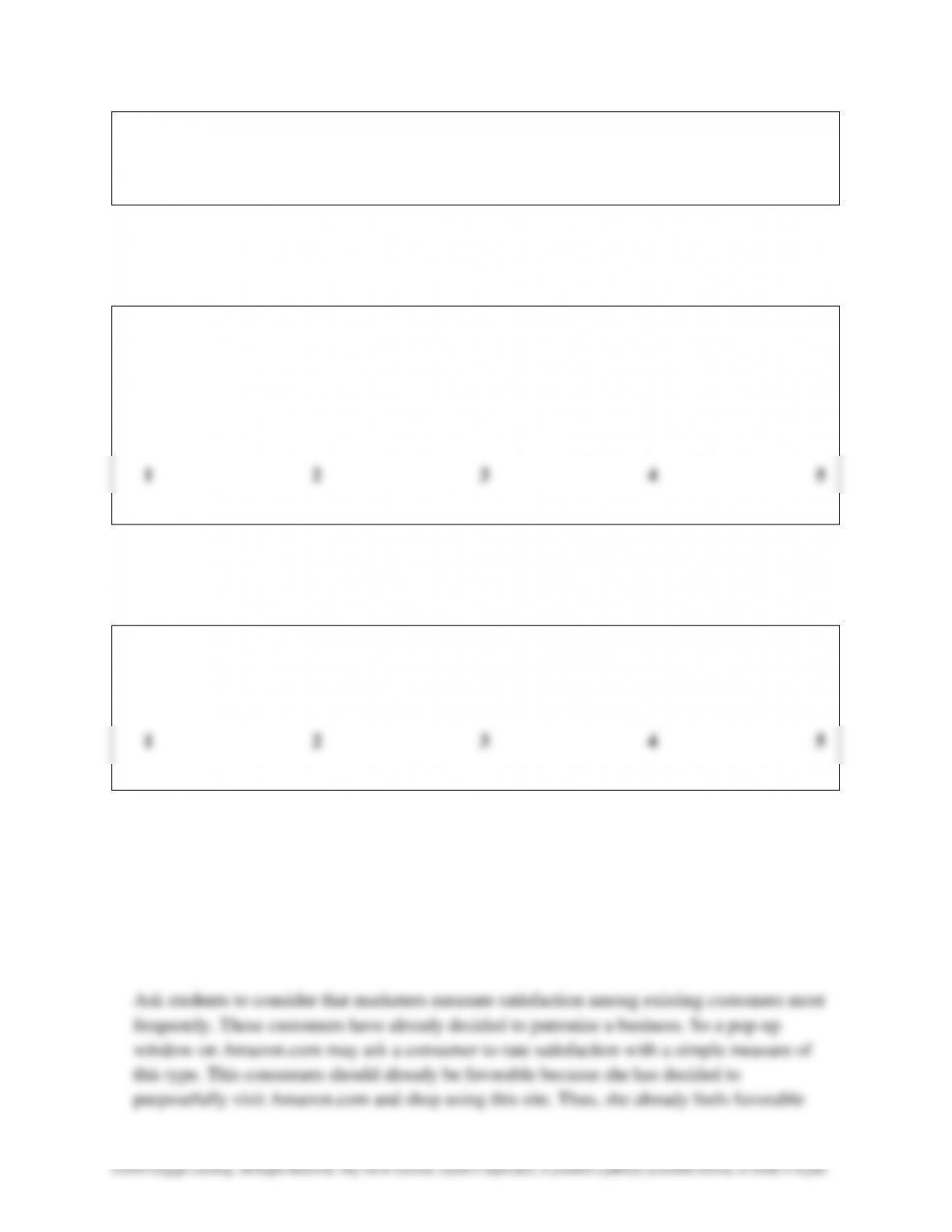
• Direct, Global Measure—Simply asks consumers to assess their satisfaction on a scale
such as:
How do you rate your overall satisfaction with your stove?
Completely dissatisfied Satisfied Completely satisfied
11
• Attribute-Specific—Assesses a consumer’s satisfaction with various components, or
attributes, of a product, service, or experience, such as:
How satisfied are you with the following attribute of your stove?
Heat of Burners
Completely dissatisfied Completely satisfied
1 2 3 4 5
• Disconfirmation—Compares the difference between expectations and performance
perceptions. This measure can be taken in a direct, subjective fashion, such as:
Compared to my expectations, this stove performs . . .
Much worse than I expected Much better than I expected
1 2 3 4 5
A. Improving Satisfaction Measures [Instructor PPT Slide 22]
Satisfaction is one of the most commonly measured concepts in consumer behavior but also
one of the most difficult to measure accurately. The problems can be severe and limit the
ability to use satisfaction ratings to explain or predict other outcomes, including whether or
not the consumer will return.
12
toward Amazon.com. Therefore, one would expect even without knowing what happened
during the visit that the customer would report some degree of satisfaction. In fact, typical
consumer responses to this type of measure show that the vast majority of consumers, 80% or
more, choose “satisfied” or “completely satisfied.” Statistically speaking, these data are left
skewed, in this instance meaning that the bulk of consumers have indicated that they are
satisfied or completely satisfied with the product or service.
Does this reflect reality, or is the scale simply inadequate in truly differentiating consumers
experiencing different levels of satisfaction? The truth is that both possibilities are likely true
LO 14-6: Describe ways that consumers dispose of products.
VI. Disposing of Refuse
A. Disposal Decisions [Instructor PPT Slides 23 and 24]
A final step in consumption is disposal of any consumer refuse. Consumer refuse is any
packaging that is no longer necessary for consumption to take place or, in some cases, the
actual good that is no longer providing value to the consumer. A growing source of refuse
falls under the category of e-waste, consisting of discarded electronics such as cell phones,
old computers and tablets and their components. A number of disposal alternatives are
available. These include the following:
• Trashing: One alternative that a consumer has is to simply throw away waste material
including unused products, packaging, and by-products. There are environmental
concerns with this alternative.