Chapter 13 – Building the Price Foundation
13–34
Epilogue
Washburn continues to live up to its rich history manufacturing exceptional guitars. The
company recently announced the addition of legendary Allman Brothers Band guitarist Warren
Haynes as a signature artist. Haynes will play and endorse the new Washburn WSD5249 Warren
Haynes Signature Model acoustic guitar. Washburn also recently introduced the new Paul
Stanley (KISS) PS10 Starfire guitar at a price of $712.90 and the new Nuno Bettencourt
(Extreme, Rihanna) EA20SNB acoustic/electric guitar at a price of $890.90. Stanley recently
13–35
TEACHING NOTE FOR APPENDIX D CASE D-13
WELLNESS GETAWAYS, INC.: THE CHALLENGE OF SETTING A PRICE
Synopsis:
“To run it, or not to run it,” that was the question. Wellness Getaways, Inc. packages
cruises to Caribbean Islands with the intent of helping passengers become healthier by breaking
bad habits such as smoking or overeating. As of November l4, only 200 passengers had signed
up for the cruise; 300 passengers were expected. Overhead expenses of $590,000 have been
incurred already and Wellness Getaways, Inc. personnel are considering whether they should
spend either $12,000 or $30,000 more for advertising to attract passengers. The sailing date for
the cruise is December l8. Students make calculations and assess trade-offs to reach a decision
on both undertaking more advertising and actually going ahead with the cruise or canceling it.
Teaching Suggestions:
This case raises issues related to break-even analysis and more broadly,
cost-volume-profit analysis. This case is suitable for teaching after Chapters l3 or l4 have been
discussed. In addition, this case raises issues related to pricing and advertising a new service and
therefore relates nicely to the product strategy chapters (10 and l1), services marketing chapter
(12), and the advertising chapter (18).
Answers to Questions
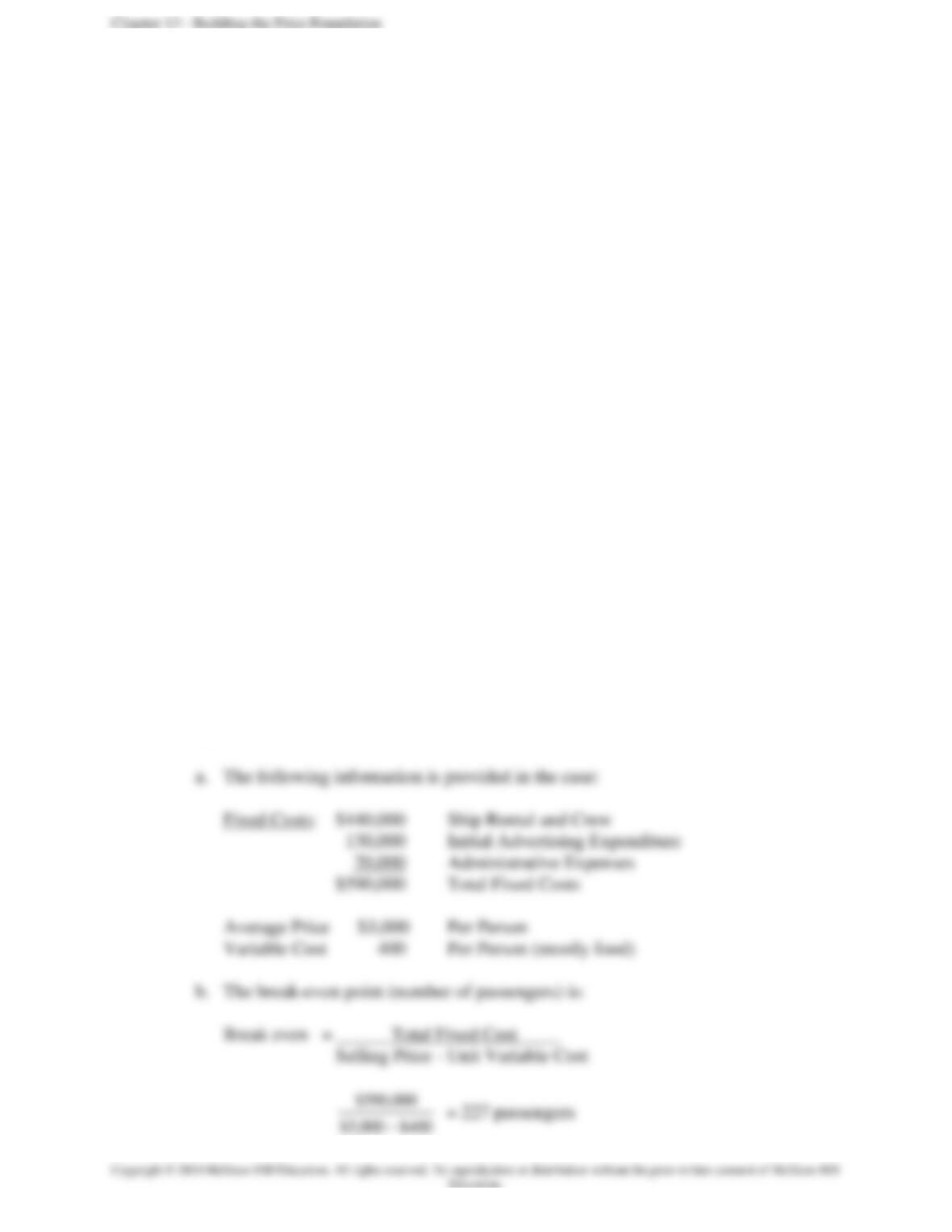
1. What is the minimum number of passengers that Wellness Getaways must sign
up by November 20 in order to break even with the cruise? Show your
calculations.
Answer:
Chapter 13 – Building the Price Foundation
13–36
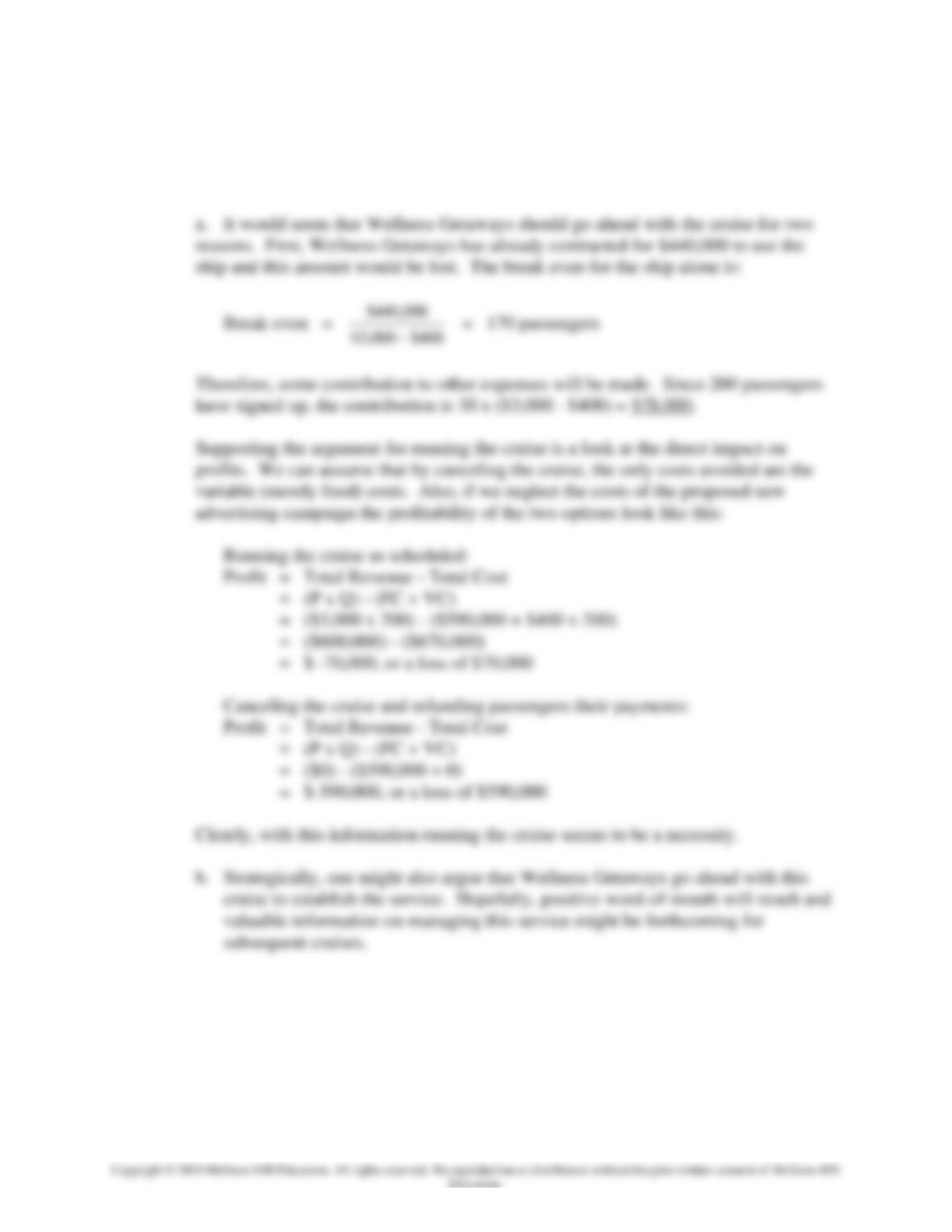
2. Should Wellness Getaways go ahead with the cruise since 200 passengers had
signed up as of November l4?
Answer:
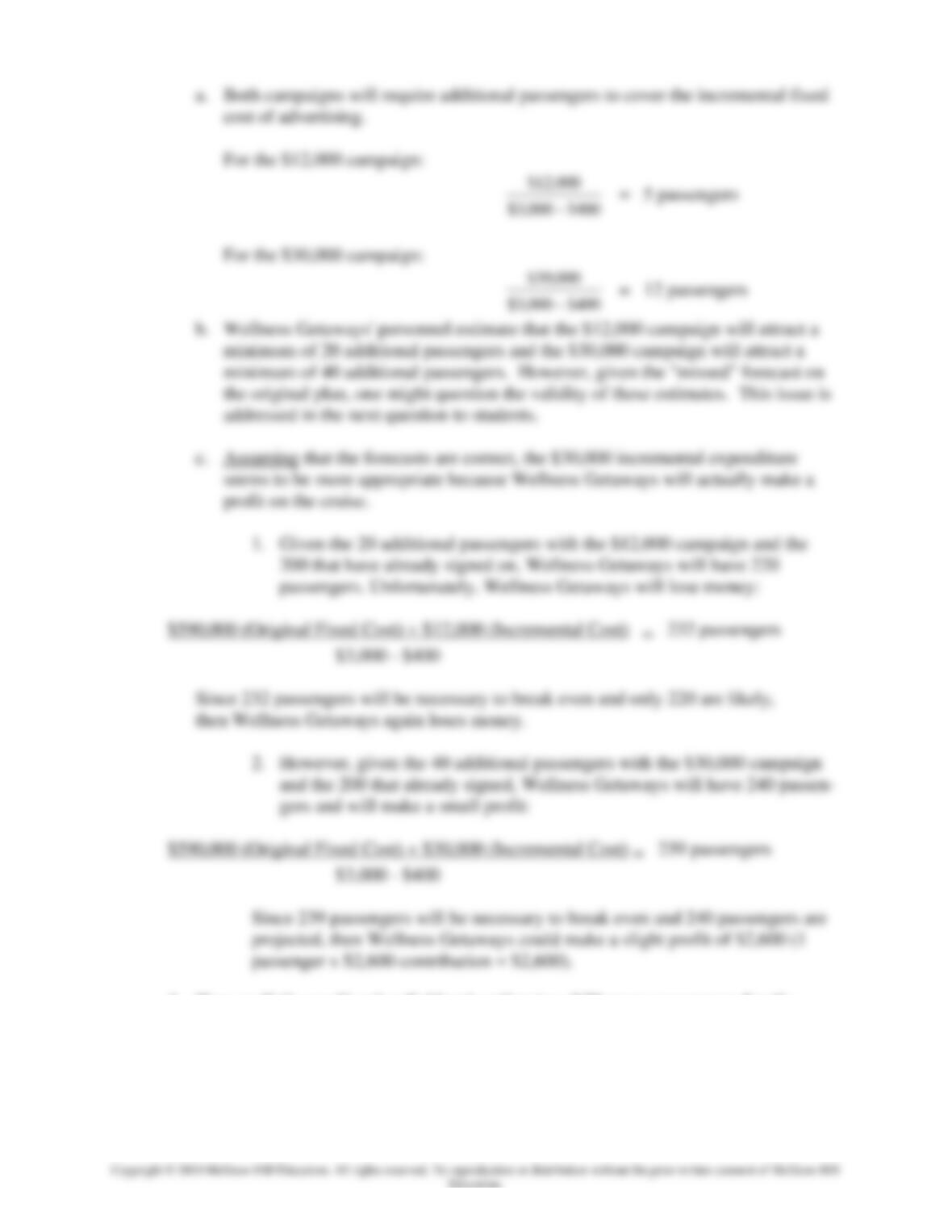
3. Would it be worthwhile for Wellness Getaways to spend either $12,000 or
$30,000 for advertising on November 20? If so, which figure would you
recommend?
Answer:
Chapter 13 – Building the Price Foundation
13–37
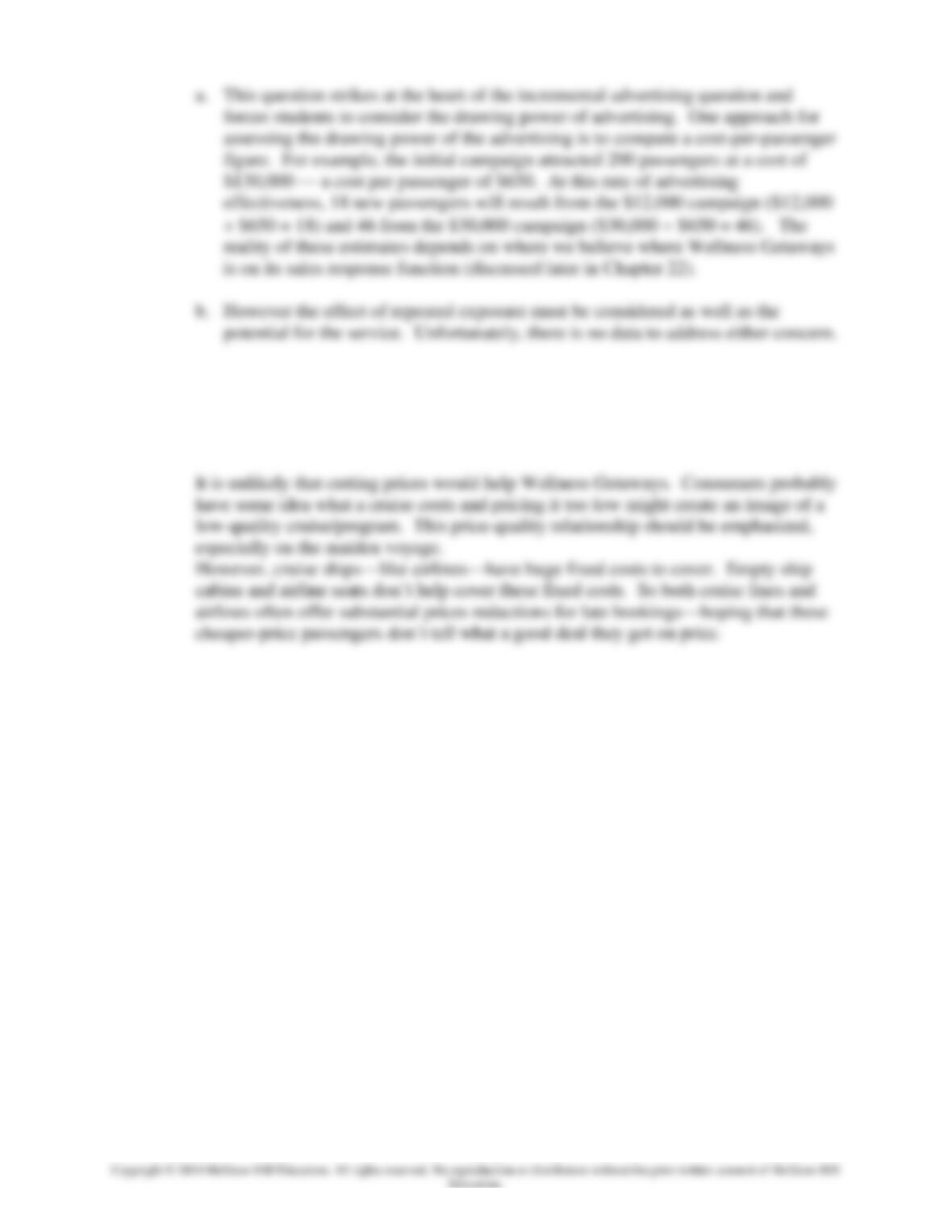
4. How realistic are Carolyn Subhan’s estimates of 20 more passengers for the
$12,000 advertising campaign and 40 more passengers for the $30,000
campaign?
Answer:
Chapter 13 – Building the Price Foundation
13–38
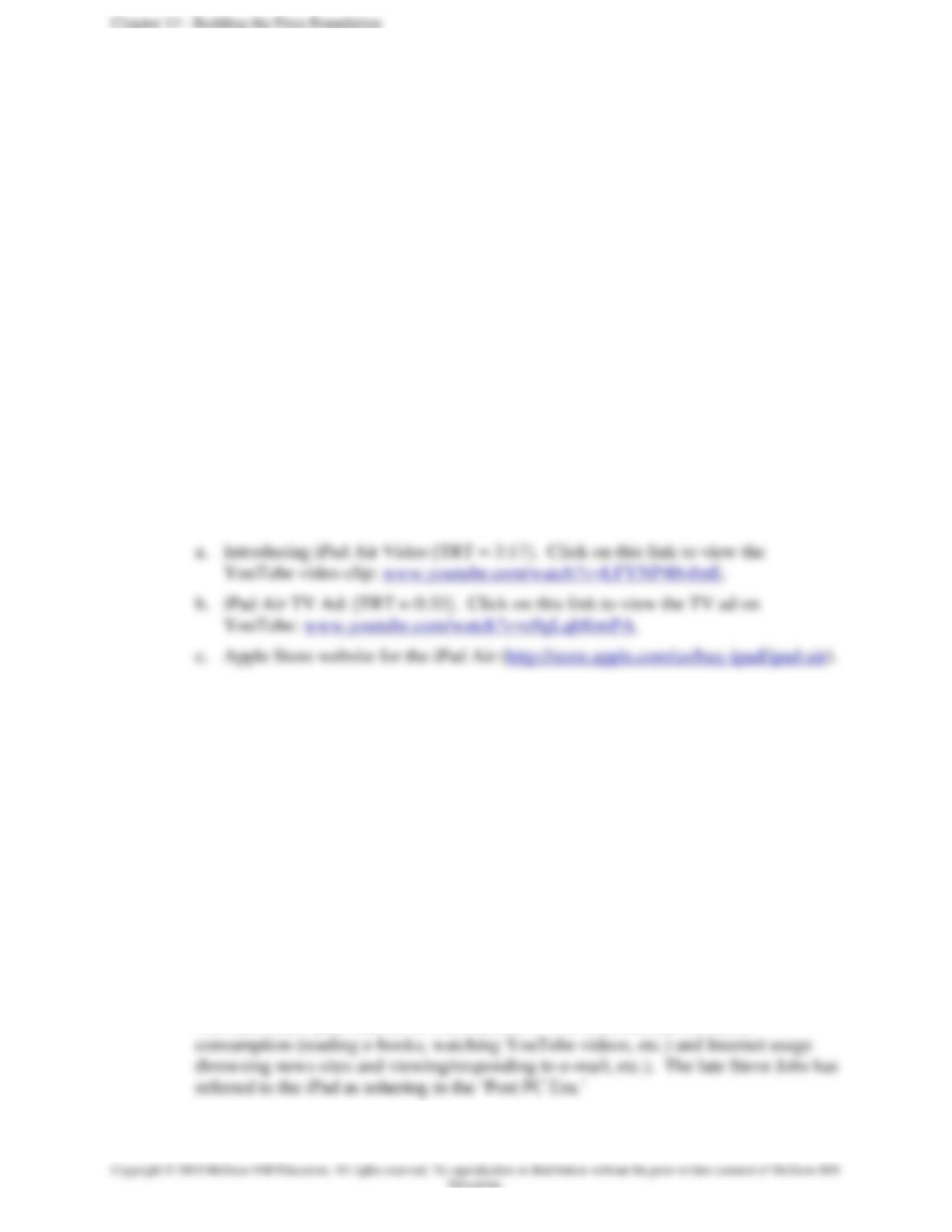
5. Should Wellness Getaways consider cutting its prices for this maiden voyage
health cruise?
Answer:
13–39
ICA 13-1: IN-CLASS ACTIVITY
Pricing an Apple iPad
Learning Objective. To have students learn the concept of the price equation as it
pertains to the price set for an Apple iPad Air tablet device.
Nature of the Activity. To have students develop a price equation for an Apple iPad Air
tablet device sold by Apple in its online Apple Store.
Estimated Class Time and Teaching Suggestions. If this ICA is conducted during a
class period in 4-person teams (20 minutes) or assigned individually as homework (15 minutes).
Materials Needed. Copies for each student of the Price Equation for an Apple iPad Air
Handout.
Steps to Teach this ICA.
1. OPTIONAL: If this ICA is conducted during the class period, then bookmark the
following websites on your classroom computer:
2. Ask students if any of them own an Apple iPad or other tablet device such as an
Amazon Kindle or the Samsung Galaxy Tab, where they bought it, what accessories,
warranties, etc. they bought, how much they paid for it, and how they like it.
a. Click on the Internet icon “iPad Air Video” to view a recent video clip about the
launch of the Apple iPad Air. [TRT = 3:17]
b. Click on the Internet icon “iPad Air TV ad” to view a recent advertisement for the
new Apple iPad Air. [TRT = 0:33]
3. OPTIONAL: Ask students what they think about the new iPad Air.
4. Give students the following mini-lecture on tablet devices and the Apple iPad Air:
“In April 2010, Apple introduced the iPad. Unique to this tablet device was its iOS
multitouch user interface borrowed from its hugely successful Apple iPhone, which
was launched 3 years earlier to much acclaim. The iPad focused on media
Chapter 13 – Building the Price Foundation
13–40
The iPad Air was launched in October 2013 and weighs just one pound. It has a 9.7”
screen that uses Retina Display technology, which provides HD quality format with
10 hours of battery life. It also has a 5-megapixel iSight camera for FaceTime video
calling, picture taking, and HD video recording. In addition, the iPad Air has next
5. Give the students the following mini-lecture on the price equation:
“The price equation consists of all the factors that raise or lower the final price
consumers pay for a product or service. These factors include (1) any incentives
(discounts, rebates, special offers) and allowances, which are subtracted from the list
6. Pass out copies of the Price Equation for an Apple iPad Air Handout to students.
7. Form students into 4-person teams if this ICA is to be conducted in class.
8. Have the team members identify the types of accessories they want,
incentives/discounts and allowances that they may receive, and the extra fees/charges
(extended warranty, sales tax, delivery charges, etc.) they may pay when purchasing
9. Call on 3 to 4 student teams to share their ideas about the accessories, incentives,
discounts, allowances, and extra fees/charges that may be involved when buying an
Apple iPad Air at Apple’s online store. Their ideas could include:
Chapter 13 – Building the Price Foundation
13–41
10. Provide teams with an overview of the expanded ICA or homework assignment:
a. Click on the Internet icon to “purchase” an Apple iPad Air from Apple. [NOTE:
[See ICA13-1PriceEquationApple.xls]
11. IN-CLASS OR HOMEWORK ASSIGNMENT. Have the teams complete the
Price Equation for an Apple iPad Handout. Again, be careful and warn students
not to purchase an Apple iPad Air. Have students identify the costs, discounts,
fees/charges, etc. for each item listed to complete the Price Equation for an Apple
iPad Air. Here are some of the accessories and options available:
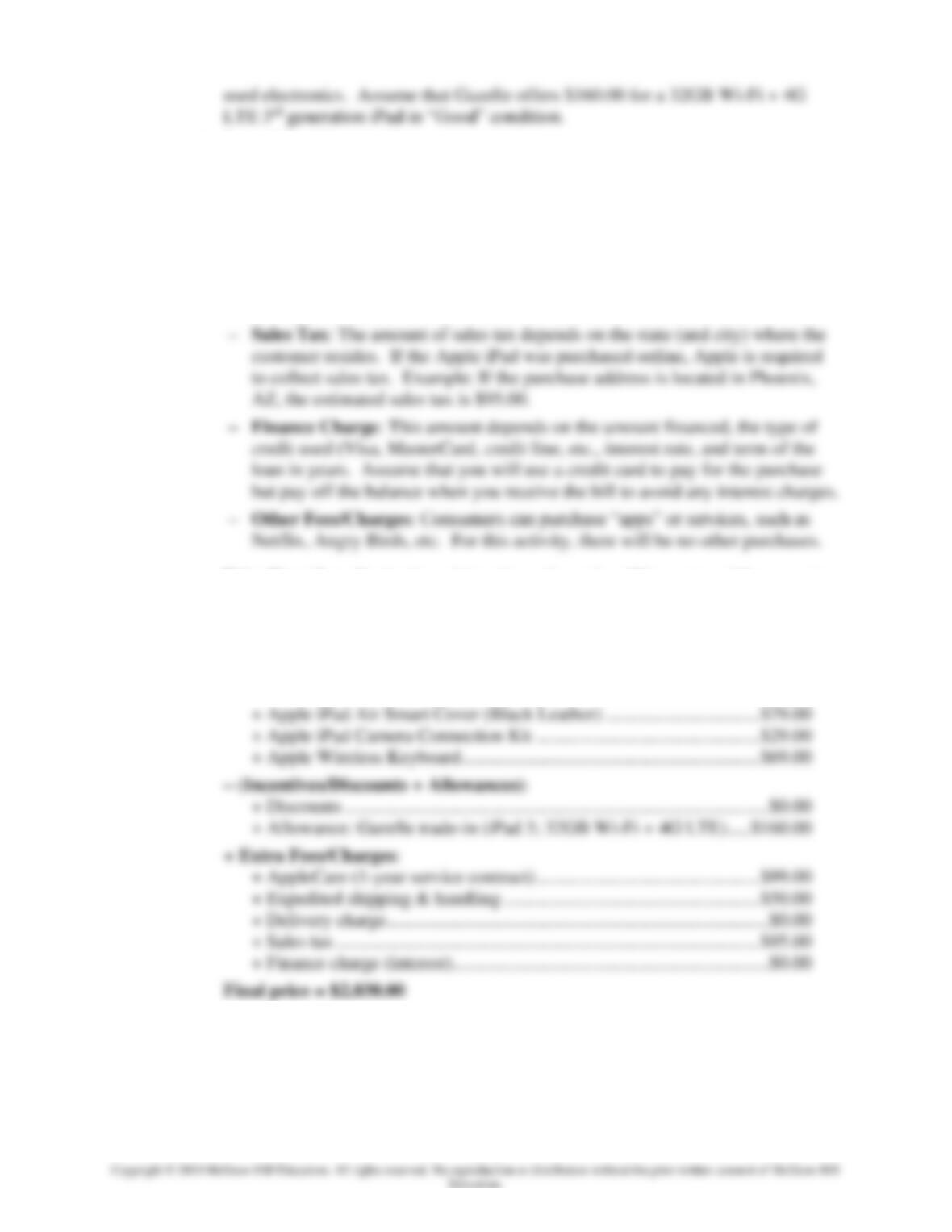
a. List Prices—Apple Online Store: (NOTE: APPLE’S PRICES MAY
CHANGE TO NEW PRICES WITHOUT NOTICE.)
– Apple iPad Air Finish/Model: Black/Space Gray, 128GB, Wi-Fi + Cellular;
MSRP is $929.00.
– Network Carrier—Verizon: Assume you’re a heavy data user (video
downloads, Internet browsing, e-mail, etc.). The cost for a 10GB data plan is
$70.00 per month ($10 line access+ $60 account access) or $840.00 per year.
Chapter 13 – Building the Price Foundation
13–42
d. Extra Fees/Charges: These can include:
– AppleCare for iPad: The MSRP for this warranty/customer support for
1 year is $99.00.
– Shipping & Handling/Delivery Charges: These are based on distance from
the store/warehouse to the consumer’s residence (zip code dependent) and the
shipping method used (local delivery, UPS, etc.). Assume that expedited
shipping & handling is $50.00 and the delivery charge is free ($0.00).
[Charges are based on shipment to Phoenix, AZ.]
e. Price Equation: Final price = List price – (Incentives/Discounts + Allowances) +
Extra fees/charges:
Final price = List prices:
+ Apple iPad Air Black/Space Gray 128GB Wi-Fi + Cellular ………$929.00
+ AT&T Data Plan: $70/month for 10GB/month ………………………..$840.00
[See ICA13-1PriceEquationApple.xls]
Marketing Lesson. The final price a consumer pays for a product or service is normally
NOT the stated list price or MSRP. It is adjusted upward or downward depending upon the

Chapter 13 – Building the Price Foundation
13–43
incentives, allowances, and extra fees that are applied. These adjustments are dependent upon
market conditions at the time of purchase.
Chapter 13 – Building the Price Foundation
13–44
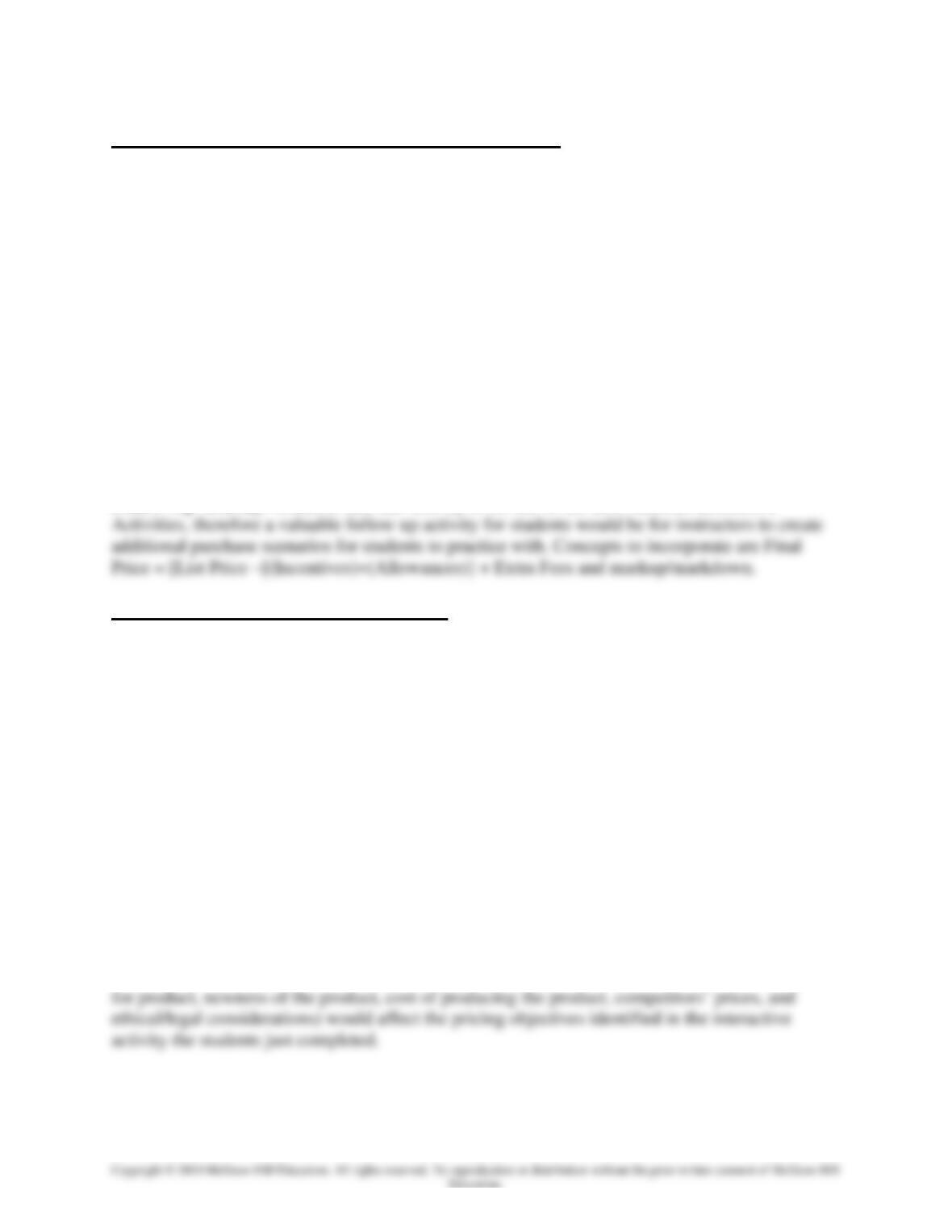
PRICE EQUATION FOR AN APPLE IPAD AIR HANDOUT
MODEL: 128GB Wi-Fi + CELLULAR—VERIZON
[PRICES OBTAINED FROM THE APPLE STORE]
ELEMENT OF PRICE
EQUATION
PRICE EQUATION FACTORS AND PRICES
LIST PRICES FOR
IPAD AIR &
ACCESSORIES
INCENTIVES/
DISCOUNTS
ALLOWANCES
EXTRA FEES/
CHARGES
Chapter 13 – Building the Price Foundation
13–45
Connect Application Exercises
Application Exercise 1: Final Price and Profit Equations
Activity Summary: In this case analysis, students utilize the price equation and apply various
incentives, allowance, and fees to calculate a final price. Students read a mini-case that describes
a student’s purchase of a printer. Pricing data is provided for the printer’s MSRP, shipping, free
USB, rebate, and coupon. Using the data provided, students calculate final price, seller’s cost,
profit, and consumer discount.
Tagging (Topic, Learning Objectives, AACSB, Bloom’s, Difficulty)
Topics: Setting Prices, Profit Equation, Price Elasticity of Demand
Learning Objectives: LO 13-01: Identify the elements that make up a price.
LO 13-04: Describe what price elasticity of demand means to a manager
facing a pricing decision.
AACSB: Analytical Thinking
Blooms: Analyze
Difficulty Level: 3 Hard
Follow-Up Activity: Students find this activity to be one of the most difficult Interactive
Application Exercise 2: Pricing Objectives
Activity Summary: In this click and drag activity, students are introduced to pricing objectives
(profit, sales revenue, market share, unit volume, survival, and social responsibility). The pricing
objectives are the drop areas for the twelve pricing examples (return on investment, return on
assets, black Friday, Nike Golf, Florida summer, iPhone, Linens ‘n Things, country club, special
drug pricing, U.S. Airways, hybrid permits). As students mouse over each pricing example, they
are provided with a description of the pricing strategy.
Tagging (Topic, Learning Objectives, AACSB, Bloom’s, Difficulty)
Topics: Pricing Strategy
Learning Objective: LO 13-02 Recognize the objectives a firm has in setting prices and the
constraints that restrict the range of prices a firm can charge.
AACSB: Knowledge Application
Blooms: Apply
Difficulty Level: 2 Medium
Follow-Up Activity: Instructors can ask students to discuss how the pricing constraints (demand
Chapter 13 – Building the Price Foundation
13–46
Application Exercise 3: Price Elasticity of Demand
Activity Summary: In this click and drag activity, students learn about the effect that price has
on demand for products through the price elasticity of demand calculation. Students are given the
formula for price elasticity of demand (E) and the definitions of elastic and inelastic demand.
Students are given four draggable Apple product examples (MacBooks, iPhones, AirPods, and
MacBook Air) which provide students with price and demand figures. After calculating the price
elasticity of demand for each, the product’s demand is classified as either inelastic or elastic by
dropping the item on the correct term.
Tagging (Topic, Learning Objectives, AACSB, Bloom’s, Difficulty)
Topics: Price Elasticity of Demand
Learning Objective: LO 13-04: Describe what price elasticity of demand means to a manager
facing a pricing decision.
AACSB: Analytical Thinking
Blooms: Analyze
Difficulty Level: 3 Hard
Follow-Up Activity: This activity is challenging for students, therefore an appropriate follow-up
Application Exercise 4: Washburn Guitars
Activity Summary: In this 10-minute video case, students learn the history of the Washburn
Guitars Company, focusing on the firm’s pricing decisions. At the conclusion of the video,
students are asked six questions covering price elasticity of demand, revenue and profit
equations, pricing objectives, and demand.
Tagging (Topic, Learning Objectives, AACSB, Bloom’s, Difficulty)
Topics: Price Elasticity of Demand, Pricing Strategy, Profit Equation, Break-Even Analysis,
Price Sensitivity
Learning Objective: LO 13-03 Explain what a demand curve is and the role of revenues in
pricing decisions.
LO 13-05 Explain the role of costs in pricing decisions and describe how
various combinations of price, fixed cost, and unit variable cost affect a
firm’s break-even point.
AACSB: Analytical Thinking, Knowledge Application
Blooms: Analyze, Understand, Evaluate
Difficulty Level: 2 Medium, 3 Hard
Follow-Up Activity: Instructors could continue the pricing discussion by having students