Chapter 13: Pricing Concepts
13-6 The Cost–Volume–Profit Relationship
Marketers usually seek to identify the price that optimizes overall profits while maintaining a
competitive advantage. They know that a higher price results in better margins, but likely
decreases sales volume, which affects profits. Lower prices might boost sales volume, but the
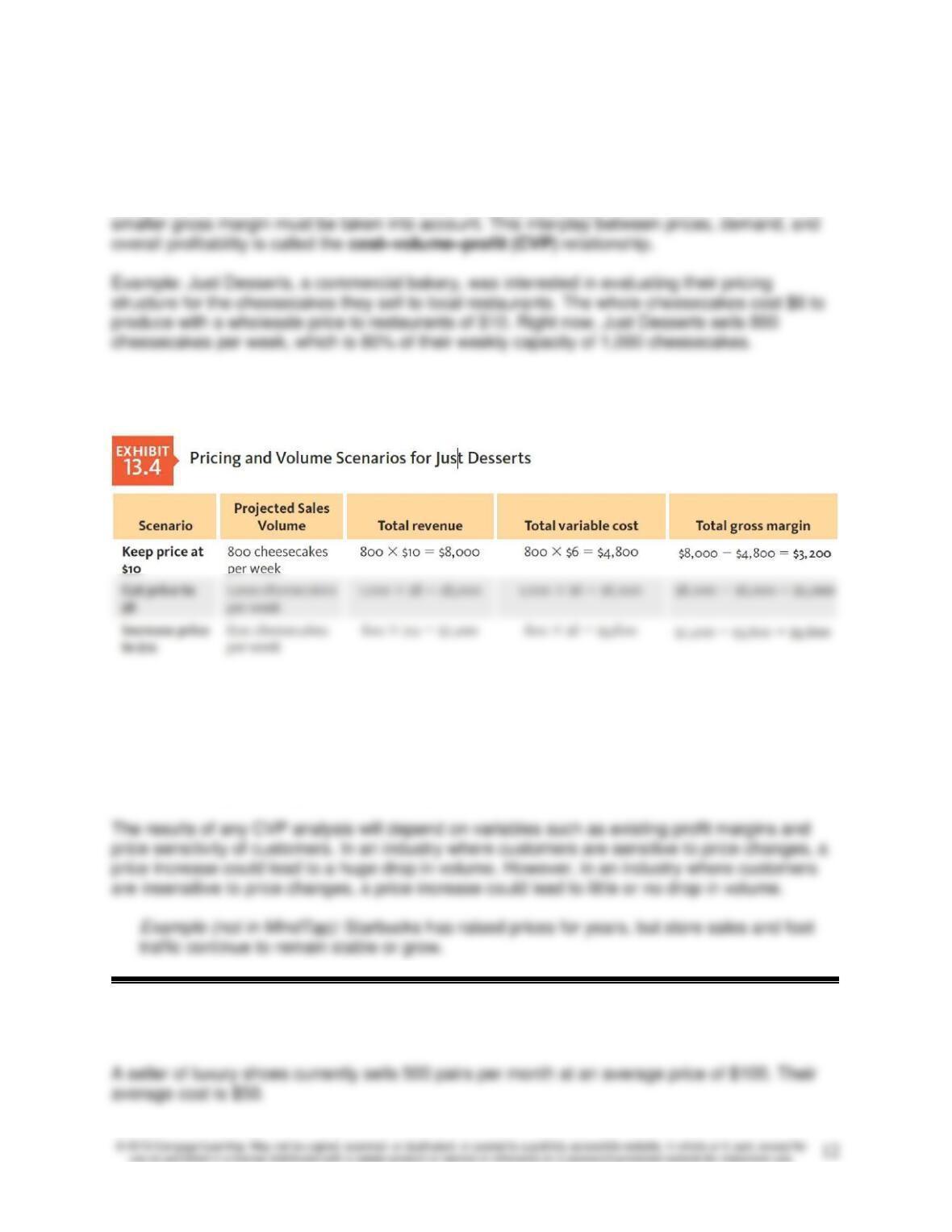
PRESENTATION VISUAL: MindTap Exhibit 13.4 showing the Just Desserts analysis of
pricing options
Note: Carefully review each of the scenarios in the chart to ensure that students understand.
Just Desserts was surprised by the results of their analysis. Where previously they considered
cutting prices to increase volume, they now realize it would be more profitable to increase prices
and invest the additional gross margin into another sales rep. By doing so, they hope to
maintain the higher margins while boosting sales back up to 800 cheesecakes per week.
Classroom activity: Divide students into groups and give them the following story problem.
Allow the groups to find a solution together, then discuss as a whole class. Groups of no more
than four are recommended.
Chapter 13: Pricing Concepts
They are considering two scenarios to increase total gross margins.
Scenario #1: Increase prices to an average of $120. They believe volume will drop by 10% if
they do this.
Key Takeaway: The CVP relationship affects pricing strategy by showing marketers how
changes in price and sales volume will affect overall profitability.
Estimated time: 15–20 minutes
13-7 Applying Breakeven Analysis
Note: This section of the chapter is intended to provide practical application of the pricing
concepts presented in this chapter, in particular margins and breakeven. If you have already
facilitated all of the classroom activities and discussion questions, this section of the chapter
might not need further coverage in class. However, it does provide further reinforcement, which
might solidify student understanding of these formulas. Only the highlights from the scenario
presented in MindTap are noted here.
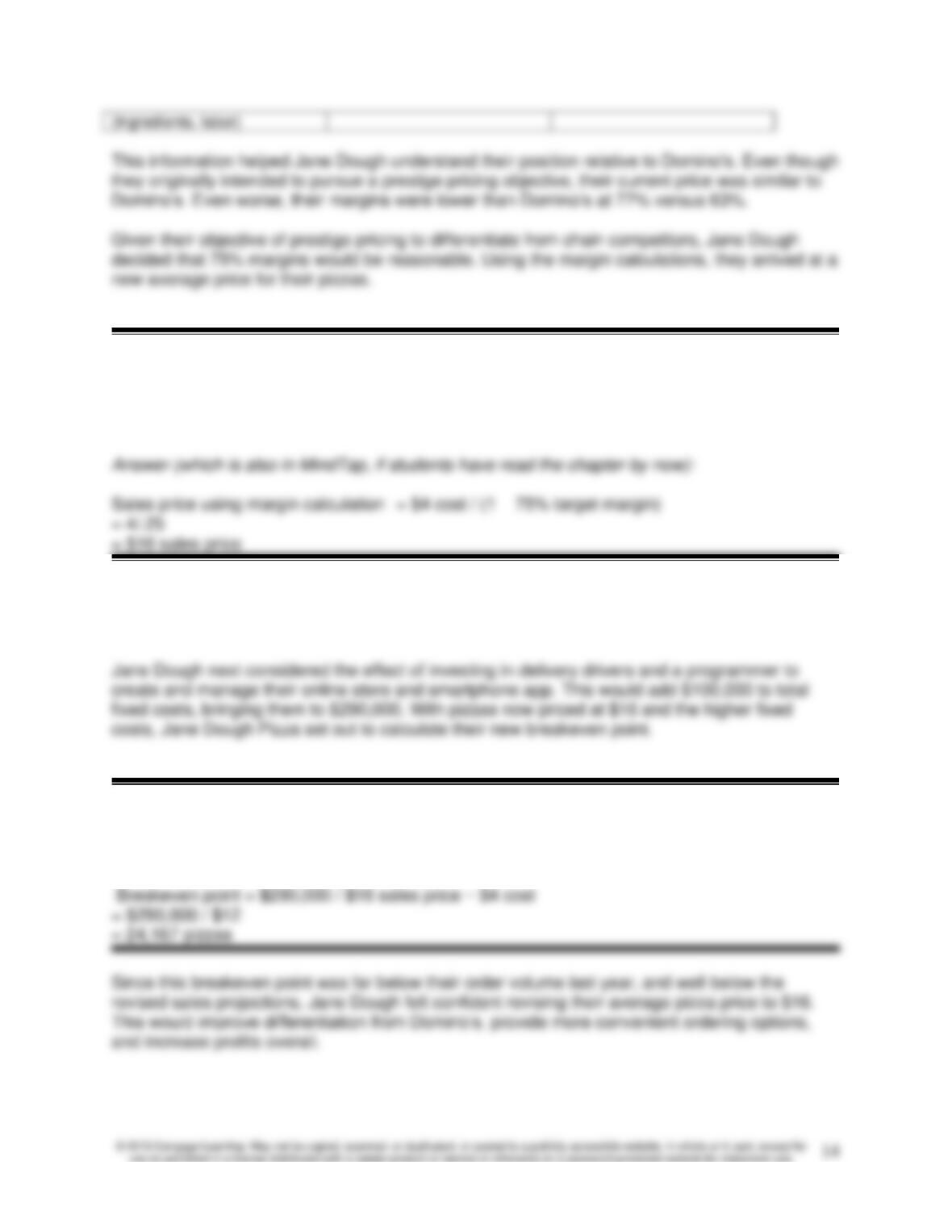
PRESENTATION VISUAL: MindTap Exhibit 13.5 showing the financial information for
Jane Dough and Domino’s
Description
Jane Dough
Local Domino’s Franchise
Annual pizza sales
$480,000
$814,000
Total fixed costs (rent,
equipment, fixtures, utilities,
insurance, salaries)
$190,000
$125,000
Chapter 13: Pricing Concepts
Discussion question: Based on this margin target, work with a partner to calculate the new
price of their pizza.
Note: You can turn this into a quiz game by having the student pairs write the answer in large
numbers on a piece of paper. Then all groups can hold up the answer at the same time.
While this price would cut sales volumes a little, Jane Dough’s target audience tends to be less
price sensitive to a quality product like this. A CVP analysis showed that even with the slight
drop in volume, overall gross profits would increase.
Discussion question: Based on this new fixed cost total, work with a partner to calculate the
new breakeven point.
Answer (which is also in MindTap, if students have read the chapter by now):

Chapter 13: Pricing Concepts
Key Takeaway: Profitable pricing requires an integrated understanding of the
foundations of pricing, pricing objectives, the ability to calculate margins, and the ability
to calculate breakeven points.
Estimated time: 10–20 minutes
Chapter 13: Pricing Concepts
LEARN IT TODAY . . . USE IT TOMORROW
VIGNETTE AND ACTIVITY
The opening vignette for Chapter 13 uses the pizza industry as a basis for talking about pricing
concepts.
The final learning objective of the chapter (LO 13.7) returns to the topic of pizza by introducing
Jane Dough Pizza, a hypothetical independent restaurant competing with Domino’s. This
Note: Answers to the chapter-ending activity can be discussed in class after the activity
due date.
Breakeven Analysis
Jane Dough Pizza now better understands how to use pricing to achieve their marketing
1. Jane Dough Pizza’s manager is now getting detailed costs for offering delivery service and
needs to properly categorize them as either fixed or variable costs:
i. Boxes for pizzas being delivered (Answer: Variable Cost)
ii. Mileage reimbursement for delivery drivers (Answer: Variable Cost)
iii. Monthly salary of programmer in charge of e-commerce website (Answer:
Fixed Cost)
iv. Cost of raw materials for pizzas that get delivered (Answer: Variable
Cost)
v. Monthly building lease (Answer: Fixed Cost)
2. After a late-night brainstorming session with Pinnacle Consulting to review a number of
pricing and breakeven scenarios, the manager at Jane Dough’s was reviewing her notes and

Chapter 13: Pricing Concepts
Chapter 13: Pricing Concepts
ADDITIONAL HOMEWORK/CLASSROOM ACTIVITIES
Introduction to Pricing
Purpose: To underscore the wide range of real-world pricing approaches.
Background: Explaining pricing approaches can be somewhat dry, complicated by the real-
Relationship to Text: Pricing Objectives and the Marketing Mix
Estimated Class Time: About 15 minutes
Preparation/Materials: Bring to class (or borrow from a student) a wristwatch that looks fancy,
but is not from a well-known brand (such as Timex, Rolex, etc.).
Exercise*: At the beginning of class, pass the wristwatch around the room and ask each
student to write on a slip of paper the price that they would write on the price tag if they were
selling this watch in their store.
Questions for Reflection:
• Why do many marketers not use a strategic approach to pricing decisions?
• How does pricing relate to brand image? Why?
* Adapted from Lewellen, Bob, “The Wristwatch Approach to Pricing,” Great Ideas for Teaching
Marketing.
Pricing Objectives
Purpose: To understand the categories that help achieve pricing objectives.
Chapter 13: Pricing Concepts
Exercise: Give your students a list of products. Ask them to come up with a pricing strategy that
would use one or more of the categories used to understand pricing objectives.
• Breakfast cereal
Questions for Reflection:
• What knowledge about consumer behavior does one need to know while evolving
pricing strategies?
• Can customers be enticed into buying things they don’t want? How?
Ethics Exercises
You work for a major restaurant in your town. The manager is facing cost pressures from rising
Question: You know the restaurant advertises the quality of its ingredients in the local media.
The menu changes are not advertised, and it bothers you. What course of action would you
take?
Internet Exercise—Price Competition
Using a popular travel site, look up airfares for each of the following pairs of cities:
• Baltimore to Los Angeles
• Atlanta to Minneapolis
Chapter 13: Pricing Concepts
http://www.kayak.com
Note: Before attempting this exercise, students should visit the websites mentioned in the
Chapter 13: Pricing Concepts
KEY TERMS
Price: The amount of funds required to purchase a product.
Volume or sales objectives: Pricing practices aimed at achieving a particular sales volume or
market share.
Margin: The portion of sales revenue left over after paying product costs. Margin is also called
gross profit.
Variable costs: Costs that change with the level of production.
Fixed costs: Costs that remain stable at any production level within a certain range.
Breakeven analysis: The method for determining the amount of product that must be sold at a
given price to generate sufficient revenue to cover total costs—both fixed and variable.