Chapter 13: Pricing Concepts
CHAPTER SUMMARY AND LEARNING OBJECTIVES
LO 13.1 Describe the three foundations of pricing strategy.
Marketers consider three factors when establishing the price for a product: costs, potential
demand, and competition.
LO 13.2 Summarize the three pricing objectives.
LO 13.3 Calculate pricing using the markup and margin methods.
LO 13.4 Differentiate between fixed and variable costs.
A product’s total cost is composed of variable costs and fixed costs. Variable cost, such as raw
LO 13.5 Calculate breakeven point.
Breakeven analysis is the method for determining the amount of product that must be sold at a
given price to generate sufficient revenue to cover total costs—both fixed and variable.
LO 13.6 Describe how the cost–volume–profit relationship affects pricing strategy.
LO 13.7 Given cost information and pricing objectives, calculate the breakeven point for
a product.
To accurately assess the effect of pricing decisions on a company, a marketer must be able to
understand different pricing objectives, calculate prices using markup or margin goals,
categorize and calculate fixed and variable expenses, and determine breakeven points.
Chapter 13: Pricing Concepts
ACTIVATOR EXERCISE: Pricing a Disneyland Ticket
Purpose: To prompt discussion about price as an exchange of value.
Format: Small group discussion, then class discussion.
Time: 20–40 minutes, depending on format.
Activity: Divide students into small groups and ask them to discuss the following:
Disneyland charges a flat fee for admissions to the park. That fee gets you unlimited access to
rides, parades, and other attractions. There are a number of factors driving the price Disney
chooses.
Result: Students will have a wide range of opinions about what the “fair price” is, what changes
to the price or product would make it a better value, and how they measure Disney’s price
versus alternatives. These are all issues that drive pricing and relate directly to the three
Chapter 13: Pricing Concepts
LECTURE OUTLINE
13-1 Foundations of Pricing Strategy
In most economies, price refers to the amount of funds required to purchase a product. This
chapter discusses the process for determining a profitable but justifiable price. While there are a
number of factors to consider when building a pricing strategy, the three foundations are costs,
potential demand, and competition. This chapter and the next will build upon these three
concepts.
The Influence of Costs on Pricing Decisions
Marketers must calculate the costs associated with making their products and set a price that, at
a minimum, covers those costs.
While some companies might sell a product below the production costs for short-term
promotional purposes, this is not a sustainable strategy over the long term.
Potential Demand and Pricing Decisions
If costs represent the price floor, the price point at which no more customers are willing to buy
represents the price ceiling.
Competition and Pricing Decisions
Competition also affects a firm’s pricing strategy, perhaps even more than cost.
Chapter 13: Pricing Concepts
Classroom activity: For each of the following examples, ask all students to raise their hands
while you do a reverse auction. You’ll ask them how much they would pay for a particular
product or experience. You’ll start with a low price that presumably all students would be willing
to pay (since it will be below cost). Then go up in increments. Students will put their hands down
when you reach a price they would no longer be willing to pay. Eventually, only a few hands will
still be up.
What would you pay for an iPhone? (Start at $100 and go up in $100 increments.)
What would you pay for a pair of jeans? (Start at $10 and go up in $10 increments.)
First note: Students might ask, “how nice a pair of jeans?” or “how nice a car?” You can reply
that it would represent the ideal version of that product in their eyes—within existing limitations
of realism (i.e., the phone can’t offer tele-transportation, no matter how much you “bid”). They
also should bid based on their current financial capabilities.
Second note: After each reverse auction, have a brief discussion about why students chose the
way they did.
Key Takeaway: Pricing decisions are complex, but they are generally constrained by
three foundations: cost, potential demand, and competition.
Estimated time: 15–20 minutes
13-2 Pricing Objectives
While costs, potential demand, and competition are the foundations of pricing strategy, they
feed into more specific pricing objectives that align with a company’s overall goals.
Chapter 13: Pricing Concepts
Example: Alternatively, a company might seek to be perceived as the highest quality
producer of products in their category. As a result, they might utilize higher levels of
pricing to signal the prestige value of its product.
Discussion questions: What are some real-world examples of companies that fit the
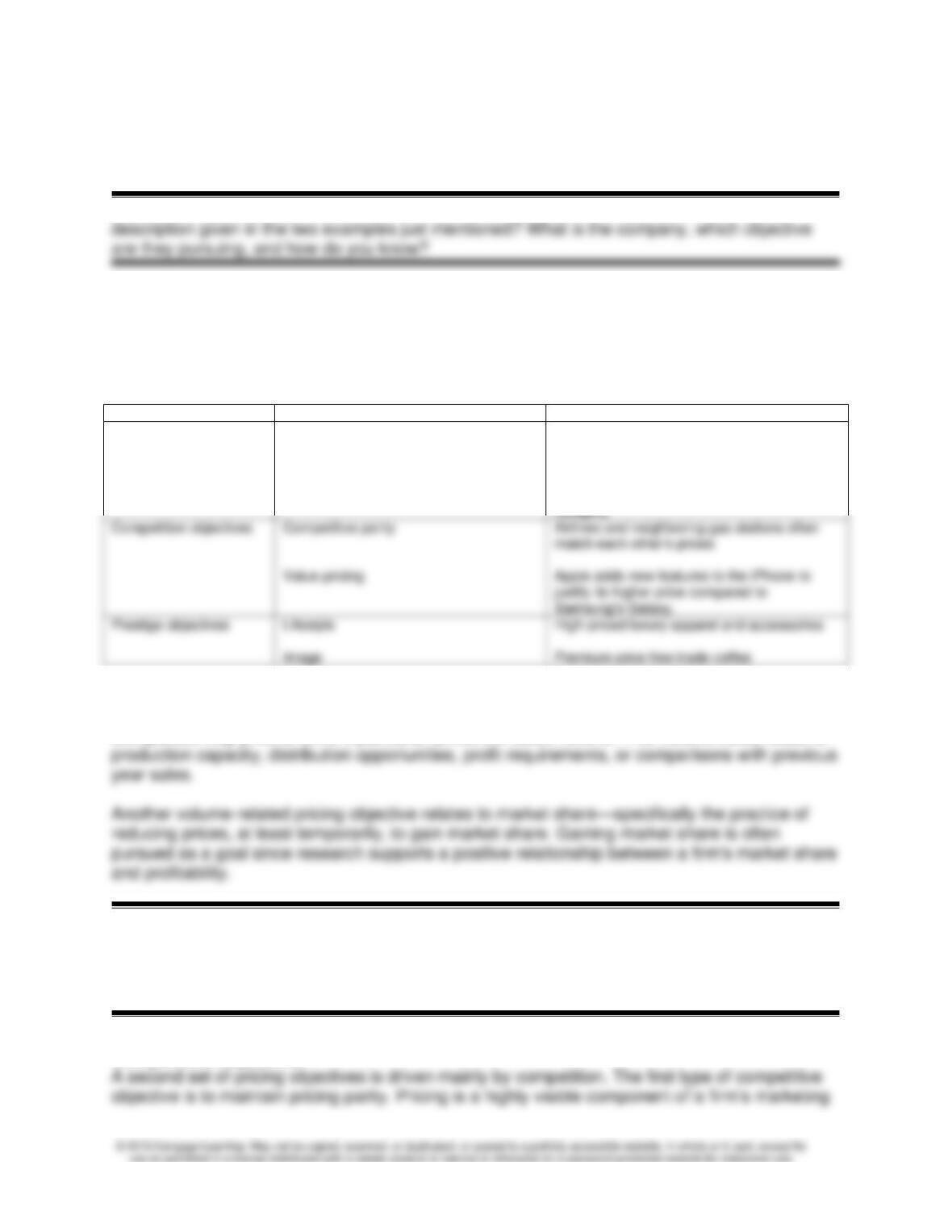
Pricing objectives vary from firm to firm, and can be classified into three major groups: volume
or sales, competition, and prestige.
PRESENTATION VISUAL: MindTap Exhibit 13.2 showing the three major pricing
objectives
Objective
Purpose
Example
Volume or sales
objectives
Sales maximization
Market share
A car manufacturer pricing to ensure they sell
through their production capacity for the year
Vita Coco temporarily cutting prices on
coconut water to gain market share in the
Competition objectives
Competitive parity
Airlines and neighboring gas stations often
Volume or Sales Objectives
Discussion question: What are some drawbacks of using price cuts alone to increase sales
volume and market share?
Follow-up question: What are examples of times you depended on “sale” prices and switched
products when they returned to regular pricing?
Competition Objectives
Chapter 13: Pricing Concepts
mix and an easy tool for obtaining a differential advantage over competitors. However, when
competitors continually undercut each other to gain that advantage, it can lead to a price war
that damages all companies involved. Many firms attempt to promote stable prices by meeting
competitors’ prices, but not drastically undercutting them.
Discussion questions: As mentioned in MindTap, the airline industry is an example of one
where companies try to maintain the status quo with competitors? What are a few other
examples? (Possible answers: gasoline, movie tickets, autos, etc.)
What are some other examples of companies that try to avoid pricing comparison by offering a
solid value? These aren’t luxury products, but ones that might be sold for a slightly higher price
than competitors because they have higher perceived value due to quality, selection, or another
factor of the marketing mix. (Answer will vary)
Prestige Objectives
Prestige pricing establishes a relatively high price to develop and maintain an image of quality
that price difference can be explained by higher costs for the producer.
Key Takeaway: The three basic pricing objectives drive more specific decisions about
pricing policy, but can also drive branding decisions as well.
Estimated time: 15–25 minutes
13-3 Calculating Markup and Margin
Once managers have established pricing objectives, they can turn their attention to pricing
calculations. Markup and margin are two straightforward methods for calculating sales prices.
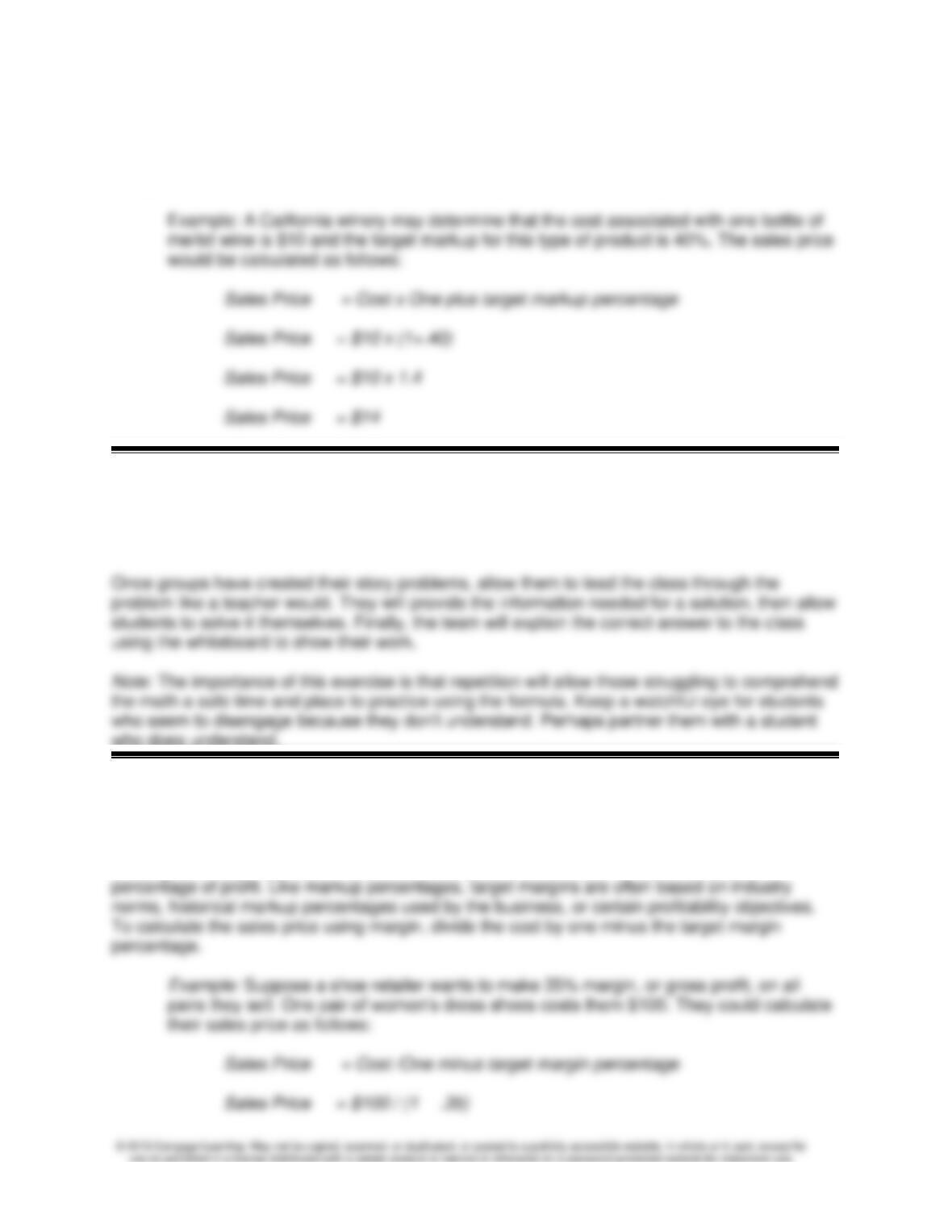
Cost-based pricing is using the product cost plus a target markup percentage to calculate the
sales price. Because the markup percentage is related to cost, this is called cost-based pricing.
Chapter 13: Pricing Concepts
The desired markup percentage is often based on industry norms, historical markup
percentages used by the business, or certain profitability objectives. To calculate the sales price
using markup, multiply the cost by one plus the target markup percentage.
Classroom activity: Divide students into groups and have them create their own markup story
problem. They should describe the business and specify what their markup target is (students
can choose this knowing that typical markups range anywhere from 50–200%, depending on
the product category). Finally, they should specify the manufacturing or wholesale cost of the
product they are selling.
who does understand.
Pricing Using Margin
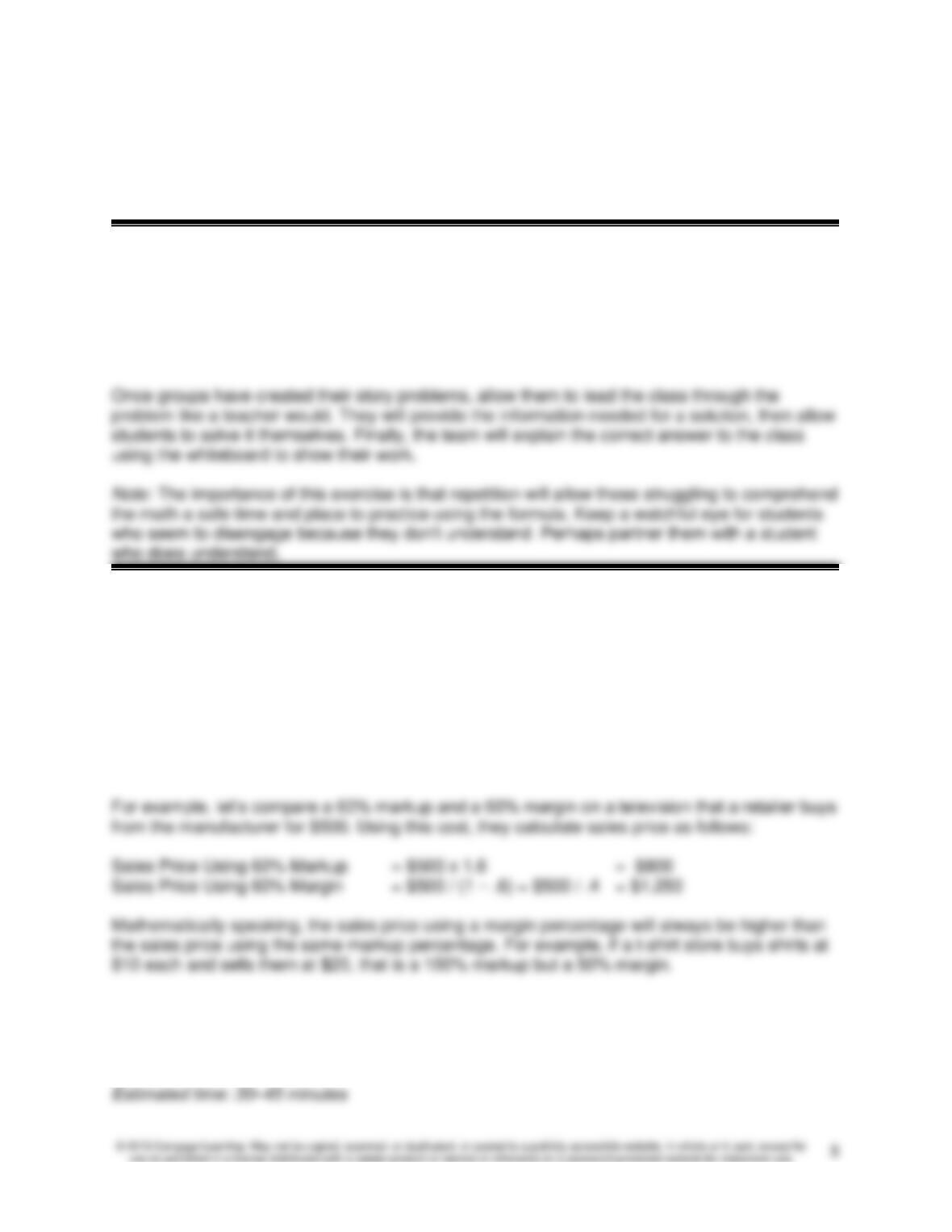
A second pricing method is margin, or gross margin percentage, which is the portion of sales
revenue left over after paying product costs. Margin is also called gross profit.
Utilizing the margin approach enables firms to price their products to realize a desired
Chapter 13: Pricing Concepts
Sales Price = $100 / .65
Sales Price = $153.80
Classroom activity: This is a repeat of the above exercise, but now students are utilizing the
margin formula instead of the markup formula.
Divide students into groups and have them create their own margin story problem. They should
describe the business and specify what their margin target is (students can choose this knowing
that typical margins range anywhere from 20% to 80%, depending on the product category).
Finally, they should specify the manufacturing or wholesale cost of the product they are selling.
Note: You can then repeat the above classroom activity; however, groups can create a story
problem based on either margin or markup. This requires the rest of the class to select the
correct formula before calculating the answer. This ensures they can differentiate between the
two types of calculations.
While some incorrectly use the terms markup and margin interchangeably, it’s clear they are
different and should not be confused. Markup is a percentage added to the cost of the product
and margin is a percentage of the sales price left over after paying for the cost of the product.
The markup percentage is anchored to the cost and the margin percentage is anchored to the
selling price.
Key Takeaway: Markup and margin are two straightforward methods for calculating sales
prices. While some use these terms interchangeably, they are different and should not be
confused.
Chapter 13: Pricing Concepts
13-4 Fixed and Variable Costs
A product’s total cost is composed of total variable costs and total fixed costs.
Variable costs, such as raw materials and labor costs, change with the level of production.
Fixed costs, such as lease payments, administrative staffing, and insurance costs, remain
stable at any production level within a certain range.
Discussion questions: For the following items, raise your hand if you believe this is a variable
cost. Raise your hand if you believe this is a fixed cost. Everyone must vote on one or the other.
Nike running a TV ad (Answer: Fixed cost)
The rubber used in a Nike show (Answer: Variable cost)
The utility bill at Nike headquarters (Answer: Fixed cost)
to understand the difference in order to accurately calculate breakeven point later in the chapter.
Key Takeaway: A product’s total cost is composed of total variable costs and total fixed
costs. Understanding the difference is required in order to calculate profitable pricing
and accurate breakeven points.
Estimated time: 10–15 minutes
13-5 Breakeven Analysis
Note: As breakeven can be a difficult topic for students, the below notes include all the text as it
Chapter 13: Pricing Concepts
Breakeven analysis is the method for determining the amount of product that must be sold at a
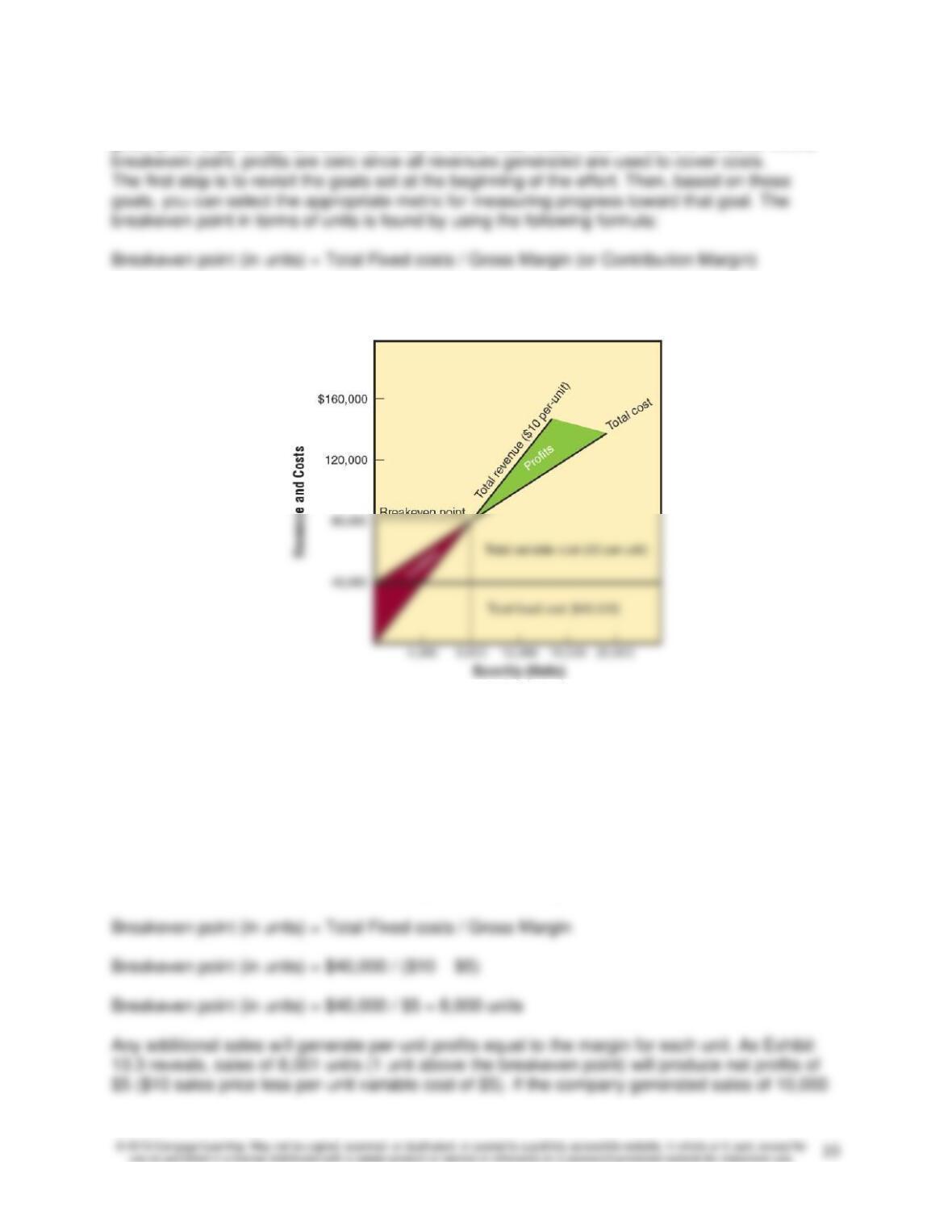
PRESENTATION VISUAL: MindTap Exhibit 13.3 showing a breakeven chart
Explaining the chart: Exhibit 13.3 graphically depicts the breakeven point. In this example, the
selling price is $10 and the variable cost is $5, providing a gross margin per unit of $5. This
gross margin is also called contribution margin, because that is how much a sale of each unit
“contributes” to covering fixed costs. In the chart, fixed costs of $40,000 are represented by the
horizontal line, which doesn’t change as the quantity produced goes up.
The total revenue curve begins at zero when no units are sold and no revenue is realized. As
units are sold, total revenue increases by the sales price of each unit sold.
The breakeven point is the point at which total revenue equals total cost. Returning to our
formula, we can calculate the breakeven point in this example as follows:
Chapter 13: Pricing Concepts
units, that would be 2,000 units beyond the breakeven point and its profit would be $10,000
(2,000 units × $5 contribution margin per unit).
A company can reduce breakeven point by reducing their fixed costs, reducing their variable
costs, or increasing sales price (which increases contribution margin per unit).
Breakeven is a cost-based model and does not directly address the crucial question of whether
consumers will purchase the product at the specified price. While a marketer can utilize a
number of price assumptions when calculating breakeven points, further research is needed to
validate whether those pricing and sales volume assumptions are realistic.
Classroom activity: Divide students into small groups and ask them to create two breakeven
story problems. Have them describe the business and the product it sells, the selling price, the
unit cost, and the company’s overall fixed costs. They should report the fixed costs as a lump
sum for now.
Key Takeaway: To calculate breakeven, divide fixed costs by your gross margin (or
contribution margin or gross profit) per unit.
Estimated time: 20–40 minutes