such as powdered brass or ceramic composite is cheaper than shipping finished
products because these materials can be packaged in perfectly cubic containers,
making transportation much more efficient and cost-effective. Raw materials are
used only when they are needed, so virtually no waste is produced during
printing.
h. Digitalizing Supply Chain Integrity: As supply chains globalize, they get longer
and more complex, yet end users of goods and services expect that the final
output of the chain will be perfect, and there is little tolerance for error. Thus,
6. Marketing Channels and Channel Intermediaries (LO 13-6, PPT Slide 41, DISC:
Distribution)
a. A marketing channel can be viewed as a canal or pipeline through which
products, their ownership, communication, financing and payment, and
b. Channel members are all parties in the marketing channel who negotiate with
one another, buy and sell products, and facilitate the change of ownership
c. How Marketing Channels Work: Marketing channels attain economies of scale
through specialization and division of labor by aiding upstream producers (who
valuable because they help create one or more of the four kinds of utility for
consumers.
• Form utility – the elements of the composition and appearance of a product
that make it desirable
Example: General Mills, the manufacturer, provides form utility when it
transforms oats grown on a distant farm into the Cheerios we eat for
breakfast. Time utility and place utility are created by channel members,
d. Functions and Activities of Channel Intermediaries: Intermediaries in a
channel negotiate, facilitate transfer of ownership, and physically move products
from the producer toward the final consumer. The most prominent difference
separating intermediaries is whether they “take title” to the product, which
means they actually own the merchandise and control the terms of the sale.
Examples of intermediaries include:
warehouses, and later ship them
• Agents and brokers – wholesaling intermediaries who do not take title to a
• Retailers – channel intermediaries that sell mainly to consumers; simplify
e. Product characteristics, buyer considerations, and market conditions determine
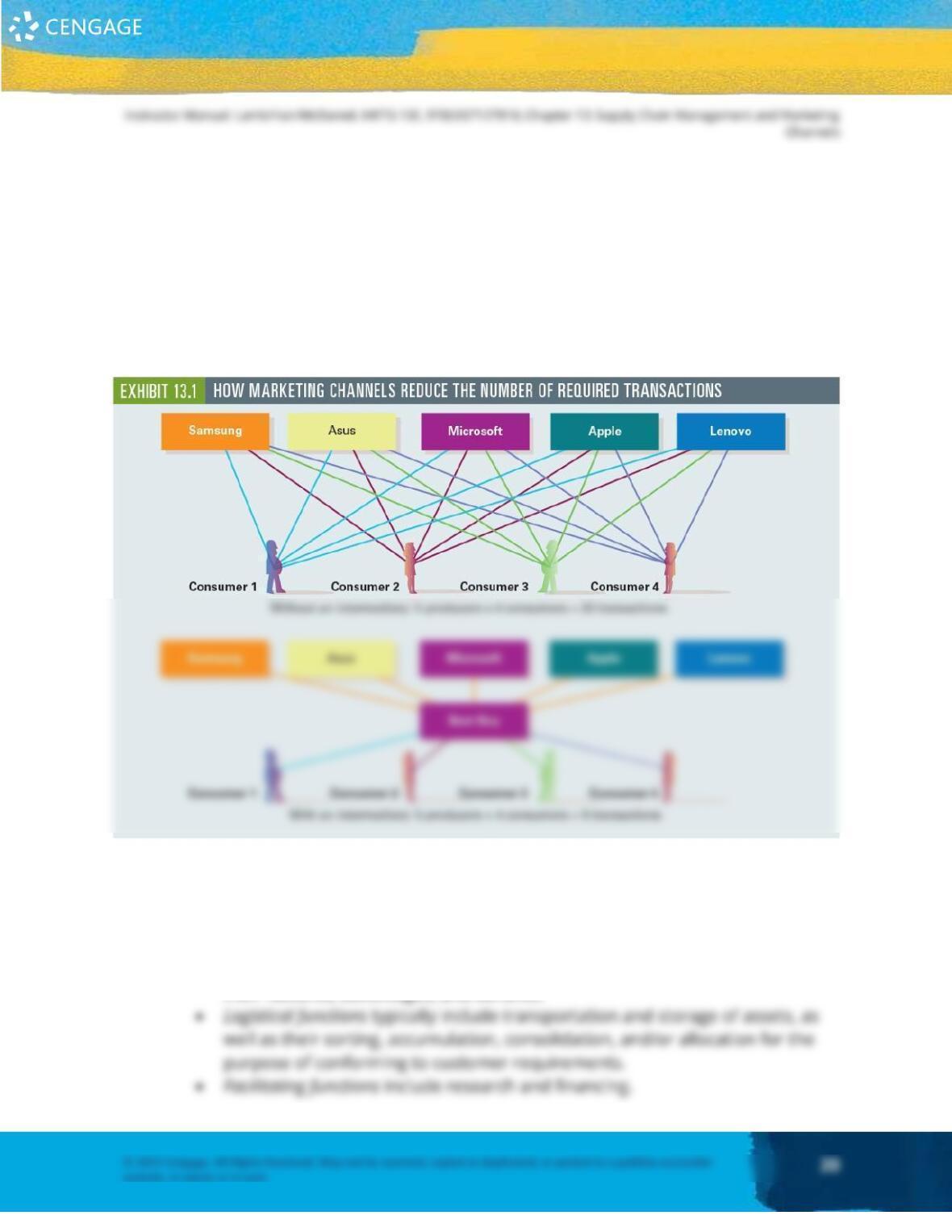
Samsung, Asus, Microsoft, Apple, and Lenovo would each have to make four
contacts to reach the four consumers who are in the target market, for a total of
20 transactions. But when Best Buy acts as an intermediary between the
producer and consumers, each producer needs to make only one contact,
reducing the number to nine transactions. This benefit to customers occurs
whether the retailer operates in a physical store location or online.
PRESENTATION VISUAL: Exhibit 13.1 How Marketing Channels Reduce the Number of
Required Transactions
f. Channel Functions Performed by Intermediaries: Intermediaries in marketing
channels perform three essential functions that enable goods to flow between
producer and consumer:
• Transactional functions involve contacting and communicating with
prospective buyers to make them aware of existing products and to explain
7. Channel Structures (LO 13-7, PPT Slide 49, DISC: Distribution)
a. A product can take any of several possible routes to reach the final consumer.
Marketers and consumers each search for the most efficient channel among
many available alternatives. Constructing channels for a consumer convenience
good such as candy differs from doing so for a specialty good like a designer
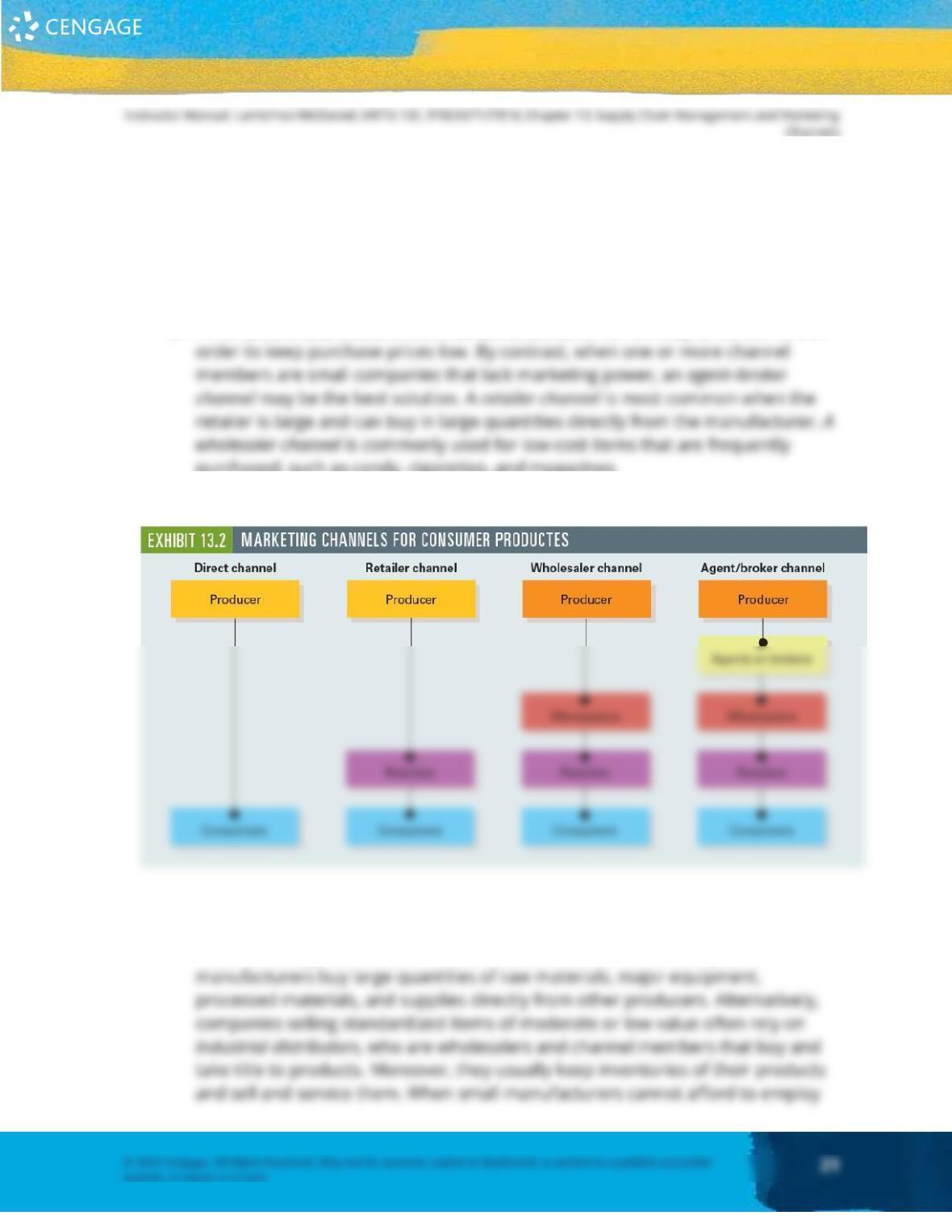
handbag. Exhibit 13.2 illustrates four ways manufacturers can route products to
consumers.
b. When possible, producers use a direct channel to sell directly to consumers in
purchased, such as candy, cigarettes, and magazines.
PRESENTATION VISUAL: Exhibit 13.2 Marketing Channels for Consumer Products
c. Channels for Business and Industrial Products: As Exhibit 13.3 illustrates, five
channel structures are common in business and industrial markets. Direct
channels are typical in business and industrial markets. For example,
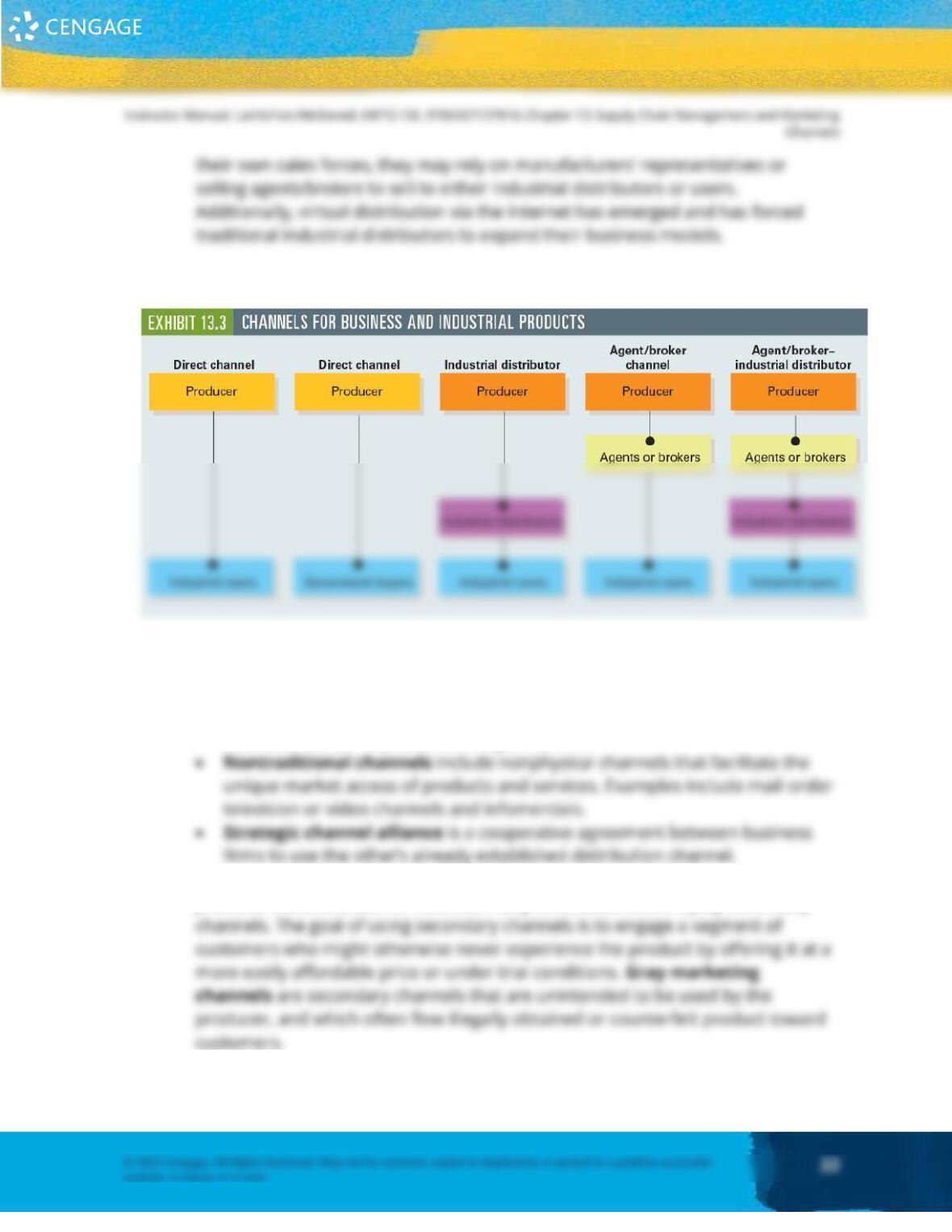
PRESENTATION VISUAL: Exhibit 13.3 Channels for Business and Industrial Products
d. Alternative Channel Arrangements: A producer may use multiple distribution
strategies, nontraditional channels, and strategic channel alliances.
• Dual or multiple distribution involves the use of two or more channels to
distribute the same product to target markets.
e. In addition to using primary traditional and nontraditional channels to flow
f. Products can be moved downstream in the direction of the customers as well as
upstream in the direction of the producer. Reverse channels enable customers
g. Digital Channels: Digital channels are electronic pathways, such as computers,
smartphones, tablets, or video game consoles, that allow products and related
information to flow from producer to consumer. Digital channels allow either
push- or pull-based information and product flows—sometimes simultaneously.
h. Factors Affecting Channel Choice
• Market Factors: When looking at how market factors affect distribution
channel choices, managers should answer the following questions:
o Who are the potential customers?
• Product Factors: Complex, customized, and expensive products tend to
benefit from shorter and more direct marketing channels. Perishable
• Producer Factors: In general, producers with large financial, managerial, and
Example: Manufacturers of upscale products, such as Gucci (handbags) and
Godiva (chocolates), may sell their wares only in expensive stores in order to
maintain an image of exclusivity. Many producers have opted to risk their
image, however, and test sales in discount channels. For example, Levi
• Timing Factors: Timing decisions such as when to release a product in
different channels, how long to keep a product on the market, and when to
launch new products are critical. Companies that offer products in multiple
channels (such as online and in-store) must decide whether to launch in both
channels simultaneously or to launch them sequentially—and if sequentially,
in what order. Companies must also decide when to withdraw a product
from a particular channel if that channel is no longer providing the expected
value.
i. Levels of Distribution Intensity: Organizations have three options for intensity
of distribution:
• Intensive distribution – a form of distribution aimed at having a product
available in every outlet where target customers might want to buy it
8. Omnichannel versus Multichannel Marketing (LO 13-8, PPT Slide 63, DISC:
Distribution)
a. Because of varying preferences through different stages of the shopping cycle,
many companies have begun to employ a multichannel marketing strategy,
whereby customers are offered information, goods, services, and/or support
b. The multichannel design creates redundancy and complexity in the firm’s
distribution system, including the construction of multiple, parallel supply
chains, each with its own inventory, processes, distribution systems, and
[return to top]
Discussion Questions
You can assign these questions several ways: in a discussion forum in your LMS; as whole-
class discussions in person; or as a partner or group activity in class. A generic discussion
rubric is provided in the Appendix.
1. Discussion: (LO 13-1, PPT Slide 5) Duration 5-10 minutes.
a. Guide students through a comparison of “push” versus “pull” in the marketplace
with the following questions:
• How does the old mass production era compare with today’s customer–
driven marketplace?
customize themselves?
• What are the benefits to the consumers in this new era? To producers?
i. Students’ answers will vary. In the mass production era,
manufacturers produced standardized products that were “pushed”
2. Discussion: (LO 13-2, PPT Slides 16–17) Duration 5-10 minutes.
a. Lead students on a discussion of supply chain integration:
• How does supply chain integration result in better customer-related
outcomes?
• What are the possible outcomes, both positive and negative, of a firm’s
failure to embrace one or more type of supply chain integration?
• How does supply chain management and integration relate to marketing?
i. Students’ answers will vary, but they should reflect an understanding
of supply chain integration. Supply chain integration occurs when
When individual companies act in isolation rather than working
together, some expected outcomes are higher prices to consumers
and higher expenses to firms, and inefficient distribution channels,
transportation systems, and manufacturing processes.
3. Discussion: (LO 13-4, PPT Slides 31-32) Duration 5-10 minutes.
a. Challenge students to think of ways a manufacturer or other organization could
make its supply chain more environmentally friendly.
• What could a firm do in terms of packaging and shipping to be more eco-
friendly?
• How do you think today’s volume of package delivery is affecting traffic
patterns and pollution levels? Is there any way to improve that?
i. Students’ answers will vary. Their answers should reflect the need for
[return to top]
Channels
Additional Activities and Assignments
A generic discussion and writing rubric is provided in the Appendix.
1. Activator Exercise: Getting from Here to There (LO 13-3)
Purpose: To encourage students to start thinking about supply chains, logistics, and
marketing.
Classroom Format: Group work, then presentations (Estimated Time: 25-35 minutes)
1. Divide students into groups of three or four, and ask them to imagine they’re in
charge of order fulfillment for a major online retailer, such as Amazon.com,
Zappos.com, or something similar. Have them try to envision what the order
fulfillment process looks like without doing any online research. Then ask them
to answer the following questions:
• Where and how is the inventory warehoused?
• What is the best means of shipping and delivery?
2. Ask each group to share their findings in a group presentation to the class.
Online Format: Written discussion board posts with responses (Estimated Time: 25-35
minutes)
1. Use the following prompt to facilitate this activity in a discussion board:
try to envision what the order fulfillment process looks like, then write a post
answering the following questions:
• Where and how is the inventory warehoused?
• What happens if there’s an error in the inventory tracking system and one of
the items is not available because it has run out?
• What is the best means of shipping and delivery?
2. Have students respond to their classmates’ posts, ask questions, and offer
constructive feedback on their proposed order fulfillment plans.
Additional questions for a classroom or discussion board: What additional
information do you need to fully understand the process? How many people are
involved in shipping even one package? How would you handle returns?
Result: Many groups will miss key factors and considerations, which is the point of the
2. Class activity (LO 13-3)
Format: This activity can be facilitated in both a classroom and an online environment.
Instructions for how to facilitate the activity in the classroom and online are provided
below. (Estimated time: 20-30 minutes)
Classroom Format: Divide students into small groups of three or four. Instruct each
group to go online and find a video documenting the supply chain or logistics operation
Online Format: If you’re delivering your course online, you can have students do this
on their own and have them post their answers in a discussion board. Use the following
prompt to facilitate this activity:
Go online and find a video documenting the supply chain or logistics operation in a major
3. Class activity (LO 13-5)
Channels
Format: This activity can be facilitated in both a classroom and an online environment.
Instructions for how to facilitate the activity in the classroom and online are provided
below. (Estimated time: 15–25 minutes)
Classroom Format: Divide students into small groups of three or four. Instruct each
group to select one of the modern forms of technology mentioned in this section—AI,
Online Format: If you’re delivering your course online, you can have students do this
on their own and have them post their answers in a discussion board. Use the following
prompt to facilitate this activity:
Select one of the modern forms of technology mentioned in this section—AI, machine
4. Class activity (LO 13-6)
Format: This activity can be facilitated in both a classroom and an online environment.
Instructions for how to facilitate the activity in the classroom and online are provided
below. (Estimated time: 10-15 minutes)
Classroom Format: Divide students into small groups of three or four. Have them
Online Format: If you’re delivering your course online, you can have students do this
on their own and have them post their answers in a discussion board. Use the following
prompt to facilitate this activity:
5. Class activity (LO 13-7)
Channels
Format: This activity can be facilitated in both a classroom and an online environment.
Instructions for how to facilitate the activity in the classroom and online are provided
below. (Estimated time: 15-25 minutes)
Classroom Format: Divide students into pairs or groups of three. Instruct each group
Invite several groups to share their findings.
Online Format: If you’re delivering your course online, you can have students do this
on their own and have them post their answers in a discussion board. Use the following
prompt to facilitate this activity:
Identify one real-world example of each of the following: intensive distribution, selective
6. Additional activity: Changing Channels (LO 13-7)
Purpose: To help students more fully understand the impact of choosing the right
distribution channels.
Background: Many factors—specifically, the market, product, producer, and timing
Relationship to Text: Channel Structures
Estimated Class Time: About 20–30 minutes
Format: This activity can be facilitated in both a classroom and an online environment.
Instructions for how to facilitate the activity in the classroom and online are provided
below.
Classroom Format: Divide students into groups of three or four. Then direct them to
follow these steps:
1. Choose a common consumer or business product to work with, such as a line of
clothing, food item, or electronic device.
Online Format: Discussion board with posted response from each student (Estimated
Time: 15-20 minutes)
1. Use the following prompt to facilitate this activity in a discussion board:
Choose a common consumer or business product to work with, such as a line of
2. Have students respond to their classmates’ posts, ask questions, and offer
constructive feedback on their channel marketing plans.
Additional Questions for Reflection:
• Which steps of the marketing research process differ based on the target audience?
• Does product category affect the marketing research process? If so, how?
7. Online Research Activity (LO 13-6)
A supply chain is the network of companies that manage the flow of products, services,
and information from the initial suppliers (the point of origin) to the ultimate customer
(the point of consumption). Many companies outsource certain functions of the supply
chain to a third-party logistics company (3PL). Since supply chain management is a
critical component in a company’s marketing strategy, it’s important to work with 3PL
providers that have high performance standards. There are many logistics
management resources available online. Some provide lists of vetted 3PL providers.
Additional Resources
External Videos or Playlist
Appendix
Generic Rubrics
Providing students with rubrics helps them understand expectations and components of
assignments. Rubrics help students become more aware of their learning process and
progress, and they improve students’ work through timely and detailed feedback.
Customize these rubrics as you wish. The writing rubric indicates 40 points and the
discussion rubric indicates 30 points.
Standard Writing Rubric
Criteria
Meets Requirements
Needs Improvement
Incomplete
Content
The assignment clearly and
comprehensively
addresses all questions in
the assignment.
15 points
The assignment partially
addresses some or all
questions in the
assignment.
8 points
The assignment does not
address the questions in
the assignment.
0 points
7 points
0 points
Research
The assignment is based
upon appropriate and
adequate academic
literature, including peer
reviewed journals and
other scholarly work.
5 points
The assignment is based
upon adequate academic
literature but does not
include peer reviewed
journals and other
scholarly work.
3 points
The assignment is not
based upon appropriate
and adequate academic
literature and does not
include peer reviewed
journals and other
scholarly work.
0 points
Research
The assignment follows the
required citation
guidelines.
5 points
3 points
0 points
The assignment follows
some of the required
citation guidelines.
The assignment does not
follow the required citation
guidelines.
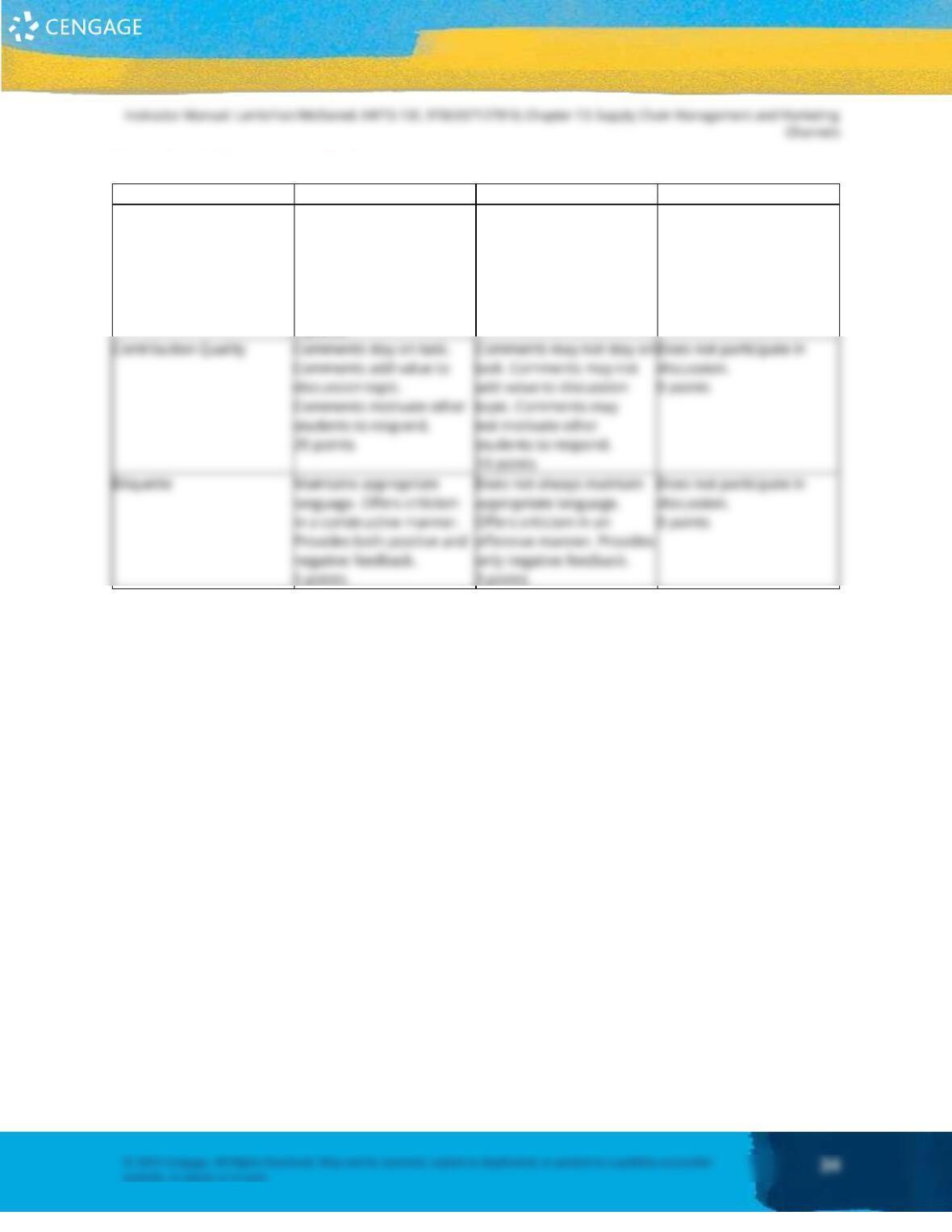
Standard Discussion Rubric
Criteria
Meets Requirements
Needs Improvement
Incomplete
Participation
Submits or participates in
discussion by the posted
deadlines. Follows all
assignment. instructions
for initial post and
responses.
Does not participate or
submit discussion by the
posted deadlines. Does not
follow instructions for
initial post and responses.
3 points
Does not participate in
discussion.
0 points