13-1
Chapter 13
LOGISTICS AND CHANNEL MANAGEMENT
Teaching Notes
This chapter covers the topic of logistics and how logistic management relates to channel
management. It has a number of key terms and definitions contained within that make up
Chapter Objectives
Logistics, the synonymous term of physical distribution, involves planning,
implementing, and controlling the physical flow of materials from the point of origin to
the point of the consumer at a profit. The role of logistics is to get the right amount of
product to the right places in the right time.
No matter how well designed and/or well implemented, over time channel members’
changing needs are sure to create shortcomings. Careful monitoring of the system should
help spot such deficiencies before they become areas of channel conflict.
Learning objectives
1) Be familiar with the definition of logistics, or physical distribution.
2) Have an awareness of the recent supply chain management emphasis of logistics.
Logistics and Channel Management
13-2
Chapter Topics
1) The Role of Logistics
Chapter Outline
Key Terms and Definitions
▪ Logistics or physical distribution (PD): Planning, implementing, and controlling the
Table 13.1 provides an overview of the key distinctions.
Whether one chooses to use the term physical distribution, logistics, or supply chain
management, the underlying principle emphasized throughout this text is the building of
strong cooperation among channel members through effective interorganizational
management.
The Role of Logistics
The movement of the right amount of the right products to the right place at the right time
is the essence of the role of logistics in the marketing channel.
Key Term and Definition
▪ Third-party logistics providers: These firms specialize in performing most or all of
Marketing Channels 8e
13-3
Logistics Systems, Costs, and Components
Key Term and Definition
▪ Systems concept: The various factors involved in the logistical process and the
Key Term and Definition
▪ Total cost approach: Addresses all of the costs of logistics together and seeks to
minimize the total cost.
A) Transportation
Transportation is the most fundamental and obviously necessary component of any
logistics system. Transportation is also often the component accounting for the highest
B) Materials Handling
This encompasses the range of activities and equipment involved in the placement and
movement of products in storage areas. Issues that must be addressed when designing
Key Term and Definition
▪ Cross docking: Sometimes referred to as flow-through distribution, it is where
merchandise is immediately moved across the receiving dock to other trucks for
immediate delivery to the stores.
In short, products are moved straight from shipping to receiving.

Logistics and Channel Management
13-4
C) Order Processing
Order processing is often a key component of logistics, and developing an efficient order
Key Term and Definition
▪ Order cycle time: The length of time between when an order is placed and when it is
finally received by the customer.
D) Inventory Control
Inventory control refers to the firm’s attempt to hold the lowest level of inventory that
will still enable it to meet customer demand.
A trade-off must be made between these two costs to find the optimum levels for both.
Key Term and Definition
▪ Economic order quantity (EOQ): Occurs at the point at which total costs (inventory
E) Warehousing
The warehousing component of a logistics system is concerned with the holding of
products until they are ready to be sold. Warehousing can be one of the more complex
Marketing Channels 8e
13-5
F) Packaging
Packaging and the costs associated with the packaging of products (consumer package
and case design) can affect the other components of the system and vice versa.
The Output of the Logistics System: Customer Service and Competitive
Advantage
Key Term and Definition
▪ Service Standards: “The attempt to define and enumerate services and to measure
performance against these standards.”
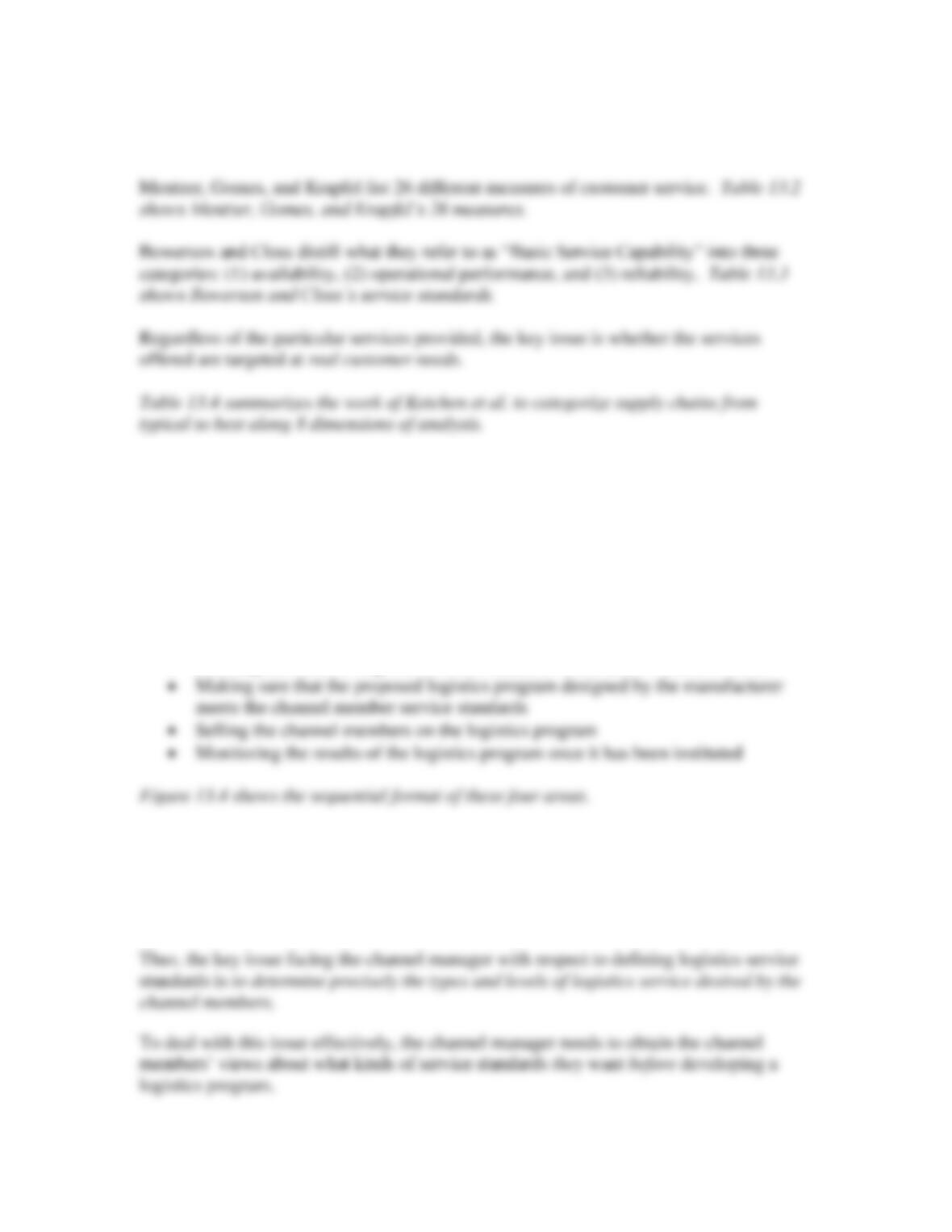
Heskett, Galskowsky, and Ivie, for example, stressed the following nine categories of
logistics service standards:
1. Time from order receipt to order shipment
2. Order size and assortment constraints
Logistics and Channel Management
13-6
The third standard – percentage of items out of stock or “stockouts” – is almost always
set in terms of percent of items ordered that cannot be filled from inventory.
Four Key Areas of Interface between Logistics and Channel Management
Channel management and logistics management go together hand in hand to provide
effective and efficient distribution. The meshing of channel management and logistics
management requires good coordination.
This especially applies to four major areas of interface between channel management and
logistics management.
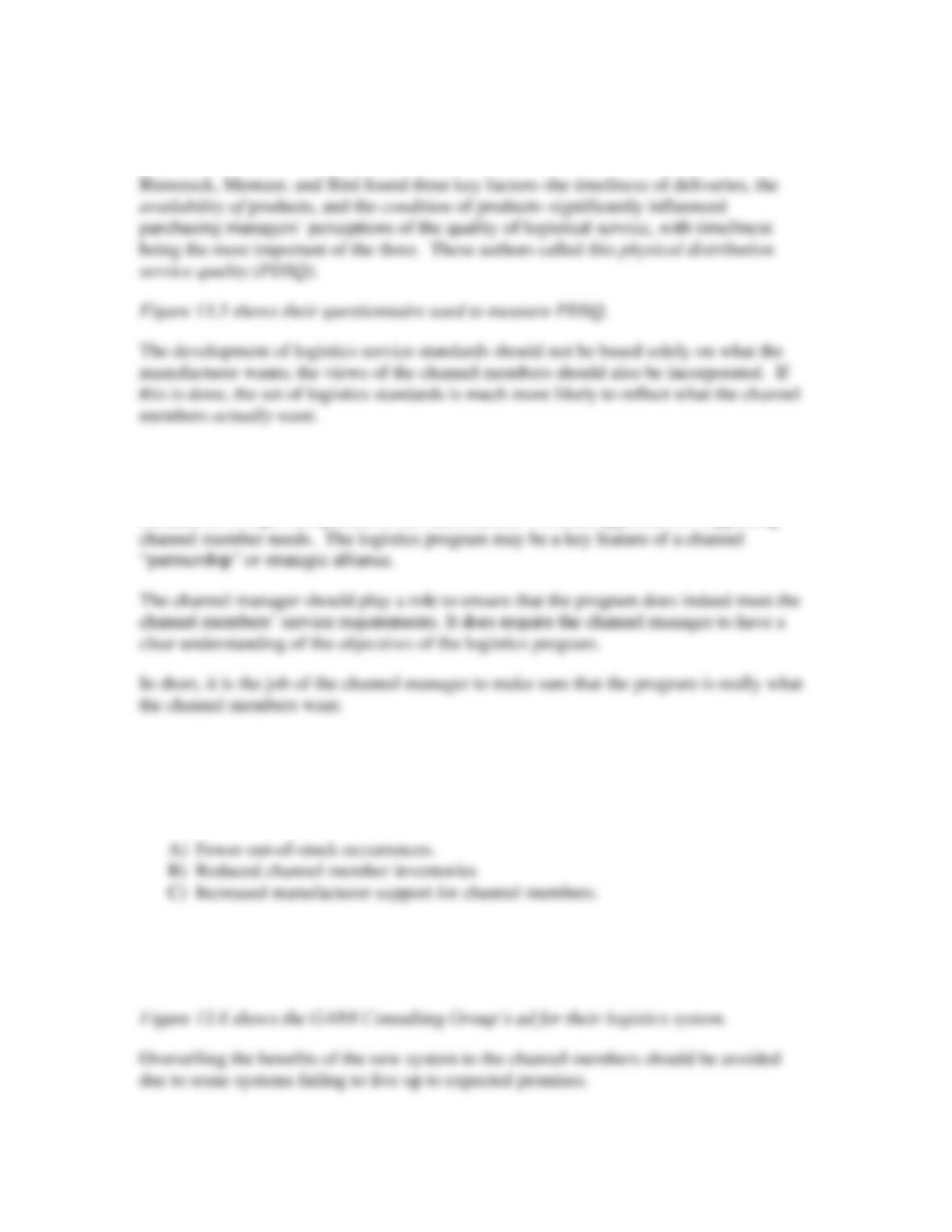
• Defining the kinds of logistics service standards that channel members want
A) Defining Logistics Service Standards
In general, the higher the service standards the manufacturer offers the higher the costs.
It is usually not possible to completely escape the trade-off of higher costs for higher
service standards.
Marketing Channels 8e
13-7
However, fewer than 20 percent of manufacturer’s make a systematic attempt to find out
the service standard needs of their customers.
B) Evaluating the Logistics Program
A logistics program may be offered to channel members as a separate entity or may be
included as a major component of the manufacturer’s overall approach for supporting
C) Selling the Channel Members on the Logistics Program
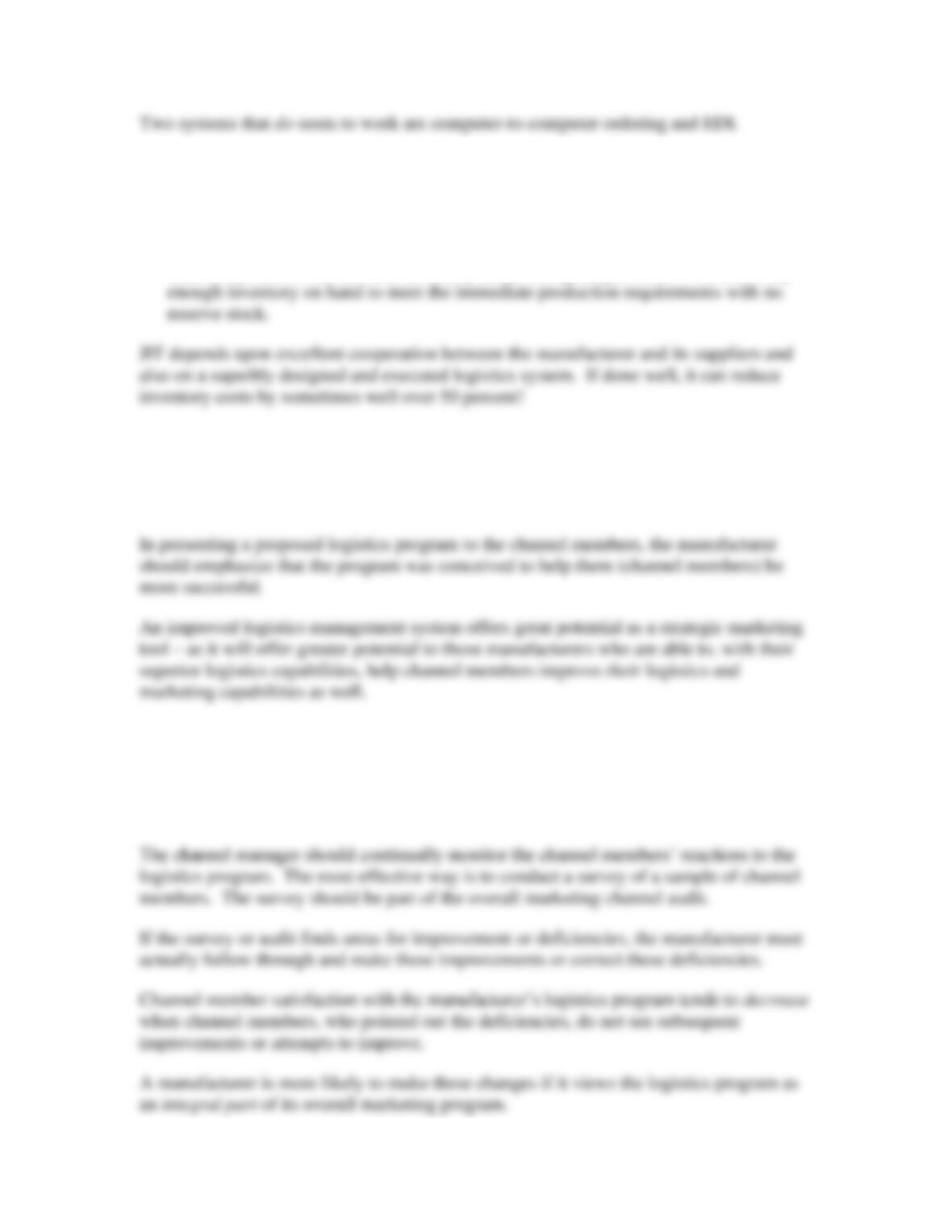
Stewart suggests several types of appeals to help sell the logistics program to channel
members. Manufacturers should emphasize that a new logistics program can foster:
A) Fewer out-of-stock occurrences.
1) Minimizing Out-Of-Stock Occurrences
By minimizing out-of-stock occurrences through an improved logistics program, sales
lost by the channel members will be reduced.
Logistics and Channel Management
13-8
2) Reducing Channel Member Inventory Requirements
A well-designed and responsive logistics program can mean shortened channel member
order cycles, which means that they can carry less inventory.
Key Term and Definition
▪ Kanban system or Just in Time Inventory (JIT): The principle of JIT is to have only
3) Strengthening the Manufacturer–Channel Member Relationship
A carefully designed logistics program aimed at improving service to the channel
members can serve as one of the most tangible signs of the manufacturer’s concern and
commitment to the channel members’ success.
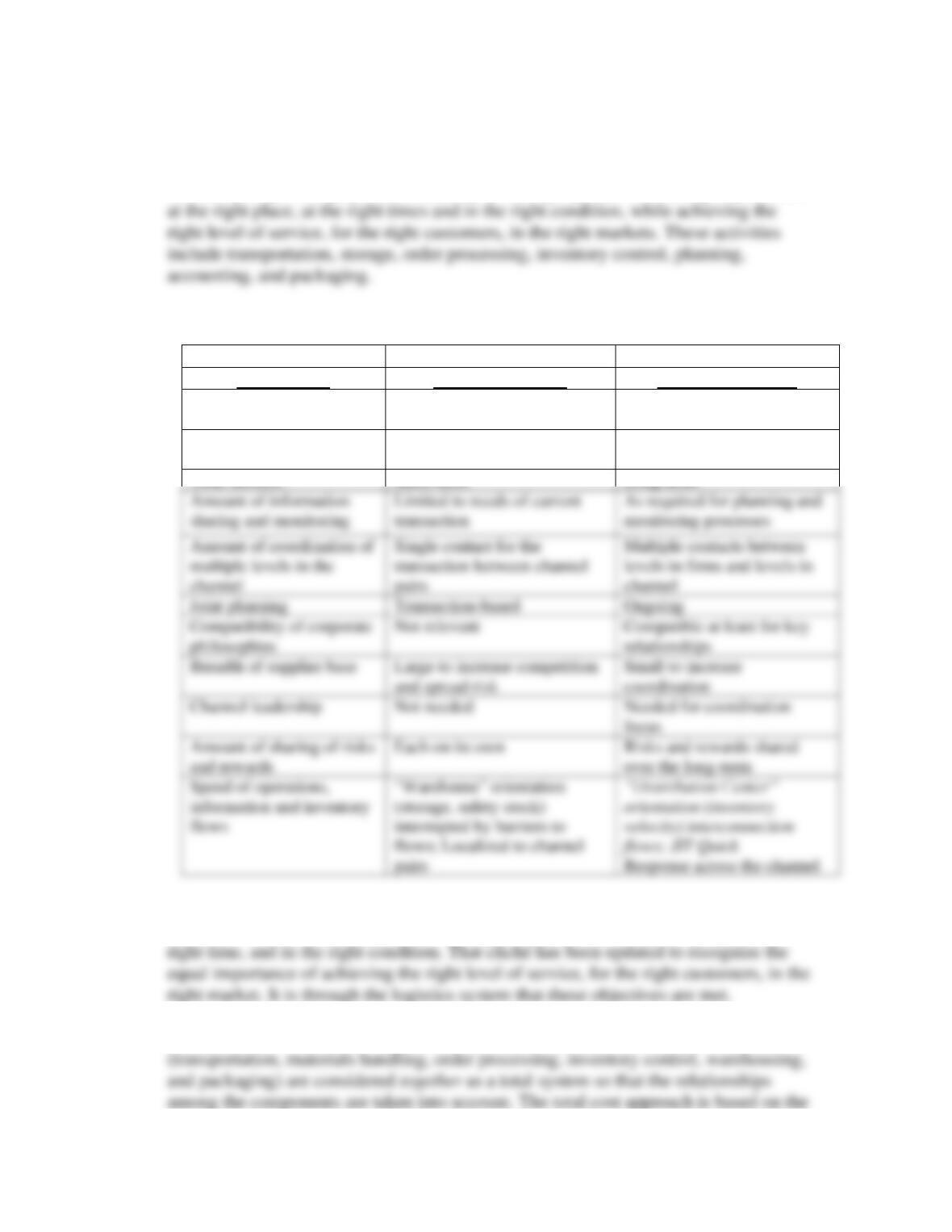
D) Monitoring the Logistics System
Logistics systems must be continuously monitored, both in terms of how successful they
are in performing for the manufacturer and, just as important, how well they are meeting
channel member needs.
Marketing Channels 8e
13-9
Answers to Review Questions
1. Logistics involves a number of activities that must be coordinated and performed
efficiently to provide physical availability of the right products in the right quantities,
2. The answer to this question is presented in Table 13.1. It is briefly summarized here:
APPROACH
ELEMENT
TRADITIONAL
SUPPLY CHAIN
Inventory management
approach
Independent efforts
Joint reduction in channel
inventories
Total cost approach
Minimize firm costs
Channel-wide cost
efficiencies
Time horizon
Short-term
Long-term
multiple levels in the
channel
transaction between channel
pairs
levels in firms and levels in
channel
Joint planning
Transaction-based
Ongoing
philosophies
relationships
Breadth of supplier base
Large to increase competition
and spread risk
Small to increase
coordination
Channel leadership
Not needed
Needed for coordination
focus
Amount of sharing of risks
and rewards
Each on its own
Risks and rewards shared
over the long-term
pairs
Response across the channel
3. Most simply, the role of logistics is to make products available to customers. The
cliché defines the role of logistics as having the right product, at the right place, at the
4. The systems concept means that all of the basic components of a logistics system
Logistics and Channel Management
13–10
5. Any logistics system consists of the following six basic components:
a. Transportation – deciding on the modes of transport to be used.
b. Materials handling – the range of activities and equipment involved in the
6. The key issue in measuring the output of a logistics system is whether the system
provides the kind and level of service that customers want. It is through careful
7. Channel management is concerned with the overall design and administration of
distribution channels and involves planning and management of all of the major
channel flows (product, negotiation, ownership, information, and promotion),
8. Channel management and logistics management are linked closely. The four major
areas of interface are:
Marketing Channels 8e
13–11
▪ Selling the channel members on the logistics program: To secure their
9. The level of cooperation the manufacturer receives from its channel members is
dependent upon many factors. One of these factors is the quality of the
manufacturer’s logistics program. If the logistics program does not meet the channel
10. The channel manager’s role in designing the manufacturer’s logistics program should
11. The benefits of a proposed logistics program may not be apparent to the channel
members. Hence, it may be necessary to sell them on its benefits. Several of the
12. Computer–to-computer ordering systems and EDI can indeed enhance the efficiency
of ordering procedures dramatically. On the other hand, the technology alone of such
systems should not be viewed as a substitute for developing effective channel
13. Just-in-Time (JIT) or kanban systems transfer products from supplier to user in a
Logistics and Channel Management
13–12
and inventory systems are “batch–push” and deliver inventory when it is ready rather
than when it is needed.
The objective of JIT systems is to reduce inventory and, in fact, sometimes are
14. There has been an unfortunate tendency to oversell the benefits of new logistics
systems-as though they could work miracles. This tends to build up unrealistic
expectations for new logistics programs on the part of the channel members. If, when
Commentaries on Issues for Discussion
1. Ketchen et al. provide an excellent framework with which students can respond to
this question. The instructor can direct students to interpret this question by
considering Barnes & Noble’s (B & N) situation in terms of the eight supply chain
Marketing Channels 8e
13–13
2. This issue is an opportunity to trace a change in market behavior (where the market
buys) through a channel design decision (inclusion of small independent retailers and
boutiques) to the logistical system accommodation of the needs of these new channel
3. The spectacular improvement in order cycle time described in this issue illustrates
how logistics can be the keystone of improved customer service. Jaguar launched a
rapid replenishment system, cut order cycle time dramatically, and doubtless pleased
4. The purpose of this issue is to show the systems concept and total-cost approach to
logistics as they might emerge in a typical business situation.
Concerning the particular situation, Menedez might very well have been too hasty in
Logistics and Channel Management
13–14
5. The battle to control inventory costs is ongoing and vital to overall cost containment.
Two of the most significant elements of inventory costs are transportation and
warehousing. What Farouk Systems is attempting to do is manage the quality of its
production by centralizing all production in a single location. From an operational
perspective this make sense but it puts additional strain on the logistics system that is
6. No, cross docking is not so simple – only the concept is simple. Its implementation is
difficult for several reasons. First, it requires almost perfect timing so that as soon as
merchandise is unloaded on one side of the dock other carriers are standing by
Marketing Channels 8e
7. Should the firm use its own carriers or common carriers is the issue presented here
with Walmart. Transportation is also quite often the component accounting for the
highest percentage of the total cost of logistics. So, controlling or, better yet, cutting
transportation costs has become a top priority in the logistics industry. Indeed, in a
8. All the basic components of the logistic system are interrelated. Therefore, a firm
must take a total cost approach or develop a system concept for dealing with logistical
problems. The essence of logistics is to ensure that the right amount of the right
products go to the right place at the right time. In meeting these goals, logistical