Chapter 12: Developing and Managing Products
CHAPTER SUMMARY AND LEARNING OBJECTIVES
LO 12.1 Summarize the four strategies for new product development.
The most effective strategy for new product development depends on a firm’s current product
mix and market conditions. Companies may choose to develop new offerings through market
penetration, market development, product development, or product diversification.
LO 12.2 Describe the six steps in the product development process.
LO 12.3 Describe the five categories of purchasers based on relative time to adoption.
LO 12.4 Differentiate the four stages of the product lifecycle in terms of industry sales
and profits.
Like people, products progress through lifecycle stages: introductory, growth, maturity, and
decline. Each of these stages is associated with distinctive fluctuations in overall industry sales
and profits.
LO 12.5 Given an example of a product, identify marketing strategies for that product’s
stage of the product lifecycle.
LO 12.6 Distinguish product mix breadth from product line depth.
LO 12.7 Summarize methods commonly used for measuring and managing product
quality.
Product quality as a marketing strategy may be pursued for both tangible goods and intangible
services. Methods such as quality programs and benchmarking, and implementation of lean or
six sigma methods can help firms make objective, actionable quality assessments.
Chapter 12: Developing and Managing Products
ACTIVATOR EXERCISE: Developing New Products
Purpose: To help students understand the necessity of a structured development process.
Format: Group brainstorming, then presentations.
Time: 20–40 minutes, depending on format.
Activity: Divide students into groups and ask them to imagine they have been asked to develop
one of the following products for their company:
• A new all-natural carbonated beverage
After students have picked their product category, have them create a detailed description of
their actual product. What are its features? What does it look like? Why did they choose those
features?
After 10–15 minutes of preparation, ask each group to share their product and their
development plan with the class.
Possible discussion questions for class: How did you choose the features you chose? How
do you know there aren’t better ideas that haven’t been considered? How do you decide
whether the product can even make money? Have you considered the competition and what
they already offer? How can you minimize the risk of this launch?
Result: Students will likely realize they missed a number of steps in the development process—
Key takeaway: Developing a new product is often time-consuming, risky, and expensive.
Usually, firms must generate dozens of new product ideas to produce even one successful
product.
Chapter 12: Developing and Managing Products
LECTURE OUTLINE
12-1 Strategies for New Product Development
As markets evolve and consumer needs change, firms must add new items to continue to
prosper. Some new products may offer major technological breakthroughs. Other new products
simply extend existing product lines.
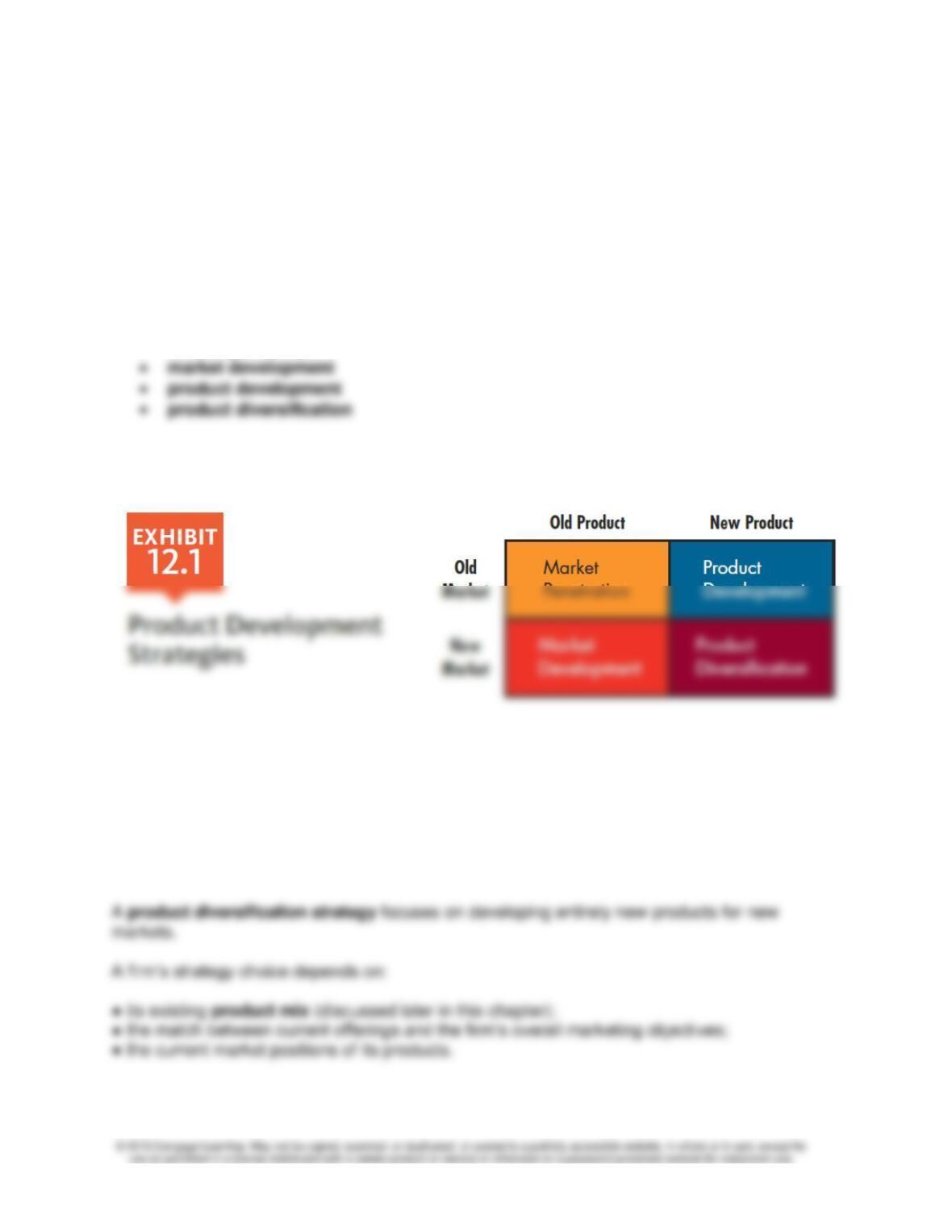
There are four alternative development strategies:
• market penetration
PRESENTATION VISUAL: MindTap Exhibit 12.1 showing the different development
strategies
A market penetration strategy seeks to increase sales of existing products in existing markets.
Firms may modify products, improve product quality, or promote new and different ways to use
products.
A market development strategy concentrates on finding new markets for existing products.
The strategy of product development refers to the introduction of new products into
established markets.
Chapter 12: Developing and Managing Products
Classroom activity: Divide students into groups and ask them to choose a company from the
electronics, apparel, or restaurant category.
Note: The key is for students to learn to differentiate between the different strategies.
Key Takeaway: As markets evolve and consumer needs change, firms must add new
items to continue to prosper. There are several strategies for doing so.
Estimated time: 15–25 minutes
12-2 The New Product Development Process
Developing a new product is often time-consuming, risky, and expensive. Usually, firms must
generate dozens of new product ideas to produce even one successful product. In fact, the
product planners to designers and engineers, then to manufacturers, and finally to marketers.
Idea Generation
New product development begins with ideas from many sources: suggestions from customers,
the sales force, research and development specialists, competing products, suppliers, retailers,
and independent inventors.
Discussion question: Going back to the activator exercise, as a class, how many ideas can we
come up with for a new all-natural carbonated beverage?
Screening
Screening separates ideas with commercial potential from those that cannot meet company
objectives. Some organizations maintain checklists of development standards in determining
Chapter 12: Developing and Managing Products
Discussion question: Going back to our list of beverages, what are some potential issues we
could run into with some of these ideas? Which ideas stand out as having the most potential?
Business Analysis
A product idea that survives the initial screening must then pass thorough business analysis.
This stage consists of assessing the new product’s potential market, growth rate, and likely
competitive strengths.
Development
Development refers to the conversion of a new product idea, like an anti-frizz product, into a
Test Marketing
After a company develops a prototype or early production version of the product, it may decide
to test market it to gauge consumer reactions and verify that the product will perform well in a
real-life environment.
Commercialization
Discussion question: Going back to the activator exercise, what parts of this process did your
group probably miss? How might that have created risk for your company?
12-3 New Product Adoption
When a new product is introduced, all consumers move through the adoption process, a series
1. Awareness: Individuals first learn of the new product, but they lack full information about it.
2. Interest: Potential buyers begin to seek information about it.
3. Evaluation: They consider the likely benefits of the product.
Chapter 12: Developing and Managing Products
Note: This aligns with the basic consumer decision process, but takes on special significance for
products new to the market. Not all people express interest or evaluate a new product at the
same rate—which brings us to the diffusion process.
The Diffusion Process
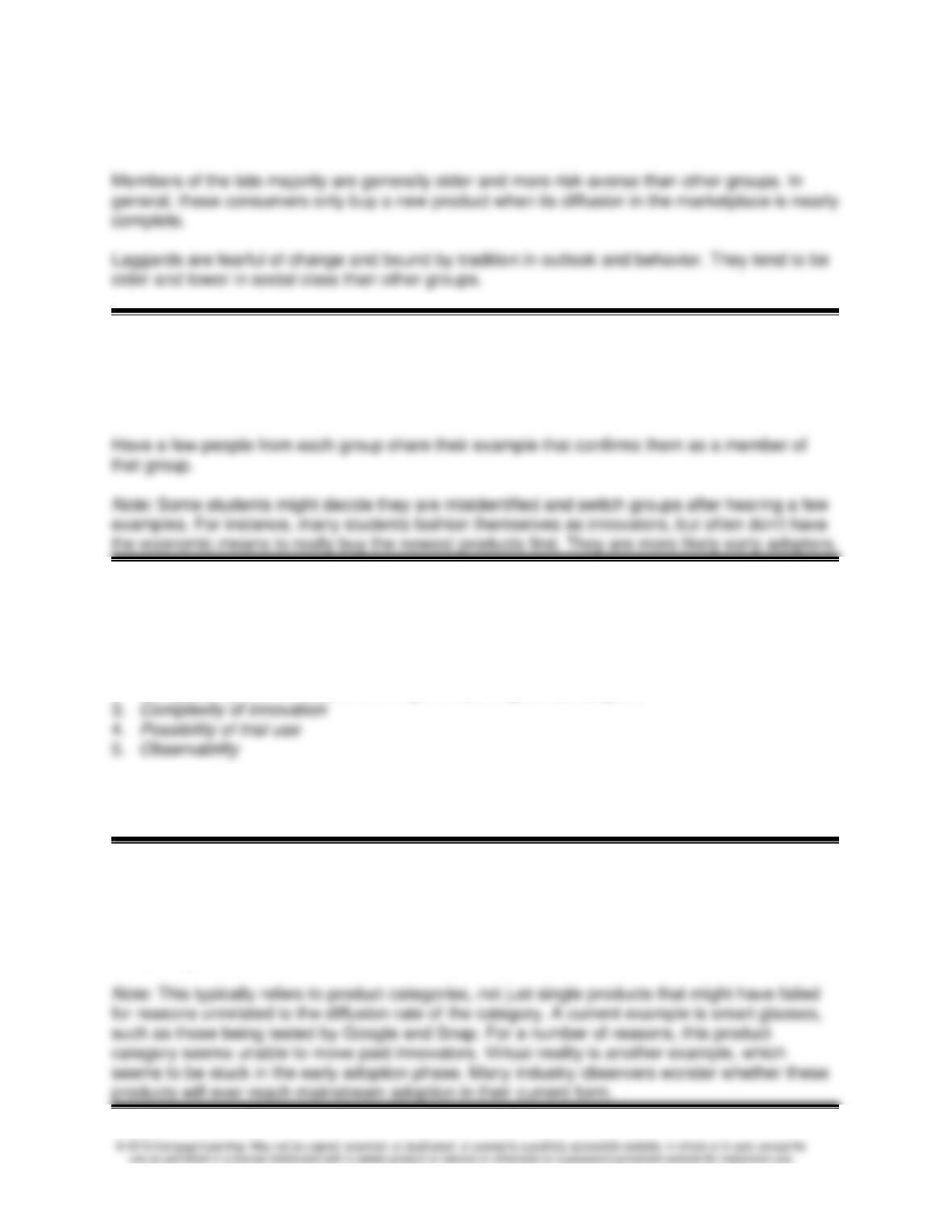
Not all consumers move through the adoption process at the same pace, though. The process
by which new products are accepted into the marketplace is called the diffusion process.
PRESENTATION VISUAL: MindTap Exhibit 12.3 showing the diffusion process
A few people, known as innovators, are first to make trial purchases; typically, they make up
the first 2.5 percent of buyers. Innovators tend to be the most highly educated of the consumer
groups. They are younger than the others and more willing to take risks on daring new
technologies like driverless cars.
Chapter 12: Developing and Managing Products
Members of the early majority typically wait to buy a new product until its benefits have been
clearly demonstrated in the marketplace.
Classroom activity: Divide students into small groups and ask them to discuss which category
they belong to. Ask them to provide an example confirming why.
Now, have students form groups by category. Ask the innovators to stand in one part of the
classroom, the early adopters in another, and so on.
Rates of Adoption Determinants
To some extent, marketers can influence the speed of the consumer adoption process by
manipulating five characteristics of a product innovation:
1. Relative advantage of new product over existing alternatives
2. Compatibility with the values and experiences of potential adopters
Generally, if a product has clear advantages, but is fairly low risk, low effort to adopt, it will move
through the diffusion process more quickly.
Discussion question: What are some products that went through (or are going through) the
diffusion process very quickly. We know from the text that Uber is one example, what is
another?
What are examples of products that were slow to go through the diffusion process or never
really caught on at all?
Chapter 12: Developing and Managing Products
Estimated time: 20–40 minutes (depending on whether you facilitate class activity)
12–4 The Product Lifecycle
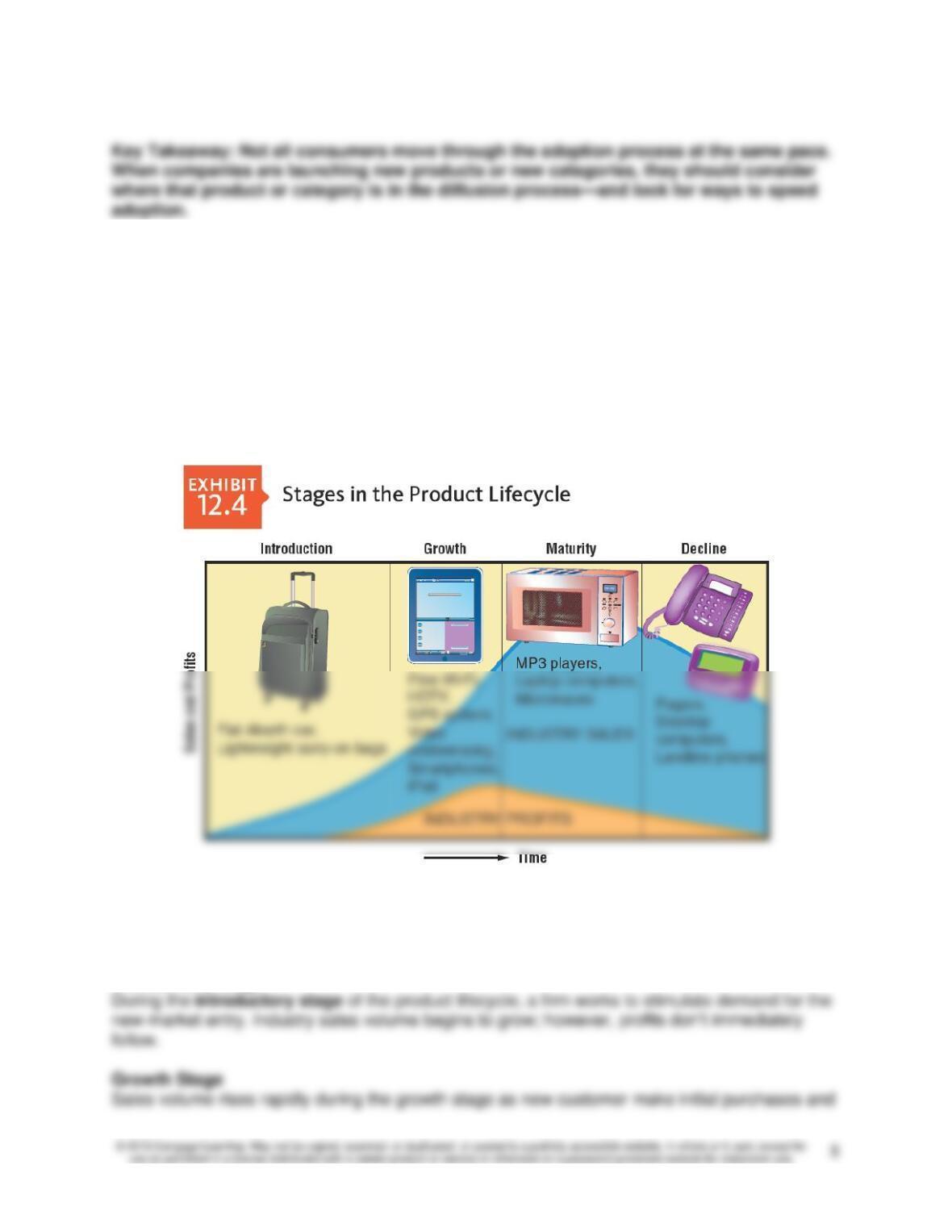
The product lifecycle is the progression of a product through four basic stages: introduction,
growth, maturity, and decline.
PRESENTATION VISUAL: MindTap Exhibit 12.4 showing product lifecycle
Important: The product lifecycle concept generally applies to products or product categories
within an industry, not to individual brands. There is no set schedule or time frame for a
particular stage of the lifecycle.
Introductory Stage
Chapter 12: Developing and Managing Products
early buyers repurchase the product. In the growth stage, firm starts to realize substantial
profits from its investment.
Maturity Stage
Sales of a product category continue to grow during the early part of the maturity stage, but
they eventually reach a plateau as the backlog of potential customers dwindles.
Classroom activity: Divide students into groups and for each stage ask them to think up five
product categories they believe are in that stage.
Ask groups to share their findings with the class.
Key Takeaway: The product lifecycle is the progression of a product through four basic
stages: introduction, growth, maturity, and decline.
Estimated time: 15–25 minutes
12-5 Marketing Across the Product Lifecycle
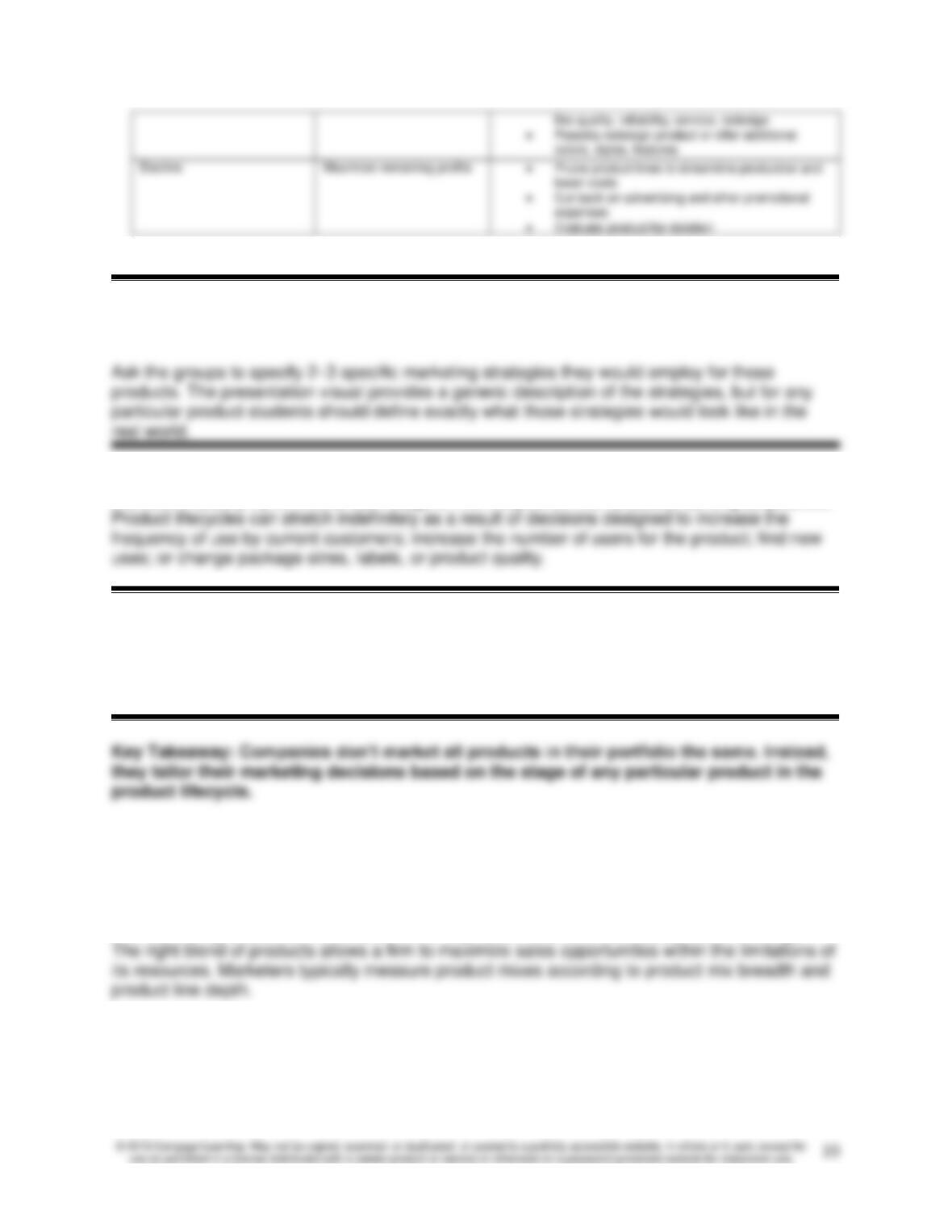
PRESENTATION VISUAL: MindTap Exhibit 12.5 showing different strategies for each
phase of the Product Lifecycle
Stage in product life cycle
Key marketing challenge
Key marketing approaches
Introductory
Need to stimulate initial
demand
• Communicate information to consumers about
product features through advertising
• Induce distribution channel members to carry the
• Use promotional tools and price discounts to
Chapter 12: Developing and Managing Products
Classroom activity: Divide students into small groups and randomly assign them two of the
products that were brainstormed in the previous class activity. Be sure to assign products from
different phases of the PLC.
Extending the Product Lifecycle
Marketers usually try to extend each stage of the lifecycle for their products as long as possible.
Discussion question: For any of the products we’ve discussed in this section—especially
those in the maturity and decline stage—what are some strategies you could employ to extend
the product lifecycle for that product or category? Be specific.
Note: Increasing frequency of use and finding new uses are usually the preferred options, but
ask students to explain exactly how they’d accomplish that.
Estimated time: 25–35 minutes
12-6 The Product Mix
A company’s product mix is its assortment of product lines and individual product offerings.
Product mix breadth refers to the number of different product lines the firm offers.
Example #1: Apple offers iPhones, iMacs, iPads, and a number of different product lines.
All of those lines together represent Apple’s product mix breadth.
Chapter 12: Developing and Managing Products
Product line depth refers to the number of variations in each product line. Variations may be in
size, flavor, color, or another relevant difference.
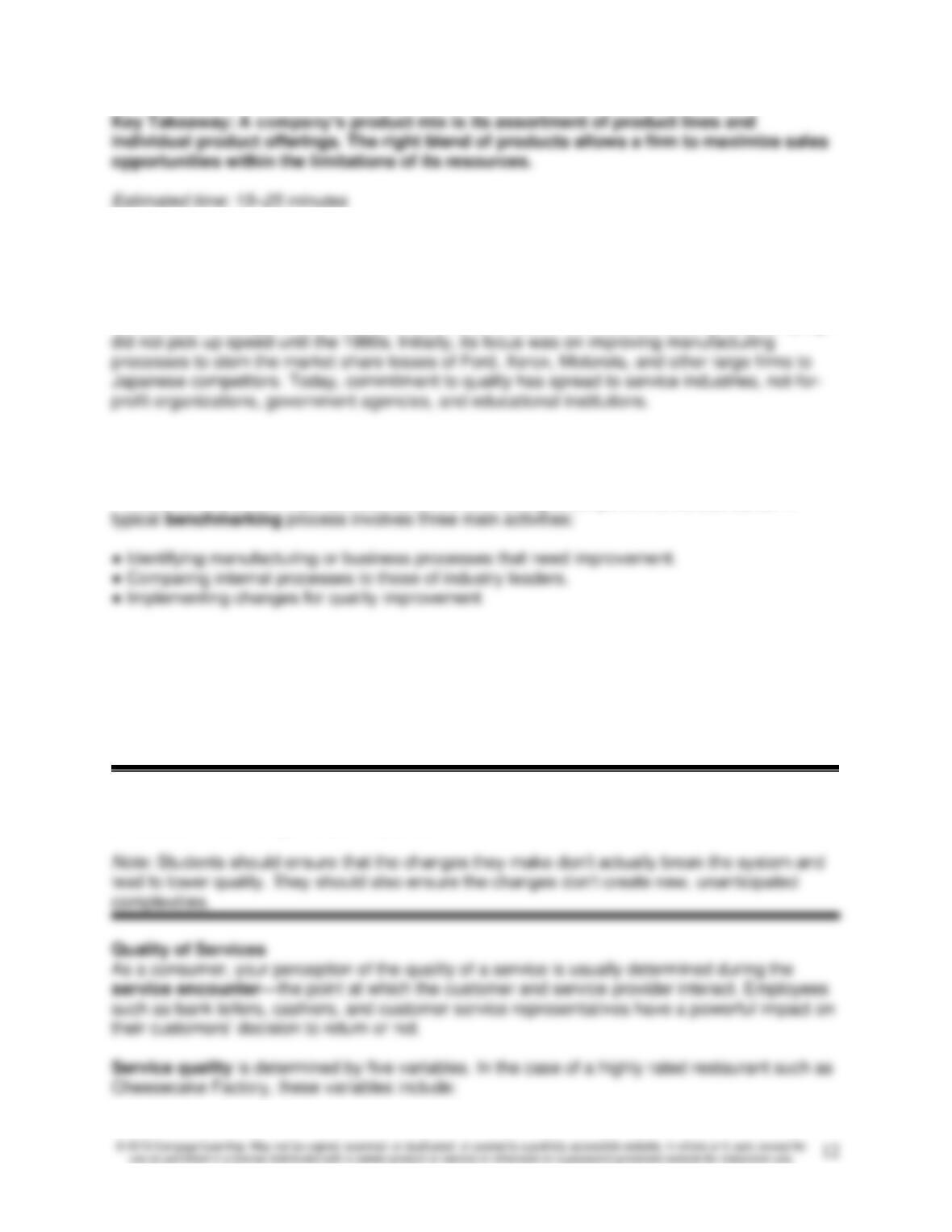
PRESENTATION VISUAL: MindTap Exhibit 12.6 showing breadth and depth for Johnson
and Johnson
Classroom activity: Divide students into small groups. Ask them to brainstorm:
Two additional examples of product mix breadth
Two additional examples of product line depth
Chapter 12: Developing and Managing Products
12-7 Quality as a Product Strategy
Quality is a key component to a firm’s success in a competitive marketplace. The goal of quality
as a product strategy first developed in the United States in the 1920s, but the quality campaign
There are several methods ensuring product quality.
Benchmarking
Firms often rely on an important tool called benchmarking to set performance standards. A
Lean and Six Sigma
Two other quality-improvement tools are common in today’s marketplace: Lean and Six Sigma.
While both seek to boost the efficiency of production and marketing processes, they differ in
emphasis. Lean is focused on identifying and eliminating waste in production systems; Six
Sigma targets defects and unnecessary variations.
Classroom activity: Divide students into groups and ask them to evaluate the school’s advising
and registration process. If they were Lean consultants in charge of eliminating waste in these
processes, what changes would they make?
Chapter 12: Developing and Managing Products
1. Tangibles, or physical evidence. For example, the restaurant is clean and comfortable; staff
are neatly dressed and groomed.
2. Reliability, or consistency of performance and dependability. Whenever you visit the
restaurant, you can count on getting prompt, courteous service.
Discussion question: Let’s evaluate an airline using these five variables. For each variable,
what are some examples that would provide evidence a company was succeeding at high
service quality? What would evidence of poor service quality be for each of these variables?
Chapter 12: Developing and Managing Products
LEARN IT TODAY . . . USE IT TOMORROW
VIGNETTE AND ACTIVITY
The opening vignette for Chapter 12 discusses Zappos, the online retailer of shoes and apparel.
The vignette highlights how product and category management is somewhat of a competitive
advantage for Zappos.
Note: Answers to the chapter-ending activity can be discussed in class after the activity
due date.
Managing Products
Online shoe retailer Zappos has built its success by developing and managing a unique
Watch the video to learn how the leaders of Zappos keep this innovative business thriving over
time. (Below are the answers to the video quiz.)
1. Zappos’ product selection includes performance athletic shoes, outdoor coats,
contemporary shirts, couture accessories, and more. This selection best illustrates the
firm’s:
a. Product mix breadth
b. Product line depth
c. Product positioning
d. Market niche
2. In which of these product lines does Zappos carry the greatest depth?
a. Footwear
b. Luggage and handbags
c. Apparel
d. Beauty and cosmetics
ANSWER
3. Zappos has grown substantially in recent years. Which of the following strategies has
the company primarily used for new product development?
a. Product diversification
b. Market planning
c. Product development
Chapter 12: Developing and Managing Products
d. Product positioning
4. In which stage of the product lifecycle is Zappos’ sister site 6pm.com?
a. Decline
b. Maturity
c. Growth
d. Rapid
ANSWER
5. Zappos’ customers expect and receive high quality customer service during each
interaction with the company. In marketing terms, this means the firm prioritizes its
service:
a. Encounters
b. Benchmarking
c. Development
d. Positioning
Chapter 12: Developing and Managing Products
ADDITIONAL HOMEWORK/CLASSROOM ACTIVITIES
The Product Lifecycle
Purpose: To highlight the transformations in product and promotion strategies over the product
lifecycle.
Estimated Class Time: About 15 minutes
Exercise: As a class, pick a few products in different product categories (automobiles, fast food,
toys, personal care products, etc.). Ask students to research the histories of these products
online, and chart out the probable product lifecycles on a timeline. Ask students to discuss the
data they obtain and identify reasons for the differing product lifecycles of different types of
products.
Questions for Reflection:
Extending the Product Lifecycle
Purpose: To encourage your students to see old products in new ways.
Relationship to Text: Extending the Product Lifecycle
Estimated Class Time: About 20 minutes
Preparation/Materials: You’ll need to gather a set of ordinary household items, enough for
Chapter 12: Developing and Managing Products
time, give them a moment to identify their two or three favorite ideas. Ask each group to report
those ideas to the class, and record their results on the board. Reconvene as a class for
Questions for Reflection:
• When does it make sense to allow an old product to die, rather than trying to
rejuvenate it? Why?
• Are any products immune from decline? Why or why not?
Quality as a Product Strategy
Purpose: To explore the meaning of quality across a range of goods and services.
Background: Quality plays a critical role in the long-term success of any product; however, the
Relationship to Text: Quality as a Product Strategy
Estimated Class Time: About 10 minutes
Exercise: Ask your class what product quality means. After they have shared some thoughts,
• A visit to the dentist
• A computer
Ask each group to share their results, and then ask the class as a whole to share what they
think this means from a marketing perspective.
Questions for Reflection:
• What is the marketing impact of poor quality?
• Should you promote high quality, or should you let your high quality products speak
for themselves? Why or why not?
Chapter 12: Developing and Managing Products
Internet Exercise—Product Lifecycle
Chapter 12: Developing and Managing Products
KEY TERMS
Market penetration strategy: Seeks to increase sales of existing products in existing markets.
Market development strategy: Concentrates on finding new markets for existing products.
Adoption process: A series of stages from first learning about the new product to trying it and
deciding whether to purchase.
Diffusion process: The process by which new products are accepted into the marketplace.
Innovators: People who are first to make trial purchases.
Early adopters: People who are quick to purchase the latest product once it is somewhat
established.
Maturity stage: Third stage of product lifecycle, in which industry sales reach a plateau as the
backlog of potential customers dwindles.
Decline stage: Final stage of the product lifecycle, in which innovations or shifts in consumer
preferences bring about a steady decline in industry sales.
Product lines: A group of related products sold under the same brand.
Product mix: An assortment of product lines and individual product offerings.

Chapter 12: Developing and Managing Products
Service encounter: The point at which the customer and service provider interact.
Service quality: The perceived level of service a customer receives.