
Instructor Manual
Lamb/Hair/McDaniel, MKTG 13E, 9780357127810; Chapter 12: Services and Nonprofit
Organization Marketing
Table of Contents
Purpose and Perspective of the Chapter …………………………………………………………………………. 2
Cengage Supplements …………………………………………………………………………………………………… 3
Learning Outcomes ……………………………………………………………………………………………………….. 3
Complete List of Chapter Activities and Assessments ……………………………………………………… 3
Key Terms ……………………………………………………………………………………………………………………… 5
What’s New in This Chapter ……………………………………………………………………………………………. 6
Chapter Outline …………………………………………………………………………………………………………….. 6
Discussion Questions …………………………………………………………………………………………………… 16
Additional Activities and Assignments …………………………………………………………………………… 16
Additional Resources ……………………………………………………………………………………………………. 21
External Videos or Playlist ……………………………………………………………………………………………………….. 21
Appendix …………………………………………………………………………………………………………………….. 22
Generic Rubrics ……………………………………………………………………………………………………………………… 22
Standard Writing Rubric …………………………..……………………………………………………………………………… 22
Standard Discussion Rubric ……………………………………………………………………………………………………… 23
Marketing
Purpose and Perspective of the Chapter
The purpose of this chapter is to learn about the importance of the service sector in the
U.S. economy, which accounts for approximately 80 percent of U.S. economic output.
Synchronizing supply with demand is particularly challenging in the service industry.
Service quality has five components: reliability (ability to perform the service dependably,
accurately, and consistently), responsiveness (providing prompt service), assurance
(knowledge and courtesy of employees and their ability to convey trust), empathy (caring,
individualized attention), and tangibles (physical evidence of the service).
Internal marketing means treating employees as customers and developing systems and
benefits that satisfy their needs. Several unique characteristics distinguish nonbusiness
marketing strategy, including a concern with services and social behaviors rather than
manufactured goods and profit; a difficult, undifferentiated, and in some ways marginal
target market; a complex product that may have only indirect benefits and elicit very low
involvement; distribution that may or may not require special facilities depending on the
service provided; a relative lack of resources for promotion; and prices only indirectly
related to the exchange between the producer and the consumer of services.
Cengage Supplements
The following product-level supplements provide additional information that may help you
in preparing your course. They are available in the Instructor Resource Center.
• Transition Guide (provides information about what’s new from edition to edition)
• Educator’s Guide (describes assets in the platform with a detailed breakdown of
Learning Outcomes
The following learning outcomes are addressed in this chapter:
12-1 Discuss the importance of services to the economy.
12-2 Discuss the differences between services and goods.
12-3 Describe the components of service quality and the gap model of service quality.
Complete List of Chapter Activities and Assessments
For additional guidance refer to the Teaching Online Guide.
Chapter
Learning
Objective
PPT slide
Activity/Assessment
Duration
Certification
Standard
N/A
MindTap: Why Do
Services Matter to Me?
5 minutes
BUSPROG:
Reflective
Thinking
DISC: Customer
12–1 – 12–
2
MindTap: Learn It 12-1
and 12-2: The
Importance of Services
and How Services Differ
From Goods
10 minutes
BUSPROG:
Analytic
DISC:
Marketing Plan
MindTap: Learn It 12-3:
Service Quality
5 minutes
BUSPROG:
Analytic
DISC: Customer
12–5 – 12–
6
MindTap: Learn It 12-5
and 12-6: Relationship
Marketing in Services
and Internal Marketing in
Service Firms
10 minutes
BUSPROG:
Analytic
DISC: Strategy
MindTap: Learn It 12-7:
Nonprofit Organization
Marketing
5 minutes
BUSPROG:
Analytic
DISC: Strategy
Perspective
12–1 – 12–
8
MindTap: Assignment
25 minutes
BUSPROG:
Analytic
DISC:
Marketing Plan
12–1 – 12–
8
MindTap: Case Activity
15 minutes
BUSPROG:
Analytic
DISC: Strategy
Knowledge Check 1 in
5 minutes
BUSPROG:
DISC: Customer
12-4
29
Group Activity 1 in PPT
35-40 minutes
BUSPROG:
Communication
DISC:
[return to top]
Key Terms
assurance: the knowledge and courtesy of employees and their ability to convey trust.
core service: the most basic benefit the consumer is buying.
heterogeneity: the variability of the inputs and outputs of services, which causes services
to tend to be less standardized and uniform than goods.
inseparability: the inability of the production and consumption of a service to be
separated; consumers must be present during the production.
intangibility: the inability of services to be touched, seen, tasted, heard, or felt in the same
manner that goods can be sensed.
perishability: the inability of services to be stored, warehoused, or inventoried.
public service advertisement (PSA): an announcement that promotes a program of a
federal, state, or local government or of a nonprofit organization.
reliability: the ability to perform a service dependably, accurately, and consistently.
responsiveness: the ability to provide prompt service.
[return to top]
What’s New in This Chapter
The following elements are improvements in this chapter from the previous edition:
• New examples of differences between goods and services
• New list of top 5 companies offering great service
[return to top]
Chapter Outline
In the outline below, each element includes references (in parentheses) to related content. “LO
CH–##” refers to the chapter learning outcome; “PPT Slide #” refers to the slide number in the
1. The Importance of Services (LO 12-1, PPT Slide 3, DISC: Strategy)
a. A service is the result of applying human or mechanical efforts to people or objects.
Services involve a deed, a performance, or an effort that cannot be physically
2. How Services Differ from Goods (LO 12-2, PPT Slide 5, DISC: Product)
a. Services have four unique characteristics that distinguish them from goods. They
are intangible, inseparable, heterogenous, and perishable.
b. Intangibility: Intangibility refers to the inability of services to be touched, seen,
tasted, heard, or felt in the same manner that goods can be sensed. Evaluating the
c. These characteristics make it more difficult for marketers to communicate the
benefits of an intangible service than to communicate the benefits of tangible
goods, so marketers rely on tangible cues.
Examples: Travelers Insurance Company uses an umbrella symbol as a tangible
reminder of the protection that insurance provides. A hotel may communicate the
benefits it offers through its décor, the staff’s manners and dress, and guest
amenities.
Marketing
Example: Professional certifications for big data engineers such as those at
Microsoft, Oracle, SAS, and INFORMS ensure a consistency of knowledge and ability
among those who can pass these programs’ rigorous exams.
f. Perishability: Perishability refers to the inability of services to be stored,
3. Service Quality (LO 12-3, PPT Slide 12, DISC: Customer)
a. Service quality is more difficult to define and measure than is the quality of tangible
goods.
b. Evaluating Service Quality: Business executives rank the improvement of service
quality as one of the most critical challenges facing them today. Customers evaluate
service quality based on five components:
• Reliability – the ability to perform a service dependably, accurately, and
consistently; involves performing the service right the first time
c. The Gap Model of Service Quality: The Gap model identifies five gaps that can
cause problems in service delivery and influence customer evaluations of service
quality. When one or more of these gaps is large, service quality is perceived as low,
but as the gaps shrink, perceptions of service quality improve.
• Gap 1: The gap between what customers want and what management thinks
customers want. A firm that does little or no customer satisfaction research is
do what should be done. Management needs to ensure that employees have the
skills and the proper tools to perform their jobs.
4. Marketing Mixes for Services (LO 12-4, PPT Slide 17, DISC: Strategy)
a. Elements of the marketing mix (product, place, promotion, and pricing) need to be
adjusted to meet the special needs of services.
b. Product (Service) Strategy: In a service organization, the product offering is
intangible and consists in large part of a process or a series of processes.
• Service as a Process: Two broad categories of things processed in service
organizations are people and objects. In some cases, the process is physical, or
marketing strategies may also differ
o People processing takes place when the service is directed at a customer.
directed at a customer’s assets. Examples are insurance and consulting.
• Core and Supplementary Service Products: The service offering can be viewed as a
bundle of activities that includes:
o Core service – the most basic benefit the consumer is buying
o Supplementary services – a group of services that support or enhance the

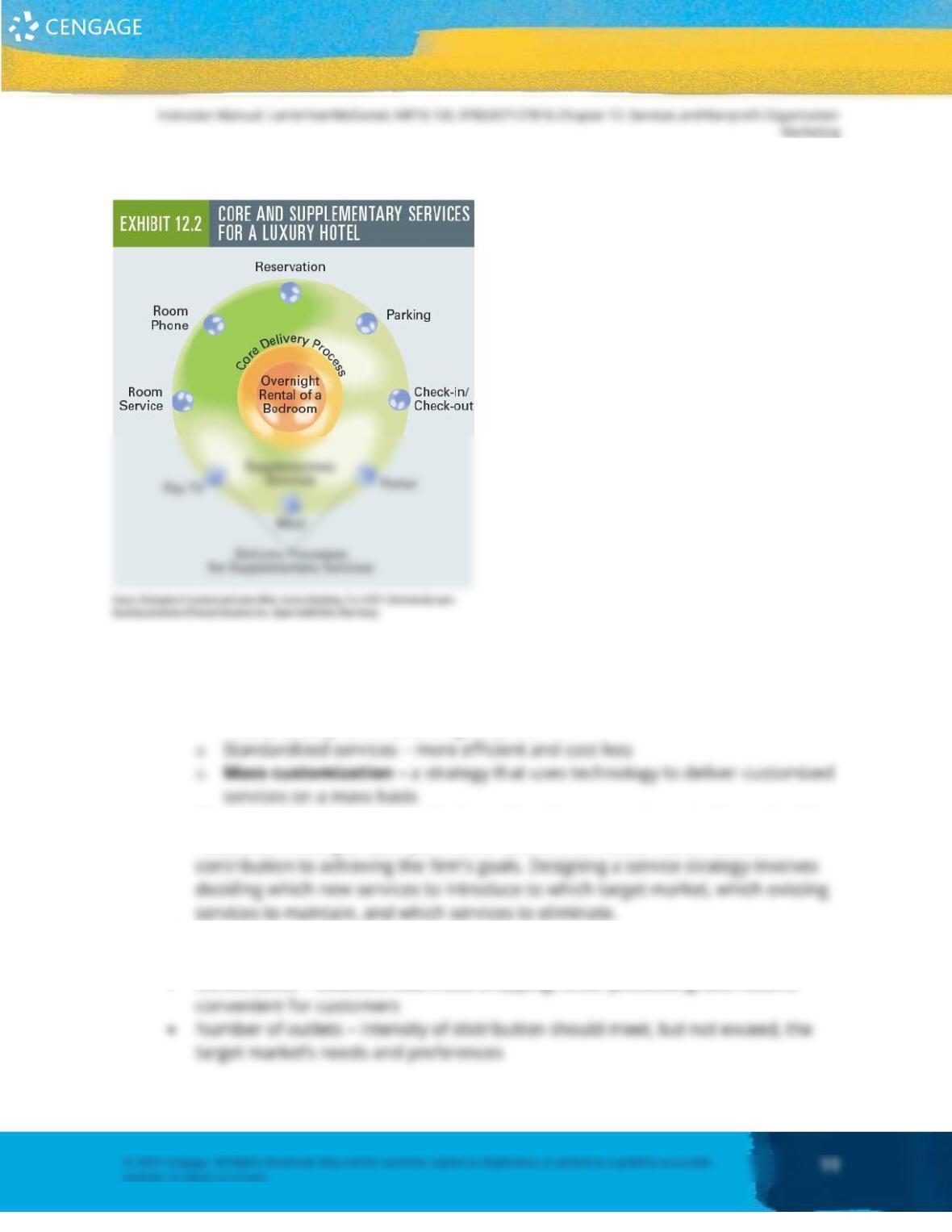
PRESENTATION VISUAL: Exhibit 12.2 Core and Supplementary Services for a Luxury
Hotel
• Customization/Standardization: When developing service offerings, service
providers have three options:
o Customized services – more flexible and responsive to individual customers’
needs, usually command a higher price
• The Service Mix: Each organization’s service mix represents a set of opportunities,
risks, and challenges. Each part of the service mix should make a different
c. Place (Distribution) Strategy: Distribution strategies for service organizations
focus on:
• Direct versus indirect distribution – direct distribution or franchising for
customized services, and indirect channels using independent intermediaries for
standardized service packages
d. Promotion Strategy: Although promoting intangible services is more difficult than
promoting tangible goods, marketers can try these four promotion strategies:
• Stressing tangible cues by using concrete symbols of the service offering
e. Price Strategy: In order to price a service, it is important to define the unit of
service consumption. For services that are composed of multiple elements, one
prefer to choose individual options. Three categories of pricing objectives include
the following:
• Revenue-oriented pricing focuses on maximizing the surplus of income over costs.
This is the same approach that manufacturing companies often use.
5. Relationship Marketing in Services (LO 12-5, PPT Slide 32, DISC: Customer)
a. Relationship marketing can be useful in developing strong loyalty by creating
satisfied customers who will buy additional services from the firm and are unlikely
to switch to a competitor. Membership services naturally lend themselves to