ANSWERS TO DISCUSSION QUESTIONS AND PROBLEMS
1. Assume you have been hired to consult with Forever 21 on sourcing decisions for
sportswear. What issues would you consider when deciding whether you should buy from
Mexico or China or find a source within the United States?
Students should consider these issues when consulting Forever 21 on sourcing decisions:
Country of Origin Effect, Foreign Currency Fluctuations, Tariffs, Foreign Trade Zones, Cost of
Carrying Inventory, Transportation Costs, Quality Control, Collaborative supply chain
management, and International Human Rights and Child Labor Violations. Given the choice
2. What are the differences among counterfeit, gray-market, and black-market
merchandise? Is the selling of this type of merchandise legal? Do you believe that the
selling of these types of merchandise should be allowed? Provide a rationale for your
position. Would you purchase a counterfeit wallet? What about a counterfeit car part or
prescription medicine?
Counterfeit merchandise includes goods that are made and sold without permission of the
owner of a trademark, a copyright, or a patented invention that is legally protected in the
country where it is marketed. Gray-market merchandise, also known as parallel imports,
3. What are the advantages and disadvantages of manufacturer’s brands versus store
brands? Consider both the retailer’s and customer’s perspectives.
National brands are products designed, produced, and marketed by a vendor/manufacturer
and sold to many different retailers. The vendor is responsible for developing the
merchandise and establishing an image for the brand. Retailers carrying national brands
receive a number of advantages. These brands help to build both the retailer’s image and its
4. Does your favorite clothing store have a store-brand strategy? If yes, how does it build
store loyalty? If no, how could a store brand create loyalty?
Students will think of a store brand that they have purchased. Answers will vary.
When the retailer designs and manages its own store brand, those brands provide the
retailer’s customers with a unique merchandise opportunity. The store brands are exclusive
5. Explain why a grocery store, such as Kroger, offers more than one tier of store brands
within a particular product category.
Different types of store brands offer consumers different advantages. Kroger may choose to
provide more than one store brand within a product category to reach different target
6. Why have retailers found exclusive store brands to be an appealing branding option?
Choose a department store, a discount store, and a grocery store. What exclusive store
brands do they offer? How are they positioned in relation to their national-brand
counterparts?
In recent years, exclusive store brands have become increasingly prominent in the
marketplace. Before this upswing in popularity, store brands were viewed as representing
lower quality merchandise from the consumer’s perspective. More recently, national-brand
manufacturers have entered these exclusive relationships to provide store
brandmerchandise for specific retailers at the same level of quality as the vendor’s own
brands.
7. When you go shopping in which product categories do you prefer store brands or national
brands? Explain your preference.
Students will likely respond to current marketplace trends here. Clothing (The GAP and
Banana Republic), cosmetics (American Beauty and Good Skin), and home goods (Martha
Stewart and American Living) are among the many popular categories of store brand
spending.
8. What are retailers doing to be more socially responsible in buying merchandise? Why are
they becoming more socially responsible? Do you buy products that you believe were
produced in a socially responsible manner, even if they cost more?
In response to significant pressures from the marketplace, retailers have become very
aware of their social responsibilities as part of their global sourcing efforts. They have faced
a number of very public critiques of global practices, particularly regarding sweatshops and
9. You have decided that you don’t want to take the final in this class. Explain how you
would negotiation this request with the instructor. Consider place, deadlines, past
relationship, possible objections, options for mutual gain, and how to maintain a
professional relationship.
The negotiation session should be planned in advance with a consideration of gathering all
the necessary facts (knowledge is power) before the meeting. Next, students should
CONNECT ACTIVITIES FOR CHAPTER 12
Power’s Books
Case Analysis
Negotiating With
Vendors,
Strategic
Relationships
Between Retailers
social responsibility
12-2 Describe how
retailers buy national
brands.
buying merchandise.
Legal and Ethical
Issues of
Merchandise
Click and Drag;
Matching (accessible
version)
Legal, Ethical, and
Social Responsibility
Issues for Buying
Merchandise
12-6 Indicate the
legal, ethical, and
social responsibility
issues involved in
buying merchandise.
ANCILLARY LECTURES AND EXERCISES
LECTURE # 12–1: NEGOTIATING WITH THE VENDOR
Introduction
What is negotiation?
Negotiation is a two-way communication designed to reach an agreement when parties
have both shared and conflicting interests.
Three key points:
1. Two-way communication – to have a negotiation there has to be communication being
sent and received.
If we agree that negotiating is simply getting what you want from others, then it stands to
reason that people are involved in the negotiating activity everyday.
Ask students: whom do you negotiate with and for what results?
Responses might include:
1. Spouse – Where to go for dinner.
2. Shopkeeper – Dickering price on antiques.
Everyone negotiates everyday.
Though we all have lots of practice, negotiating is still not easy to do well.
As buyers, the success, i.e., profitability of the business would be greatly affected by how
well they negotiate.
In talking about negotiating we want to direct our attention to results.
Potential results
Today, planning and execution is the method through which obstacles are overcome.
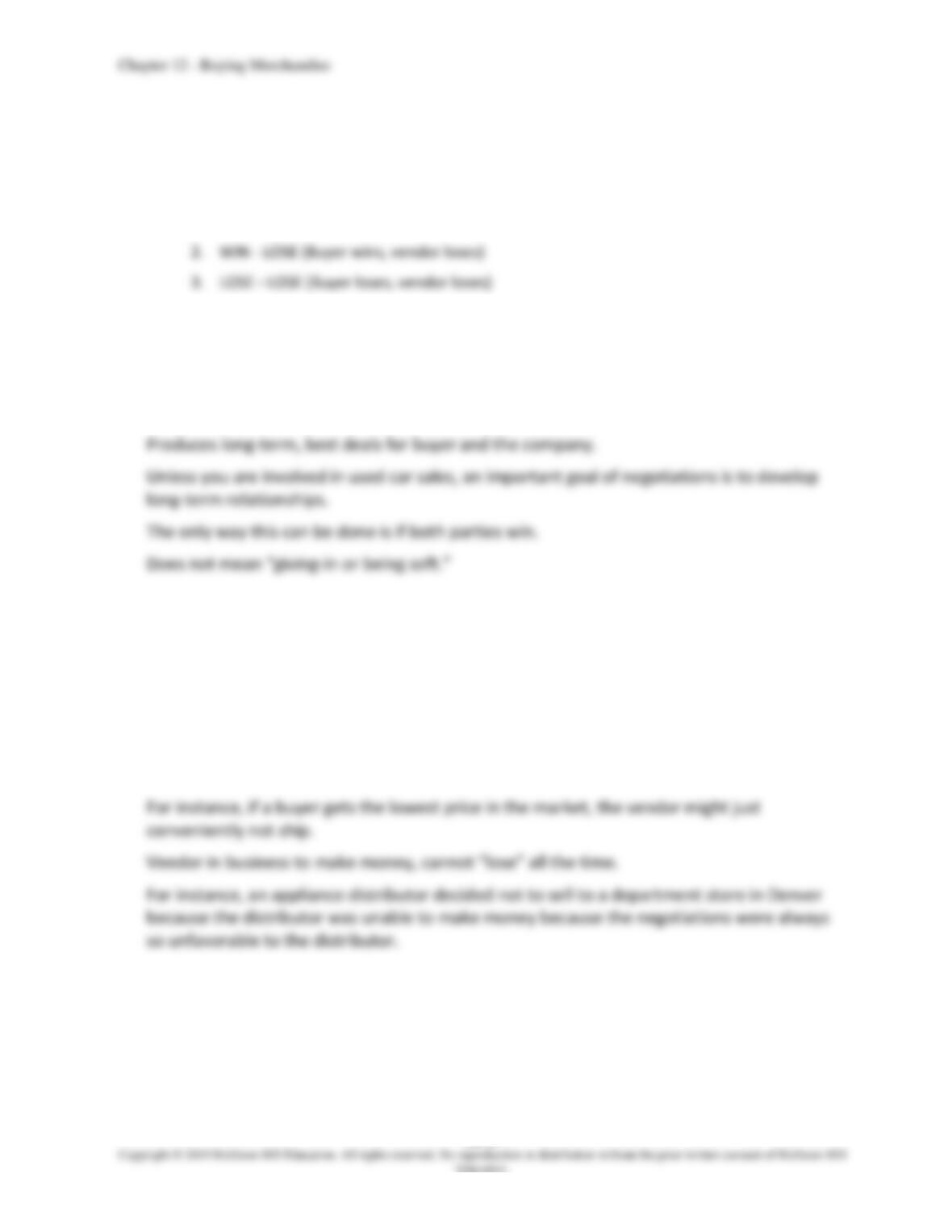
When involved in negotiating, the results you achieve can be any of the following:
1. WIN – WIN (Buyer wins, vendor wins)
WIN – WIN
This is the best situation.
Based on cooperation and collaboration.
Enhances vendor trust in buyer as a professional.
WIN – LOSE
There are some instances where win/lose can be positive — if buyer doesn’t want to
develop a long-term relationship.
It is generally negative because if the vendor feels like a loser, then there is little possibility
of going back to the vendor again.
Win/lose can turn into lose/lose.
LOSE – LOSE
Wastes time and energy.
No relationship established.
Objectives not met.
How can you determine what negotiating result you are going to achieve?
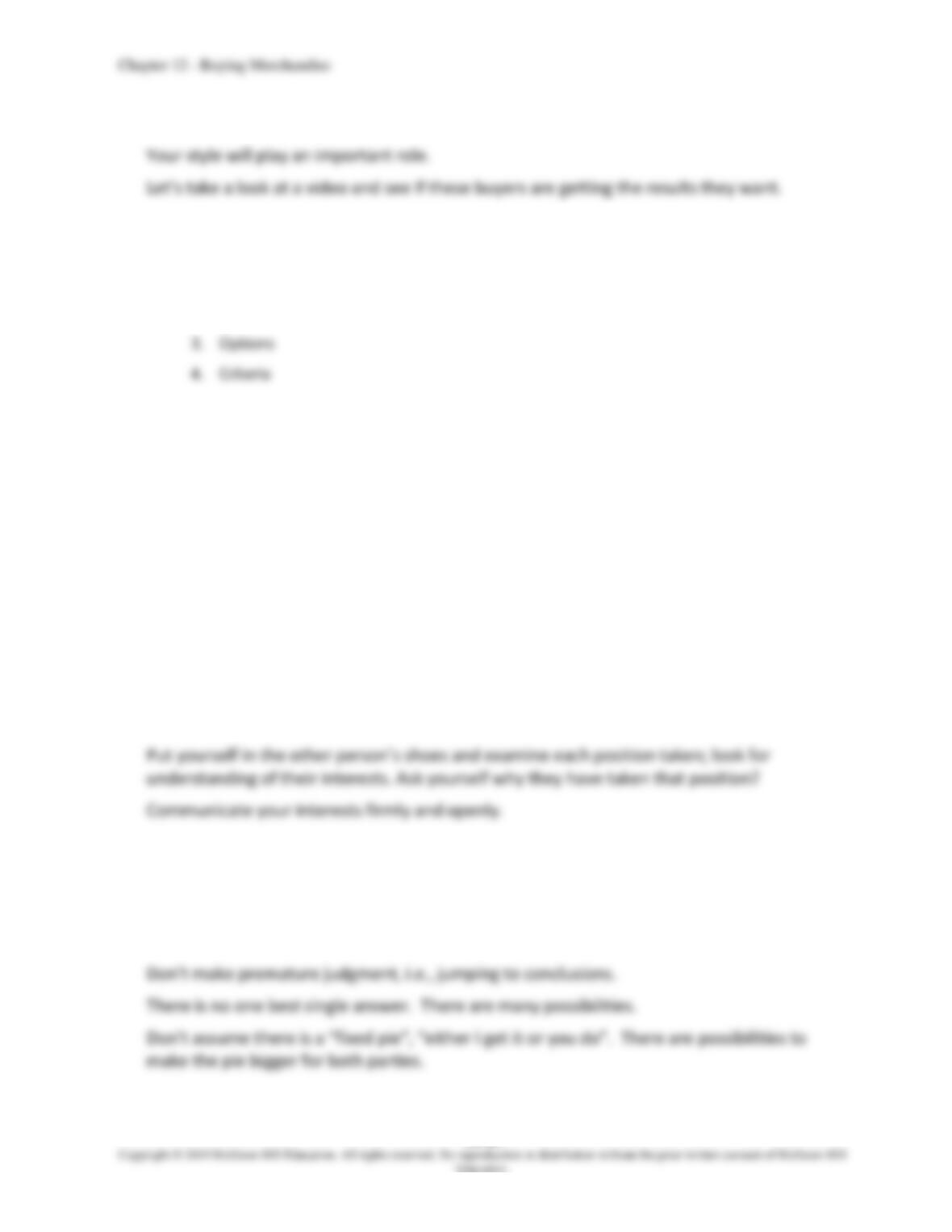
Principled Negotiations
The concept of principled negotiating is based on four basic points:
1. People
2. Interests
Let’s talk about them individually.
Separate the people from the problem
Negotiators are people first — all have human aspects.
Relationships between negotiators tend to become entangled with the problem.
There is a need to separate the relationship from the problem and see ourselves as working
side by side.
Attack the problem, not each other.
Focus on interests, not positions
Position is something you have decided on.
Interests are what caused you to decide (desires, concerns)
Invent options for mutual gains
Think of a wide range of possible solutions that will benefit both parties.
Consider all options — all sides.
Get over the obstacles that inhibit you from inventing an abundance of options.

Get the options out in the open.
Look for mutual gain and shared interests.
Insist on using objective criteria
Use fair standards, i.e., market value, cost.
Once agreement is reached, what standards will be used to make sure the deal is carried
out?
Be reasonable and be open to reason.
Planning
In addition to style and probably even more important is one simple word/action —
PLANNING.
To be effective in the market, to get the success you want, you must plan effectively.
Being prepared — ready to anticipate and answer questions gives the buyer confidence.
Confidence breeds success!
What are the areas that we must look at in order to plan?
1. History – To go forward, you must understand what has happened in the past. Know the
merchandise and its sales history. What is the customer telling you? What is the future
potential?
4. Vendor objectives – An important point in preplanning is anticipating what the vendor
wants and what he will settle for. Vendors, like buyers, will have concessions ready, but
will keep them hidden.
Setting objectives
Keep in mind that to set goals you must:
1. Know the market: What are the current trends? How is business generally? How are
each of your vendors performing against the overall market?
4. Know the competition: Who are they? Other department stores, chains, specialty
stores? What financial condition are they in? What is their inventory position? How
much of the same type of merchandise do they carry? Are they canceling orders or
buying merchandise at lower than normal prices? How will you protect your margin if
you are forced to meet competitive prices?
5. Know yourself: Know your personal strengths and limits. Are you a morning or afternoon
person? Set up your meetings for when you are at your best. Can you pull this off by
yourself or do you need help? If so, get it!
Negotiating tips
There are several tips that one can use while negotiating:
1. Beware of time pressures. Almost everything happens at or just before the deadline. Think of the
last major labor strike. Give and get appropriate deadlines.
4. Let the other guy mention a figure first. It might be better than you would ask for. In any case, it
tells you where you are starting.
5. Know when to use your boss as a partner and source of extra power. The bigger your deal, the
higher you go.
6. Don‘t be afraid to say no to an offer that doesn’t help you get what you need.
10. Before you go into the negotiation, use a technique that Olympic athletes use: envision how the
meeting will go, and picture yourself being very successful — it will build your self-confidence.
12. Make every effort to reduce stress for yourself. Just being in New York City can be stressful, so do
things that make you feel better — whether it‘s exercise, staying in touch with family at home,
seeing friends outside the business — whatever is a harmless escape. Don‘t burn the candle at
both ends; get a decent amount of sleep and don‘t overindulge in bad habits like drinking and
overeating. Keep yourself in top condition.
ANCIALLRY EXERCISE : ROLE PLAYING NEGOTIATIONS
————–——–——–——————-
Instructor’s Note: This exercise should be used in conjunction with Chapter 12, but only after the class
has had Lecture 12–1.
————–——–——–——————-
Directions
Get two groups of students to volunteer for this exercise.
One group will represent Drip-Dry; while the other will represent Burdines.
Each group should have three to four people.
Provide the entire class with the following handouts:
1. Dealer letter from Drip-Dry
Give the two groups 15 minutes to prepare or give them the assignment one class period in
advance.
The two groups will role play the negotiation for about 15 minutes.
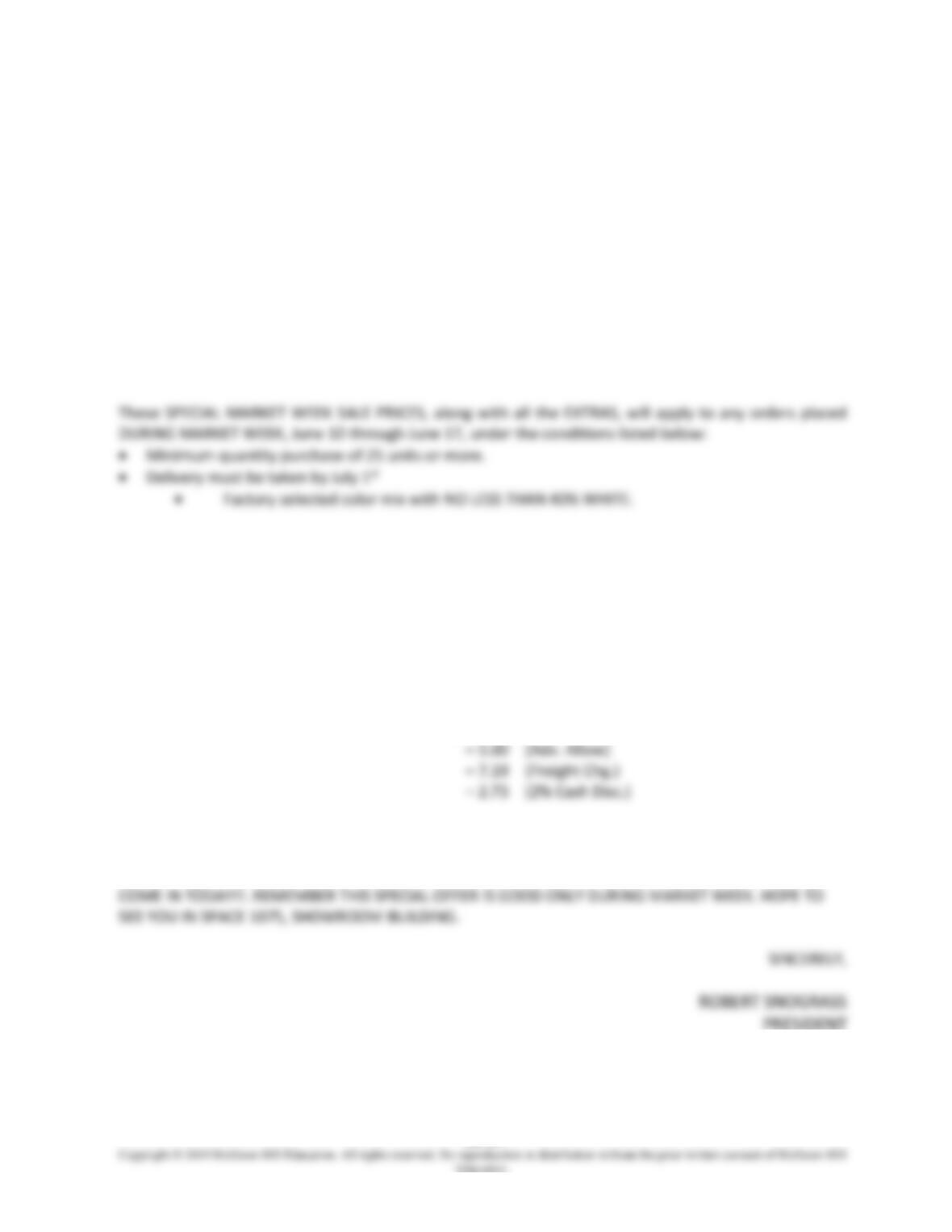
Chapter 12 – Buying Merchandise
P.O. BOX 999
NEW YORK, N.Y. 10038
October 12, 2017
DEAR MR DEALER
DRIP-DRY is proud to announce a SUPER MARKET SPECIAL on all orders placed in our showroom the
week of June 10.
• INTRODUCTORY SALE ON ALL NEW MODEL WASHERS @ 15% off regular prices!
• $5.00/unit ADVERTISING ALLOWANCE included!
• PREPAID FREIGHT!
• Regular CASH DISCOUNT of 2% (our normal teens) stD1 applies!
Here’s how the promotion actually works. On any purchase of 25 units or more, we will invoice you as
follows:
Regular Wholesale Price
$175.00 ea.
Less 15% Sale Discount
26.25
Promotia1On “sale. Price
$148.75 ea.
In addition, you may bill us back $5.00/unit advertising allowance, all freight costs, as well as your
regular 2% Cash Discount:
Promotion “sale”. Price
$148.75
ea.
(Adv. Allow)
(Freight Chg.)
(2% Cash Disc.)
JUST SEND YOUR CHECK FOR: $133.83 ea.