Chapter 12
Economic Impact Analysis
Chapter Overview
I. Introduction
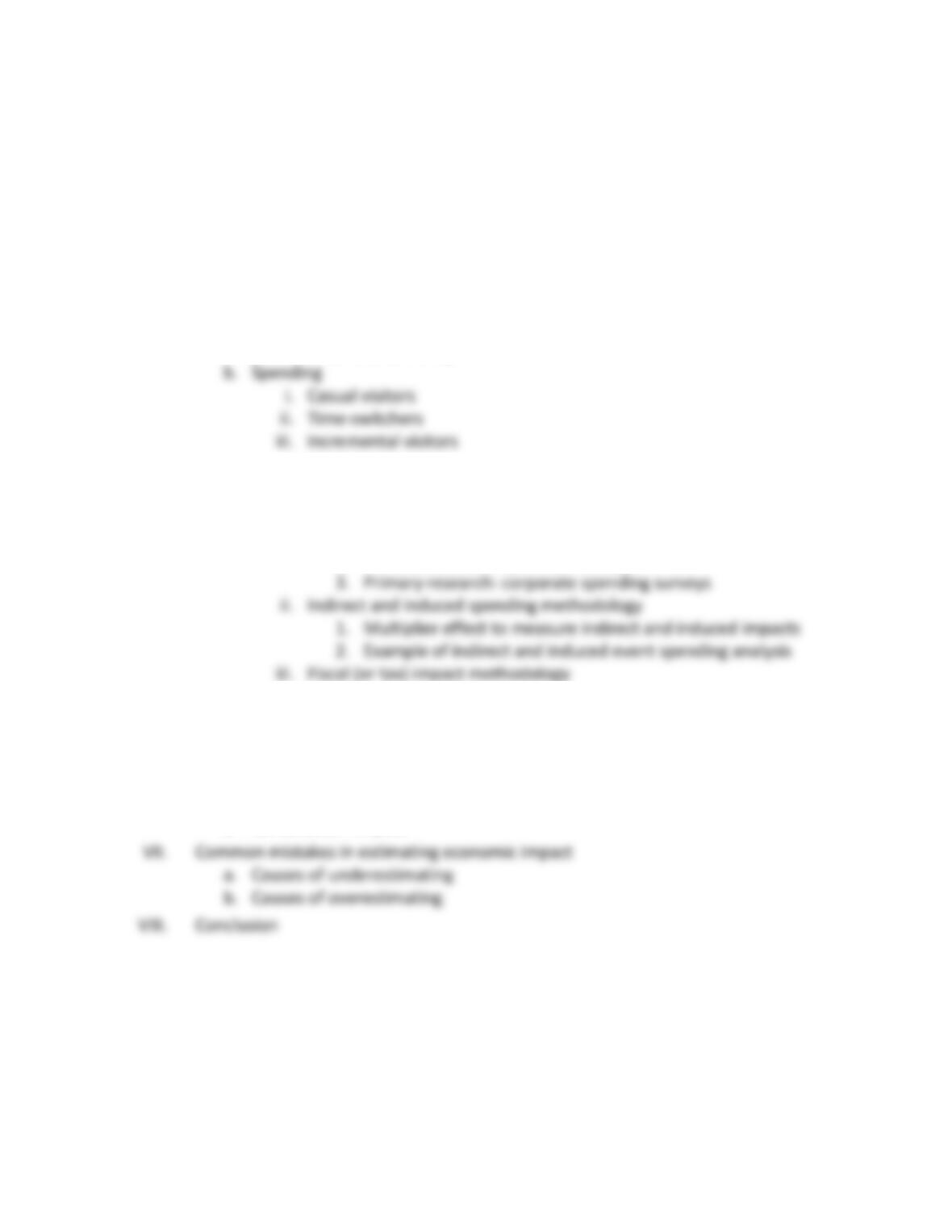
II. Setting the parameters
a. Geographic area of impact
i. Displaced spending
III. Methodologies for measuring event economic benefits
a. Spending methodologies
i. Direct spending methodology
1. Secondary research
2. Primary research: spectator surveys
IV. Measuring event costs
V. Economic impact of a local team
a. Capture rate
VI. Economic impact of a sport facility
a. Operations impact
b. Construction impact
Key Concepts
When reading this chapter, students should focus on the following key concepts:
1. An economic impact analysis is a form of cost-benefit analysis in which the true costs
and benefits are measured to assess the net effect or impact.

Concept Check Responses
1. What is the difference between induced and indirect economic impact?
While these terms are sometimes comingled in practice, indirect impact is the re-
spending of the initial direct spending. It is usually measured by reference to some sort
2. Can a person be both a casual visitor and a time-switcher for the same event?
Imagine a scenario in which Amanda planned to travel to San Diego to see a Padres
game in May but instead chose to go to San Diego to visit her Uncle Nick in June. While
visiting him, Amanda attends a Padres game. This appears to be a case in which Amanda
3. Under what conditions should spending by local residents be counted in a calculation of
economic impact?
As with all economic impact, the key question is what would have happened otherwise.
If some residents would have left town had the event not been held in town (either not
held at all or held elsewhere), then that event caused them to stay in town and not
4. In measuring the economic impact of a sport team, is it correct to count both the
spending by fans inside the stadium and the spending by the team (in running its
operations) in the community?
In general, the answer is no. This could lead to double-counting, as explained in the text.
You might wonder why money spent by a visitor in a hotel that is then re-spent by the
hotel and its employees in the community gets counted as indirect spending. Doesn’t
5. All else being equal, does increasing the size of the geographic area of impact raise,
lower, or have no effect on the capture rate?
Generally, increasing the geographic area of impact will raise the capture rate, because
initial direct spending will have a harder time leaking out if the geographic area is large.
Imagine measuring the economic impact of a St. Louis Cardinals baseball game on the
United States as a whole. Most of the re-spending (the amount that stays in the
6. How would one determine the extent to which locals are reverse time-switchers for a
particular event?
Reverse time-switchers are local residents who leave because of an event, thus taking
their money away from the event and locality and thereby lowering economic impact.
Most economic impact studies conduct surveys during the event, but these people will
not actually be at the event. It also won’t be known how many people left town and
became reverse time-switchers.
7. What are some causes of overestimating the economic impact of sport event? Of
underestimating?
Some causes for underestimating include
• Not capturing all of the corporate spending related to an event.
• Not capturing all visitors (such as those who come for the event but don’t
Responses to Case Analysis Questions
This case involves using a spreadsheet to calculate a series of questions. After completing all
the questions, students will have an estimate of economic impact on the city of Cincinnati
for hosting the MLB All-Star Game.
The Additional Instructor Resources & Solutions folder for Chapter 12 contains two Excel