
Instructor Manual
Lamb/Hair/McDaniel, MKTG 13E, 9780357127810; Chapter 11: Developing and Managing
Products
Table of Contents
Purpose and Perspective of the Chapter …………………………………………………………………………. 2
Cengage Supplements …………………………………………………………………………………………………… 2
Learning Outcomes ……………………………………………………………………………………………………….. 4
Complete List of Chapter Activities and Assessments ……………………………………………………… 4
Key Terms ……………………………………………………………………………………………………………………… 5
What’s New in This Chapter ……………………………………………………………………………………………. 6
Chapter Outline …………………………………………………………………………………………………………….. 7
Discussion Questions …………………………………………………………………………………………………… 15
Additional Activities and Assignments …………………………………………………………………………… 16
Additional Resources ……………………………………………………………………………………………………. 21
External Videos or Playlist ……………………………………………………………………………………………………….. 21
Appendix …………………………………………………………………………………………………………………….. 22
Generic Rubrics ……………………………………………………………………………………………………………………… 22
Standard Writing Rubric …………………………..……………………………………………………………………………… 22
Standard Discussion Rubric ……………………………………………………………………………………………………… 23
Purpose and Perspective of the Chapter
The purpose of this chapter is to learn about the importance of developing new products in
order to sustain growth and profits and to replace obsolete items. The chapter also
describes the six categories of new products: new-to-the-world products (discontinuous
innovations), new product lines, additions to existing product lines, improvements or
revisions of existing products, repositioned products, and lower-priced products.
The diffusion process is the spread of a new product from its producer to ultimate
adopters. Adopters in the diffusion process belong to five categories: innovators, early
adopters, the early majority, the late majority, and laggards.
Cengage Supplements
The following product-level supplements provide additional information that may help you
in preparing your course. They are available in the Instructor Resource Center.
• Transition Guide (provides information about what’s new from edition to edition)
• Educator’s Guide (describes assets in the platform with a detailed breakdown of

Learning Outcomes
The following learning outcomes are addressed in this chapter:
11-1 Explain the importance of developing new products and describe the six categories
of new products.
11-2 Explain the steps in the new-product development process.
Complete List of Chapter Activities and Assessments
For additional guidance refer to the Teaching Online Guide.
Chapter
Learning
Objective
PPT slide
Activity/Assessment
Duration
Certification
Standard
N/A
MindTap: Why Does New
Product Development
Matter to Me?
5 minutes
BUSPROG:
Reflective
Thinking
DISC: Product
11-1
MindTap: Learn It 11-1:
The Importance of New
Products
5 minutes
BUSPROG:
Analytic
DISC: Product
11-2
MindTap: Learn It 11-2:
The New-Product
Development Process
5 minutes
BUSPROG:
Analytic
DISC: Product
11-3
MindTap: Learn It 11-3:
Why Some Products
Succeed and Others Fail
5 minutes
BUSPROG:
Analytic
DISC: Product
11-4
MindTap: Learn It 11-4:
Global Issues in New-
Product Development
5 minutes
BUSPROG:
Analytic
DISC: Product
11-5
MindTap: Learn It 11-5:
The Spread of New
Products
5 minutes
BUSPROG:
Analytic
DISC: Product
Product Life Cycles
Analytic
11–1 – 11–
6
MindTap: Assignment
25 minutes
BUSPROG:
Analytic
DISC:
Marketing Plan
11–1 – 11–
6
MindTap: Case Activity
15 minutes
BUSPROG:
Analytic
DISC: Strategy
11-1
6
Group Activity 1 in PPT
25-30 minutes
BUSPROG:
Analytic
DISC: Product
Knowledge Check 1 in
15 minutes
BUSPROG:
11-4
30
Discussion 1 in PPT
15-20 minutes
BUSPROG:
Analytic
DISC: Product
11-5
41
Knowledge Check 2 in
5-10 minutes
BUSPROG:
Analytic
DISC: Customer
DISC: Product
[return to top]
Key Terms
brainstorming: the process of getting a group to think of unlimited ways to vary a product
or solve a problem.
business analysis: the second stage of the screening process, where preliminary figures
for demand, cost, sales, and profitability are calculated.
diffusion: the process by which the adoption of an innovation spreads.
growth stage: the second stage of the product life cycle, when sales typically grow at an
increasing rate; many competitors enter the market; large companies may start to acquire
small pioneering firms; and profits are healthy.
products.
product life cycle (PLC): a concept that provides a way to trace the stages of a product’s
acceptance, from its introduction (birth) to its decline (death).
screening: the first filter in the product development process, which eliminates ideas that
are inconsistent with the organization’s new-product strategy or are obviously
inappropriate for some other reason.
[return to top]
What’s New in This Chapter
The following elements are improvements in this chapter from the previous edition:
• Updated Fast Company list of most innovative companies

[return to top]
Chapter Outline
In the outline below, each element includes references (in parentheses) to related content. “LO
CH–##” refers to the chapter learning outcome; “PPT Slide #” refers to the slide number in the
PowerPoint deck for this chapter (provided in the PowerPoints section of the Instructor Resource
Center); and, as applicable for each discipline, accreditation or certification standards (“DISC”).
Introduce Chapter 11 and review the learning outcomes. (PPT Slide 2).
1. The Importance of New Products (LO 11-1, PPT Slide 3, DISC: Product)
a. New products are essential to sustaining growth, increasing revenues and profits,
and replacing obsolete items.
b. Introduction of New Products: Some companies spend a considerable amount of
c. Categories of New Products: A new product is a product new to the world, the
market, the producer, the seller, or some combination of these. There are six
categories of new products:
• New-to-the-world products – create an entirely new market; represent the
smallest category of new products
2. The New-Product Development Process (LO 11-2, PPT Slide 8, DISC: Product)
a. Research has shown that the companies most likely to succeed in developing and
introducing new products:
• Make long-term commitments to innovation and new-product development
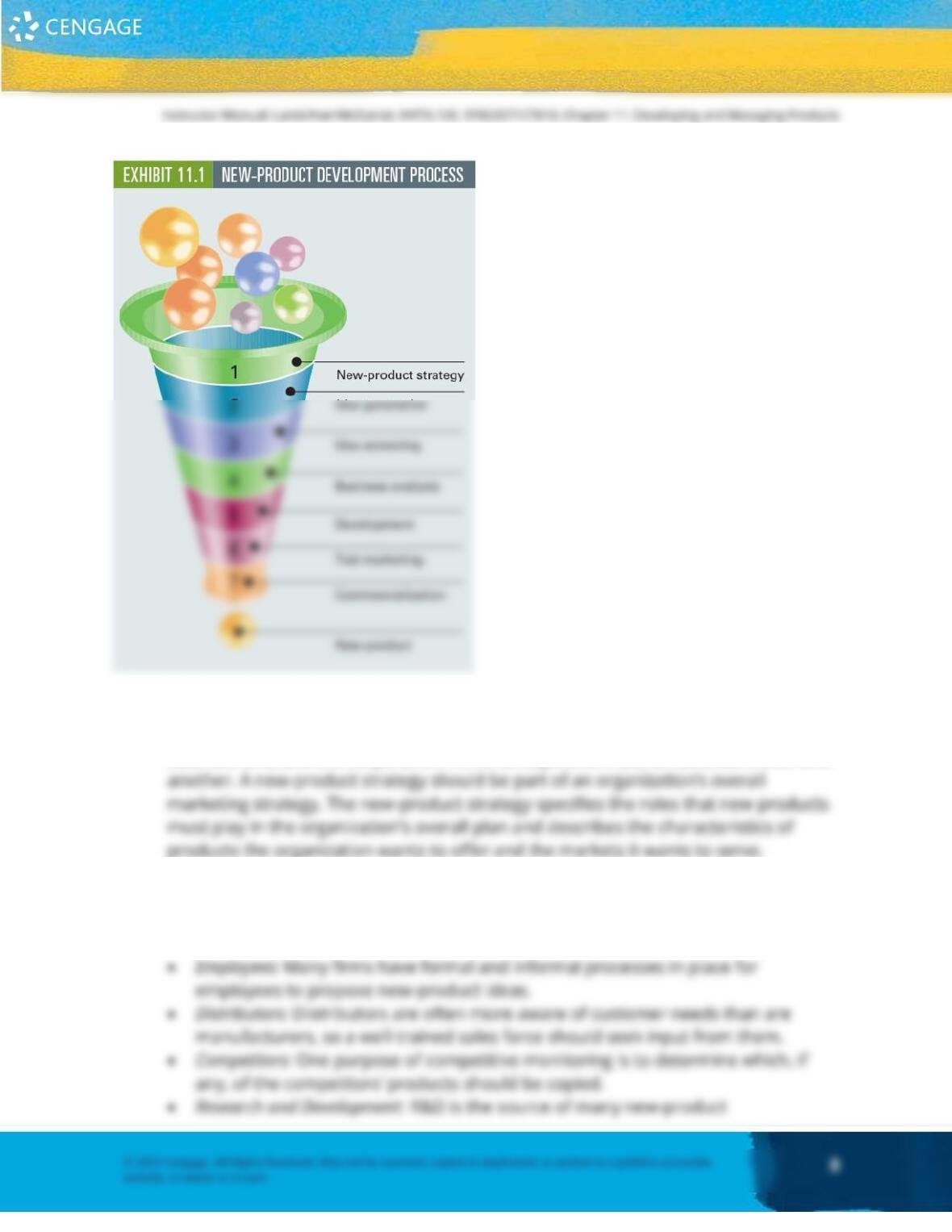
PRESENTATION VISUAL: Exhibit 11.1 New Product Development Process
c. New Product Strategy: A new-product strategy is a plan that links the new-
product development process with the objectives of the marketing department, the
d. Idea Generation: New-product ideas come from many sources, including the
following:
• Customers: Customers’ wants and needs should be the springboard for product
ideas.
breakthroughs. The United States has been the global leader in R&D, but it is
beginning to lose ground to China. R&D is carried out in four ways. Basic
research and applied research were discussed in Chapter 4. The other two ways
include the following:
o Product development is a marketing strategy that entails the creation of
products.
• Consultants: Outside consultants help determine whether a company has a
balanced portfolio of products and, if not, what new product ideas are needed to
offset the imbalance. Consultancy firms may design new goods and services,
work on brand makeovers, and conduct consumer research.
Example: Tupperware uses crowdsourcing to develop new ideas to help it create
better food containers. In 2018, Tupperware launched “The Clever Container
Challenge” to explore ways through which it could create a more technologically
advanced, but still reusable and affordable, food container. The contest ran for a
month and gave away $10,000 in prizes to the top three entries.
e. Idea Screening: The new-product committee, the new-product department, or
some other formally appointed group often review ideas, a process known as
screening. Screening is the first filter in the product development process, which
eliminates ideas that are inconsistent with the organization’s new–product strategy
or are obviously inappropriate for some other reason.

for an established market. Common questions to ask in the business analysis stage
include:
• What is the likely demand for the product?
• What impact would the new product probably have on total sales, profits,
market share, and return on investment?
h. Understanding the market potential at this stage is important because costs
increase dramatically once a product idea enters the next stage—development.
i. Development: Development is the stage in the product development process in
which a prototype is developed and a marketing strategy is outlined. The
development stage can last a long time and be very expensive. Simultaneous
product development is a team-oriented approach to new-product development
that involves a cross-functional team working in unison. This approach allows firms
to shorten the development process and reduce costs. The Internet is a useful tool
for implementing simultaneous product development because:
• Multiple partners from a variety of locations can meet regularly to assess ideas,
analyze markets and demographics, and review cost information.
j. Laboratory tests are often conducted on prototype models during the development
stage. The Consumer Product Safety Act of 1972 requires manufacturers to conduct
a “reasonable testing program” to ensure that their products conform to established
safety standards. If a product tests well in the laboratory, the company may also
have customers try it out in their homes.

new products. Recently, Wendy’s tested the reception of its vegan-friendly Black
Bean Burger.
• The High Costs of Test Marketing: Test marketing frequently takes one year or
longer, can cost more than $1 million, and informs competitors of new products
and marketing plans. Many firms believe it is better to fail in a test than in a
national introduction.
• Alternatives to Test Marketing: One alternative to traditional test marketing is
simulated (laboratory) market testing, which is the presentation of advertising
l. Commercialization: Commercialization is the decision to market a product. This
sets several tasks in motion.
• Ordering production materials and equipment
• Starting production
3. Why Some Products Succeed and Others Fail (LO 11-3, PPT Slide 26, DISC: Product)
a. Many products fail or perform poorly because:
• They don’t offer any discernible benefit as compared to existing products.
b. Successful new products deliver a meaningful and perceivable benefit to a sizable
number of people or organizations and are different in some meaningful way from
their intended substitutes.
Example: Some of the biggest product failures of all time include New Coke,
4. Global Issues in New-Product Development (LO 11-4, PPT Slide 28, DISC: International
Perspective)
a. In many multinational corporations, every product is developed for potential
worldwide distribution, and unique market requirements are satisfied during
5. The Spread of New Products (LO 11-5, PPT Slide 32, DISC: Product)
a. Marketers have a better chance of successfully marketing products if they
understand how consumers learn about and adopt new products.
b. Diffusion of Innovation: An innovation is a product perceived as new by a
potential adopter. Diffusion is the process by which the adoption of an innovation
spreads. Five categories of adopters participate in the diffusion process:
• Innovators:
o The first 2.5 percent of all those who adopt the product
sources and experts
• Early Adopters:
o The next 13.5 percent to adopt the product
o Rely much more on group norms and values
• Early Majority:
o The next 34 percent to adopt the product
• Late Majority:
o The next 34 percent to adopt the product