• Research indicates that these allocation decisions
have a much bigger impact on profitability than does
the decision about the quantity of merchandise to
of the challenges of allocating
merchandise to stores. What
might influence the decision of
A. Amount of Merchandise Allocated
* Retail chains typically classify each of their stores on the
basis of annual sales. Thus, A stores would have the largest
sales volume and typically receive the most inventory,
while C stores would have the lowest sales volume and
receive the least inventory for a category.
• B. Type of Merchandise Allocated In addition to classifying
stores on the basis of their size and sales volume, retailers
classify stores according to the characteristics of the stores’
trading area.
• Store trade area geodemographics are used to develop
merchandise assortments for specific stores.
See PPT 11–40 for illustrations
of merchandise allocation
decisions
C. Timing of Merchandise Allocation
• Differences in the timing of category purchases across
stores also needs to be considered.
See PPT 11–41
purchases when they get their paychecks at the
beginning of the month, but cut back on purchases as
that money runs out toward the end of the month.
VIII. Analyzing Merchandise Management Performance
• The next step in the merchandise management process is
to analyze the performance of the process and make
adjustments as necessary.
LO 11-8 Review how retailers
evaluate the performance of
their merchandise
management decisions.
A. Evaluating the Merchandise Plan Using Sell-Through Analysis:
• A sell-through analysis is a comparison between actual and
planned sales to determine whether price reuctions
(markdowns) are required or whether more merchandise is
needed to satisfy demand.
See PPT 11–43
Ask students what action
should be taken with the white
B. Evaluating the Assortment Plan Using ABC Analysis
• ABC analysis identifies the performance of individual SKUs
in the assortment plan.
• ABC uses the general 80-20 principle that implies that
approximately 80 percent of a retailer’s sales or profits
See PPT 11–44
Ask students to think of other
generated by 20% of its sales
force or 20% of its space.
come from 20 percent of the products.
• The first step in the ABC analysis is to rank-order SKUs
using one or more performance measures.
• A items account for 5 percent of items and represent 70
percent of sales. These items should never be out of stock.
• B items represent 10 percent of the SKUs and an additional
20 percent of sales. The store should pay close attention
to the B items, but it may run out of some SKUs in the B
category, since it’s not carrying the same amount of
backup stock as for A items.
• C items account for 65 percent of SKUs but contribute to
only 10 percent of sales.
1. Evaluating Vendors Using the Multiattribute Method
• The multiattribute analysis method for evaluating vendors
uses a weighted-average score for each vendor.
• A buyer can evaluate vendors by using five steps.
See PPT 11–45
Students may find this a little
being least important and 10 being most important,
can be used.
3. Make judgments about each individual brand‘s
performance on each issue.
seem more rational. They
might argue that the ratings
and the importance weights
are arbitrary. But they really
IX. Summary
• This chapter provides an overview of the merchandise
management planning process and examines sales
forecasting and assortment planning in more detail.
• The next step in the merchandise planning process is
developing an assortment plan and model stock list.
Appendix 11A: Merchandise Budget Report and Open-to-Buy
System for a Fashion Merchandise Category
I. Merchandise Budget Plan
A. Monthly Sales Percent Distribution To Season (Line 1)
• Line 1 of the plan projects what percentage of the
total sales is expected to be sold in each month.
Also called a seasonality index.
Most merchandise has some
seasonality. Even toilet paper –
– fancy styles sell better during
month.
See PPT 11A-4
B. Monthly Sales (Line 2)
• Monthly sales for April = $27,300 (i.e., $130,000 X
21%)
See PPT 11A-5
C. Monthly Reductions Percent Distribution to Season (Line 3)
• To have enough merchandise every month to support
the monthly sales forecast, the buyer must consider
factors that reduce the inventory level. Apart from
sales, the value of the inventory is also reduced by
markdowns, shrinkages, and discounts to employees.
• Shrinkage is caused by shoplifting by employees or
customers, by merchandise being misplaced or
damaged, or by poor bookkeeping. The buyer
measures shrinkage by taking the difference between
(1) the inventory’s recorded value based on
merchandise bought and received and (2) physical
inventory in stores and distribution centers.
Reductions are often difficult
for students to understand.
Tell them that they work in the
same direction as sales. In
other words, if you put
reductions. If they don’t,
consider reductions, they will
run out of stock by the amount
of merchandise that is put on
sale or stolen.
D. Monthly Reductions (Line 4)
• Monthly reductions are calculated the same way
monthly sales are calculated. Total reductions are
multiplied by each percentage in line 3.
See PPT 11A-7
• April reductions = $6,600 (i.e., $16,500 X 40%).
E. BOM (Beginning-of-Month) Stock-to–Sales Ratio (Line 5)
• The stock-to-sales ratio specifies the amount of
inventory that should be on hand at the beginning of
the month to support the sales forecast and maintain
the inventory turnover objective.
• Step 1: Calculate stock-to-sales ratio
• Step 2: Convert the sales-to-stock ration to inventory
turnover
Like % distribution of sales by
month, monthly stock-to-sales
ratios fluctuate by month, but
in opposite direction of sales.
Bathing suits start arriving in
March, but sales don’t take off
until May, so in May, stock and
sales are both increasing, but
sales are increasing faster, so
stock-to-sales ratio decreases.
But in July, stores still have
See PPT 11A-8
F. BOM Stock (Line 6)
• The amount of inventory planned for the beginning
of month (BOM) equals
Sales X (stock/sales) = stock.
That is, sales drops out of the
equation.
G. EOM (End of Month) Inventory (Line 7)
• The BOM inventory from the current month is the
When a retailer closes for
business at the end of the
month, the inventory should be
See PPT 11A-14
H. Monthly Additions to Stock (Inventory) (line 8)
• The monthly additions to stock is the amount to be
ordered for delivery in each month, given turnover
and sales objectives.
Emphasize: Retailer should
purchase amounts indicated in
line 8 which is based on sales
forecasts, inventory turnover
goals, and historical sales
• The difference between EOM stock if nothing is
purchased (BOM stock – sales – reductions) and the
forecast EOM stock is the additions to stock.
See PPT 11A-15
II. Open-to-Buy System
• The open-to-buy system is used after the merchandise
is purchased using the merchandise budget plan or
staple merchandise management system.
See PPT 11A–16
Now that the buyer knows how
much to spend in each month
A. Calculating Open-to-Buy for the Current Period
• Buyers develop plans indicating how much inventory
for the merchandise category will be available at the
end of the month.
• These plans might be inaccurate. Shipments might not
arrive on time, sales might be greater than expected,
and/or reductions might be less than expected.
• Projected EOM inventory =
actual BOM inventory + monthly additions actual
(received new merchandise) + on order (merchandise
to be delivered) – sales plan (merchandise sold) –
See PPT 11A–17
monthly reductions plan.
ANSWERS TO SELECTED GET OUT & DO ITS
2. INTERNET EXERCISE Go to the home page of Merchandise Management Company
(MMC)athttp://www.merchmanco.com/Default.aspx Read the posted information (read
section on “news”) on this website. How does this service provider support vendors to
manage merchandise sold at this discount department store (read section on “Our Services”)?
Increases sales at retail
– Consistent product presentation to match planograms
– Account managers and merchandisers who are in store
3. IN-STORE or INTERNET EXERCISE Go to the store location or homepage for a craft store
such as Michaels Stores, Jo-Ann Fabric and Craft Stores, or A.C. Moore Arts & Crafts
(http://www.michaels.com, http://www.joann.com or http://www.acmoore.com). How
does this retailer organize its merchandise in terms of merchandise group, department,
category, and stock-keeping unit? Select two categories of merchandise: one you would
expect to have a high inventory turnover and the other, a low inventory turnover. Explain
your reasoning for each selection.
From the Michael’s Homepage – Departments
4. GO SHOPPING Visit a big-box office supply store and then a discount store to shop for
school supplies. Contrast the variety and assortment offered at both. What are the
advantages and disadvantages of breath versus. depth for each retailer? What are the
advantages and disadvantages from the consumer’s perspective?
Students should be able to describe that an office supply store has greater depth in
office and school supplies. The discount store does carry this type of merchandise, but
5. INTERNET EXERCISE. Go to the home pages of the following retail trade publications: Chain
Store Age at www.chainstoreage.com, and Retailing Today at www.retailingtoday.com . Find
an article in each that focuses on managing merchandise. How can these articles assist
retailers with merchandise planning decisions?
6. INTERNET EXERCISE Go to www.sas.com/en_us/industry/retail/integrated-merchandise-
planning.html, the SAS Merchandise Planning website. How does its system provide retailers
with information to support merchandising planning, forecasting, and measurement?
From the company website…
Right merchandise. Right place. Right price.
SAS® Merchandise Intelligence includes:
SAS Integrated Merchandise Planning, which provides complete planning
capabilities for the merchandising process, including performance analysis,
financial planning, assortment planning, space planning, allocation and more.
SAS Size Optimization, which uses powerful analytics to transform historical sales
data into valuable size-demand intelligence. The solution accurately predicts
Because it includes our leading forecasting capabilities and advanced analytics, SAS
Merchandise Intelligence helps you drive profits by optimizing the merchandising process
from planning through inventory fulfillment.
ANSWERS TO DISCUSSION QUESTIONS AND PROBLEMS
1. How and why would you expect variety and assortment to differ between JCPenney’s
store and Internet site?
JCPenney’s individual stores will cater more toward local and regional tastes than will
JCPenney’s online site. In addition, JCPenney’s stores are limited on space and cannot
physically contain the variety and assortment that an online channel can. Therefore the variety
2. Simply speaking, increasing inventory turnover is an important goal for a retail manager.
What are the consequences of turnover that’s too low? Too high?
With a high amount of turnover, sales volume increases. When retailers sell merchandise
quickly, they are able to obtain fresh stock, improve salesperson morale, and create more
open-to-buy opportunities. Also, there are fewer markdowns caused by slow selling
3. Assume you are the grocery buyer for canned fruits and vegetables at a five-store
supermarket chain. Del Monte has told you and your boss that it would be responsible
for making all inventory decisions for those merchandise categories. It would determine
how much to order and when shipments should be made. It promises a 10 percent
increase in gross margin dollars in the coming year. Would you take Del Monte up on its
offer? Justify your answer.
In this case, Del Monte would act as a category captain for the fruits and vegetables
category for the supermarket chain. Since the supermarket is a small five-store chain, one
On the flip side, there could be several issues that must be settled before proceeding
further on the arrangement. First, Del Monte may be able to take advantage of its position
as the controller of information and inventory and make decisions that may profit it more
than the supermarket chain. Second, if Del Monte stocks more of its own brands with no
space devoted to competitive products, consumers may be deprived of a good assortment
and brand choice. Third, there may be other attempts by Del Monte to control more store–
level decisions, including shelf space utilizations, display, etc.
4. A buyer at Old Navy has received a number of customer complaints that he has been out
of stock on some sizes of men’s T-shirts. The buyer subsequently decides to increase this
category’s product availability from 80 percent to 90 percent. What will be the impact on
backup stock and inventory turnover? Would your answer be the same if the product
category were men’s fleece sweatshirts?
An increase in customer service by 10 percent will increase backup stock by much greater
than 10 percent (see Exhibit 11–10). Inventory turnover will be adversely affected.
Although net sales will increase by 10 percent, because service level increased by 10
5. Variety, assortment, and product availability are the cornerstones of the merchandise
planning process. Provide examples of retailers that have done an outstanding job of
positioning their stores based on one or more of these issues.
Students will have a variety of answers to this question. However, some possible responses
are:
6. The fine jewelry department in a department store has the same GMROI as the small
appliances department, even though characteristics of the merchandise are quite
different. Explain this situation.
The jewelry department has a low turnover, but a very high margin. Typically, a jewelry
department can command a very high markup because they are selling merchandise that
the customer perceives as being unique. It is also difficult to make price comparisons for
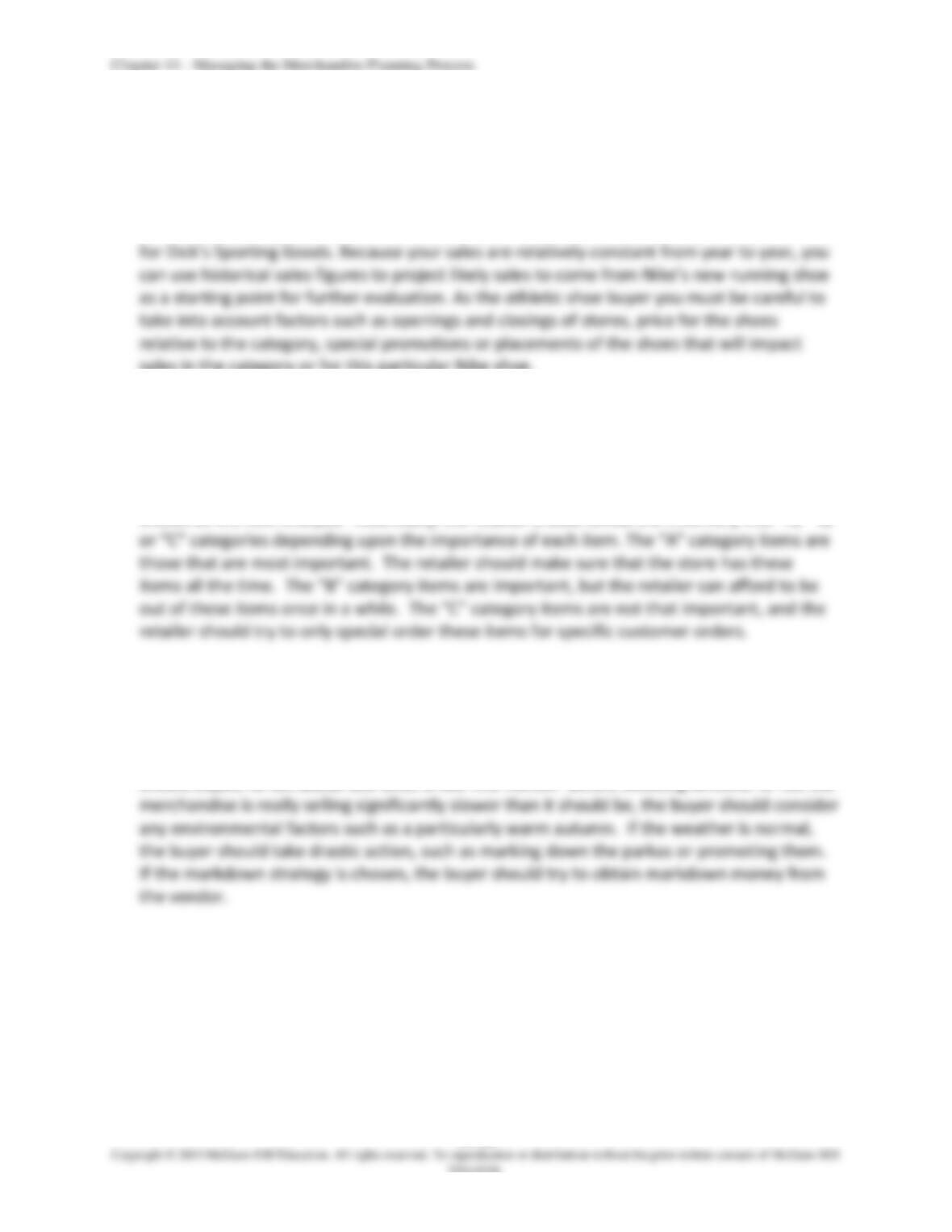
7. Calculate the GMROI and inventory turnover given annual sales of $20,000, average
inventory (at cost) of $4,000 and a gross margin of 45 percent.
• GMROI = Gross margin % x Sales-to-stock ratio
• GMROI = 45% x (20,000 ÷ 4,000)
8. As the athletic shoe buyer for Dick’s Sporting Goods, how would you go about forecasting
sales for a new Nike running shoe?
As the athletic shoe buyer for Dick’s Sporting Goods, you are dealing with a staple
merchandise category. Sales of athletic shoes should prove to be relatively steady over time
sales in the category or for this particular Nike shoe.
9. Using the 80-20 principle, how can a retailer make certain it has enough inventory of fast–
selling merchandise and a minimal amount of slow-selling merchandise?
Retailers should rank products by the 80-20 principle, which maintains that 80 percent of a
retailer’s sales or profits come from 20 percent of the products. This ranking system is
10. A buyer at a sporting goods store in Denver receives a shipment of 400 ski parkas on
October 1 and expects to sell out by 31. On November 1, the buyer still has 350 parkas
left. What issues should the buyer consider in evaluating the selling season’s progress?
Using a sell-through analysis, if the selling season is supposed to be four months, the buyer
Chapter 11 – Managing the Merchandise Planning Process
11. A buyer is trying to decide from which vendor to buy a certain item. Using the following
information, determine from which vendor the buyer should buy.
VENDOR PERFORMANCE
Importance
Issues Weight Vendor A Vendor B
Reputation for collaboration 8 9 8
Vendor A Vendor B
8 x 9= 72 8 x 8 = 64
7 x 8 = 56 7 x 7 = 49
9 x 7 = 63 9 x 8 = 72
CONNECT ACTIVITIES FOR CHAPTER 11
Activity Title
Activity Type(s)
Topic(s)
Learning Objective(s)
Merchandise
Management Process
Drag and Drop;
Matching (accessible
version)
Overview of
Merchandise
Management
11-1 Explain the
merchandise
management
organization and
performance
measures.
Merchandise
Planning at
Buycostumes.com
Video Case
Merchandise
Forecasting and
Budgeting,
Inventory Levels and
Inventory
Management
11-5 Illustrate how to
determine the
appropriate inventory
levels.