Chapter 11: Product and Branding Concepts
CHAPTER SUMMARY AND LEARNING OBJECTIVES
LO 11.1 Distinguish between goods and services.
Services are intangible products. You can’t hold a service in your hand. By contrast, goods are
tangible products that customers can see, hear, smell, taste, and/or touch.
LO 11.2 Contrast the three classifications of consumer products in terms of consumer
factors and marketing mix factors.
LO 11.3 Identify the six types of business products.
The classification system for business products emphasizes product uses rather than customer
buying behavior. Business market products generally fall into one of six categories for product
uses: installations, accessory equipment, component parts and materials, raw materials,
supplies, and business services.
LO 11.4 Summarize the major elements of brand equity.
LO 11.5 Differentiate the methods used to develop and protect brand identity.
LO 11.6 Outline the various types of brand strategies used by marketers.
LO 11.7 Explain how companies organize to manage brands and products.
LO 11.8 Summarize the three major objectives of packaging.
Like its brand name, a product’s package can powerfully influence buyers’ purchase decisions.
A package serves three major objectives: protection against damage, spoilage, and pilferage;
assistance in marketing the product; and cost effectiveness.
Chapter 11: Product and Branding Concepts
ACTIVATOR EXERCISE: The Power of Brand Loyalty
Purpose: For students to understand the concept of brand equity and loyalty.
Time: 20–40 minutes, depending on format.
Activity: Ask student to individually journal about the following:
• Identify 3–5 products or brands that you are loyal to. Even if you generally don’t regard
yourself as brand loyal, it’s likely there are several products that you tend to buy over
and over so that you don’t constantly have to reassess the alternatives.
Once students have journaled this individually, ask them to share their results in groups of 3–4.
Then, have a few students share with the class.
Result: Students will likely see that the more brand loyal they are to a product, the more it
Key takeaway: Brand equity provides real strategic value to marketers through customer loyalty
and the potential to command higher prices.
Chapter 11: Product and Branding Concepts
LECTURE OUTLINE
11-1 What Are Goods and Services?
Services can be distinguished from goods in several ways:
1. Services are intangible: Services do not have physical features buyers can see, hear,
smell, taste, or touch prior to purchase.
2. Services are inseparable from the service providers: The names of doctors, lawyers, or
hair stylists are synonymous with the service they provide.
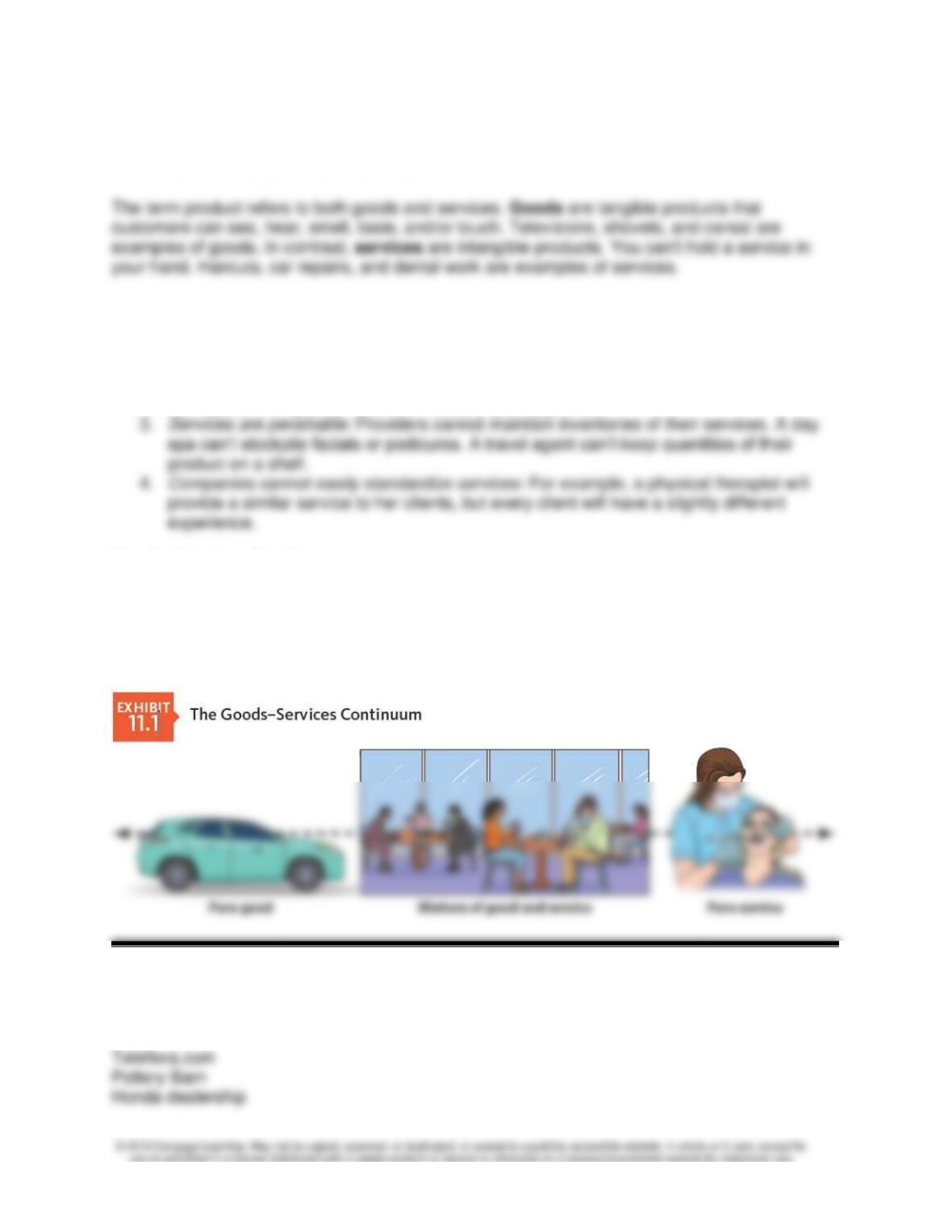
Goods–Services Continuum
Sometimes it is difficult to determine whether or not a product is a good, a service, or a mix of
both. One tool that marketers use to distinguish services from goods is the goods–services
continuum.
PRESENTATION VISUAL: MindTap Exhibit 11.1 showing the goods–services continuum
Classroom activity: Draw a line representing the good–services continuum. For each of the
below products, ask the class where on the continuum it should fall and why.
Skype
Uber
Chapter 11: Product and Branding Concepts
Redbox
Netflix
Estimated time: 15 minutes
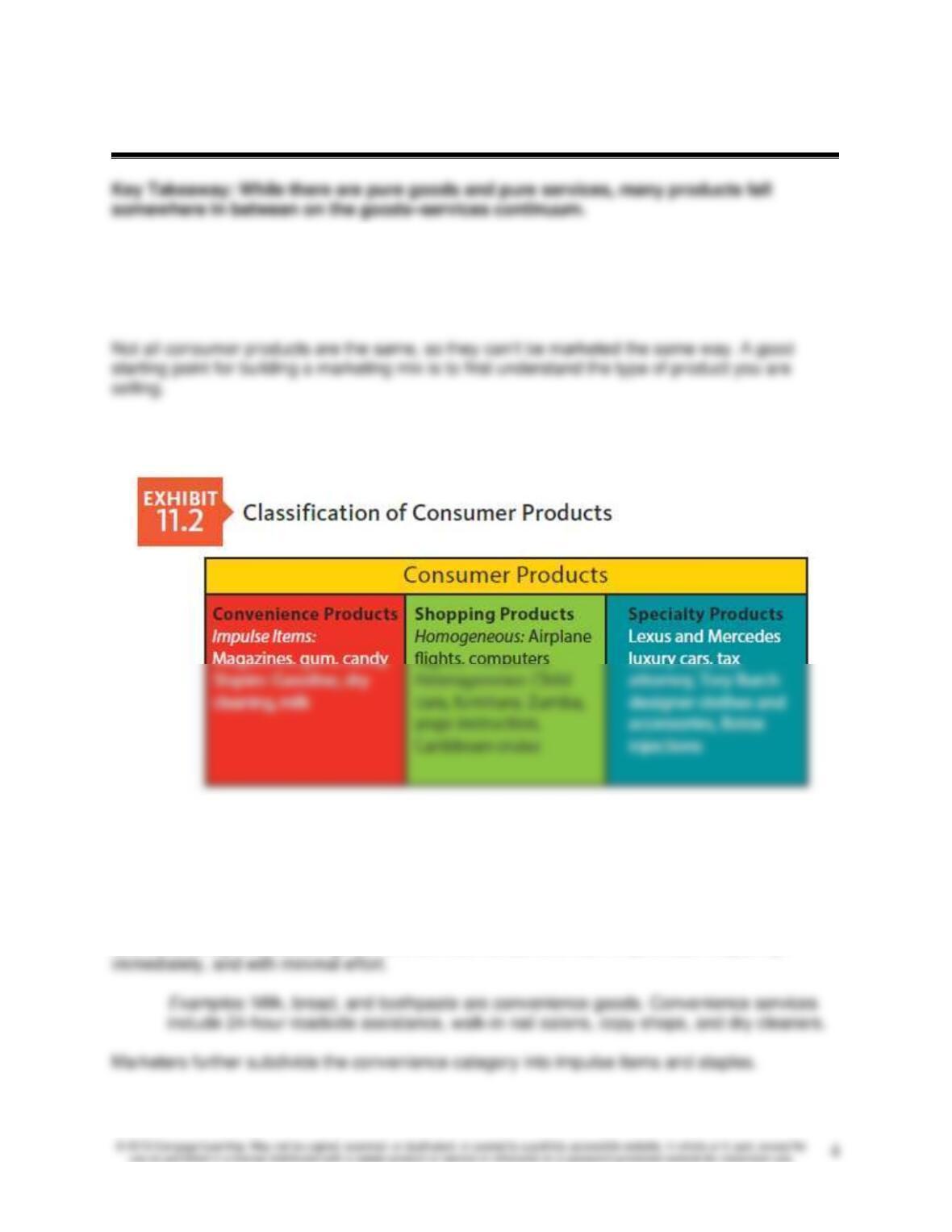
11-2 Types of Consumer Products
PRESENTATION VISUAL: MindTap Exhibit 11.2 MindTap showing the classification of
consumer products
Think of the categorization process as a continuum representing degrees of effort expended by
consumers. At one end of the continuum, consumers casually pick up convenience items. At the
other end, consumers search extensively for specialty products. Shopping products fall between
these extremes.
Convenience Products
Convenience products are goods and services consumers want to purchase frequently,
Chapter 11: Product and Branding Concepts
Shopping Products
In contrast to convenience products, consumers purchase shopping products only after
Specialty Products
Specialty products offer unique characteristics that compel buyers to purchase particular
brands. Purchasers of specialty products typically undergo an extensive search for their first
purchase of a particular product or brand. But once loyal to that brand, buyers making future
purchases know exactly what they want—and they are willing to pay accordingly.
Classroom activity: Make a list of all the convenience products you bought in the last week.
Discussion questions: Does the list change from week to week? What would it take to make you
switch from one product to another?
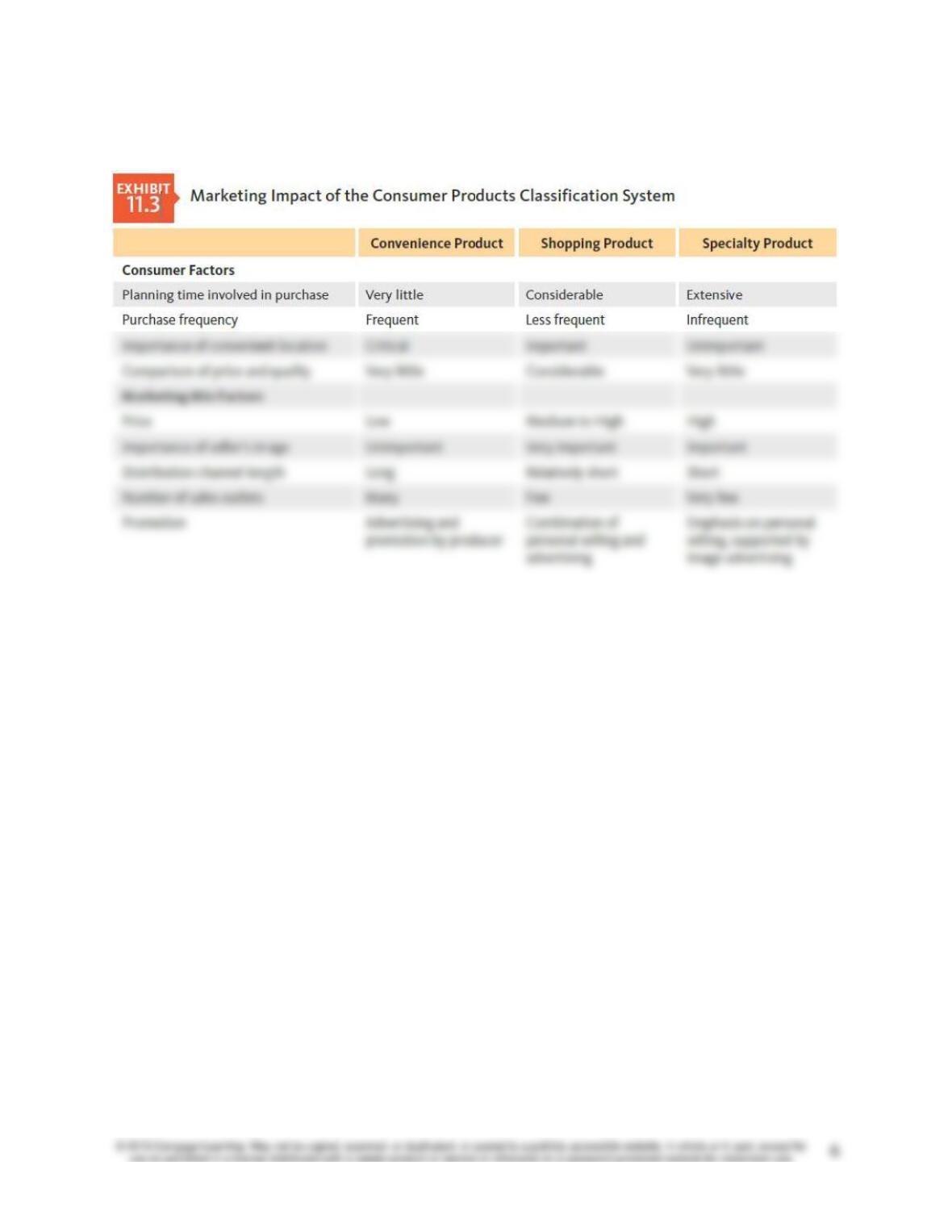
How the Marketing Mix Applies
While not all products can be easily classified into one of these three categories, this
classification system helps guide marketers in developing a successful marketing strategy.
Buyer behavior patterns differ for the three types of purchases.
Chapter 11: Product and Branding Concepts
PRESENTATION VISUAL: MindTap Exhibit 11.3 showing the buying behavior across
categories
Key Takeaway: Understanding the differences in buying behavior for different categories
of products can help marketers choose the most effective strategies for the products
they sell.
Estimated time: 15–25 minutes
Chapter 11: Product and Branding Concepts
11-3 Types of Business Products
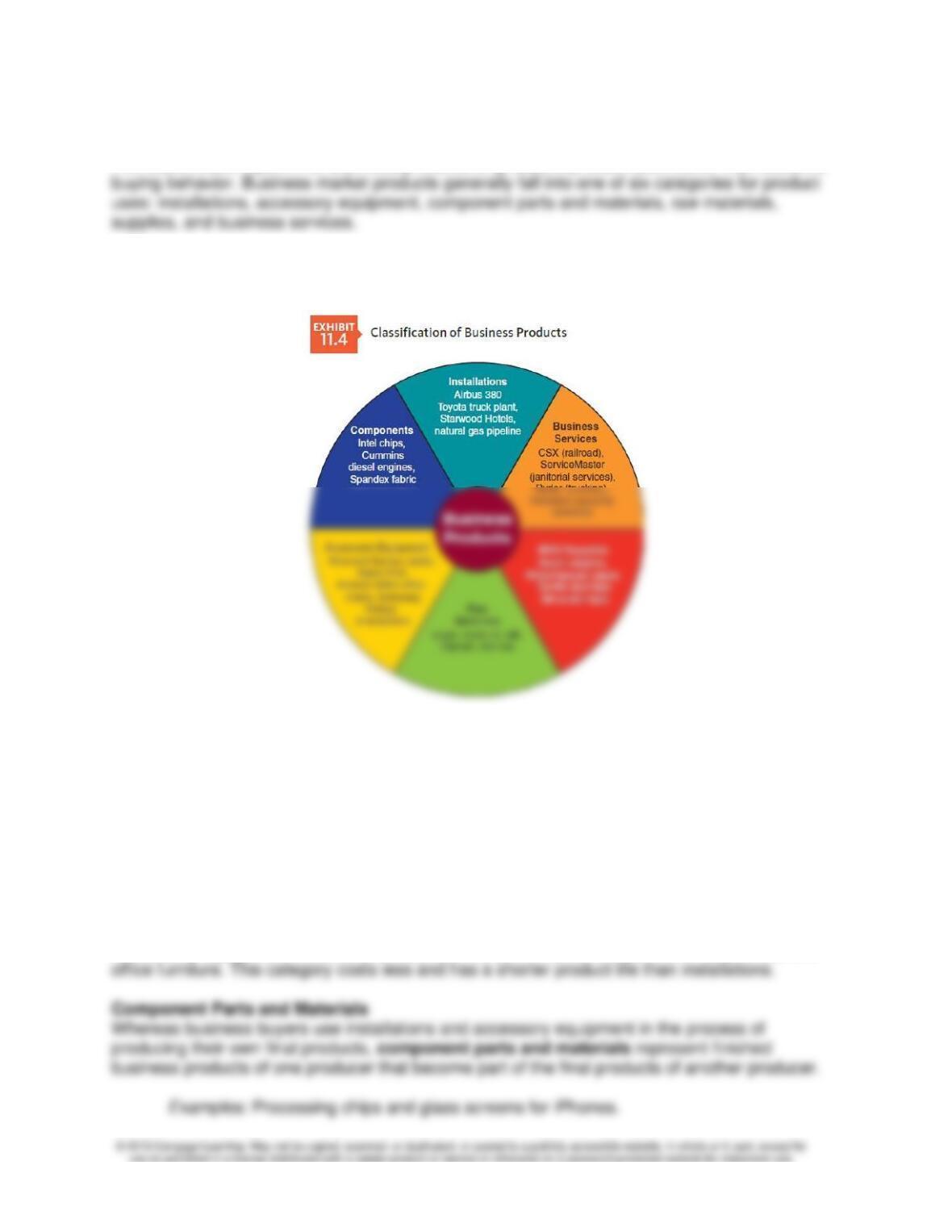
The classification system for business products emphasizes product uses rather than customer
PRESENTATION VISUAL: MindTap Exhibit 11.4 showing the business market product
categories
Installations
The specialty products of the business market are called installations. This classification
includes major capital investments for new factories, heavy machinery, customized software,
and major telecommunications systems. As installations often have a long product life and are
very expensive, they represent major purchasing decisions for organizations.
Example: Purchases of Boeing’s 787 Dreamliner airplanes by Qantas and Kenya
Airways are considered installations for those airlines.
Accessory Equipment
Accessory equipment includes products such as power tools, computers, smartphones, and
Chapter 11: Product and Branding Concepts
Raw Materials
Supplies
Classroom activity: Imagine your favorite restaurant. List as many installations, raw materials,
and supplies as you can that you think the owner or manager is responsible for purchasing.
What are examples of industries where it’s more difficult to enter? This is usually due to higher
costs or more technological barriers to entry.
Example: Airlines, movie studio, virtual or augmented reality company, biotech
Business Services
Business services includes the intangible products firms buy to facilitate their production and
operations.
11-4 Managing Brands for Competitive Advantage
A brand is a name, term, sign, symbol, design, or some combination that identifies the products
of one firm while differentiating these products from competitors.
Chapter 11: Product and Branding Concepts
At the second level of brand loyalty, brand preference, buyers rely on previous experiences
with a product when choosing it over competitors’ products. Brand preference is common in
clothing, electronics, and restaurants.
Classroom activity: Ask students to journal individually on the following:
Identify five brands you recognize, but don’t prefer. Then identify five other brands that you
prefer, but don’t insist on. Now identify three brands you insist on.
Then ask students to share the list with a neighbor and discuss the following questions:
Brand equity refers to the added value the brand gives to a product in the marketplace. Brands
with high brand equity often command comparatively large market shares and higher prices.
Global advertising agency Young & Rubicam developed a brand equity system called the
BrandAsset Valuator.i According to Y&R, a firm builds brand equity sequentially on four
dimensions of brand personality. These four dimensions are as follows:
• Differentiation refers to a brand’s ability to stand apart from competitors.
Discussion questions: How do some of the top brands, such as Apple, Ford, McDonald’s, and
Starbucks, measure up according to these four dimensions? Start with Starbucks.
Chapter 11: Product and Branding Concepts
11-5 Protecting Brand Identity
The American Marketing Association defines a brand name as the part of a brand that can be
spoken. It can consist of letters, numbers, or words and forms a name that identifies and
distinguishes the firm’s offerings from those of its competitors. The brand name itself is not
associated with any design elements.
However, firms can also identify their brands by using brand marks, which do incorporate
elements of design. A brand mark, or logo, is a symbol or pictorial design that distinguishes a
product, such as the Jolly Green Giant for Green Giant vegetables.
Classroom activity: In small groups, have students go to the homepage for five brands. Ask
Trademarks
The high value of brand equity encourages firms to take steps to protect what they invest in their
brands. A trademark is a brand for which the owner claims exclusive legal protection. To
receive trademark protection, companies file an application with the U.S. Patent and
Trademarking Office.
A trademark should not be confused with a trade name, which identifies a company. The Coca-
Cola Company is a trade name, but Coke is a trademark of the company’s product.
Trade Dress
While brand names and brand marks mainly involve wording or a logo, trade dress is a broader
category of brand identity. Trade dress is the visual cues used in branding that create an
overall look differentiating a brand or product from competitors. These visual components may
Chapter 11: Product and Branding Concepts
Classroom activity: In small groups, have students research one of the following companies:
Home Depot
Key Takeaway: While providing a sought-after product is the foundation for any
successful brand, another important step is deciding how to identify—and protect—a
firm’s products in the marketplace.
Estimated time: 30–45 minutes
11-6 Types of Brand Strategies
Brands are typically classified in three distinct ways: generic, private, and manufacturer. Each
has a different set of characteristics that defines it.
Examples: Kellogg’s, Dole, Sony, and Chevrolet.
The brands offered by wholesalers and retailers are called private brands (or private labels).
Although some manufacturers refuse to produce private-label goods, most regard such
production as a way to reach additional market segments.
Example: Kroger offers their brand of Simple Truth products in many categories within their
QFC and Fred Meyer grocery stores.
Discussion question: Retailers are increasingly launching their own brands. In particular,
Amazon is launching brands in multiple categories, including household goods, electronics, and
even apparel.
Chapter 11: Product and Branding Concepts
Brand Extension vs. Line Extension
Some brands become so popular that marketers look for ways to leverage their brand equity
with new products. The first strategy is line extension, which refers to the development and
implementation of new sizes, styles, or related product offerings.
Example: When Cheerios is offered in different sizes and flavors on the cereal aisle, this
is line extension.
Discussion question: What are some examples of brand extension—where a popular brand
launched a product in a category unrelated to their original products.
Note: There are many examples, many of which come from the grocery store. But there are
Key Takeaway: There are several strategies for branding products and extending the
reach of a brand name.
Estimated time: 20 minutes
11-7 Organizing Brands and Products
Traditionally, companies have assigned the task of managing a brand’s marketing strategies to
a brand manager or product manager. The precise title and responsibilities for these positions
vary by company and industry. In general, brand and product managers support the marketing
The traditional model of having brand and/or product managers is not always the best fit for a
company. For example, major consumer goods manufacturers, like Unilever and Procter &