o Depend mainly on word-of–mouth communication rather than on mass
media
o Skeptical
• Laggards:
o Final 16 percent to adopt
replaced by something else
c. Product Characteristics and the Rate of Adoption: Five product characteristics
can be used to predict and explain the rate of acceptance and diffusion of a new
product:
• Complexity: The more complex the product is to understand and use, the slower
is its diffusion.
d. Marketing Implications of the Adoption Process: Two types of communication
aid the diffusion process:
• Word-of-mouth communication among consumers
• Communication from marketers to consumers
e. Word-of-mouth communication within and across groups, including social media
and viral communication, speeds diffusion. Opinion leaders discuss new products
6. Product Life Cycles (LO 11-5, PPT Slide 42, DISC: Product)
a. The product life cycle (PLC) is a concept that provides a way to trace the stages of a
product’s acceptance, from its introduction (birth) to its decline (death). Product
categories have the longest life cycles. A product category includes all brands that
b. Introductory Stage: The introductory stage of the PLC represents the full-scale
launch of a new product into the marketplace. It is typified by high failure rates, little
and informing consumers about potential benefits.
c. Growth Stage: The growth stage is the second stage of the PLC, when sales
typically grow at an increasing rate; many competitors enter the market; large
d. Maturity Stage: The maturity stage is a period during which sales increase at a
slower rate. Typically, this is the longest stage of the PLC, sustained through heavy
e. Decline Stage: The decline stage signals a long-run drop in sales. The rate of
decline is governed by how rapidly consumer tastes change or substitute products
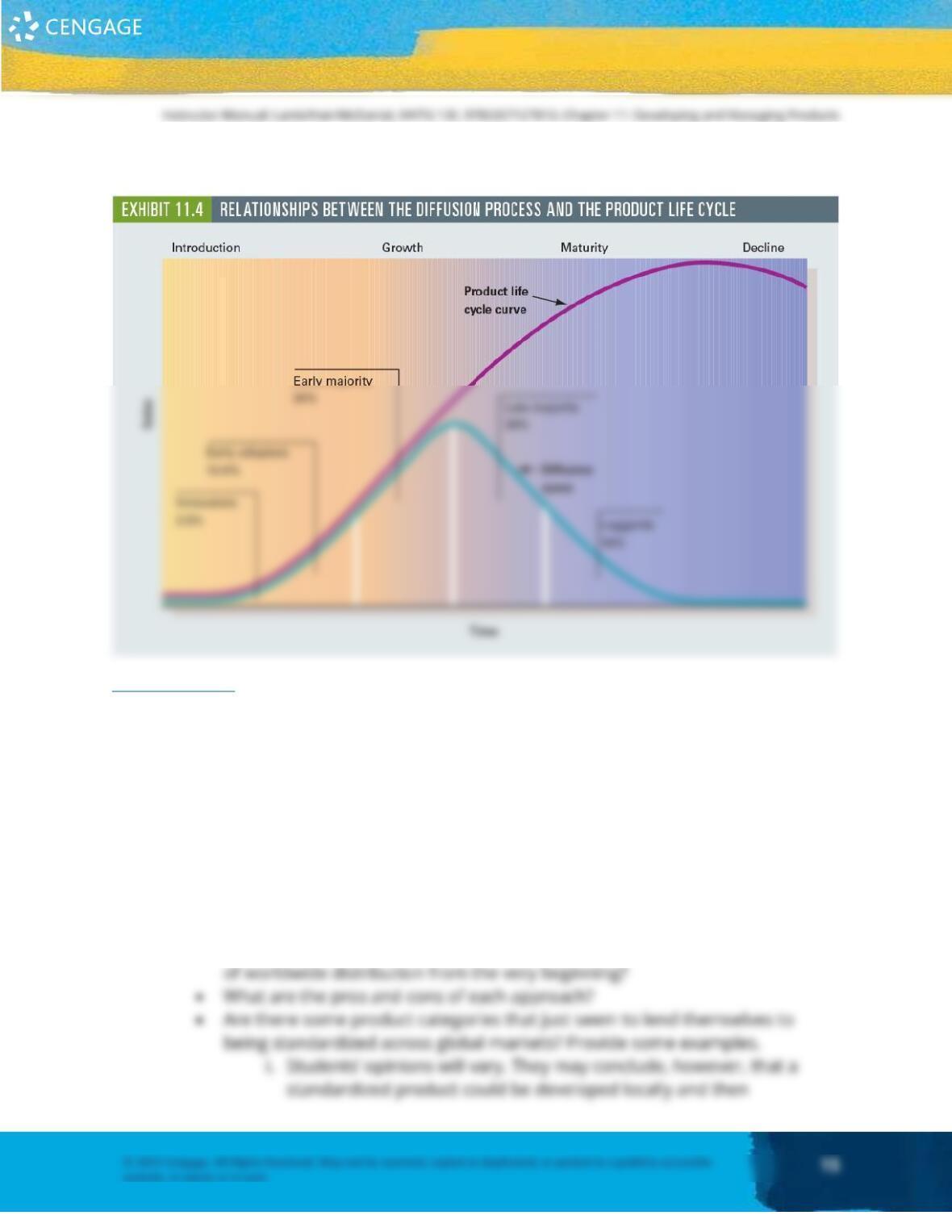
PRESENTATION VISUAL: Exhibit 11.4 Relationships Between the Diffusion Process and
Product Life Cycle
[return to top]
Discussion Questions
You can assign these questions several ways: in a discussion forum in your LMS; as whole-
class discussions in person; or as a partner or group activity in class. A generic discussion
rubric is provided in the Appendix.
1. Discussion: (LO 11-4, PPT Slides 30–31) Duration: 5-10 minutes
a. Lead students on a discussion of challenges related to new-product
development in a global context:
• Which do you think is better: Developing a product for a local market and
then adapting for global markets, or developing a product with the intention
2. Discussion: (LO 11-5, PPT Slide 38) Duration: 5–10 minutes
a. Invite students to apply the adoption process to their personal experiences:
• Which of the five types of adopters do they identify with most closely?
[return to top]
Additional Activities and Assignments
A generic discussion and writing rubric is provided in the Appendix.
1. Activator Exercise: Developing New Products (LO 11-1)
Purpose: To help students understand the necessity of a structured development
process.
online are provided below.
Classroom Format: Group brainstorming, then presentations (Estimated Time: 20-30
minutes)
1. Divide students into groups and ask them to imagine they have been asked
to develop one of the following NEW products for their company:
• An all-natural carbonated beverage
2. After students have selected their product category, have them create a
detailed description of their actual product. What are its features? What does
it look like? Why did they choose those features?
Online Format: Video presentation submitted by each student (Estimated Time: 20-
30 minutes)
1. Create this assignment in the Bongo app in MindTap or your LMS. Click on
2. Imagine you have been asked to develop one of the following NEW products:
• An all-natural carbonated beverage
3. Create a detailed description of your actual product. What are its features?
What does it look like? Why did you choose those features?
4. Develop a process for bringing the product to market. What exactly do you
5. Create and record a short presentation of your plan.
Have each student upload their video presentation to Bongo in MindTap. Grade the
video presentation using the Rubric provided with the Instructor’s Manual on the
Instructor Companion Site.
Additional questions for a classroom or discussion board: How did you select
the features you chose? How do you know there aren’t better ideas that haven’t
been considered? How do you decide whether the product can even make money?
Have you considered the competition and what they already offer? How can you
minimize the risk of this launch?
Result: Students will likely realize they missed a number of steps in the
2. Class activity (LO 11-1)
Format: This activity can be facilitated in both a classroom and an online
environment. Instructions for how to facilitate the activity in the classroom and
online are provided below. (Estimated time: 10-20 minutes)
Classroom Format: Divide students into small groups of three or four. Instruct
groups to use the Internet to identify three products that have been introduced into
the marketplace within the last two years. Categorize each of your three products as
Online Format: If you’re delivering your course online, you can have students do
this on their own and have them post their answers in a discussion board. Use the
3. Class activity (LO 11-2)
Format: This activity can be facilitated in both a classroom and an online
environment. Instructions for how to facilitate the activity in the classroom and
online are provided below. (Estimated time: 10-20 minutes)
Classroom Format: Divide students into small groups of three or four. Have them
of the class.
Online Format: If you’re delivering your course online, you can have students do
this on their own and have them post their answers in a discussion board. Use the
Alternative class activity: Have the groups from the activator exercise reconvene.
Now that they have studied the new-product development process, ask them to
consider what steps in the process they may have missed in trying to bring their
product to market. Have them revise their new-product development plan and
invite some of the groups to share what changes they made to their plan.
Alternative Online Format: Have students revisit the new-product plan they
developed in the Activator Exercise to determine if revisions are needed. Use the
following prompt to facilitate this activity:
4. Class activity (LO 11-6)
Format: This activity can be facilitated in both a classroom and an online
environment. Instructions for how to facilitate the activity in the classroom and
online are provided below. (Estimated time: 10-20 minutes)
Classroom Format: Divide students into small groups of three or four. Instruct
groups to identify two different products related to two of the four stages of the
Online Format: If you’re delivering your course online, you can have students do
this on their own and have them post their answers in a discussion board. Use the
following prompt to facilitate this activity:
Identify a product and determine which of the four stages of the product life cycle the
5. Additional activity: Extending the Product Life Cycle (LO 11-6)
Purpose: To encourage students to see old products in new ways.
Background: As product life cycles in many categories condense into shorter
timeframes, extending the product life cycle has become a critical issue. This
Format: This activity can be facilitated in both a classroom and an online
environment. Instructions for how to facilitate the activity in the classroom and
online are provided below.
Classroom Format: Small group discussion, then class discussion
1. Preparation/Materials: You’ll need to gather a set of ordinary household
items, enough for each group of three to five to have something different.
2. Small group work: Divide your class into small groups and give each group
one of the household items that you collected. Direct them to spend five
minutes brainstorming as many alternative uses as possible for their item
3. Class discussion: Reconvene as a class for discussion. Which idea is the most
practical? The most creative? The silliest? Could the silliest idea be made
Online Format: Discussion board with posted response from each student
(Estimated Time: 10 minutes)
1. Give students the following writing prompt:
Choose a common household item, such as a fork, a coffee cup, a cloth napkin, a
pencil, a paper clip, a manila folder, etc. Spend five minutes brainstorming as
2. Have students respond to their classmates’ posts, and discuss which ideas
are the most practical, the most creative, or the silliest. Could the silliest idea
be made marketable? How? What other ways could old products be
marketed in new ways?
Additional Questions for Reflection:
6. Online Research Activity: Product Life Cycle (LO 11-6)
Note: Student answers may vary. They must visit the website and prepare a short
report on the product. By applying the product life cycle concept to that product,
they should report ways in which the makers of Arm & Hammer baking soda have
successfully extended the product’s life cycle. (Possible answers could include
increasing the frequency of use by current customers; increasing the number of
users for the product; finding new uses; or changing package sizes, labels, or
product quality).
[return to top]
Additional Resources
Appendix
Generic Rubrics
Providing students with rubrics helps them understand expectations and components of
assignments. Rubrics help students become more aware of their learning process and
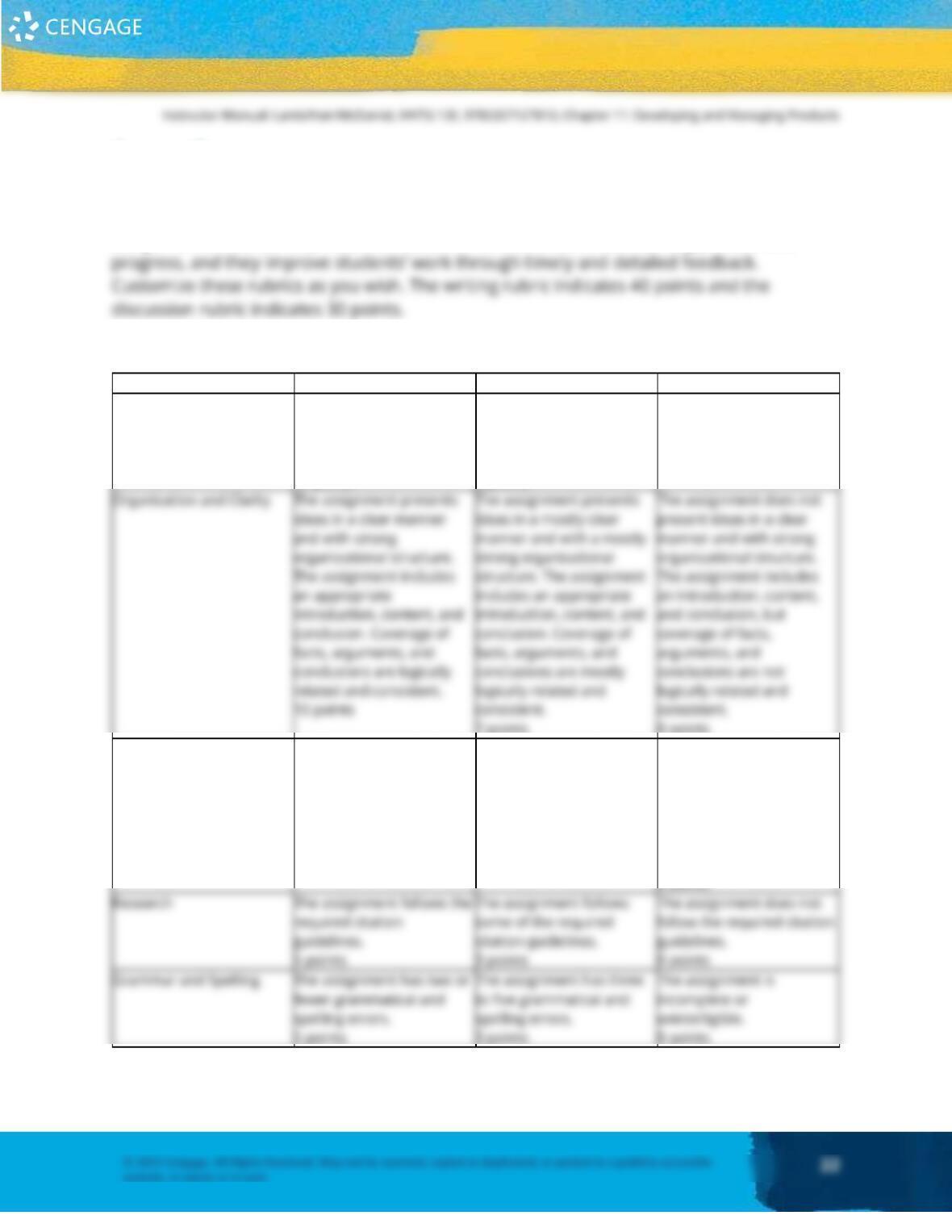
Standard Writing Rubric
Criteria
Meets Requirements
Needs Improvement
Incomplete
Content
The assignment clearly and
comprehensively
addresses all questions in
the assignment.
The assignment partially
addresses some or all
questions in the
assignment.
The assignment does not
address the questions in
the assignment.
0 points
7 points
0 points
Research
The assignment is based
upon appropriate and
adequate academic
literature, including peer
reviewed journals and
other scholarly work.
5 points
The assignment is based
upon adequate academic
literature but does not
include peer reviewed
journals and other
scholarly work.
3 points
The assignment is not
based upon appropriate
and adequate academic
literature and does not
include peer reviewed
journals and other
scholarly work.
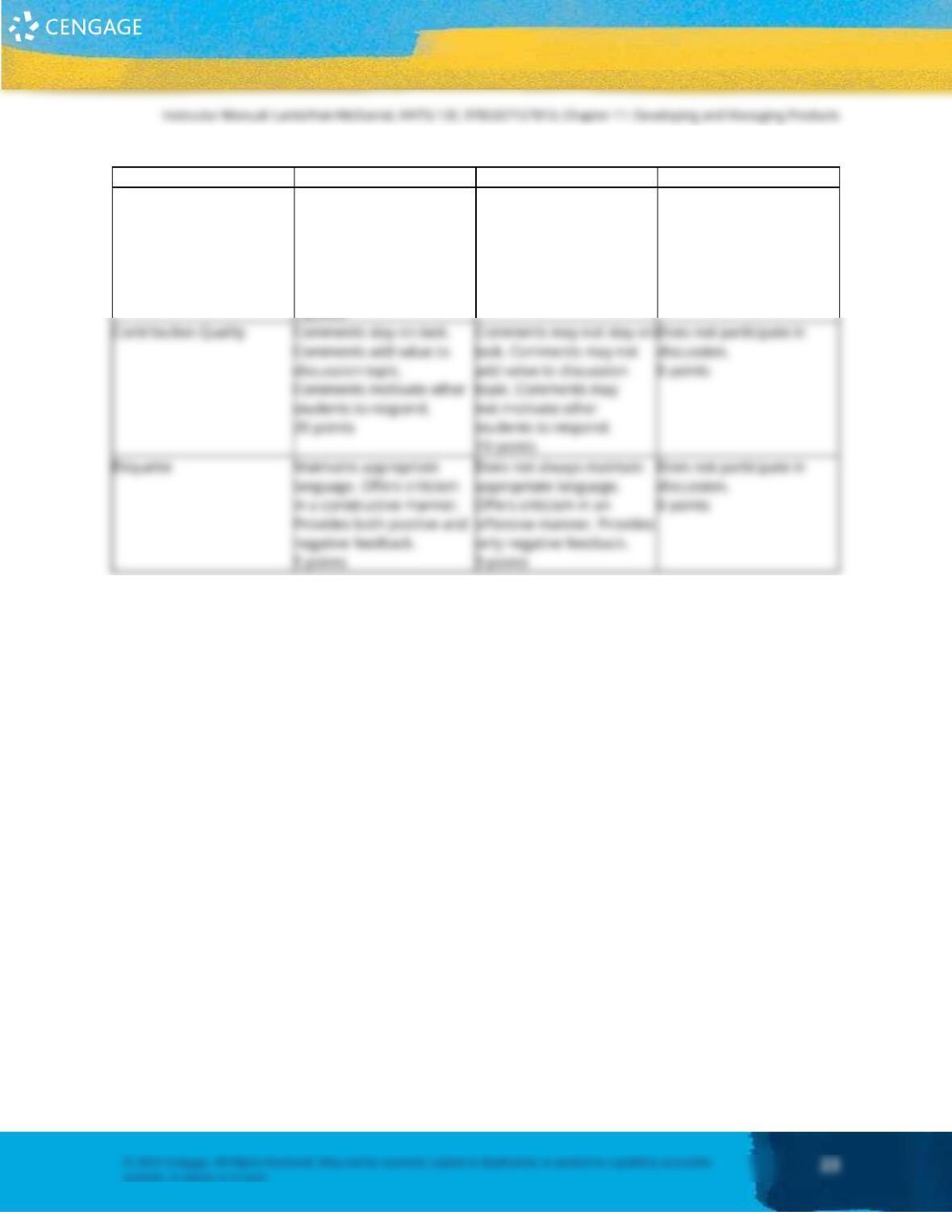
Standard Discussion Rubric
Criteria
Meets Requirements
Needs Improvement
Incomplete
Participation
Submits or participates in
discussion by the posted
deadlines. Follows all
assignment. instructions
for initial post and
responses.
Does not participate or
submit discussion by the
posted deadlines. Does not
follow instructions for
initial post and responses.
3 points
Does not participate in
discussion.
0 points