Chapter 11
Feasibility Studies
Go to the Chapter 11 folder in the Additional Instructor Resources & Solutions folder to find
the Excel spreadsheets that accompany this chapter’s material.
Chapter Overview
I. Introduction
II. Feasibility studies defined
III. Market demand
a. Primary research
b. Secondary research
i. Comparables analysis
c. Individual ticket demand
i. Size of population
d. Corporate demand
i. Corporate depth analysis
ii. Suite and seat revenue potential
iii. Naming rights and other sponsorship revenue
e. Event activity
IV. Financing
V. Location, construction costs, and engineering
VI. Feasibility studies for recreation facilities
VII. Conclusion
Key Concepts
When reading this chapter, students should focus on the following key concepts:

1. Feasibility studies are extremely important components of facility construction projects,
as they specify the size and cost of the facility, expected revenues, the types and
sources of financing, and likely economic impact.
Concept Check Responses
1. What factor or variable is the most important in forecasting market demand for a new
MLB stadium? Provide evidence for your answer.
The point of this question is to get students thinking about all of the fundamental
factors that make a good market for Major League Baseball. These include population,
corporate depth, and spending power (income or a better measure of that). The
fundamental factors are those that are inherent in the community. The team factors
such as winning, history, and so forth also matter, as do stadium quality. Team and
2. What factor or variable is the most important in forecasting market demand for a new
minor league baseball stadium? Provide evidence for your answer.
This is similar to the previous question. From Siegfried and Eisenberg (1980):
Our empirical estimation of the demand for minor league baseball
3. Is a comparables analysis a type of secondary research or primary research? Explain your
answer.
Comparing similar situations in other markets (whether it be attendance in other
interviews, focus groups, and so forth.
4. Suppose a community is considering constructing a large pool facility for use by
community residents. How might it go about conducting a feasibility study for the pool?
a. Describe possible methods for determining annual usage at the pool.
b. Describe possible methods for determining prices to be charged (if any) for entry,
concessions, and any other services or items to be sold.
5. Why do analysts sometimes use retail spending as a factor in measuring market demand
for a sport facility? What are the pros and cons of using it?
Answers will vary; students may not find the answer in the text directly but will need to
Response to Case Analysis Questions
See the Chapter 11 Excel Spreadsheets found in the Additional Instructor Resources &
Solutions folder.
This case involves a new minor league baseball stadium near the central business district of
a small southern California town. Instead of creating a new Single A team, they would move
an existing franchise there.
Background:
The City of Ventura (officially San Buenaventura) sits on 21 square miles just northwest of
Los Angeles, California, and has just over one hundred thousand people (although estimates
for 2010 peg it at 115,000), with median household income just over $52,000 (from the
2000 Census). Retail sales per capita is more than 60% higher than the California average.
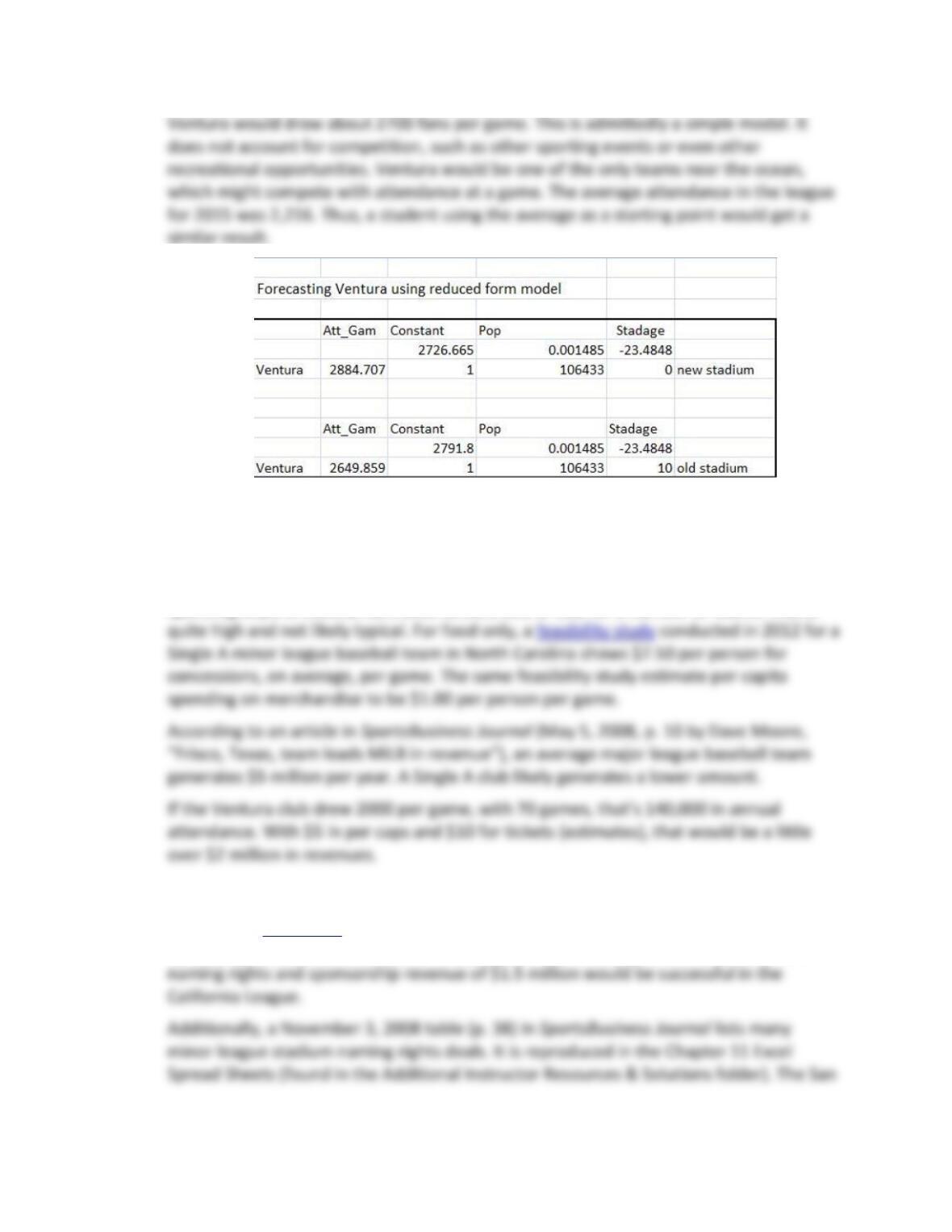
1. Assuming a club that is average in terms of performance on the field, what would be the
expected attendance per season during a typical year (once the “honeymoon effect” has
worn away)?
Using the data provided in the Chapter 11 Excel Spread Sheet (found in the Additional
2. What revenue would you expect to be generated from tickets, concessions, parking, and
merchandise?
Some comparable information had been provided by a minor league baseball
concessions company (Pro Sports Catering). It showed that per caps (per capita
spending beyond tickets) have been around $11 or $12 for a number of teams. That is
3. What revenues would you expect from naming rights and sponsorship?
As shown in this article, the Lansing Lugnuts (Single A) received $1.5 million per year in
naming rights revenue. That appears quite generous for a Single A club. Perhaps total