Chapter 11: Product and Branding Concepts
Example: Procter & Gamble might have one category manager who oversees the dental
care category for Walmart. This manager would try to maximize profitability of all of
Procter & Gamble’s toothpaste, mouthwash, and floss brands on that aisle.
Classroom activity: In small groups, ask students to pick a large company that has many
product lines. Ask them to describe how that company might be managed if they used
product/brand managers. Then ask them to distinguish how it might be different if that company
was organized using category managers.
Organizing for New Product Development
A firm needs to be organized in such a way that its personnel can stimulate and coordinate new
product development. Most companies assign product-innovation functions to one or more of
the following three entities: new product committees, new product departments, or product
managers.
Estimated time: 15 minutes
11-8 Three Major Objectives of Packaging
A package serves three major objectives: protection against damage, spoilage, and pilferage;
assistance in marketing the product; and cost-effectiveness.
Protection against Damage, Spoilage, and Pilferage
The first objective of packaging is to offer physical protection for the merchandise. Products
typically pass through several stages of handling between manufacturing and customer
purchase, and a package must protect its contents from damage. In addition, packages of
perishable products, such as food, must protect the contents against spoilage. Product
tampering is also a concern for many firms.
Assistance in Marketing the Product
Cost-Effectiveness
Although packaging must perform a number of functions, it must do so at a reasonable cost.
Sometimes changes in the packaging can make packages both cheaper and better for the
Chapter 11: Product and Branding Concepts
environment. A redesign of the standard gallon milk jug, for example, could cut shipping costs
and lessen its environmental impact.
What suggestions would they make for improving the package to more effectively meet one or
more of these objectives?
Labels
Labels were once a separate element applied to a package. Today, they are an integral part of
packaging strategy. Labels perform both promotional and informational functions. A label
carries an item’s brand name or symbol, the name and address of the manufacturer or
Key Takeaway: Like its brand name, a product’s package can powerfully influence buyer
purchase decisions.
Estimated time: 15–25 minutes
Chapter 11: Product and Branding Concepts
LEARN IT TODAY . . . USE IT TOMORROW
VIGNETTE AND ACTIVITY
The opening vignette for Chapter 11 discusses Under Armour, the fitness apparel company first
introduced in Chapter 2. This company provides a good case study because they have multiple
product lines in various categories.
Note: Answers to the chapter-ending activity can be discussed in class after the activity
due date.
Branding at Under Armour
One of Under Armour’s core marketing strategies has been “patient” sponsorship: signing on
professional athletes before they hit superstar status.ii Sid Jatia, Under Armour’s VP of direct–to–
consumer media, explains that there is “a ton of scientific research over how an athlete can
perform over the next five to 10 years, there’s a team dedicated to it.” And as sponsored
athletes and teams move up the ranks, so does Under Armour’s brand.
Decision 1
In the United States, Under Armour is commonly associated with baseball and football. In order
to penetrate deeper into the market for Major League Soccer (MLS) fans, it has developed a line
of premium jerseys (considered shopping products) that feature the insignias of different MLS
Answer to Decision 1
#1—Incorrect. As the new line is made up of shopping products that are more expensive,
advertising can help build awareness, but personal selling by the retailer will likely be needed.
Chapter 11: Product and Branding Concepts
#2—Correct. Shopping products typically utilize advertising to build awareness, but also
personally selling to inform consumers and persuade them to buy.
Decision 2
In new global markets, Under Armour wants to focus on line extension to leverage their existing
brand name and market strength. In Brazil, Under Armour’s apparel and shoes are already big
Answer to Decision 2
#1—Correct. Since Under Armour already makes apparel and wants to concentrate on line
extension, this is a way for them to increase sales by offering a new product within one of their
existing product categories.
#2—Incorrect. Since this would represent an entirely new product category for Under Armour, it
represents brand extension. Under Armour wanted to focus on line extension, so expanding
products in their existing apparel category would be a better choice.
Decision 3
Because building brand equity is so important to Under Armour, they don’t participate in private
branding. Suppose two new line extension opportunities have presented themselves. First,
Answer to Decision 3
#1—Correct. Since the soccer jerseys would be branded as Under Armour, this opportunity
aligns with Under Armour’s goal of building equity in their national brand.
#2—Incorrect. While Amazon’s sales projection is higher than Walmart’s, this is a private
branding arrangement that does not build equity in Under Armour’s national brand.
Decision 4
A product manager at Under Armour suggests packaging upgrades for their flagship line of
compression shirts. Instead of putting the shirts on hangers or folding them on a shelf—as is the
Chapter 11: Product and Branding Concepts
#1—Implement the new packaging
#2—Maintain existing packaging or look for other alternatives
Answer to Decision 4
#1—Incorrect. While the new packaging might protect the product from damage and assist in
Decision 5
Suppose Under Armour has created a new, super nylon that is 50% more durable and long-
lasting than the synthetic fibers it has been using. Under Armour has branded it ProWear, but
Answer to Decision 5
#1—Incorrect. The word “Nike” is already trademarked in the same industry as Under Armour.
As a result, it’s legally protected and can’t be used by another firm.
Chapter 11: Product and Branding Concepts
ADDITIONAL HOMEWORK/CLASSROOM ACTIVITIES
Goods-Services Continuum
Purpose: To help students better understand the goods–services continuum.
Background: The distinction between a good and a service can be somewhat confusing, since
Relationship to Text: What Are Goods and Services? Goods–Services Continuum
Estimated Class Time: About 15 minutes
Preparation/Materials:
• Write a giant goods–services continuum line on the board. Number the line from one
to ten, with “pure good” at the one and “pure service” at the ten:
Pure good |—--|——|—–|——|—–|——|—--|——|——| Pure service
1 2 3 4 5 6 7 8 9 10
Exercise: Divide your class into small groups. For the sake of esprit de corps, give them a
moment to choose names, and write them on the board. Then, direct the groups to decide
where to place the following companies on the continuum (whole numbers only—no fractions
allowed), along with a strong rationale.
• Yahoo.com
Then the fun begins. Announce that each group starts with ten points (which you should track
on the board). A volunteer from each team will choose a company at random (from your folded
papers), write it on the continuum, and explain why the group assigned that placement. Then,
Chapter 11: Product and Branding Concepts
points wins. To encourage risk-taking, you may also want to offer a small prize to the group with
the least number of points. Tootsie Rolls work great for both the winning and the losing groups.
Questions for Reflection:
• How would marketing strategies differ for products at either end of the continuum?
Features of Services
Purpose: To highlight the concrete meaning of each feature of services.
Background: Since few services are completely “pure,” students are often quite puzzled about
Relationship to Text: What Are Goods and Services?
Estimated Class Time: Less than five minutes
Exercise: Choose an example of a complex service—Disneyland and Disney World work
Questions for Reflection:
• Why does it matter whether your product is a good or a service? How (if at all) would
the distinction affect marketing strategy?
• What is the biggest challenge in marketing services? Why?
Brand Names
Purpose: To emphasize the varied origins of effective brand names.
Background: A surprising number of students are planning to start their own businesses, so
Relationship to Text: Brand Names and Brand Marks
Estimated Class Time: About 20 minutes
Preparation/Materials: Make a copy of the list of brands (below) for each student.
Chapter 11: Product and Branding Concepts
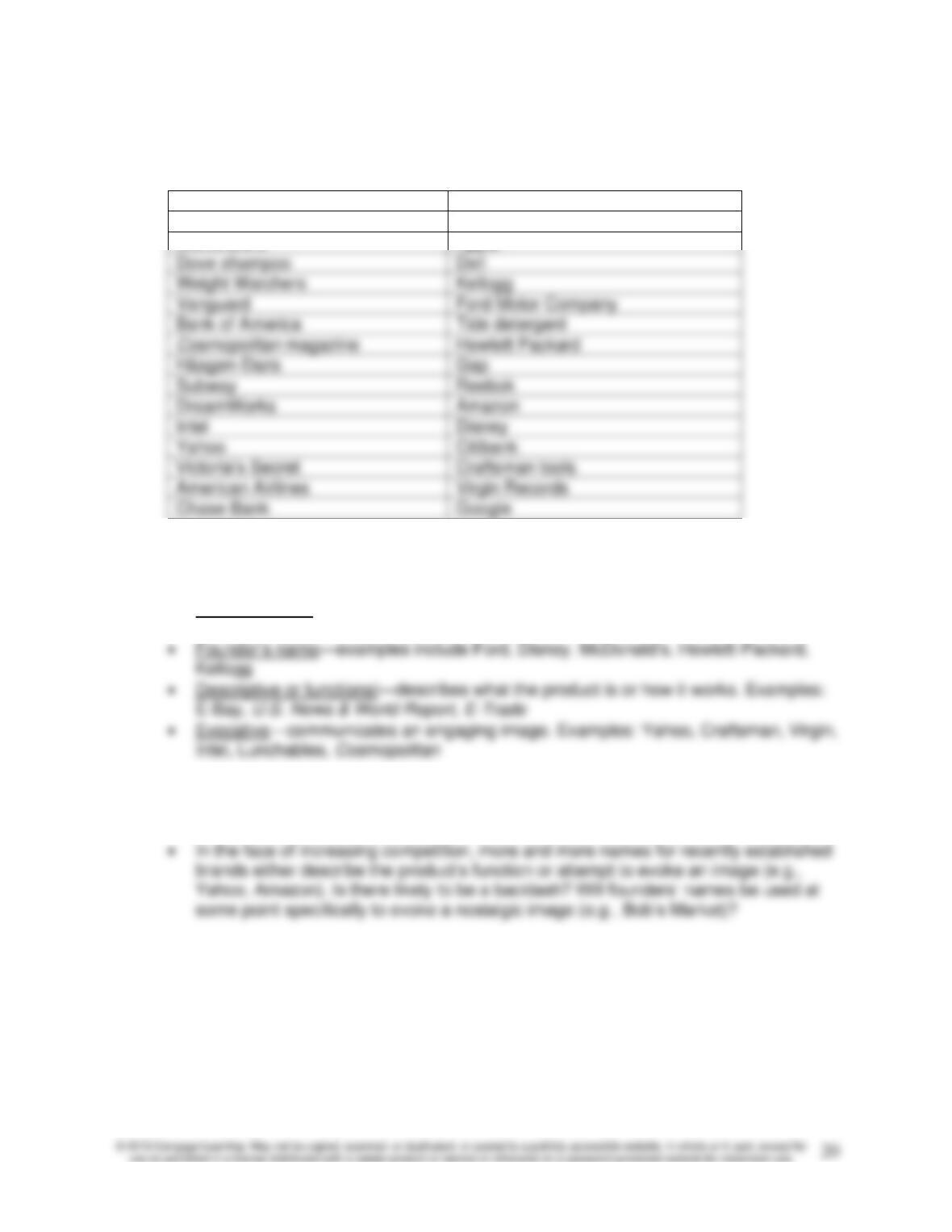
Exercise: Divide your students into small groups and give each person the list of brands in the
table below. Direct the teams to extrapolate different sources of brand names from the brands in
the table (and encourage them to use any other brand names to support their thinking.)
Lunchables
Southwest Airlines
Dave’s Killer Bread
Nike
Apple
Dove shampoo
Dell
Weight Watchers
Kellogg
Vanguard
Ford Motor Company
Bank of America
Tide detergent
Hewlett Packard
Gap
Subway
Reebok
DreamWorks
Amazon
Intel
Disney
Yahoo
Citibank
Victoria’s Secret
Craftsman tools
American Airlines
Virgin Records
Chase Bank
Google
Students seem to love this exercise, perhaps for its relevance to their own business
plans. Categories that typically emerge include the following:
• Location-based—refers to either the area-served or the place of origin. Examples:
Southwest Airlines, Bank of America
Questions for Reflection:
• Can a name fall into more than one category? What are some examples (e.g., E-Bay
is both descriptive and evocative)?
Trademarks
Purpose: To explore the value of trademarks.
Background: Brand identifiers for many products go far beyond brand names, sometimes
including symbols, packaging, colors, and other elements of trade dress. This exercise is
Chapter 11: Product and Branding Concepts
designed to help students internalize the value of trademarks and trade dress, while flexing their
creative muscles.
Relationship to Text: Trademarks
Estimated Class Time: About 10 minutes
Exercise: Share the following brand identifiers with your class: McDonald’s golden arches, the
Questions for Reflection:
• What role should the government play in protecting trademarks? Why?
• Should any trademark “knock–offs” be legal? Why or why not?
Internet Exercise—Brand equity
Several sources compile lists each year of the world’s most valuable brands. Two are
Bloomberg Businessweek magazine and a consulting firm called Brand Finance. Visit both
Chapter 11: Product and Branding Concepts
KEY TERMS
Goods: Tangible products that customers can see, hear, smell, taste, and/or touch.
Services: Intangible products.
Shopping products: Products that are more expensive than convenience items and ones
where consumer lacks complete information prior to the buying process.
Specialty products: Higher-end products offering unique characteristics that compel buyers to
purchase particular brands.
Installations: Major capital investments in the B2B market.
Accessory equipment: Products such as power tools, computers, and office furniture that
typically cost less and last for shorter periods than installations.
Business services: Intangible products firms buy to facilitate their production and operations.
Brand: A name, term, sign, symbol, design, or some combination that identifies the products of
one firm while differentiating these products from competitors.
Brand recognition: Consumer awareness and identification of a brand.
Brand preference: When buyers choose a product over a competitor based on experience.
Chapter 11: Product and Branding Concepts
Trademark: A brand for which the owner claims exclusive legal protection.
Line extension: The development and implementation of new sizes, styles, or related product
offerings.
Brand extension: Attaching a popular brand name to a new product in an unrelated product
category.
Brand manager (or product manager): The marketer responsible for a single brand or
product.