CHAPTER 11
Cultural Values and Consumer Behavior
LEARNING OBJECTIVES
11.2 To understand cultural learning.
11.4 To understand core cultural values and their marketing applications.
CHAPTER SUMMARY
Learning Objective 11.1: To understand culture’s dynamics and impact on consumer behavior.
Culture represents a society’s values, customs, norms, arts, social institutions, and intellectual
achievements of a particular society. Cultural values express the collective principles, standards,
and priorities of a community. Most of the promotional messages across the world reflect, to
some degree, the cultural values of the target audiences. Cultures always evolve, so marketers
must monitor the sociocultural environment so as to market existing products more effectively
and develop new products that are congruent with changing cultural trends. Understanding
cultural changes is not an easy task because many factors produce cultural changes within a
given society, including new technologies, population shifts, resource shortages, and customs
from other cultures.
Learning Objective 11.2: To understand cultural learning.
Society’s members share their values and customs through a common language, although some
cultures include more than one language. We learn cultural norms and customs mostly from
family and peers, and begin at a very young age to understand that some behaviors are
appropriate and others are not. Anthropologists have identified three forms of cultural learning:
formal learning, informal learning, and technical learning. Our ethical values are also formed
during childhood, as we learn them from parents, teachers, and other significant adults.
Anthropologists distinguish between enculturation (learning one’s own culture) and acculturation
periodically.
Learning Objective 11.3: To understand the means to study cultural values.
The most widely used measurements of cultural values are content analysis, consumer field
observation, and value measurement instruments. Content analysis focuses on the content of
societies’ verbal, written, and pictorial communications, including promotional messages. When
examining a specific society, anthropologists frequently study cultures through field observation,
which consists of observing the daily behavior of selected members of a society. Based on their
Learning Objective 11.4: To understand core cultural values and their marketing applications.
Americans’ and other societies’ core values—often employed as persuasive appeals in
advertising campaigns—include achievement and success, time and activity, efficiency and
practicality, progress, comfort and pleasure, individualism and conformity, freedom of choice,
humanitarianism, youthfulness, fitness and health, and environmental concerns.
CHAPTER OUTLINE
Introduction
1. Culture is the collective values, customs, norms, arts, social institutions and intellectual
achievements of a particular society.
2. The study of culture is a challenging undertaking because its primary focus is on the broadest
component of social behavior in an entire society.
*****Use Figures #11.1 and #11.2 Here; Use Review and Discussion Question 11.1
Here*****
Culture’s Role and Dynamics
1. Culture, the collective values, customs, norms, arts, social institutions, and intellectual
2. There are three “levels” of cultural norms:

24) includes:
i) In-crowd – privileged and seeking approval from others
ii) Pop mavericks – word-of-mouth spreads rapidly; passion, individuality, instant
gratification and personalization important
iii) Networked intelligentsia – hub of online social networks; revolution, creativity,
deconstruction
iv) Thrill renegades – infamy, adrenaline, anarchy
b) National level factors – such as shared core values, customs, personalities, and
predispositional factors that tend to capture the essence of the “national character” of
***** Use Learning Objective #11.1 Here *****
3. Researchers identified four segments of global youth aged 14 to 24:
a) In-Crowd
4. Marketers should periodically reconsider why consumers are doing what they do, who are the
5. Culture expresses and satisfies the needs of societies.
a) It offers order, direction and guidance for problem solving by providing methods of
satisfying physiological, personal, and social needs.
b) Culture determines whether a product is a necessity or discretionary luxury.
c) Culture dictates which clothes are suitable for different occasions.
d) When a specific standard no longer satisfies the members of a society or reflects its
needs, it is modified or replaced.
Learning Cultural Values
1. We learn cultural norms and customs mostly from family and peers.
2. There are three distinct forms of learning:
a. Formal learning—adults and older siblings teach a young family member “how to
behave.”

4. The learning of a new or foreign culture is known as acculturation.
6. Marketing influences cultural learning.
8. Social media conveys and shapes cultural values; influential people communicate.
9. A symbol is used to convey desired product images or characteristics; it is anything that
stands for something else.
10. A ritual is a type of symbolic activity consisting of a series of steps occurring in a fixed
sequence and repeated over time.
a. They can be public or private, elaborate, religious, or civil ceremonies, or they can be
mundane.
b. Rituals tend to include ritual artifacts (products) that are associated with, or somehow
enhance, performance of the ritual.
c. Ritualistic behavior is any behavior that is made into a ritual.
*****Use Key Terms ritual and ritualistic behavior Here; Use Figures #11.4 and #11.5 Here;
Use Assignment #11.8 Here*****
Measuring Cultural Values
1. There are a variety of measures of culture, including: content analysis, consumer field
2. Content analysis focuses on the content of verbal, written, and pictorial communications. It
3. When examining a specific society, anthropologists frequently study cultures through field
observation, which consists of observing the daily behavior or selected members of a society
4. In addition to fieldwork methods, depth interviews and focus groups are also quite often
employed by marketers to study social and cultural changes.
5. Researchers exploring the symbolic meanings of food conducted 30 in-depth interviews
suggested there are six types of foods:
a) Symbolic
b) Individual
c) Social
d) Ritualistic
e) Context
f) Experience
*****Use Key Terms content analysis, field observation, and depth interviews Here *****
6. Recently there has been a gradual shift away from inferring characteristics about culture via
observation to directly measuring values by means of survey research.
a) Value instruments ask people how they feel about such basic personal and social
concepts as freedom, comfort, national security, and peace.
b) The Rokeach Value Survey is a self-administered value inventory, which is divided
into two parts.
i) Part one consists of 18 terminal value items, designed to measure the relative
importance of end-states of existence (personal goals).
*****Use Key Terms Rokeach Value Survey, terminal values, interpersonal values, and
Gordon’s Surveys of Personal and Interpersonal Values Here; Use Figure #11.6 Here
******
Core Cultural Values
1. Identification of core values in the United States is a very difficult task for several reasons.
a) The United States is a very diverse country consisting of a variety of subcultures, each
of which interprets and responds to society’s basic beliefs and values in its own specific
way.
b) The United States is a dynamic society, as illustrated by changes due to rapid
*****Use Key Term American core values Here; Use Learning Objective #11.4 Here*****
3. The core values identified include achievement and success, time and activity, efficiency and
practicality, progress, materialism (comfort and pleasure), individualism and conformity,
freedom of choice, humanitarianism, youthfulness, fitness and health.
a) Achievement and Success
i) These values have historical roots in the traditional Protestant work ethic, which
considers work to be wholesome, spiritually rewarding, and an appropriate end in
itself.
ii) Research shows the achievement orientation is closely associated with the technical
development and economic growth of the American society.
iii) Individuals who consider a sense of accomplishment to be an important personal
f) Individualism and Conformity
i) Americans want to be themselves.
ii) Self-reliance, self-interest, self-confidence, self-esteem, and self-fulfillment are all
expressions of individualism.
iii) Although Americans deeply embrace freedom of choice and individualism, they
accept the reality of conformity.
g) Freedom of Choice means the opportunity to choose from a wide range of alternatives
and is reflected in the large number of competitive brands and product variations that
can be found on the shelves of the modern supermarket or department store.
h) Humanitarianism
i) Americans tend to be charitable and willing to come to the aid of people less
fortunate.
4. Four distinct benefits donors received from monetary pledges to ALS were belongingness,
trust, social-practical motivation, and prestige.
5. Green marketing is producing and promoting reusable and eco-friendly products.
a) Virtually all companies have adopted at least some environmentally friendly practices
in response to global awareness of climate change and its consequences for our planet.
b) Many Americans consider buying environmentally sound products part of their duties
as consumers and societal and cultural priority.
6. Consumer environmental stewardship is one’s personal sense of responsibility for the
environment, accountability for purchases’ environmental impact, and willingness to
sacrifice personal comfort for the good of the environment.
8. Another study identifies four groups of “green” consumers: True Greens, Donor Greens,
Learning Greens, Non-Greens.
REVIEW AND DISCUSSION QUESTIONS
11.1 Distinguish among beliefs, values, and customs. Illustrate how the clothing a person
wears at different times or for different occasions is influenced by customs.
Beliefs consist of the very large number of mental or verbal statements that reflect a person’s
particular knowledge and assessment of something. Values are also beliefs, however, values
11.2 A manufacturer of fat-free granola bars is considering targeting school-age children
by positioning its product as a healthy, nutritious snack food. How can the three forms
of cultural learning be used in developing applicable marketing strategies?
Anthropologists have identified three distinct forms of cultural learning; formal learning, in
which adults and older siblings teach a young family member how to behave; informal
11.3 The Citrus Growers of America is designing an advertising campaign aimed at
getting consumers to switch to orange and grapefruit juices instead of soft drinks as a
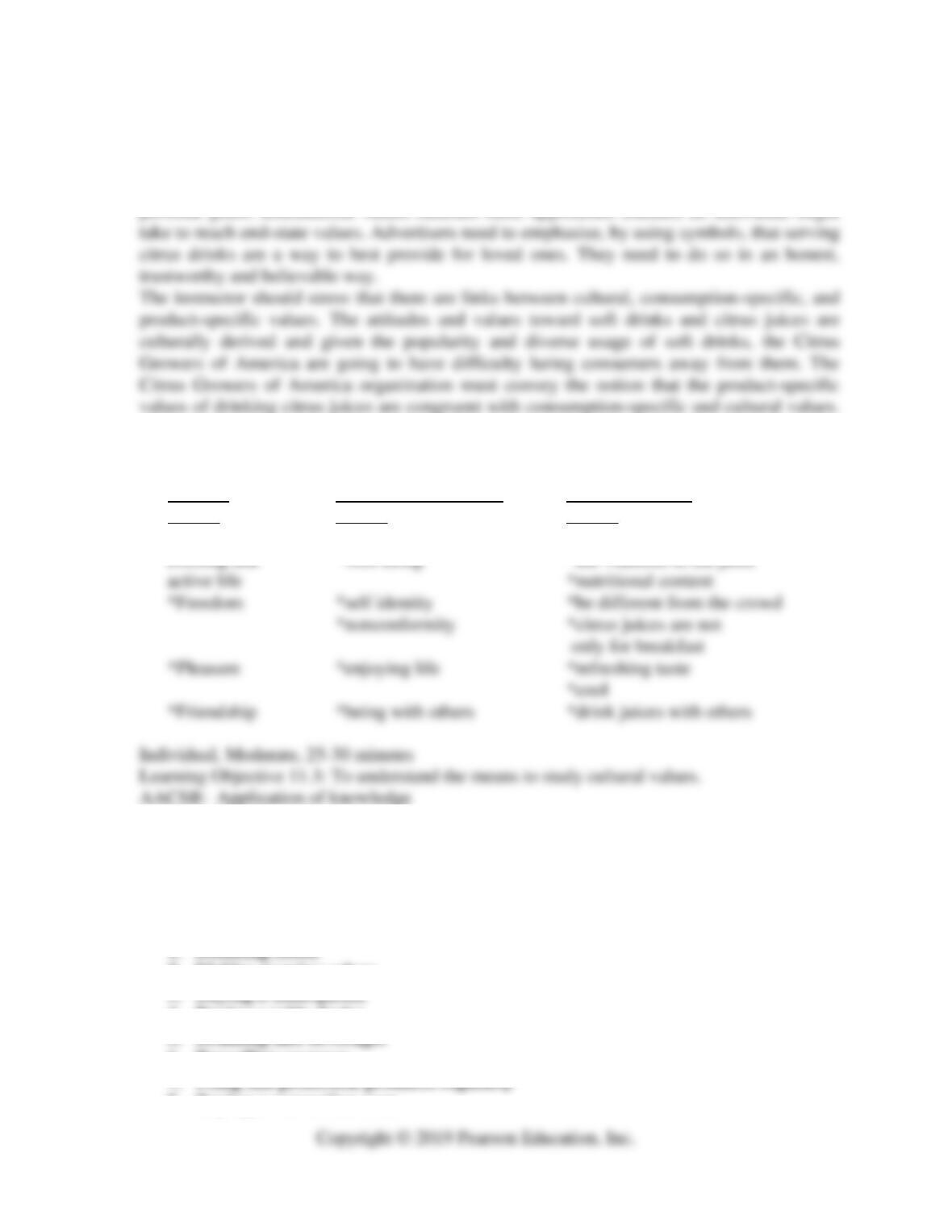
“sugar jolt” in the late afternoon. Describe how the organization can use the Rokeach
and the Gordon measures in planning its campaign.
Terminal values are designed to measure the relative importance of end states of existence or
Thus, the association should consider the links between culture and consumption of juices
and soft drinks. Some of these possible links are:
Cultural Consumption-Specific Product-Specific
Values Values Values
*An *physical health *natural drink
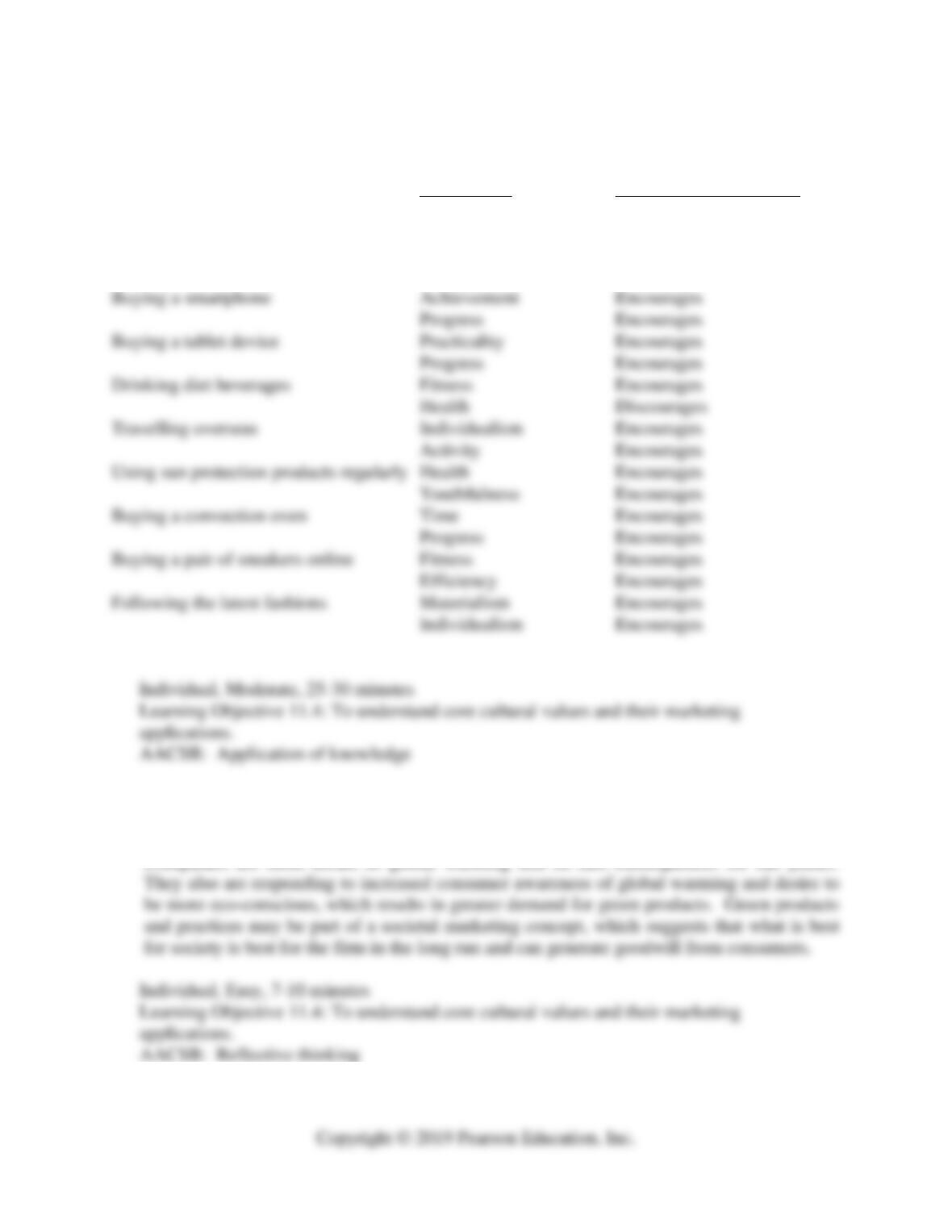
11.4 For each of the following products and activities listed below:
a. List two relevant core values and explain your choices.
b. Describe how each value either encourages or discourages buying the product or
engaging in the activity.
The products and activities are:
2. Visiting tanning salons
4. Buying a table device
6. Travelling overseas
8. Buying a convection oven
9. Buying a pair of sneakers online
10. Following the latest fashions
Core Values Encourages/Discourages
Donating blood Humanitarianism Encourages
Individualism Discourages
Visiting tanning salons Time Encourages
Health Discourages
11.5 Why are companies increasingly introducing “green” products and engaging in
ecological- friendly practices?
11.6 How did consumers react to “green” products?
There is a discrepancy between what consumers say and what they do. Although many
Americans claim to feel it is a societal and cultural priority to engage in more
HANDS-ON ASSIGNMENTS
11.7 Identify a singer or singing group whose music you like and discuss the symbolic
function of the clothes that person (or group) wears.
Instructor’s Discussion
11.8 Thinking of your daily routines, identify one routine that you consider a ritual.
Describe it and explain why it is a ritual. Assume that you allow a marketing
researcher come to your house and observe your entire ritual. Explain how the
marketer of a product that you use during your routine can employ observation to
design an ad aimed at getting you to switch brands.
Instructor’s Discussion
Prepare to share a couple of your own or family rituals to prime the pump. Students’
11.9 a. Summarize an episode of a Netflix, TV show, or online series that you watch
regularly. Describe how the episode transmitted cultural beliefs, values, and customs.
b. Select three commercials that were broadcast during the episode and describe how
each reflects cultural value(s).
Instructor’s Discussion
In advance of the class, the professor should assign a TV program that all students must
11.10 a. Find advertisements for two brands of deodorants. Do a content analysis of the
written and pictorial aspects of each ad. Identify any core values portrayed in each ad
and explain your choices.
b. Describe how the symbols in each ad convey the deodorant’s characteristics and
brand image.
Instructor’s Discussion
This exercise provides students with an opportunity to identify the presence of cultural values
11.11 Find five ads promoting “green” products or activities and explain whether you
believe each one is effective or not.
Instructor Discussion
This exercise provides students with an opportunity to identify the products and services that
are communicating that they minimize the harm associated with consumption and/or
S.TA.R. PROJECTS
Ethical Issues in Consumer Behavior
S.T.A.R. Project #1
Do a search of popular magazines that carry a number of clothing and consumer products ads.
Select magazines that are clearly targeting an Anglo market, an African-American market, and a
Hispanic market. Compare the ads in the different magazines for similarities and differences.
How are the beliefs, values, and customs of the three American-cultural groups different and/or
similar? What different symbols are used to convey messages within the different magazines?
Are the predominant color schemes different? Once the preceding analysis is completed,
comment on any ethical issues that you have observed during your research. Write a short paper
that summarizes your findings.
Instructor’s Discussion
S.T.A.R. Project #2
Review the material found in the chapter on American Core Values. As you read about the
general features and relevance to consumer behavior of the American Core Values, consider the
ethical responsibility that marketers must have when directing promotional efforts toward these
values. Write a short paper that expresses what you perceive these ethical responsibilities to be.
You may pick a particular company or product to use as an example or may discuss the issues
generally. Be sure to consider using illustrations (advertisements) of your thoughts or position.
Instructor’s Discussion
Small Group Projects
S.T.A.R. Project #3
The learning of one’s own culture is called enculturation. How do we learn this culture?
(10) language or symbols for communication illustrations for each group. Write a short paper
that discusses what you have done and conclusions on the differences and similarities found.
Present the information in class.
Instructor’s Discussion
S.T.A.R. Project #4
“We all live in tribes.” Well, maybe not all of us, but those on the hit CBS TV series Survivor
certainly do (see www.cbs.com). Your group’s assignment is to examine tribal (ritual) behavior
and its impact on consumer behavior. Begin the assignment by examining the Survivor TV
show’s history found on the CBS Web site. Next, do secondary research on tribal behavior
(rituals). For example, review rituals in the military, sports, fraternities, sororities, clubs, and
organizations and how these rituals are transferred to consumptive behavior. Once this has been
completed, write a short position paper that summarizes your findings and indicates what you
have learned about the relationship between tribal (ritual) behavior and consumer behavior.
Instructor’s Discussion
S.T.A.R. Project #5
Advertising symbols are important ways that companies communicate with consumers. We all
know the logos for Kellogg’s, Chevrolet, and IBM. Your assignment in this question is to play a
symbols game and see how you score. Mr. Joey Katzen has developed an excellent symbols
recognition game to be found at www.joeykatzen.com/alpha. The Retail Alphabet Game takes
letters (symbols) from well-known retail names or phrases and asks you to identify them. This
trivia game helps us to understand how important symbols and names are to the marketing and
communication effort. Play the game and tell us how you scored. What did you miss? What did
you get right? What conclusions can you draw about your ability to recognize symbols? Write a
short paper that expresses your thoughts.
Instructor’s Discussion
S.T.A.R. Project #6
One of the easiest ways to examine one’s values is to observe how they dress. Specifically,
jewelry says a lot about the man or woman. Your assignment is to find four (4) wrist watch Web
sites and review the products found on these Web sites. Taking the American Core Values
discussed in the chapter, write a short paper about how the companies you investigated appeal to
American Core Values. Be sure to include examples to illustrate your feelings. Lastly, comment
on how the opening Web pages of the sampled sites set the stage for value transmission to the
consumer. What specific devices are used by the site marketers?
Instructor’s Discussion