
Chapter Eleven
Business Development and Planning
Authors’ Comments
In this chapter, we develop several ideas that have arisen from our contact with
marketing managers and entrepreneurs, as well as from our own experience.
Businesses, both new and established, pursue product development and innovation
efforts as they are usually well aware that they need to be active in looking for new
An important part of business development–and an important tool for marketing and
sales planning as well–is the Market Operations Forecast (MOF). This is a tool that
allows managers to plan and continuously review the company’s marketing activity, its
effectiveness, how it is influenced by exogenous trends, and how new opportunities
are likely to develop. We present the basics, giving you, the instructor, a base to work
from in presenting this to student.
Users of this book’s predecessor will recognize the forecasting portion of this chapter
as originally in Chapter Six. In the development of this edition, it became apparent
that Chapter Six, with the updates we planned, was too long. When this chapter
With the continued use of the Product Life Cycle as the anchor, we discuss how
Chapter 11: Business Development and Planning 2
business development and marketing combine to address new opportunities and
change over time. We relate the PLC to the Technology Adoption Life Cycle–the
distinctions between customer adopter types provide clues for how marketers will
need to change their marketing strategies as products evolve.
Opening Vignette
Sensacon and New Business Progression
Sensacon, our hypothetical company (founded in Chapter 8) about an innovator in the
pressure sensor industry, serves as the model for this opening. As noted earlier,
Sensacon is a composite of several real companies and illustrates many of the ideas
we are trying to get across. In this vignette, we trace Sensacon’s movement from
offering specialty sensor products in small market niches to crossing the chasm,
competing in larger, sophisticated, rapidly evolving markets.
The Sensacon example can be referred to throughout this chapter to illustrate the
concepts presented and their practical implications. It would also be useful to return
Learning Objective
Understand the distinctions between “line” functions and
“development” functions in an organization.
Chapter 11: Business Development and Planning 3
Business Development (PowerPoint 11.2)
The search for opportunities and the structuring of business entities to exploit
those opportunities with current or near term organizational capabilities. It
involves
Business development (BD) is the “link” between planning to create new
revenue from a new source and the execution of that revenue generation. It is
the activity that encounters uncertainty, finds a way to overcome that
uncertainty and executes the activity to generate revenue from the new source.
Learning Objective
Explore how the level of innovation of an offering can determine the
part of an organization that is responsible for its success.
As markets change in the context of the PLC and the TALC, the best segments
to target will also change. BD efforts search for new segments, define their
usage and purchasing patterns and structure new offerings and operations to
address these new opportunities.
Students may ask what the difference is between business
Chapter 11: Business Development and Planning 4
Learning Objective
Understand the different types of forecasts and the integration of
market information into the organization.
Chapter Six has discussed market research methods in business-to-business.
Market research is usually a snapshot in time and in itself, not a tool for
The usefulness of a forecast will be directly related to the time, effort and
money invested in its accuracy. (PowerPoint 11.3)
Marketing forecasts attempt to account for: (PowerPoint 11.4)
• Technological change
Different types of forecasts can be employed depending on purpose, the data
that are available, and time available to do the analysis.
Types of Forecasts (PowerPoint 11.5)
• Strategic forecasts
Strategic forecast (PowerPoint 11.6)
• “Top down” forecast
Marketing planning forecasts (PowerPoint 11.7)
• Usually associated with a product or market
Marketing operation forecasts (MOFs) (PowerPoint 11.8)
Chapter 11: Business Development and Planning 5
• Usually the responsibility of the field marketing organization
Sales forecasts (PowerPoint 11.9)
• Shorter range than MOFs
Other predictive models: Exhibit 11-1 (PowerPoint 11.10)
Often involve statistical manipulation of historical data
• Rolling Averages
Learning Objective
Exhibit 11-1: Predictive Models
Rolling Averages
Forecast for the next period is a weighted average of a preset number of prior periods.
Econometric Models
Forecasts are based on relationships derived through statistical analysis.
• Useful for coverage of several years
Delphi Approach
Forecasts are from a panel of experts who are systematically polled.
• Executive opinion polling, with feedback provided to respondents to enable “correction” to the mean
Chapter 11: Business Development and Planning 6
Understand the distinctions between
New Business, Translation
and
Core Churn
categories of business and the business-to–business
marketing resources necessary to support each effort.
These categories of business provide marketing managers with insight into the
level of resources that will be required to support market development efforts.
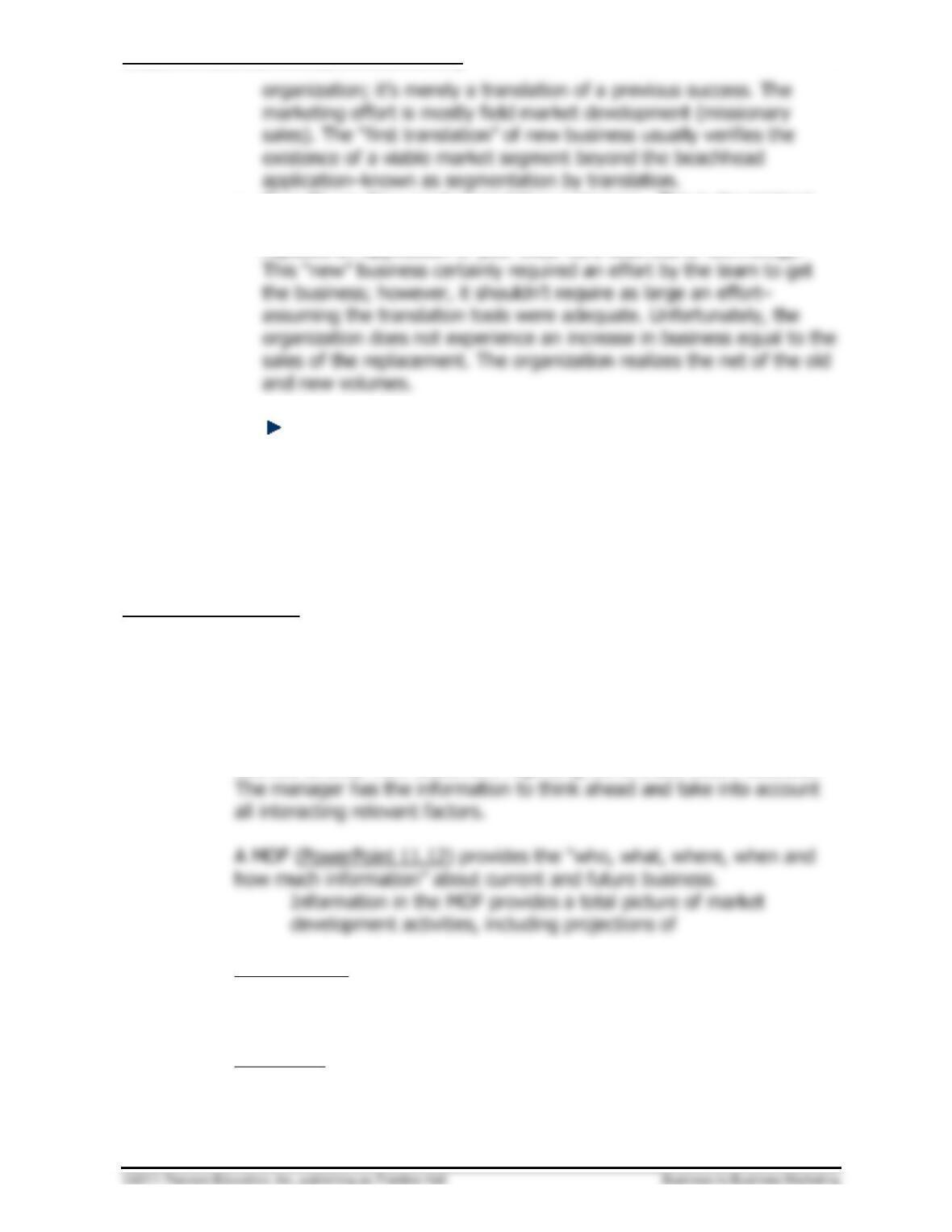
Business Development Tracking Grid: Exhibit 11-2 (PowerPoint 11.11)
This grid provides relatively straightforward definitions of the categories
of business.
• Core: Existing business with existing customers/markets. Most
resource commitments are logistical in nature. Field sales maintains a
successful relationship with customers, recognizing that the business
Products
New Existing
New
New
Business
Translation
Exhibit 11-2 Business Development Tracking Grid
Chapter 11: Business Development and Planning 7
• Core Churn: New products/existing customers. This is the trickiest
category.
Churn
occurs when translation business at a customer
replaces an application of your older core business or technology.
A single piece of business can fall into more than one category, as
described by the core churn definition. Students may note the
similarity between product/market expansion tools that define new
markets/new products as diversification. Please note that new
business is not necessarily a diversification. The resources required
can be significantly different.
Learning Objective
Understand the value, use and development of a market operations
forecast, and the launch of new business efforts, segmentation by
translation, and core churn management.
The MOF is one of the most useful tools in managing marketing, sales
and business development. Done well, the most of the information is
sourced directly from customers regarding current and future business.
• Core business–How much will customers buy of what they are now
already buying and when will they buy it? How much will customers pay
for it?
• Core churn–How much of current customers’ demand for existing
products will be replaced (usually through translation efforts) by demand
for new products? When will they buy it? How much will customers pay
for it?
Chapter 11: Business Development and Planning 8
Operational forecasts of this detail can be difficult, not because the necessary
information is not available but because obtaining it can be time consuming and
will be viewed by a field seller as getting in the way of selling. This will be
aggravated if there is no formal missionary sales structure.
Learning Objective
Understand the different efforts involved with launching new
products and managing mature business both at the organizational
and customer level.
Managing products through the product life cycle
In this section, we make use of the Product Life Cycle and Technology
Adoption Life Cycle simultaneously.
Chapter 11: Business Development and Planning 9
The following is a review of the stages of the PLC with the ideas of the
TALC integrated in. This is a precursor to the discussion of business
development and marketing implications for each stage. The instructor
can decide whether to present these as two passes through the stages
or to treat the changing environment and changing BD/Marketing
implications simultaneously.
For classroom discussion, consider leading students through a
discussion of the challenges faced by Sensacon as the company evolves
through the TALC and the PLC.
Development Stage of the product life cycle, efforts focus on moving
invention to innovation, often with a specific partner or customer.
Introduction Stage–with feedback from technophiles and visionaries,
development work continues to improve the product. The customers in
Growth Stage–product innovation continues, but moves toward a
consistent architecture; the type of innovation transitions toward
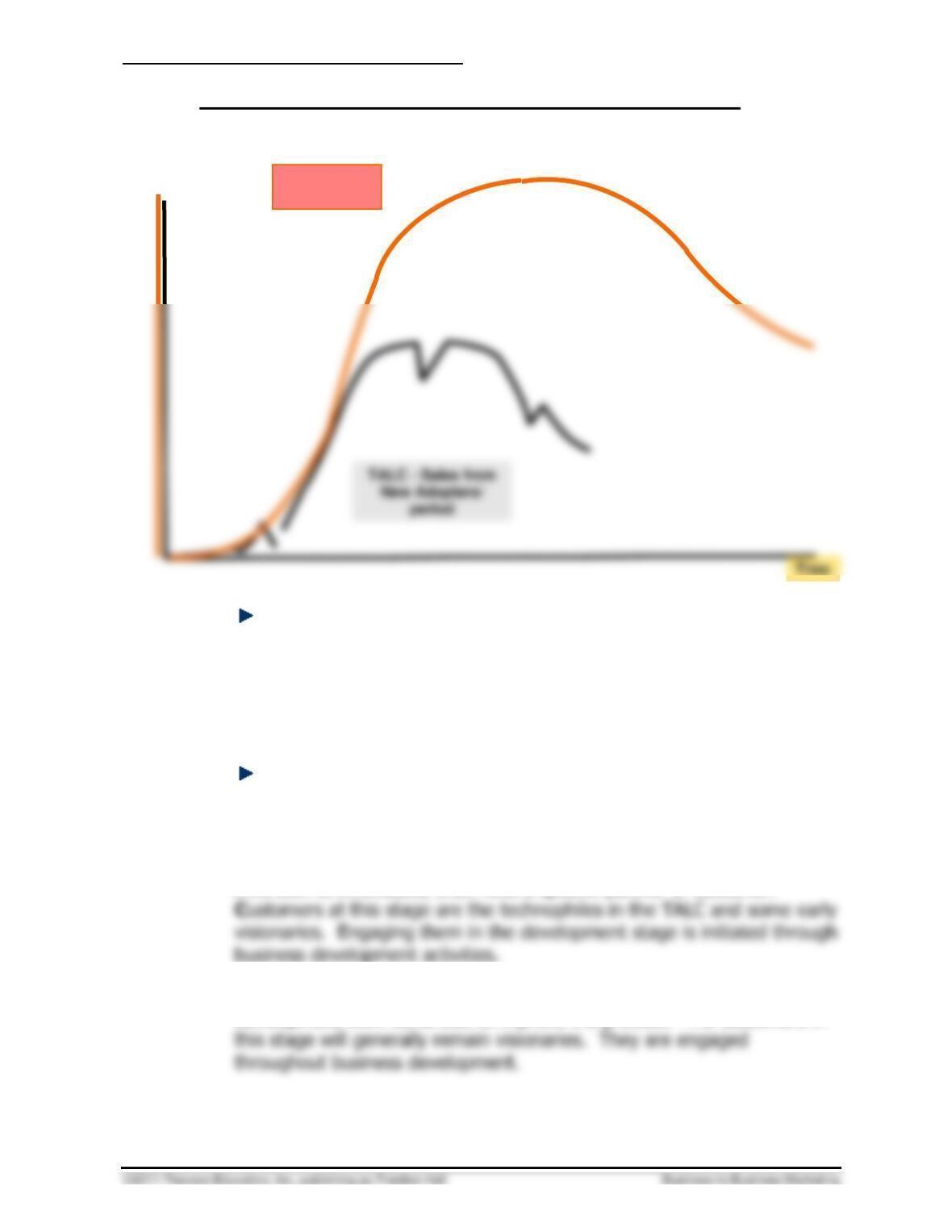
Exhibit 11-4 The TALC and PLC Superimposed
PLC – Total
Sales
Chapter 11: Business Development and Planning 10
incremental from radical. Two phases occur in the growth stage.
Mature Stage–begins when markets begin to become saturated and
when most buyers are customers that have incorporated the product into
Decline Stage–customers have begun shifting demand to other
Marketing and Business Development throughout the Product Life Cycle
(PowerPoint 11.14)
The PLC and TALC cannot predict specific inflexion points in the total sales
curve, nor can they prescribe specific marketing strategies to address specific
Development Stage–the company working on early stage products in a new
product category must
• Find a marketing strategy,
• Learn about customers,
Chapter 11: Business Development and Planning 11
Introduction Stage–the purpose in this stage is to get exposure and begin to
educate potential customers–prospective visionary customers–about the
technology, its near term products and potential benefits. The company
working on early stage products in a new product category must find a
marketing strategy: learn about customers, find initial target markets and begin
exploring how to shape the business to pursue the opportunity.
• To get exposure and interest, the marketer should pursue
participation in trade shows, information-rich web sites, and
Growth Stage–initially, the purpose in this stage is building sales in the
beachhead segment across the chasm. Concurrently, marketers and business