
Chapter 11: Business Development and Planning 12
developers will be finding and developing business in next adopter pragmatist
segments. The second phase of the growth stage starts when earlier
pragmatists begin repeat purchasing and field marketing and account
management take on business maintenance.
• Marketing communications would be aimed at generating awareness
and understanding of the advantages of the product.
• Pricing is driven by the value perceptions of these first customers,
plus profit requirements, both current and future.
• Build Market Ownership
➢ stay close to the front in product development
➢ become recognized as the owner of the market
▪ good branding communications
Maturity Stage–the slow-down in growth occurs as pragmatist customers
become saturated. New customers are conservatives. This stage can last a
the transition from current offering to next generation offering with large
volume pragmatists.
• If a supplier is relatively small, a reasonable strategy is to find a niche
that they can dominate and defend.
• The successful large suppliers will be those that focus innovation for
low-cost production. The supplier with the most staying power wins
through the established sales force.

Chapter 11: Business Development and Planning 13
• Inadvertently, newcomers that compete with the new technologies
will eventually marginalize the mature company’s lines of business
Decline Stage–this stage occurs when customers have shifted demand to a
new product category or no longer have much need for the products offered.
Often, a company decides that it is not cost effective to pursue a line of
business that is in decline and they sell it to another company. Some users will
stay with the older technology just because it works well and meets their
needs. If there are any new customers, they are skeptics (laggards).
• If a supplier is relatively small, a reasonable strategy is to find a niche
that they can dominate and defend.
• The successful large suppliers will be those that focus innovation for
• Field market development will be non-existent, with sales efforts
rewarded through short-term reward systems (i.e., commission
selling). The company that stays in the late-cycle business uses a
sales-oriented sub-organization or separate department entirely.
• Many of these products have achieved commodity status, thus
marketers tend to sell and distribute through industrial distribution.
However, many products in the decline stage are now sold through

Chapter 11: Business Development and Planning 14
Learning Objective
Recognize the changing roles played by marketing professionals as an
offering evolves in the market.
Organizing to Manage Simultaneous Product Life Cycles
Most companies attempt to manage a series of products in various
stages of their own PLCs. The company needs to take a “pipeline”
There are two general alternatives to the organization of its marketing based on
this pipeline analogy.
Each alternative has advantages and disadvantages, but we believe the second
alternative is better suited for long term viability, on the whole. Creating a
team for each product that markets the product from “cradle to grave” requires
the team to learn too much, too fast to adapt to changes in the life cycle
stages.
Exhibit 11- 6 Activities Emphasized at Stages of the PLC for a Hypothetical Product
Activity
Development
Stage
Intro
Stage
Chasm
and Early
Growth
Tornado –
Later
Growth
Maturity
Stage
Decline
Stage
Research & analysis
▲
▲
▲
▲
▲
▲
Product development
▲
▲
▲
▲
▲
New business
development
▲
▲
▲
Translation business
dev.
▲
▲
▲
Core churn business
▲
▲
▲
▲
▲
▲
▲
▲
▲
▲
▲
▲
▲
Chapter 11: Business Development and Planning 15
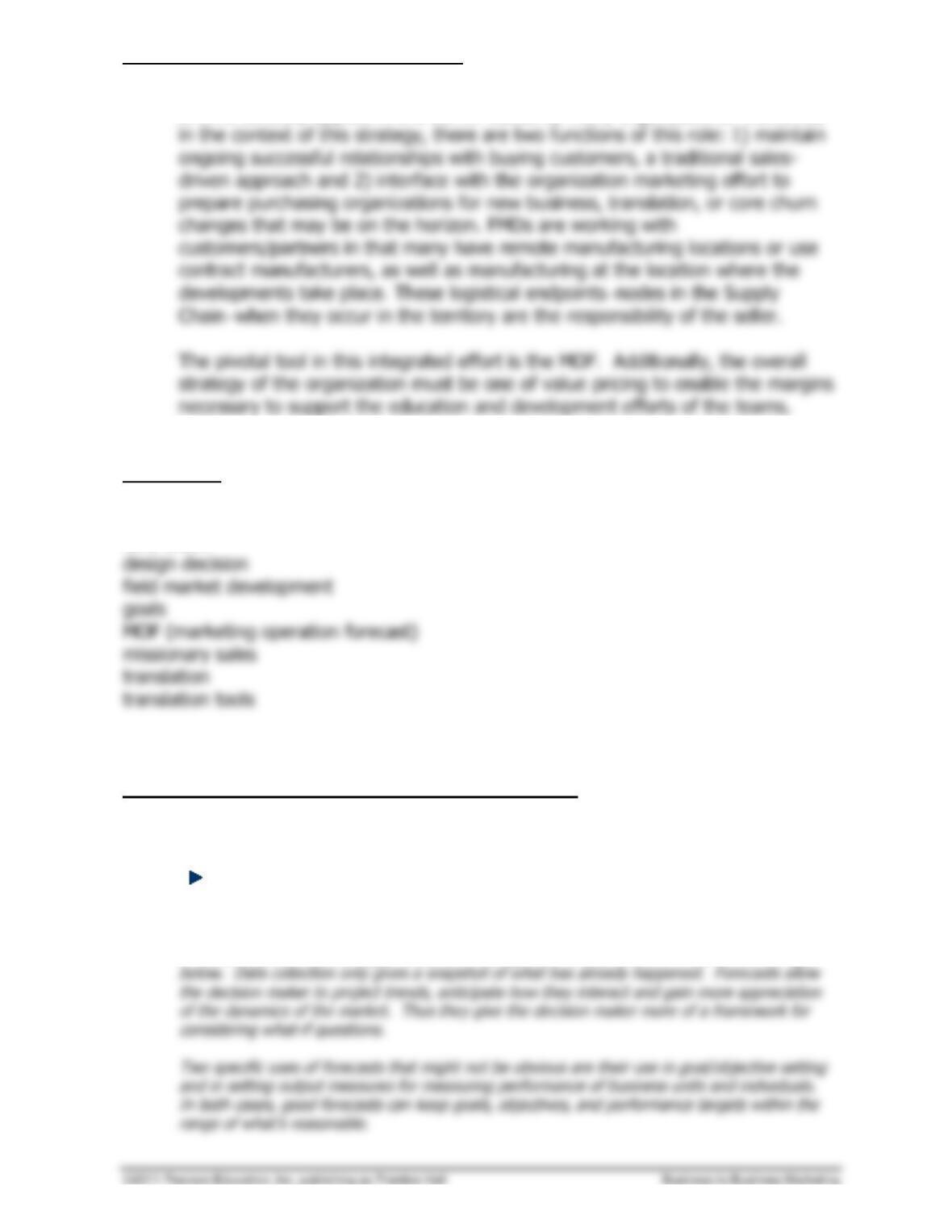
We believe the best results come from a marketing organization configured
around the different kinds of adopters (customer-centric). Different pieces of
the marketing organization will have different goals and objectives to achieve
The
Range of Initial Business Development for Each Offering
employs business
development teams focused on the innovators/visionaries in potential customer
organizations.
The
Range of Major Translation Effort
is the period when field market
The
Range of Major Sales-Driven Effort
is the third and final band. At first
Revenue
Exhibit 11-7: Business Development
Bands over The Product Life Cycle
Range of Major Sales-Driven Effort
Chapter 11: Business Development and Planning 16
glance, this type of representation, the results-compensated sales-driven role,
is unfortunately applied in the earlier bands by many organizations. However,
Key Terms
business development
core business
core churn
Answers to Questions for Review and Discussion
1. List the uses for forecasts in business-to-business marketing.
[ Instructor – an answer to this question requires the student to use the information in this
chapter, as well as previous chapters, to think creatively about how forecasts can and cannot
be used.]
Forecasts can be used to support decision making at all levels, as listed in the answer to Q2,

Chapter 11: Business Development and Planning 17
2. What are the different kinds of forecasts used in business-to-business
marketing?
In this chapter we have discussed:
•
strategic planning forecasts, which are generally long-range business forecasts associated
3. Who has primary responsibility for developing the marketing operations
forecast? Why?
Operational forecasts are usually the responsibility of the field operation, sometimes in
4. How is a marketing operations forecast used differently than a sales forecast?
The MOF is used for marketing tactical and often strategy decisions based on the best thinking
5. What is business development? How does it differ from personal selling?
6. Describe the role of the Field Market Development person in an organization
whose focus is technophiles and visionaries.

Chapter 11: Business Development and Planning 18
Technophiles are the prevalent customers in the development stage of the PLC. Visionaries are
7. Describe the role of the Field Market Development person in an organization
whose focus is pragmatists.
The role of FMDs varies somewhat between working with early pragmatists and later
8. Why is the role of the FMD diminished for products in maturity and decline?
In maturity and decline, most of the business is repeat business or core churn. Customer
9. As an offering moves across the chasm, what strategies will be necessary to
ensure market ownership?
Market ownership comes from maintaining an innovative progression, so the product and
related service stay on the forefront of providing value. A second element is customer care. So

Chapter 11: Business Development and Planning 19
10. How do the goals of market “ownership” and market “share leadership” differ?
Market ownership and share leadership are not necessarily incompatible. Ownership often
translates into share leadership. However, as competition increases, share leadership may be
11. Describe how “real new business” is analogous to diversification.
Real new business is the result of a major R&D, product development, and/or marketing effort,
12. When is core churn also new business?
Core churn comes from existing customers moving on to new products or offerings. When this
13. How does business development change as the PLC progresses through its
stages?
Because the main new customers change as the PLC progresses, the efforts to find and work
with new customers changes, as well.
Development Stage
–
learn about customers, find initial target markets and begin exploring
how to shape the business to pursue the opportunity. Business development works with
Introduction Stage–BD begins to educate potential customers
–
prospective visionary
customers
–
about the technology, its near term products and potential benefits. BD is still

Chapter 11: Business Development and Planning 20
14. Why should a marketing organization be oriented toward different types of
adopters rather than specializing in different products?
15. How should compensation be used to motivate and reward business
development activities, such as field market development? Why?
16. List the roles and responsibilities of the three different bands in the
management of simultaneous life cycles.
Range of Initial Business Development for Each Offering
–
business development teams focused
on the innovators/visionaries in potential customer organizations. The team will be prospecting

Chapter 11: Business Development and Planning 21