Chapter Ten
Pricing in Business-to-Business Marketing
Authors’ Comments
Because price is easily changed, particularly in consumer markets, it often becomes a
tactical surrogate for other problems. In the classroom, students often view price as
the solution to every customer objection. (We often challenge this approach by
suggesting that price be increased, rather than decreased.) In business–to-business
marketing, tactical price moves can often cover the real issues of a customer’s
resistance to the offering.
We also spend some time building an understanding of costs, based on Nagle’s ideas,
and examining pricing dynamics in light of customer relationships, the PLC and the
TALC. Most notably, we emphasize that, other than as a determinant of profitability,
cost has little to do with price−cost is what it takes to create an offering−price is the
assignment of value from the customer’s perspective.
Chapter 10: Pricing in Business–to-Business Marketing 2
Opening Vignette
Intel Changes Its Competitive Pricing For Microprocessors
This opening vignette describes the evolution of microprocessor pricing by Intel
Corporation over the product life cycle.
Initially, Intel processors were priced for high-end users and early corporate adopters.
At low volumes, most “desktop” computers were out of the reach of home users.
When Intel introduced a faster processor, the previous processor price was lowered to
be acceptable to users with lower budgets. Intel used a basic price skimming strategy.
As a result of the economic slowdown of 2000-2001, computer sales slowed. Intel
“remade” itself, downsizing where necessary. During this period, Intel did not reduce
R&D spending. When the market recovered, cash-rich Intel was ready with new
technology products and a new brand campaign. As the processor market moved
through growth stage of the PLC, lesser competitors faded away. Intel and AMD
remain the two major competitors in this market.
Learning Objective
Reinforce the basics of pricing from marketing principles courses.
What is Price? (PowerPoint 10.2)
• Price is a strategic element of the marketing mix.
Consumer “low price guarantees” make it difficult for students to understand
this value exchange proposition. Consider asking these questions of students:
a. Did you ever purchase something and a short time later see it
available for a lower price? (Usually there will be several students that
say yes.)
b. Did that bother you? (Likely, yes.)
c. Then, why did you pay the higher price?
The ensuing discussion should present an opportunity to point out
Chapter 10: Pricing in Business–to-Business Marketing 3
Learning Objectives
Understand the relationship between perceived value and price.
Understand the relationship between cost and price.
Perceived Value and Evaluated Price (PowerPoint 10.3)
Value-Based versus Cost-Based Pricing
• Value-based pricing is often difficult to establish−it is price
determined by value as perceived by the customer and often includes
The Total Offering (From Chapter 1), Exhibit 10-1 (PowerPoint 10.4)
The offering that provides a complete solution to the buyer’s needs
can include
Over time, value associated with the total offering can include
• cost of operation, including environmental costs
Evaluated Price
The price of the offering, from the view of the customer, after all costs
associated with the total offering are evaluated. Includes all elements
Chapter 10: Pricing in Business–to-Business Marketing 4
Learning Objective
Gain a sense of what aspects of business-to-business pricing are
strategic and which are tactical, and how to address these aspects.
Perceived value, relative to competitors’ offerings, establishes the appropriate
price to be charged
Maximum and Minimum Price: Exhibit 10-5 (PowerPoint 10.7)
Over time, there is a maximum price that can be charged dictated by the
Relevant costs must meet the following criteria: (PowerPoint 10.8)
• Resultant (PowerPoint 10.9)
Contribution Margin (PowerPoint 10.13)
(Contribution analysis is discussed further in the appendix at the end of
this chapter.)
Viewed as the difference between ongoing attributable costs and ongoing
Chapter 10: Pricing in Business–to-Business Marketing 5
This is a good time to review the differences between demand in
consumer markets and demand in business-to-business markets. In
the short-term, business-to-business demand is inelastic; in the long
term, it can be very elastic. Markets will behave differently in the short
term than they will in the long term. A business–to-business customer
may have no choice but to accept a price increase in the short term,
but may begin the process to completely eliminate the need for the
product in the future. Price increases must be sustainable within the
parameters of the ongoing relationship between supplier and
customer.
Example: The advent of platinum-based catalytic converters for
Summary of the Economic Fundamentals of Price: (PowerPoint 10.16)
1. Demand levels will be different at different levels of price
2. Changes in price yield reactions from customers−different in the long and
short term
3. Changes in price yield reactions from competitors−different in the long
and short term
”Remember the signals you send.” A consideration often not fully
recognized (both in the classroom and in business) is that a price change
Managing Price as Part of Marketing Strategy
Price is a strategic part of positioning, and thus the range of acceptable
Chapter 10: Pricing in Business–to-Business Marketing 6
Pricing Through the Product Life Cycle and Technology Adoption Life Cycle
The text reviews several factors that influence price over the life cycle.
Many of the basics are considered in Chapter 8, Developing the Value
Offering.
Pricing Considerations through the PLC & TALC (summarized) (PowerPoint
10.19)
• Pricing is situational, depending on strategic purposes and market
Price Models
Pricing an Innovative Product
Market Skimming and Market Penetration pricing
Exhibit 10- 8 Several Marketing Objectives Addressed by Pricing
Strategic Purposes (PowerPoint 10.17)
Tactical Purposes (PowerPoint 10.18)
• Winning the business of a new, important customer
Chapter 10: Pricing in Business–to-Business Marketing 7
Students often make the assumption that skimming is used
during introduction and market penetration pricing is used during
late growth/maturity. This discussion applies to the use of both
price models, depending on circumstances and the resources of the
marketing organization, for
innovative products
.
Market Skimming and Market Penetration pricing defined
Learning Objectives
Understand how negotiated pricing works; gain a sense of strategies
for maintaining margin and customer relationships in negotiated
pricing.
Learn how to avoid dropping price as a short-term tactic (optional).
Many portions of the following material are often considered “as time
allows” or as optional topics.
Managing Pricing Tactics (PowerPoint 10.22)
• Bundling
Chapter 10: Pricing in Business–to-Business Marketing 8
Where:
Effect of an Industry Increase in Costs: Exhibit 10-11 (PowerPoint 10.25)
Types of Negotiating Situations: Exhibit 10-12 (PowerPoint 10.26)
Stages in the Negotiation Prices in Business–to-Business Sales: Exhibit 10-13
(PowerPoint 10.27)
Final Negotiation Considerations (PowerPoint 10.28)
Learning Objective
Gain an appreciation for the effects of current trends on pricing.
Pricing and the Changing Business Environment (PowerPoint 10.29)
Time Compression
Exhibit 10-9: Market Conditions Necessary for the Success of Skimming or
Penetration Pricing
Price skimming strategy: (PowerPoint 10.21)
• With skimming, the value of the offering as perceived by the market must reflect the high price
Penetration strategy:
• the market is somewhat elastic
Chapter 10: Pricing in Business–to-Business Marketing 9
The Internet
Improves communication, increases both buyers and marketers
Key Terms
avoidable costs
bundling
contribution margin
cost-based pricing
open bid
penetration pricing
price skimming
realized costs
resultant costs
revenues
Answers to Questions for Review and Discussion
1. In general, what is the maximum price that can be charged for a product or
Chapter 10: Pricing in Business–to-Business Marketing 10
service?
In short, the maximum price that can be charged, ideally, is the price just noticeably below the
2. What is the maximum price that can be charged for your product when you have
direct competitors but your product is differentiated, that is, it provides more
benefits than competitors provide?
When your product is differentiated and provides more benefits than the competition it can be
3. Under what kinds of circumstances would a marketer want to charge a price less
than the maximum price possible for the offering?
A marketer might be inclined to charge a lower price than the maximum possible price, when the
4. In general, what is the minimum price that can be charged for a product or
service?
5. When would R&D costs be a relevant cost to consider in pricing decisions?
R&D costs are a relevant cost to consider in a pricing decision when they have yet to be incurred,
Chapter 10: Pricing in Business–to-Business Marketing 11
6. Suppose you were considering a price increase. What kind of difference would
you expect between short-term elasticity and long-term elasticity in response to
your price increase?
In many cases, the short-term response to a price increase may be minimal or non-existent.
7. Under what general conditions would you want to use a price skimming strategy?
A penetration price strategy?
A price skimming strategy is ideally used the when price of the offering is a reflection of its value
as perceived by the market, and
•
the market is somewhat inelastic
8. Under what conditions would you switch from a skimming strategy to a
penetration strategy? What elements of the marketing mix other than price
would be involved?
You would switch from skimming to penetration when a competitive product or substitute was
Chapter 10: Pricing in Business–to-Business Marketing 12
9. The chapter relates the “second in, low–cost producer” to the acquisition of small
technology companies by large firms as two strategies that have potentially
similar strategic outcomes. In a fast-paced market, which strategy would be
most effective for a) an established, large manufacturer of consumer products
and, b) a large high technology network equipment manufacturer?
a). An established manufacturer likely has existing investment and economies of scale that will
10. Discuss the organizational and marketing-mix changes required when a small
company hits the chasm. From question 9, above, of the two strategies
discussed, which would be the most appropriate in today’s marketplace?
The chasm generally occurs at late-introduction/early-growth of the product life cycle. The
Chapter 10: Pricing In Business to Business Marketing 13
11. Suppose your company is the market leader in a fast-growing market. Your
product is differentiated in that it provides more and better benefits than your
competitors’. How would you price your product?
With a product differentiated by more and better benefits in a fast-growing market, and where
you are striving to become the market leader, the question becomes whether you are helped
12. In competitive bidding, what factors would enter into your determination of a
bid to offer?
In competitive bidding, the first consideration is how badly you want the business. If the
13. Why is preparation for negotiation so important to effective pricing?
14. Explain the major differences between negotiation in a single-transaction
situation and negotiation in a balanced-concern situation.
The differences between negotiation in a single-transaction situation and a balanced-concern
15. Explain why time compression causes problems for price negotiations even
when both parties have an interest in enhancing a relationship.
The best resolution of a negotiation occurs when the parties find a creative solution that
16. Explain “Evaluated Price?”
One view of evaluated price is what your customer believes it will cost to select you as a
APPENDIX 1: CONTRIBUTION ANALYSIS
In evaluating alternative marketing programs or actions, a useful way to make
comparisons is to analyze the contribution to fixed cost, overhead and profit from the
alternatives presented.
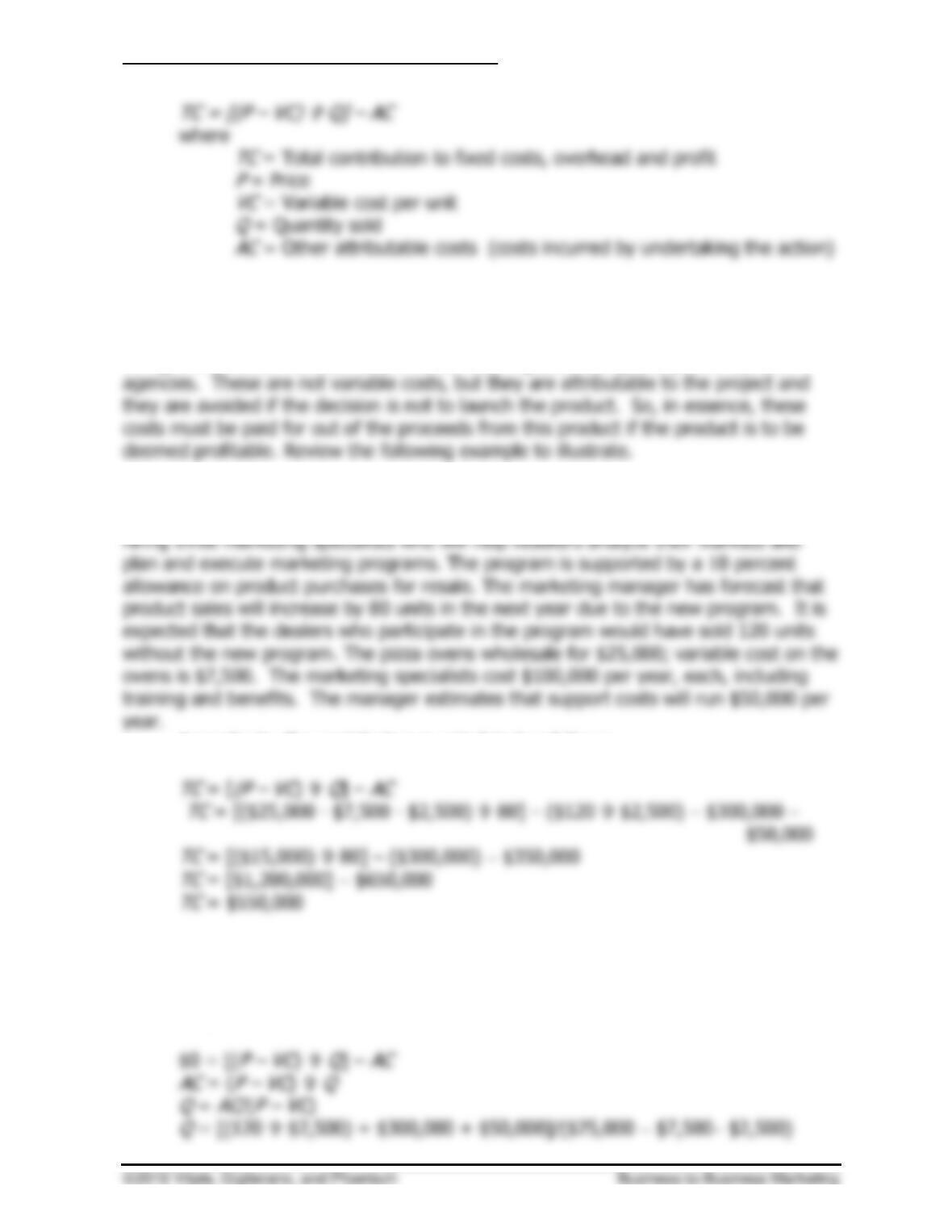
Contribution
is the expected revenue less the costs that can be
attributed to the action taken, as shown in the following equation:
Chapter 10: Pricing In Business to Business Marketing 15
Often one will see contribution presented as revenue minus the variable costs.
The problem with this is that variable costs are not the only kind of costs that are
caused by a particular action. For instance, launch of a new product may require the
hiring of a product marketer and involve retaining advertising and public relations
Suppose a marketing manager for a manufacturer of commercial pizza ovens is
considering launching a new service program for resellers. The program will involve
Accordingly, the contribution is calculated as follows:
This has a positive contribution, so the company would be better off if the
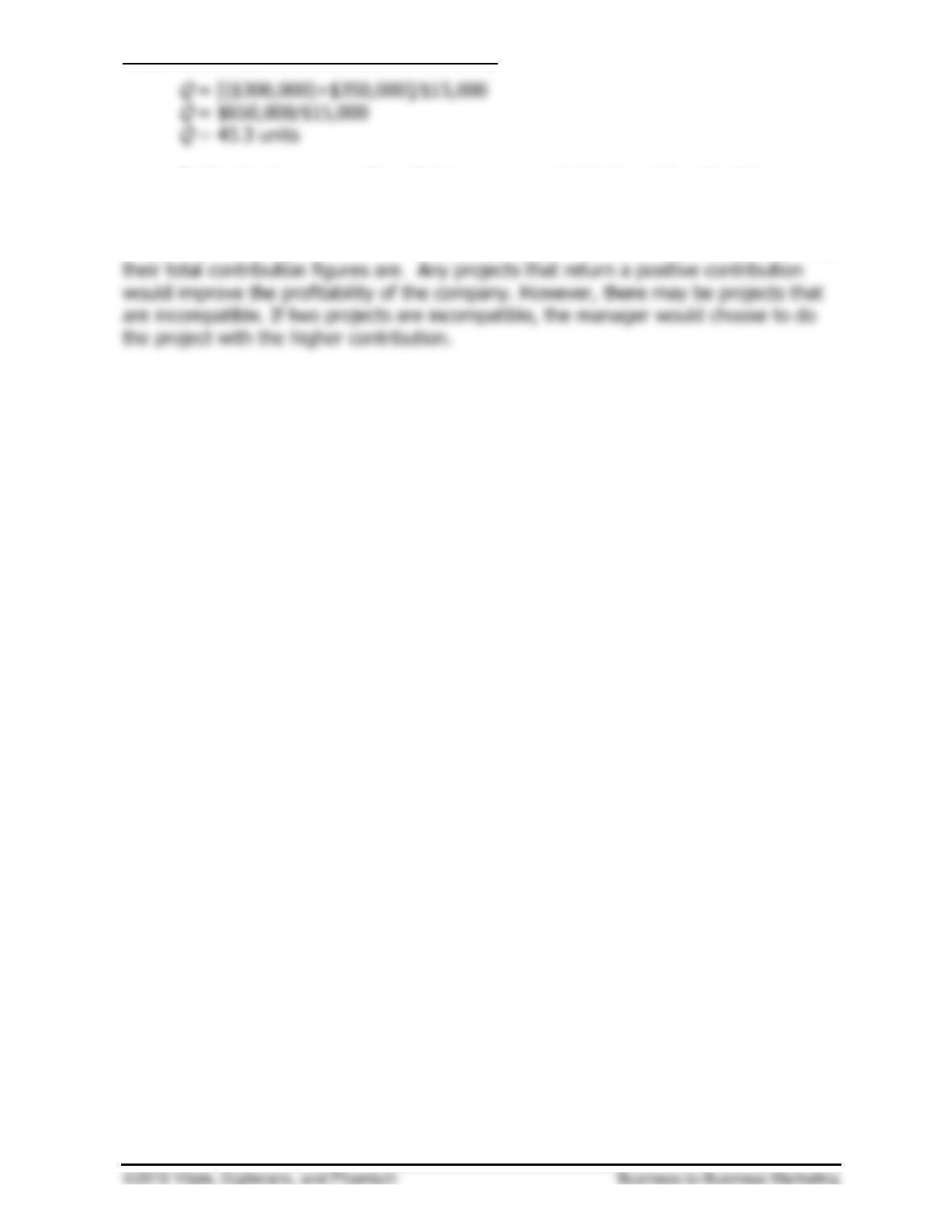
manager pursued this program. We can also see what the break-even volume would
have to be for this program. If we set
TC
= 0, which is break-even, we can solve
easily for
Q
:
Chapter 10: Pricing In Business to Business Marketing 16
So the break-even number of pizza ovens needed to be sold under this program
is 44. The expected total of 80 is considerably more than the break-even number, so
there would seem to be ample room for uncertainty. The manager should probably go
ahead with this program. The final decision will depend on other alternatives and what