Chapter Ten: Measurement and Attitude Scaling
QUESTIONS FOR REVIEW AND CRITICAL THINKING/ANSWERS
1. Define measurement. How is your performance in a marketing research class being
measured?
2. What is the difference between a concept and a construct? In what ways is the definition of
the term variable similar or different?
3. Consider the following research questions or hypotheses. What variables need to be measured
in each?
a. Do consumers who spend more time and are more committed to Facebook spend more
money at Amazon.com?
b. What are the demographic characteristics of consumers who belong to the PowerUp
Rewards program (loyalty program) of GameStop (video games and accessories) stores?
c. The temperature inside the supermarket will determine how much time that shoppers
spend in the store such that when the store is cold they will spend less time shopping than
when the store is warm.
Chapter Ten: Measurement and Attitude Scaling
d. Product price is related positively to product quality.
e. Consumer perceptions of value from a service provider are related negatively to the
likelihood of switching service providers.
4. An official in the financial office is considering an applicant for financial aid. The officer
uses the following process. If the student has a GPA in the 90th percentile among the
admission group, 5 points are added. If the student has an ACT or SAT score in the 90th
percentile among the admission group, 5 points are added. If the student comes from a family
whose cumulative household income was less than $60,000/year for the last 3 years, 8 points
are added. If the student is from out of state, 5 points are added. What variables are being
used to determine eligibility for this financial aid? What would your approximate score be on
this scale? Is it best described as an index or a composite scale? Explain your response.
5. What role does an operational concept definition play in planning a research project?
6. Describe the concept of measurement level and the four different levels of scale
measurement.
© 2016 Cengage Learning. All Rights Reserved. May not be scanned, copied or duplicated, in whole or in
part, except for use as permitted in a license distributed with a certain product or service or otherwise on a
password-protected website for classroom use.
13. Indicate whether the following measures use a nominal, ordinal, interval, or ratio scale:
a. Prices on the stock market
b. Marital status, classified as “married” or “never married”
c. Whether a respondent has ever been unemployed
d. Professorial rank: assistant professor, associate professor, or professor
e. Course grades: A, B, C, D, or F
f. Blood-alcohol content
g. Number of Facebook friends
h. The color of one’s eyes
Chapter Ten: Measurement and Attitude Scaling
The size of one’s pupils
i. Time spent per day using a smartphone or tablet?
14. What is an attitude? Why do businesses place so much emphasis on measuring attitudinal
concepts?
15. Attitudes are sometimes called tri-partite, meaning they have three components. What are the
three components of an attitude?
16. Distinguish between rating and ranking. Which is a better attitude measurement technique?
Why?
17. Construct a Likert scale that would measure student attitudes toward constructing a new
business building on campus using a forced choice approach.
© 2016 Cengage Learning. All Rights Reserved. May not be scanned, copied or duplicated, in whole or in
part, except for use as permitted in a license distributed with a certain product or service or otherwise on a
password-protected website for classroom use.
18. What are key differences between a five-item and a six-item Likert scale?
19. Describe the way a semantic differential scale could be constructed to measure the behavioral
component of attitudes.
20. What is a fundamental weakness of a constant sum or ranking scale?
21. In each of the following, identify the type of scale and evaluate it:
a. A U.S. representative’s questionnaire sent to constituents:
Do you favor or oppose the Fair Tax Proposal?
In Favor
□
Opposed
□
No Opinion
□
This is a simple rating scale with two categories. However, it is a non-forced choice scale that
provides a “no opinion” category.
b. How favorable are you toward the Fair Tax Proposal?
c. A psychographic statement asking the respondent to circle the appropriate response:
I shop a lot for specials.
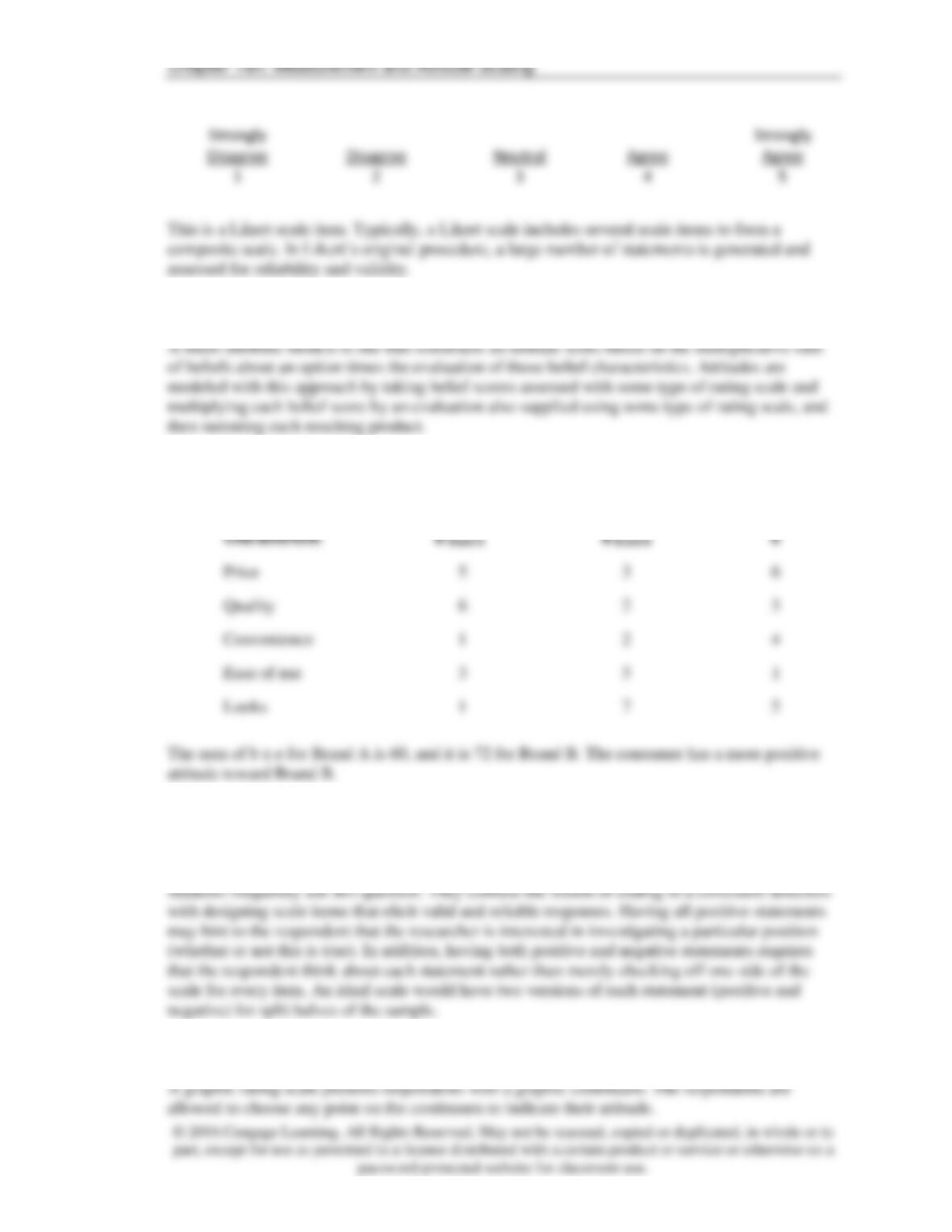
© 2016 Cengage Learning. All Rights Reserved. May not be scanned, copied or duplicated, in whole or in
part, except for use as permitted in a license distributed with a certain product or service or otherwise on a
password-protected website for classroom use.
22. What is a multi-attribute model of consumer attitudes?
23. Look at the table. The b columns represent belief scores for two competing products. The e
column represents the evaluations of those characteristics. Compute the attitude score for
each competitor and comment on the competitive positioning of each.
Characteristic
b Brand A
b Brand B
e
Price
5
3
6
Quality
6
2
3
Convenience
1
2
4
Ease of use
3
5
1
Looks
1
7
5
The sum of b x e for Brand A is 60, and it is 72 for Brand B. The consumer has a more positive
attitude toward Brand B.
24. If a Likert summated scale has 10 scale items, do all 10 items have to be phrased as either
positive or negative statements, or can the scale contain a mix of positive and negative
statements? Explain.
25. What are the advantages of using a slider scale?
© 2016 Cengage Learning. All Rights Reserved. May not be scanned, copied or duplicated, in whole or in
part, except for use as permitted in a license distributed with a certain product or service or otherwise on a
password-protected website for classroom use.
26. [Ethics Question] A researcher thinks many respondents will answer “don’t know” or “can’t
say” if these options are printed on an attitude scale along with categories indicating level of
agreement. The researcher does not print either “don’t know” or “can’t say” on the
questionnaire because the resulting data would be more complicated to analyze and report. Is
this proper?
RESEARCH ACTIVITIES
1. Define each of the following concepts, and then operationally define each one by providing
correspondence rules between the definition and the scale:
a. A good bowler
b. Purchasing intention for a hair salon
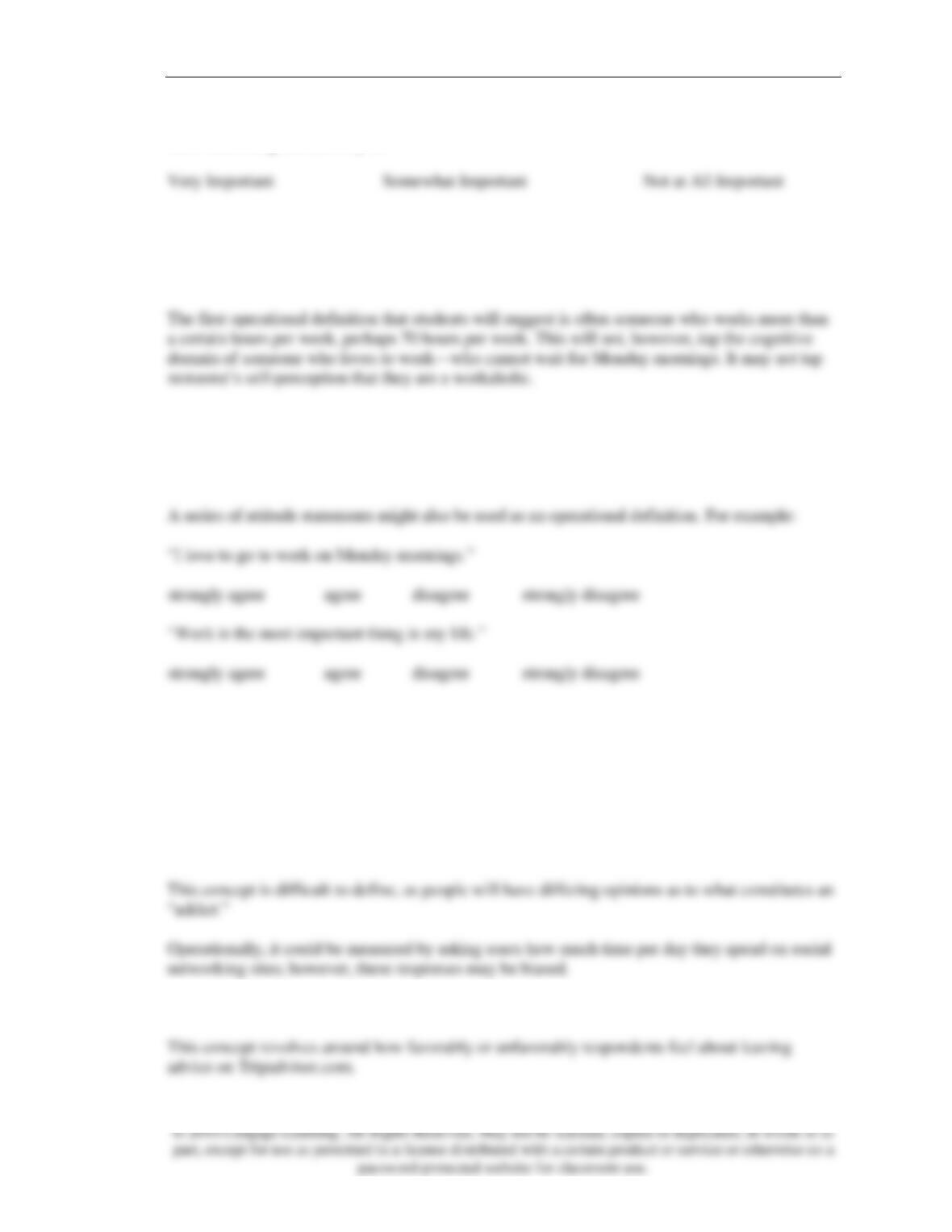
c. Consumer involvement with cars
How important are cars in your personal life?
Chapter Ten: Measurement and Attitude Scaling
How interesting are cars to you?
d. A workaholic
Most students will have a feel for this concept and conceptually define it like an alcoholic—as
someone who works all the time, who is addicted to work, or who works to excess.
Some operational definitions might be answers to “How many hours per week do you work?” or
“How many hours did you work this week?”
Or you could use a simple self-report statement, such as “Are you a workaholic?”
e. Fast-food restaurant
This is a good one for class discussion. This issue revolves around what is fast “service” and the
distinction between counter service versus service from a waiter or waitress. Of course,
McDonald’s and Arby’s are fast-food restaurants, but what about a pizza place that has pizza by
the slice and also offers made-to–order pizza?
f. Online social networking addict
g. Attitude toward leaving advice (reviews) on Tripadvisor.com
Chapter Ten: Measurement and Attitude Scaling
© 2016 Cengage Learning. All Rights Reserved. May not be scanned, copied or duplicated, in whole or in
part, except for use as permitted in a license distributed with a certain product or service or otherwise on a
password-protected website for classroom use.
It can be measured the following way:
“Leaving a review on Tripadvisor.com is helpful.”
strongly agree agree disagree strongly disagree
2. Use the ACSI scores found at http://www.theacsi.org to respond to this question. Using the
most recent two years of data, test the following two hypotheses:
a. American consumers are more satisfied with breweries than they are with wireless
telephone services.
b. American consumers are more satisfied with discount and department stores than they are
with automobile companies.
c. American consumers are most satisfied with Southwest Airlines relative to other airlines.
3. Go to http://www.queendom.com/tests. Click on the lists of personality tests. Take the
hostility test. Do you think this is a reliable and valid measure of how prone someone is to
generally act in a hostile manner? Would it be ethical to assign prospective employees a
hostility score to be used in a hiring index based on results from this or a similar test?