Chapter 10 ♦ Product Concepts 10-1
CHAPTER 10 Product Concepts
CHAPTER FEATURES
Chapter Features
Key Points
✓ Marketing & You
Students are given a survey to indicate their brand consciousness.
✓ Ethics in Marketing
The National Milk Producers Federation is attempting to ban non–
dairy products from using traditional dairy titles. They argue that
dairy labels on non-dairy products are confusing to customers and
harm sales of dairy products.
USING THIS MANUAL
Chapter ten includes seven learning outcomes that help students become more familiar with product concepts. The
chapter outline provides detailed analysis of these learning outcomes, listing PowerPoint slides and review questions as
LEARNING OUTCOMES
1 Define the term “product”
A product is anything, desired or not, that a person or organization receives in an exchange. The basic goal of purchasing
2 Classify consumer products
Consumer products are classified into four categories: convenience products, shopping products, specialty products, and
Students draft a plan to revive the dead Hydrox cookie brand (the
original chocolate sandwich cookie).
Ford Motor Company engineered a turnaround for itself by
restructuring its product lines and divesting troublesome brands.
Kodak faces the challenge of leveraging the equity of its brand in a
new competitive market – one that doesn’t include film.
10-2 Chapter 10 ♦ Product Concepts
3 Define the terms “product item,” “product line,” and “product mix”
A product item is a specific version of a product that can be designated as a distinct offering among an organization’s
4 Describe marketing uses of branding
A brand is a name, term, or symbol that identifies and differentiates a firm’s products. Established brands encourage
5 Describe marketing uses of packaging and labeling
Packaging has four functions: containing and protecting products; promoting products; facilitating product storage, use,
before they make a purchase decision.
6 Discuss global issues in branding and packaging
In addition to brand piracy, international marketers must address a variety of concerns regarding branding and
7 Describe how and why product warranties are important marketing tools
Product warranties are important tools because they offer consumers protection and help them gauge product quality.
CHAPTER OUTLINE
PowerPoint 10-5, 10-6:
1 Define the term “product”
I. What is a Product?
A product may be defined as everything, both favorable and
Chapter 10 ♦ Product Concepts 10-3
2 Classify consumer products
PowerPoint 10-9:
Types of Products
II. Types of Consumer Products
Products are classified as either business or consumer products depending on the
buyer’s intentions for the product’s use.
PowerPoint 10-10, 10-11:
Types of Consumer
Products
Review Question 2.1
A. A convenience product is an inexpensive item that requires little
shopping effort, those products are purchased regularly, usually with little
planning, and require wide distribution.
B. A shopping product requires comparison shopping, because it is usually
more expensive than a convenience product and is found in fewer stores.
Consumers usually compare items across brands or stores.
a. Homogeneous shopping products are products that consumers see
C. A specialty product is searched for extensively, and substitutes are not
acceptable. These products may be quite expensive, and often distribution
is very limited.
3 Define the terms “product item,” “product line,” and
“product mix”
PowerPoint 10-14:
Product Items, Lines, and
III. Product Items, Lines, and Mixes
10-4 Chapter 10 ♦ Product Concepts
Review Question 3.2
PowerPoint 10-16:
Benefits of Product Lines
PowerPoint 10-17:
Product Mix Width
PowerPoint 10-18:
Product Line Depth
Why Form Product Lines?
1. Advertising economies occur when several products are advertised
under the umbrella of the line.
Width and Depth
1. Product mix width refers to the number of product lines that an
organization offers. Firms increase product mix width to:
a. Spread risk across multiple lines.
2. Product line depth is the number of product items in a product
line. Firms increase product line depth to:
PowerPoint 10-19:
Adjustments
a. Attract buyers with widely different preferences.
A. Adjustments to Product Items, Lines, and Mixes
PowerPoint 10-20:
Types of Product
1. Modifying Existing Products
Product modification involves changing one or more of a
product’s characteristics.
a. A quality modification entails changing a product’s
dependability or durability.
PowerPoint 10-21:
Planned Obsolescence
they actually need replacement. It is often implemented
through style modifications.
PowerPoint 10-22:
Repositioning
PowerPoint 10-24:
Product Line Contraction
2. Repositioning involves changing customers’ perceptions of a
product.
4. Product line contraction may be undertaken if the line is
overextended.
Symptoms of overextension include:
• Some products are not contributing to profit because of low
Benefits of contraction include:
• Resources become concentrated to the most important
products.
4 Describe marketing uses of branding
Class Activity:
Encourages students to
investigate the effect of
branding on the Internet
IV. Branding
Branding is the major tool marketers have to distinguish their products from
those of the competition.
1. A brand is a name, term, symbol, design, or combination thereof
that identifies a seller’s products and differentiates them from
competitors’ products.
PowerPoint 10-28:
Benefits of Branding
A. Benefits of Branding
Branding has three main purposes:
1. Product identification is the most important objective. The brand
allows the product to be differentiated from others and serves as an
indicator of quality to consumers.
10-6 Chapter 10 ♦ Product Concepts
2. Promoting repeat sales is a second objective. Branding helps
PowerPoint 10-30:
Branding Strategies
B. Branding Strategies
PowerPoint 10-31:
Manufacturer’s Brands vs.
Private Brands
PowerPoint 10-32:
Advantages of
PowerPoint 10-33:
1. Manufacturer’s brands vs. private brands
a. A manufacturer’s brand strategy is used when
Advantages of manufacturer’s brands:
▪ Heavy consumer ads by manufacturers
▪ Attract new customers
Advantages of private brands:
▪ Earn higher profits on own brand
PowerPoint 10-34:
Individual Brands vs.
Family Brands
2. Individual brands vs. family brands
a. Individual branding is the practice of using a different brand
name for each product.
PowerPoint 10-35:
Cobranding
3. Cobranding
Cobranding entails placing two or more brands’ names on a
product or its package
a. Ingredient branding identifies the brand of a part that makes
PowerPoint 10-36:
Trademarks
marketed together to suggest usage.
C. Trademarks
1. A trademark is a legal term indicating the owner’s exclusive right
to use the brand or part of the brand. Others are prohibited from
2. Companies must guard against the unauthorized use of their brands,
slight alterations to the brand by mimics, and counterfeit
merchandise that is labeled with the brand.
a. In 1999, legislation went into effect that explicitly applies
trademark law to the online world.
5 Describe marketing uses of packaging and labeling
V. Packaging
Packaging is a container for protecting and promoting a product. Packaging
has traditionally been viewed as a means of holding contents together and as a
way of protecting the physical good as it moves through the distribution
channel.
PowerPoint 10-39:
Functions of Packaging
A. Packaging Functions
1. Containing and Protecting Products
a. Some packaging has to be quite sophisticated to protect the
10-8 Chapter 10 ♦ Product Concepts
PowerPoint 10-40:
Labeling
PowerPoint 10-41:
Universal Product Codes
3. Facilitating Storage, Use, and Convenience
a. Wholesalers and retailers prefer packages that are easy to ship,
store, and stock on shelves. They also like packages that
4. Facilitating Recycling and Reducing Environmental Damage
a. An important issue recently is the compatibility of the package
and environmental concerns.
B. Labeling
1. Persuasive labeling focuses on a promotional theme or logo, and
consumer information is secondary.
2. Informational labeling is designed to help consumers in making
4. The Universal Product Codes (UPC) that appear on most items
found in supermarkets and other high-volume outlets were first
introduced in 1974. The bar codes, series of thick and thin vertical
lines, are read by computerized optical scanners.
6 Discuss global issues in branding and packaging
Review Question 6.1
PowerPoint 10-44:
Global Issues in Branding
VI. Global Issues in Branding and Packaging
A. Branding
When entering a foreign market, a firm has three options for handling
the brand name.
1. One brand name everywhere
Chapter 10 ♦ Product Concepts 10-9
PowerPoint 10-45:
Global Issues in
Packaging
B. Packaging
Three aspects of packaging are especially important in international
marketing.
7 Describe how and why product warranties are important
marketing tools
VII. Product Warranties
PowerPoint 10-48:
Product Warranties
A. Another part of the product is its warranty, a protection and information
device for consumers.
TERMS
brand
generic product name
product line depth
brand equity
global brand
product line extension
brand loyalty
implied warranty
product mix
individual branding
product mix width
brand name
informational labeling
product modification
business product
service mark
captive brands
persuasive labeling
shopping product
cobranding
planned obsolescence
specialty product
consumer product
private brand
trademark
convenience product
product
universal product code (UPC)
express warranty
product item
unsought product
family brand
product line
warranty
Suggested Homework:
• The end of each chapter contains numerous questions that can be assigned or used as the basis for longer
investigations into marketing.
REVIEW AND APPLICATIONS
1.1 Form a team of four or five members. Have the team determine what the tangible and intangible benefits are
for a computer, a tube of toothpaste, a beauty salon, and a dentist.
Computer: Tangible benefits include the storage capacity, speed, aesthetics (such as variety of colors), and the
2.1 Break into groups of four or five. Have the members of the group classify each of the following products into
the category (convenience, shopping, specialty, unsought) that they think fits best from their perspective as
consumers (i.e. if they were buying the product): Coca Cola (brand), car stereo, winter coat, pair of shoes,
life insurance, blue jeans, hamburgers, shampoo, canned vegetables, curtains.
2.2 Although major appliances, like washers and dryers, are usually considered homogeneous shopping
products, the high-efficiency front-loaders that boast many more features than standard machines are
gaining in popularity. Do you think high-efficiency technology is enough to make washers and dryers
heterogeneous shopping products? Explain.
3.1 A local civic organization has asked you to give a luncheon presentation about planned obsolescence. Rather
than pursuing a negative approach by talking about how businesses exploit customers through planned
obsolescence, you have decided to talk about the benefits of producing products that do not last forever.
3.2 Go to Unilever’s Web site at www.unilever.com. Can Unilever delete anything from its product lines?
Visit the company’s product category pages on its “Brands” Web page to see the number of existing
products and new products planned. Write a proposal for contracting one of Unilever’s product lines.
4.1 A local supermarket would like to introduce their own brand of paper goods (e.g. paper towels, facial tissue,
etc.) to sell alongside their current inventory. The company has hired you to generate a report outlining the
advantages and disadvantages of doing so. Write the report.
Although students’ answers will vary, they should address some of these points. Retailers’ private-label store brands
Chapter 10 ♦ Product Concepts 10–11
4.2 How does Hormel use its Web site (www.hormel.com) to promote its store brands? Is the site designed
more to promote the company or its brands? Check out the Spam Web site at www.spam.com. How do
you think Hormel is able to successfully sustain this brand that is often the punch line to a joke?
5.1 Find a product at home that has a distinctive package. Write a paragraph evaluating that package based on
the four functions of packaging discussed in this chapter.
6.1 List the countries to which Levi Strauss & Co. markets through the Web site www.levi.com. How do the
product offerings differ between the United States and European selections?
Levi Strauss markets in the U.S., Canada, Europe, South Africa, Asia/Pacific (Japan, Korea, Australia, New
7.1 Land’s End and L.L. Bean are renowned for their product guarantees. Find and read the exact wording
of their guarantees on their Web sites (www.landsend.com and www.llbean.com). Do you think a
company could successfully compete against either without offering the same guarantee?
All other things being equal, it would be very difficult for a company to compete head-to-head with either Land’s
Supplemental Exercise: Group Work
Review and Applications
Review and Applications Questions 1.1 and 2.1 lend themselves well to group work. For these activities, divide the
APPLICATION EXERCISE
Purpose: To show students how important branding can be to product success. Students try to relaunch the Hydrox
cookie brand (the original chocolate sandwich cookie) by investigating branding issues, including brand name and brand
mark, determining the role of packaging, and assessing the feasibility of brand extensions.
Setting It Up: This exercise will work best in teams or as a group project. It could also serve as the basis for a marketing
plan project.
Alice Griswold
Clarke College
THE OREO DEBATE
10–12 Chapter 10 ♦ Product Concepts
This exercise can be effectively used in the chapters relating to “product” as it deals with issues pertaining to brands
(national vs. private), packaging, brand loyalty, and image.
I come to class with three packages of chocolate sandwich cookies -Oreo, Hydrox, and a private-label brand. I then ask
• New name – Keebler Droxies. What did the Hydrox name mean? It came from a mix of hydrogen and oxygen to signify
pure ingredients, but consumer research studies revealed it sounded more like a cleaning fluid.
Not only does Hydrox face a huge challenge trying to catch up to Oreo but they face challenges from the private label
cookies with their improved quality and lower price.
Price comparisons will show the private label at almost half the price of Oreo with Hydrox somewhere in between.
ETHICS EXERCISE
1. Is the marketing of unsought products unethical? Discuss your answer in terms of the AMA Statement of
Marketing unsought products is not unethical, because consumers may have needs and wants that they themselves
MARKETING PLAN EXERCISE
After reading chapter 10, use the exercises on page 378 to guide you through the third part of your strategic marketing
plan.
Chapter 10 ♦ Product Concepts 10–13
CASE STUDY
TerraCycle: Turning Worm Poop into a Product
1. What are some of the benefits Ford has achieved through reorganizing its product line?
The most evident benefits Ford has achieved would probably be standardized components and efficient sales
2. Discuss the various product modifications which Ford made to the Ford Explorer.
The switch to a car chassis, making the Explorer lighter, would act as a quality modification. It also carries a
3. What are some examples of Ford’s product line extensions?
Many of Ford’s new products focusing on greater fuel efficiency would be examples of product line extensions.
4. What are some examples of Ford’s product line contractions?
Ford’s nameplate reductions would serve as product line contractions. The divestiture of noncore brands,
LESSON PLAN FOR VIDEO
Company Clips: Kodak – Reinventing the Brand
Unquestionably, Kodak is one of most recognized brands in the United States and the world. For over a century, Kodak
10–14 Chapter 10 ♦ Product Concepts
Solutions for Viewing Activities (also for the Company Clips questions in the textbook):
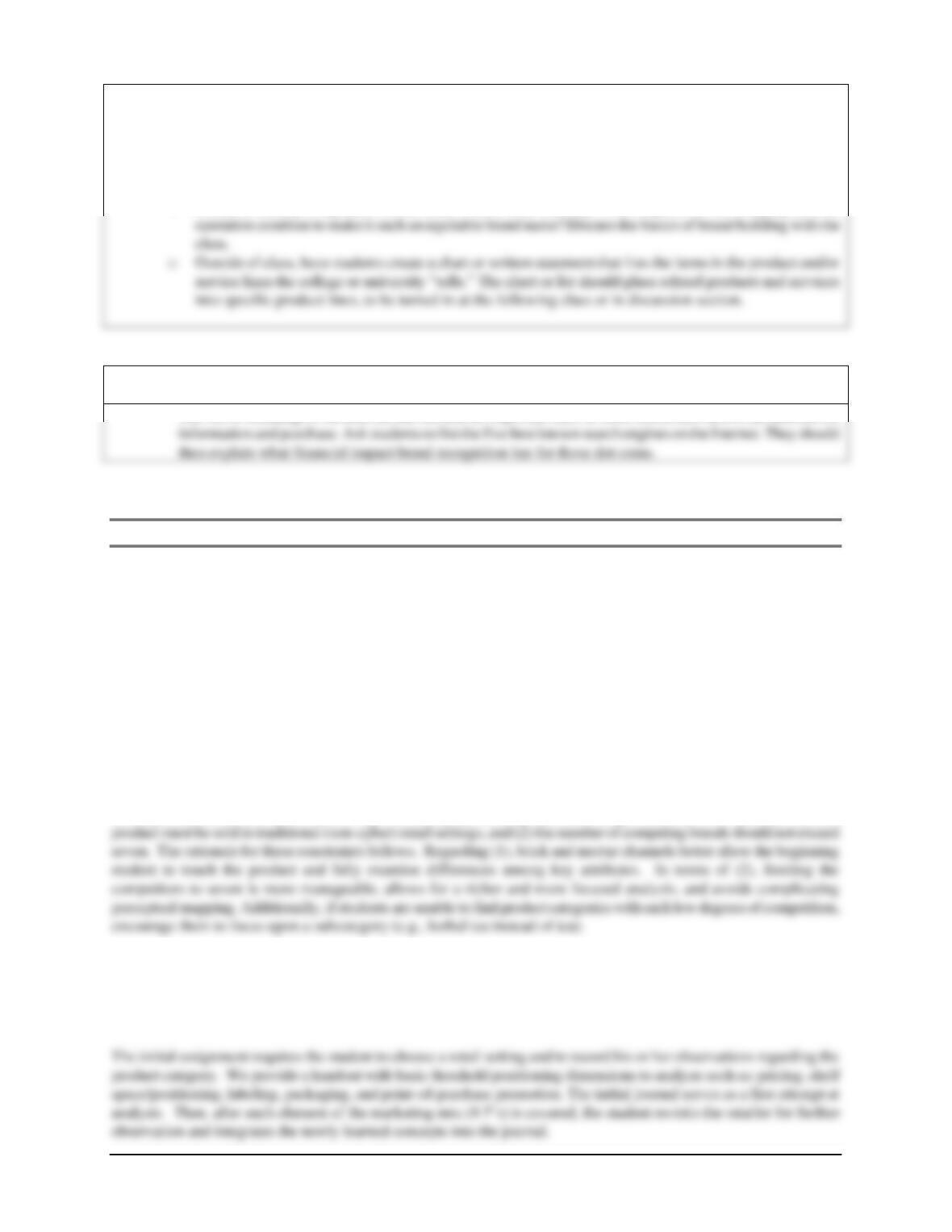
1. Using Exhibit 10.1 as a guide, create a diagram that organizes the Kodak products mentioned in the video.
How are changes in the company’s product mix necessitating changes to the way managers market Kodak’s
offerings?
2. List the attributes of the Kodak brand. What benefits of branding has the company experienced over time?
Have there been pitfalls to having a brand with such strong associations?
Kodak has a reputation for unparalleled brand equity, i.e. a brand name that translates as trust, quality, innovation,
3. Describe the functions of packaging of a disposable camera.
The functions for packaging a disposable camera are 1) to contain and protect the products during shipping and for
Supplemental Exercise: Video
Company Clips
Pre-Class Prep for You:
• Preview the Company Clips video segment for Chapter 10. This exercise reviews concepts for LO1, LO2, LO3,
LO4, and LO5
• Review your lesson plan.
• Make sure you have all of the equipment needed to show the video to the class, including the DVD and a way to
project the video.
Pre-Class Prep for Students:
• Have students review and familiarize themselves with the following terms and concepts: product; types of consumer
Video Review Exercise Activity
• Warm-up
o Begin by asking students: “What is a product?”
• In-Class Preview
Kodak Products
Consumer Products
Commercial Products
Chapter 10 ♦ Product Concepts 10–15
other companies, making sure they understand the difference between product items, lines, and mixes.
o Discuss the difference between a product line extension and the addition of a new product line; and discuss
the difference between mix width and line depth.
o Ask students to review the Company Clips questions in the textbook and to be prepared to answer them
after viewing the video.
• Follow-up
o Kodak is clearly a reputable brand name within their industry. What aspects of the company and its
Supplemental Exercise: Class Activity
Brand Names
The use of branding on the Internet has become an important topic as more consumers turn to the Internet for
GREAT IDEAS FOR TEACHING CHAPTER 10
Jon M Shapiro, Northeastern State University
Michael C Murphy, Langston University
PRODUCT POSITIONING FOR THE PRODUCT MANAGER: A CAPSTONE EXPERIENCE FOR AN
INTRODUCTION TO MARKETING CLASS
The objective of this activity is to encourage beginning students to think about product positioning, its components and
strategic implications. Pedagogically, we believe that the right mix of theory and experiential learning increases student
interest and enriches their learning experience. This ongoing, sequential project can be introduced within the first few
weeks of class, regardless of the student’s knowledge-base, or the topical sequencing within a given textbook.
Initially, students are directed to choose a product category that they find interesting. There are two constraints: (1) the
What products do students pick and why? The key thing is that if they find a category relevant to their life (ideally,
something that they use and enjoy), they will likely exhibit more passion and do a more in-depth analysis. Based on
experience, we find that food products such as peanut butter, salsa, and frozen pizza work well; however, anything the
student is interested will suffice.
10–16 Chapter 10 ♦ Product Concepts
The final, capstone paper requires the student to construct at least two perceptual maps. The end product includes the
product descriptions, a justification of the map axes (why these salient attributes were selected), and a description of the
perceptual map.
Michael Luthy, Bellarmine University
THE SEARCH FOR THE PERFECT PACKAGE
In most Principles of Marketing courses the subject of consumer product packaging is discussed, at least in
passing, as part of the product umbrella in the marketing mix. Some instructors address it in discussions of the bundle of
benefits concept, the rationale that ultimately serves consumers’ interests. However the subject is broached, an alterative
Separating the class into teams of 2-4 students, giving each a banana, and then tasking them with coming up with
as many reasons as they can to support your contention generates a healthy competition and can lead to some interesting
rationales. Below are some of the many reasons they make come up with:
• Protects the product from damage
• Attracts attention because of bright color
From these reasons, the instructor can then generalize, perhaps by bringing into the discussion the VIEW model
(visibility, information, emotional appeal, workability), rules for package evaluation. The ultimate goal is to change the
way students look at the world outside of the classroom and acknowledge the role that other disciplines and perspectives
can play in problem solving.
James S. Cleveland, Sage College of Albany
DISCUSSION BOARD TOPICS TO ENCOURAGE PARTICIPATION
Discussion board questions provided to students to encourage them to engage in thinking and writing about the content
of the Principles of Marketing course usually take the form of a provocative statement to which students are asked to
Chapter 10 ♦ Product Concepts 10–17
understand the course material, and to make their own responses more interesting to themselves and to the other students
in the class who will read and comment on them.
Each question has three parts:
1. First, there is a sentence or two from the students’ textbook introducing the topic. By using the text author’s
own words, students are enabled to locate relevant material in the text more easily, the text content is
which they can apply the text material, and a question or questions for them to address in their reply.
Here are additional such discussion board questions developed for Chapter 9 of Marketing 9e. Each is written to fit
the same text cited above but could easily be rewritten and revised to fit another text.
Series A
1. A consumer product is bought to satisfy an individual’s personal wants. Although there are several ways to
classify them, the most popular approach includes these four types: convenience products, shopping products,
Series B
1. A group of closely related product items is a product line. Product lines are said to have depth (shallow or
deep). An organization’s product mix includes all the products it sells. Product mixes are said to have width or
Deborah Reed Scarfino, William Jewell College
PACKAGING EGG-CITEMENT
This topic concerns a packaging challenge that requires the student to use three main objectives of packing successfully.
(1) Each student must creatively package a raw egg using cost effective materials. (Special consideration is given to
The product is a raw egg with the likeness of Elvis Presley on it. This is a limited number production item that Elvis fans
worldwide will be interested in having in their collections. The student is the packaging engineer consultant of this
decorative and very special item that sells for $175.00. Consumer collectors value the product more in its original
10–18 Chapter 10 ♦ Product Concepts
Note: This can be a messy class. Most concepts survive the toss and the students enjoy the fun and sharing of their
forward to the challenge and it becomes a memorable project assignment regardless of the toss outcome.
Robert J. Brake, Concordia University
RESEARCHING FOOD PRODUCTS WE LOVE TO HATE
Since my students needed to experience some real hands-on learning earlier in the Marketing Management course, I
created what became an entertaining research project, assigned after we examined product concepts and new-product
development.
The class was divided into three- or four-member teams, each assigned to explore a food or beverage most people love to
hate. The five products originally chosen were: (1) Spam (Hormel’s WWII sumptuous repast that is now a cult favorite in
America); (2) Twinkies (Hostess’ shortcake spinoff characterized by intriguing ingredients like beef fat, lard, and
lecithin, and the shelf-life of gravel); (3) Fig Newtons (Nabisco’s 1891 concoction that is America’s third most popular
vary the products from term to term, substituting products like White Castle burgers, Oreos, Mystic Mints, anything by
Mrs. Paul’s and KFC.
At the end of the two-week preparation period, students present a 10-15 minute “show” about their product. They also
submit a 10-15 page group paper, discussing their findings and citing the resources used.
The students had a great time! They used the Internet, 800 numbers, interviews with store managers (Safeway, e. g.),
library books and articles, trade journals, food industry materials, store customers’ opinions (they developed some
questionnaire design skills), and, in one case, a student’s parents, who live thirty miles from the Austin, MN Hormel
Robert D. Winsor, Loyola Marymount University
IMPLEMENTING PRODUCT POSITIONS: A PERCEPTUAL PICNIC
This demonstration is designed to illustrate the marketing mix strategies used in product positioning through a fun and
involving approach. In addition, students learn that although positions are typically interpreted through product
attributes, consumer behavior is actually determined by individuals’ perceptions of these attributes.
For this demonstration, the following beverages should be brought to class:
1. Orange-flavored soda (any popular brand)
8. Orange juice (any popular brand)
If possible, all beverages should be in bottles of roughly the same size, and these bottles should be in a box which
conceals them from the view of students. In addition, bring a container of ice and enough disposable cups for all class
members. Once the above materials are assembled, the exercise can be performed in four steps.

Chapter 10 ♦ Product Concepts 10–19
I. The demonstration should begin by placing the bottle of orange-flavored soda at one end of a long table or desk at the
front of the classroom. A brief history of the soft drink industry can be noted, if desired. Next, place the bottle of Perrier
at the other end of the table and initiate a brief discussion of the positioning strategy used to introduce this brand to the
market (by differentiating it from traditional soft drinks and targeting an older, more “sophisticated” market). Now, walk
which it is most similar. At this point, note that Quest has only two calories per serving, and ask the students how many
calories Clearly Canadian has. Point out the potential consumer confusion and positional “disequilibrium” created in the
beverage market by the introduction of this brand.
Finally, note to students that Clearly Canadian’s actual attributes are equivalent to those of a conventional fruit-flavored
soda. Positioned as a sparkling water, Clearly Canadian is altogether superior in taste to its “competitors.” As a soda
however, it is vastly overpriced and somewhat less flavorful than substitute brands. Ask students how successful they
believe this brand would have been if positioned as a soda rather than as a sparkling water.
II. Continue this demonstration with the remaining beverages. Observe that the introduction of Clearly 2 brand low-