Student responses will vary depending on the website visited. Most should consider:
– Cookies
– Personal information
– E-mail
– Age of web page users
– How the company protects customer data and credit card transactions
3. INTERNET EXERCISE Go to the website for the Electronic Privacy Information Center
(www.epic.org) and review the issues raised by the organization. What does this watchdog
organization feel are the most important retailers’ consumer privacy issues? How will these
issues evolve in the future?
Top Ten Consumer Privacy Resolutions – Protect Your Privacy in The New Year!
1. Engage in “privacy self-defense.” Don’t share any personal information with businesses unless
it is absolutely necessary (for delivery of an item, etc.). Don’t give your phone number, address,
or name to retail stores. If you do, they can sell that information or use it for telemarketing and
junk mail. If they ask for your information, say “it’s none of your business,” or give “John Doe,
555-1212, 123 Main St.” Don’t return product warranty cards. Don’t complete consumer surveys
even if they appear to be anonymous. Profilers can build in barely-perceptible codes that link
you to the survey, and this data goes straight to direct marketers.
4. Use a temporary rather than a permanent change of address. If you move in 2005, be sure to
forward your mail by using a temporary change of address order rather than a permanent one.
The junk mailers have access to the permanent change of address database; they use it to
update their lists. By using the temporary change of address, you’ll avoid unwanted junk mail.
6. Choose Supermarkets that Don’t Use Loyalty Cards. Be loyal to supermarkets that offer
discounts without requiring enrollment in a loyalty club. If you have to use a supermarket
shopping card, be sure to exchange it with your friends or with strangers.
7. Opt out of financial, insurance, and brokerage information sharing. Be sure to call all of your
banks, insurance companies, and brokerage companies and ask to opt out of having your
financial information shared. This will cut down on the telemarketing and junk mail that you
receive.
monitoring by requesting one of your three reports every four months. By staggering your
request, you can check for errors regularly and identify potential problems in your credit report
before you lose out on a loan or home purchase. Currently, these reports are available to
residents of most western states. By September 2005, all Americans will have free access to
their credit report.
9. Enroll all of your phone numbers in the Federal Trade Commission’s Do-Not-Call Registry. The
10. File a complaint. If you believe a company has violated your privacy, contact the Federal
Trade Commission, your state Attorney General, and the Better Business Bureau. Successful
investigations improve privacy protections for all consumers.
4. INTERNET EXERCISE Go to the 1-800-Flowers Fresh Rewards Landing page at
www.1800flowers.com/fresh-rewards and read about the Fresh Rewards program. How does
this company’s CRM program help it to track its best customers, grow its business and
increase customer loyalty?
Fresh Rewards is a three-tier CRM program that rewards loyal customers with savings, a
ANSWERS TO DISCUSSION QUESTIONS AND PROBLEMS
1. What is a customer relationship management (CRM) program? Describe one CRM
program that you have participated in as a customer.
Customer relationship management (CRM) is a business philosophy and a set of strategies,
programs, and systems that focuses on identifying and building loyalty with a retailer’s most
value customers. CRM is based on the philosophy that retailers can increase profitability by
2. Why do retailers want to determine the lifetime value of their customers? How does past
customer behavior help retailers anticipate future customer retention?
Retailers have realized that it costs significantly more to sell products and services to new
customers than existing customers and that small increases in customer retention can lead
to dramatic increases in profits. Thus, it costs the retailer less to focus on customer
retention, i.e., building stronger relationships with existing customers, than to focus on
customer acquisition, i.e., attracting new customers through a variety of marketing
communications efforts.
3. Why do some customers have a low or negative CLV value? What approach can retailers
take with these customers to minimize their impact on the bottom line?
Customers with the lowest CLV can cost the company money. They often demand a lot of
4. Why do customers have privacy concerns about the frequent-shopper programs that
supermarkets offer, and what can supermarkets do to minimize these concerns?
Frequent-shopper programs often collect a customer’s descriptive information when they
sign up for a frequent-shopper card. When customers use the card at the supermarket, the
Chapter 10 – Customer Relationship Management
In many cases, the most important benefits of the frequent shopper program for
supermarkets is the information needed to make better decisions at the corporate and
store levels, such as store location, assessing traffic in various departments, merchandising,
and inventory management. For all these decisions, specific descriptive customer
information may not be needed. As such, supermarkets could educate their customers
about how their transaction data is being used for enhancing customer service and assure
them that descriptive information will not be used without the customer’s prior consent.
Moreover, the supermarket could develop privacy policies that limit sharing and use of data
5. Why are most frequent-shopper programs ineffective in terms of building loyalty? What
can be done to make them more effective?
Most frequent-shopper programs are ineffective because consumers don’t perceive much
difference between programs from competing retailers. Most frequent-shopper programs
offer price discounts to customers that are available to all customers that register for the
program. There is no differentiation for high CLV customers. In addition, for most retailers,
6. Which of the following types of retailers do you think would benefit most from instituting
a CRM program: (a) supermarkets, (b) banks, (c) automobile dealers, or (d) consumer
electronic retailers? Why?

Supermarkets may benefit from some aspects of CRM, such as frequent-shopper cards and
targeted promotions, especially if there is a strong competitor in the same trading area.
However, in the absence of a strong competitor in the neighborhood, supermarkets only
need to ensure that their assortment, prices, and services are satisfactory to the residents
in the area.
Automobile dealers benefit from CRM, especially since automobile servicing at the
dealership is a highly profitable business. The dealer’s goals should not simply be to sell a
car to a customer, but also ensure that the customer brings the car back to the dealership
every time some service is needed. For this, they would need to devise programs that
would enhance dealer repair services as well as special targeted promotions that would
encourage customers to use the dealer’s repair service not only more often, but also
beyond the warranty period.
In general, while all retailers benefit from CRM, banks are better positioned than others to
take advantage of the benefits from CRM programs. For one, these firms are much larger
than the others being compared and are better placed to make the necessary investments
in data warehousing and analysis. In addition, there are very few tangible factors for these
7. Develop a CRM program for a local store that sells apparel and gifts with your college’s or
university’s logo. What type of information would you collect about your customers, and
how would you use this information to increase the sales and profits of the store?
The various activities in the CRM program include: (1) collecting customer data, (2)
analyzing data and identifying target customers, (3) developing CRM programs, and (4)
implementing CRM programs. The focus here on collecting and using information addresses
the various activities involved in the CRM program.
After matching all sources of information in the database and deleting redundant or
repetitive entries, the information collected would have the following features: (1) it would
show a history of purchases made by the customer, including whether the customer has
bought logo apparel in the past, the price paid, and whether or not the customer paid a sale
or promotion price for the product; (2) it would have a record of all interactions with the
store, including the timing of the transactions (e.g., during the college football season, etc.);
(3) it would also be grouped according to customer preferences, such as the types of
apparel sought, sizes, etc. ; (4) it would have descriptive information, at least in terms of the
contact information, and; (5) it would record the customer responses to marketing
activities, such as mailing, special event promotions, alumni discounts, etc.
to various data mining questions. The store could develop special event promotions during
specific sports seasons. It could offer various linked deals, such as buying a baseball cap
along with a rugby shirt, or various special services, including ordering over the phone,
especially for the alumni who may be living beyond the local trading area. In addition, it
could attempt to enhance customer loyalty through targeted mailings, in-store services, and
sponsorship of events most valued by students and alumni, such as sports, victory parties,
and homecoming or family weekends.
8. What are the different approaches retailers can use to identify customers by their
transactions? What are the advantages and disadvantages of each approach?
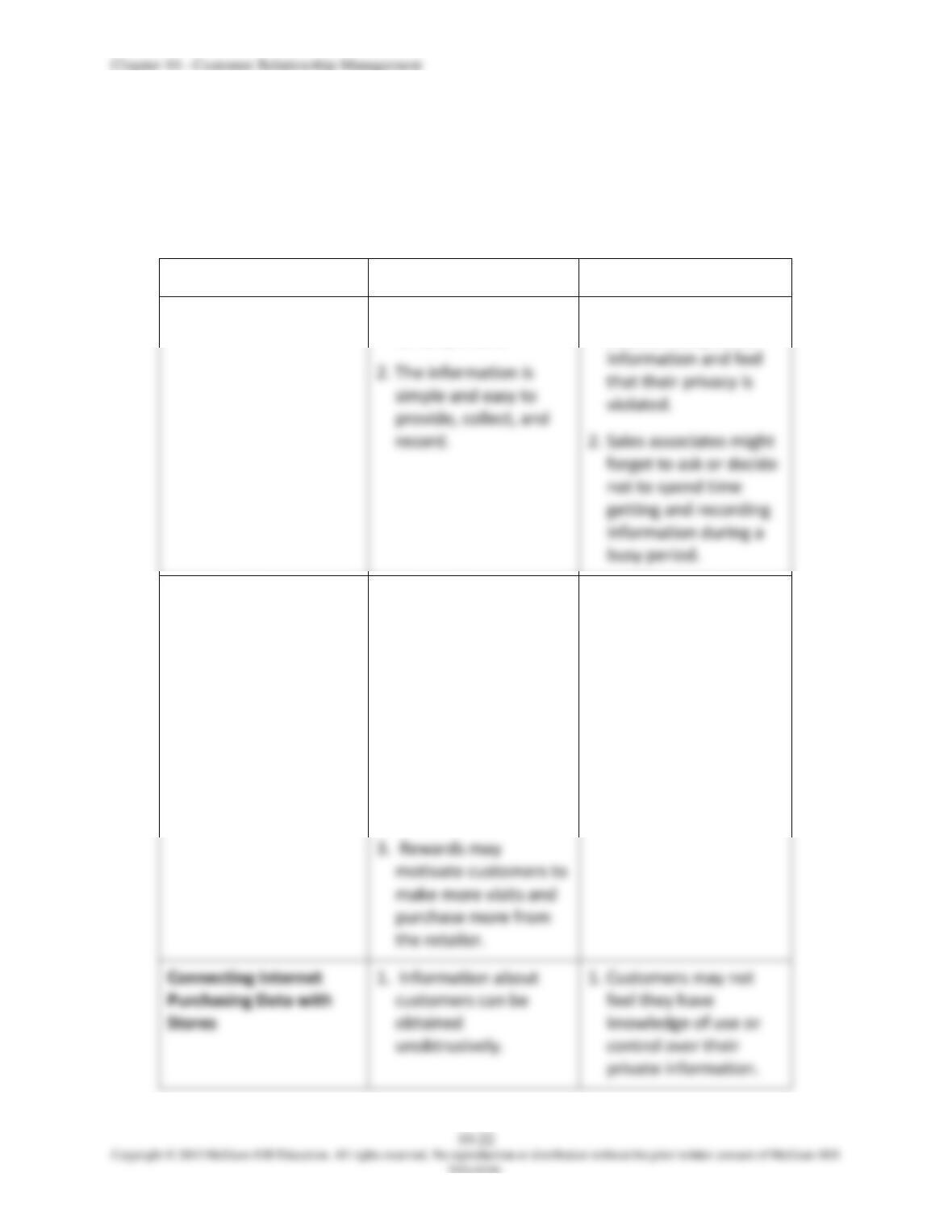
There are three approaches that retailers can use to identify customers by their
transactions. They can: (1) ask customers for the identifying information, (2) offer frequent-
shopper programs, and (3) connect Internet purchasing data with stores.
Advantages
Disadvantages
Asking Customers
1. Customers do not have
to carry a card.
1. Customers may be
reluctant to provide
Offering a Frequent-
Shopper Program
1. Transaction
information could be
better linked to
descriptive customer
information.
2. Rewards offered
would motivate
customers to use the
card every time they
purchase.
1. Customers already
carry too many cards
and may not want to
carry another one.
2. Customers may forget
to bring the card or
decide not to use it if
they are in a hurry.
9. A CRM program focuses on building relationships with a retailer’s better customers.
Some customers who do not receive the same benefits as the retailer’s best customers
may be upset because they are treated differently. What can retailers do to minimize this
negative reaction?
On one hand, retailers may feel that the minimum negative reaction from customers would
be to not patronize the retailer again. If this segment of customers is the one most costly to
serve and the least profitable to the retailer, the unprofitable customers are weeded out
anyway. However, the problem is compounded during two likely cases: (1) the customers
are somewhat profitable but are not yet the retailer’s best customers, and (2) when
Another way is the exact opposite: publicize the differences in benefits more clearly.
Customers then make their own decision as to the level and quality of interactions they
want with the retailer. For example, some banks clearly promote various types of checking
and savings accounts customers could enroll in as well as the interest rates for various levels
of balances. Customers can then decide, for example, if they want an account with higher
minimum balances and free checking or lower minimum balances and a charge for checks
above a low minimum limit per month.
10. Think of one of your favorite places to shop. How does this retailer create customer
loyalty and satisfaction, encourage repeat visits, establish an emotional bond between
the customer and the retailer, know the customer’s preferences, and provide personal
attention and memorable experiences to its best customers?
Retailers have any number of practices in place to create these positive relationships with
customers. One effort toward building these relationships is establishing a truly valued
frequent-shopper program. A truly valued program is one the retailer’s consumers
understand and appreciate as providing them direct benefits through an easily understood
program. Many of the frequent-shopper programs now offer tiered benefits, providing
higher levels of benefits to the retailer’s best customers.
Personalization is another technique retailers use to foster emotional connections and
loyalty with customers. One-to-one relationships, like a personal shopper service, allow the
retailer to connect with each customer’s needs and wants directly. Internet retailers often
use this technique providing purchase suggestions and tailored merchandise information
each time a “best shopper” logs onto the retailer’s website.
CONNECT ACTIVITIES FOR CHAPTER 10
Activity Title
Activity Type(s)
Topic
Learning Objective
Customer
Relationship
Management
Terminology
Click and Drag;
Matching (accessible
version)
Customer
Relationship
Management Process
10-1 Describe the
customer relationship
management process.
Matching (accessible
version)
Relationship
Management Process
ways to implement
effective CRM