Chapter 9: Financial Analysis
Swing v. Steady
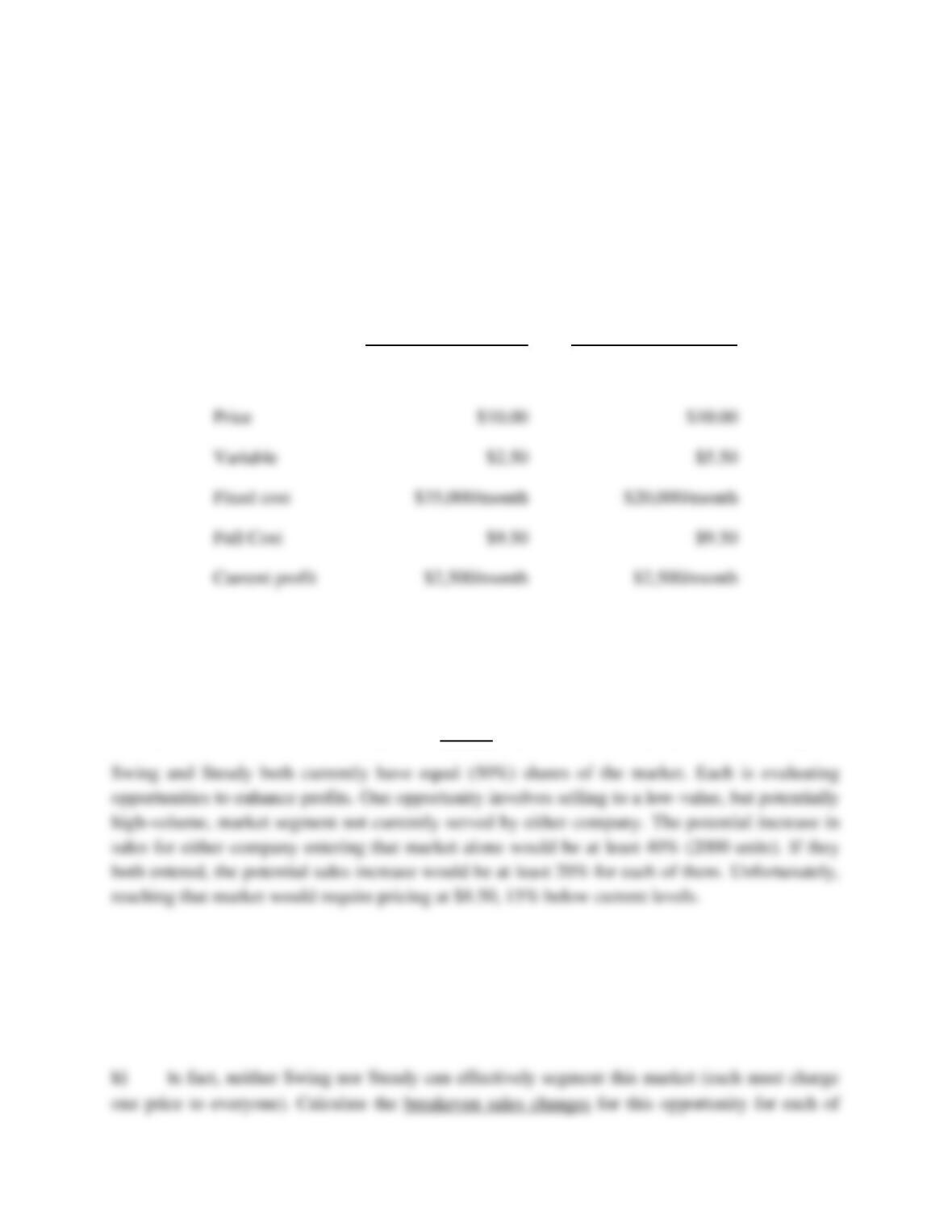
Swing Manufacturing and Steady Manufacturing both operate in the widget industry, but with
radically different cost structures. Swing is a capital-intensive, automated manufacturer, while
Steady is a labor-intensive “job-shop.” Monthly operating data are as follows.
Swing Manufacturing
Steady Manufacturing
Sales
5,000 units
5,000 units
Price
Fixed cost
Current profit
Please answer the following questions. DO NOT calculate the profitability of these changes by
calculating profit levels before and after the changes, spreadsheet style. That approach would
take four times longer and not show me that you understand the formulas. Use the simple
concept of contribution to calculate just the change in profits due to the proposed price changes.
a) If either company could costlessly segment the market for pricing (that is, charge the 15%
lower price only to this new segment without undermining the prices charged to current
customers), how much additional profitability could each company earn by achieving a 20% and
a 40% increase in sales? Would you recommend that either or both companies pursue this
opportunity?
them. Calculate the changes in profit for a 40% increase in sales. Briefly explain why this answer
differs from your answer in part A.
c) Which competitor is better positioned to take advantage of this opportunity? Assuming
that neither company can segment the market, what advice would you give to Swing and to
Steady regarding this opportunity?
Swing took the opportunity to enter the new market segment, cutting its prices 15% to do so.
d) Was Steady’s decision to cut price financially justified?
Assume that if Steady were to withdraw from this market, it could reduce its fixed costs by half
e) Given the financial information that you have at this point, would Steady be better off to
withdraw from this market altogether?
Fortunately, crisis has a way of focusing the mind. After reading Michael Porter’s Competitive
Advantage, Steady’s management decided to analyze the entire value chain of which widgets are
a part. Steady learned that at least 3,500 units of current market demand comes from companies
that must modify the commodity widget they buy to meet their specific needs. This creates an
opportunity for Steady to integrate forward, casting specialized widgets to meet the needs of
f) What is the minimum monthly unit sales that Steady would require to make it more
profitable as a specialty widget manufacturer than it is currently as a commodity
manufacturer?
g) How much additional profit would Steady earn as a specialty widget, given its minimum case
scenario of 3,500 specialty units at a $6.00 price premium?