Chapter 10
Valuation
Go to the Chapter 10 folder in the Additional Instructor Resources & Solutions folder to find
the Excel spreadsheets and other resources that accompany this chapter’s material.
Chapter Overview
I. Introduction
II. Fair market value
a. Arms’ length
b. Synergistic premium
c. Marketability discount
IV. Approaches to valuing an asset
a. Market approach
i. Market transactions approach
b. Income approach
i. Steps in the income approach
ii. Valuation calculations in the income approach
iii. The income approach and sport franchises
Key Concepts
When reading this chapter, students should focus on the following key concepts:
1. The three approaches that can be used to analyze valuation in sport: market,
income, and cost.
2. Differences in methods used to analyze value.
Concept Check Responses
1. In the Exhibit, why do the Expos have the highest price-to-revenue multiple?
While having the lowest revenue in the league (as shown), the Expos were the least
2. Give examples of ways in which a sport team majority owner could violate fiduciary
duties and financially harm the minority shareholders.
Any actions that either raise expenses or lower revenues from what they would be
otherwise potentially violate fiduciary duties.
Examples include:
3. In a discounted cash flow analysis, what happens to the NPV, if, all else being equal, the
discount rate goes up? What happens to NPV if the growth rate for the terminal value
(perpetual growth rate) rises?
If the discount rate rises, the discount factor decreases because the discount rate is in
4. Give examples of how a sport franchise can use related-party transactions to reduce its
net income. For each example, how does it reduce net income?
This is similar to Question 2 above. Using related-party transactions (RPT) to benefit the
majority owner at the expense of the minority owners is potentially a violation of
fiduciary duties. However, using RPT to lower the franchise’s net income is not likely
5. When an analyst determines the value of a private company owned 100% by a single
investor by analyzing the share prices of publicly traded companies, what adjustments
must they make in order to arrive at a final value?
There exist controlling interest premiums (or the opposite being a minority interest
discount), marketability discounts or premiums, and synergistic premiums. When using
Responses to Practice Problems
1. If the minority price for a single share of stock of a company is $20, if there are 500
thousand shares of stock, and a person offers to buy the entire company for $14.5
million, what is the controlling interest premium being offered?
The market capitalization (price*number of shares) is $10 million. However, in order to
2. Using the same information, what is the minority or non-controlling interest discount
for a company that has a control value of $14.5 million, 500 thousand shares, and a
share price of $20?
This is just doing the flipped-over calculation. It is similar to saying that if a company
Response to Case Analysis Questions
1. Net Present Value Calculated Under the Discounted Cash Flow Income Approach
The Greatest Deal in Sports is referenced in Chapter 4. Darren Rovell, CNBC sports
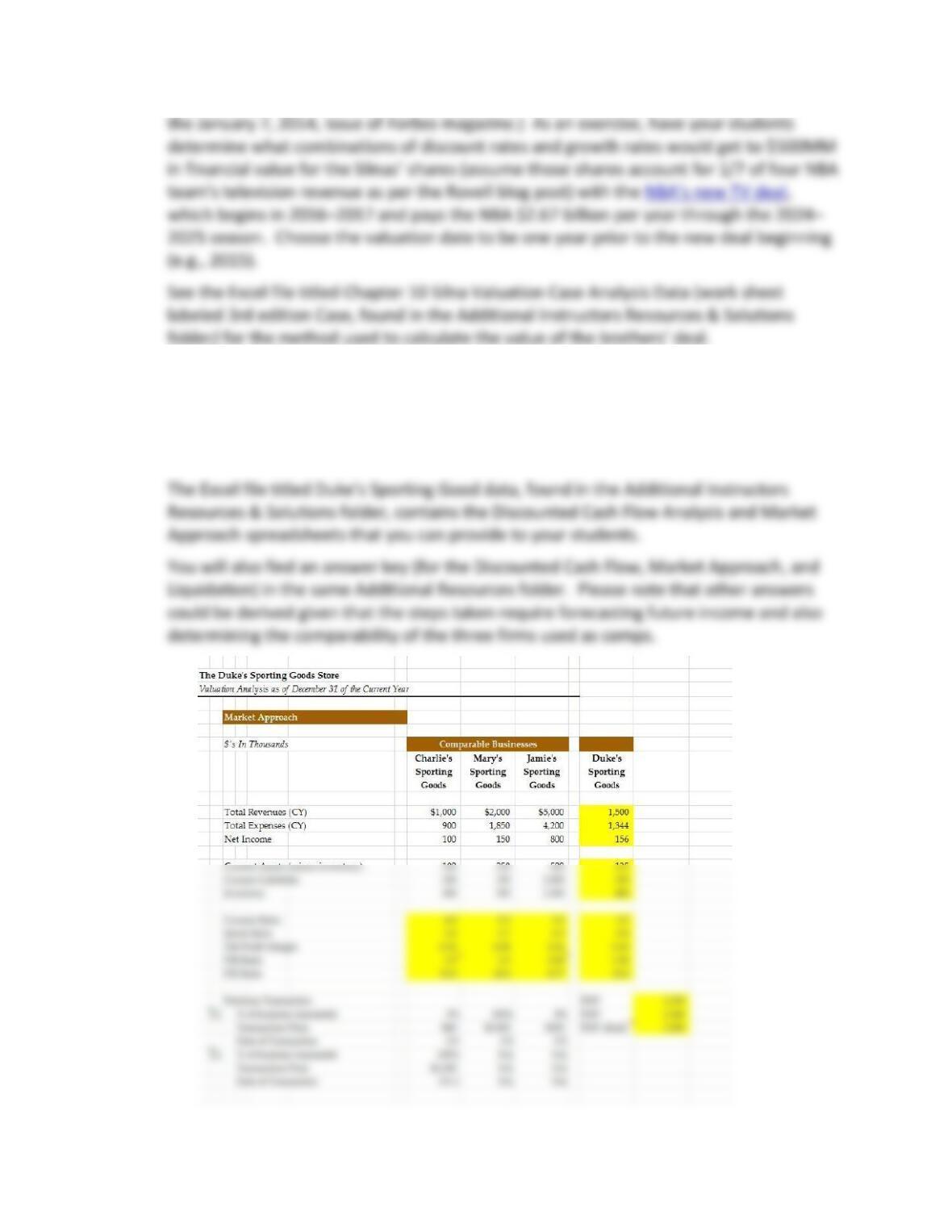
2. Fair Market Valuation: Market Approach, Income Approach, and Liquidation Value
This case involves calculating the fair market valuation FMV of a sporting goods store.
The information provided allows for an Income Approach (DCF), a Market Approach,
and Liquidation Value (which is not typically FMV because there is a forced sale).