Chapter 10: Marketing Research
CHAPTER SUMMARY AND LEARNING OBJECTIVES
LO 10.1 Describe the six steps in the marketing research process.
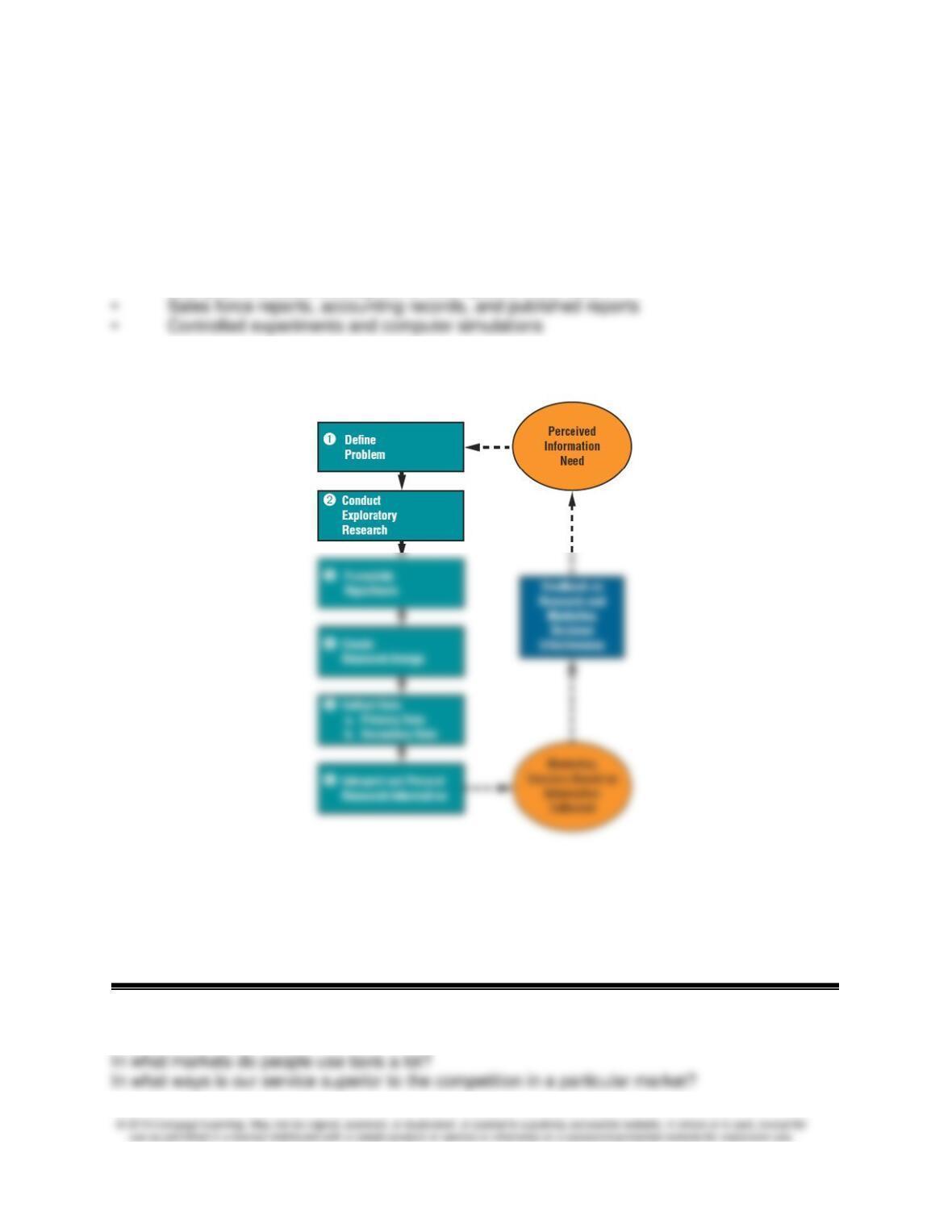
The six steps in the marketing research process are define problem, conduct exploratory
research, formulate hypothesis, create research design, collect data, and interpret and present
research information.
LO 10.2 Summarize the four sources of secondary marketing research data.
LO 10.3 Compare the three principal methods of collecting primary marketing research
data.
Primary data refers to information collected for the first time specifically for a marketing research
study. The three principal methods of collecting primary marketing research data are
observation, survey, and experimental.
LO 10.4 Outline four considerations for conducting marketing research in global markets.
LO 10.5 Summarize how technology is used to assist collection and analysis of
LO 10.6 Given a list of marketing research data from various sources, classify as either
primary or secondary data.
It is important for marketers to understand the difference between primary and secondary
Chapter 10: Marketing Research
ACTIVATOR EXERCISE: Quick Research Study
Purpose: To engage students in the process of collecting research data.
Format: Small group activity
Time: 20–30 minutes, depending on format.
Activity: The goal of this exercise is to research the coffee market.
STEP 1: Divide the class into small groups and assign each one of the following tasks (it’s OK if
more than one group is assigned tasks 2 and 3 because you’ll be able to compare results).
Task 1: Primary Research Group—The group assigned this task will conduct a primary research
survey of the class. Their first job is to create 5–7 questions to ask the class about their coffee
use. Examples include “Do you drink coffee?” “How many cups per day/week?” “How much do
you spend per day/week?” and so on. While you can provide the students a few hints, let them
drive the process of creating the questions. It will help them learn how challenging that can be.
Task 3: Secondary Research about Coffee Competitors—The groups assigned this task will
research and identify the size of the largest coffee companies in the United States or globally.
This will include companies with coffee stores (i.e., Starbucks) and other brands that sell coffee
(i.e., Green Mountain).
STEP 2: Provide about 10 minutes for each group to work.
Result: Students will get to experience the process of market research and see the difference
between primary and secondary research—all topics discussed in the chapter.
costs. These methods complement each other and provide a clearer picture.
Chapter 10: Marketing Research
LECTURE OUTLINE
10-1 The Marketing Research Process
Collecting and managing information about what customers need and want is a challenging task
for any marketer. Marketing research is the process of collecting and using information for
marketing decision making. Research data comes from a variety of sources, such as:
• Well-planned studies designed to elicit specific information
PRESENTATION VISUAL: MindTap Exhibit 10.1 showing the research process
Define the Problem
A well-defined problem permits researchers to focus on securing the exact information needed
for the solution. Clearly defining the question that researchers need to answer increases the
speed and accuracy of the research process.
Discussion question: What is an example of a research “problem” for a company like Uber?
Possible answers:
Chapter 10: Marketing Research
How big is the pool of potential drivers in a particular market?
What pricing is most likely to be effective in a particular market?
Conduct Exploratory Research
Once a firm has defined the question it wants to answer, researchers can begin exploratory
research. Exploratory research seeks to discover the cause of a specific problem by discussing
the problem with informed sources both inside and outside the firm, and by examining data from
other information sources.
Formulate a Hypothesis
Classroom activity: Using the questions/problems identified in the previous activity, divide
students into small groups and have them formulate hypothesis for each of them.
Create a Research Design
To test hypotheses and find solutions to marketing problems, a marketer creates a research
design, a master plan for conducting marketing research. This includes defining the types of
research to be utilized and the selection of respondents. The goal of this step is to ensure the
research will measure what it’s intended to measure. Poorly designed research plans can yield
misleading or inaccurate results, and waste valuable resources.
Collect Data
Marketing researchers gather data that can be classified as secondary or primary. Secondary
current customers about their preferences for product improvements.
Chapter 10: Marketing Research
Secondary data offers two important advantages:
• It’s almost always less expensive to gather than primary data
However, secondary data has limitations that primary data does not. First, unless updated
regularly, published information becomes obsolete.
Example: A marketer analyzing the population of various areas may discover that even
Interpret and Present Research Data
The final step in the marketing research process is to interpret the findings and present them to
decision makers in a format that allows them to make effective judgments. Possible differences
Key Takeaway: By following the marketing research process, a company can conduct
effective research that may influence a number of decisions about their marketing mix.
Estimated time: 20–40 minutes
10-2 Secondary Data Collection
Internal data
Internal data includes sales records, product performance reviews, website analytics, and
marketing reports. Marketers can find valuable data in their firm’s own internal records.
Chapter 10: Marketing Research
Discussion question: Try to come up with as many examples as possible of data that is
collected within an organization that could be used in marketing research.
Possible answers:
Sales revenue for each product line
The relationship between promotional spending and profitability of each product line
Government Data
The U.S. government is a leading source of marketing data. Conducting a periodic census of
housing, population, business, manufacturing, agriculture, minerals, and governments, the U.S.
Census Bureau provides the most frequently used government statistics. The Census Bureau
also conducts a census of population every 10 years, which contains a wealth of valuable
information for marketers.
Industry Publications
A trade association, an organization of businesses that operate within an industry, may be an
Research Services
Several national research firms offer information to businesses for a fee. GfK Roper Reports
Worldwide provides continuing data on consumer attitudes, life stages, lifestyle, and buying
Classroom activity: Divide students into groups and give each of them an industry to research.
Chapter 10: Marketing Research
Note: Often they will find results for expensive reports related to that industry, which shows the
value that sellers of this information put on their research findings. It also shows the value
Key Takeaway: Secondary data are fast and low-cost ways of gathering marketing
research.
Estimated time: 25–45 minutes
10-3 Primary Research Methods
Primary data refers to information collected for the first time specifically for a marketing research
Observation
Marketers trying to understand how consumers behave in certain situations find observation a
useful technique. In observational studies, researchers view the overt actions of the subjects
they’re studying. Examples of observation include:
• Counting the number of cars passing by a potential site for a restaurant
Another type of observation method is interpretive research, a method in which a researcher
observes a customer or group of customers in their natural setting and interprets their behavior
based on an understanding of the social and cultural characteristics of that setting.
Survey
Observation alone cannot supply all of the information researchers desire. They must ask
questions to get information on demographics, attitudes, motives, and opinions. There are
several methods for collecting survey data.
• Telephone interviews
Classroom activity: Divide students into groups. Select one person from each group and ask
them to lead a focus group survey of their group. The topic is “Study habits.”
Chapter 10: Marketing Research
The general goal is to find out how much time students spend on schoolwork, what tools and
habits they find effective, what obstacles they face, and what suggestions they have for
improving the process of assigning and grading schoolwork? Leaders can then inquire deeper
with each focus group member based on the responses they receive. The leader is basically
performing a group interview and trying to gather the highest quality information possible.
Test Marketing
Test marketing is a marketing research technique that involves introducing a new product in a
specific geographic area and then observing its degree of success. Test marketing is the first
stage where the product performs in a real-life environment. Some firms omit test marketing and
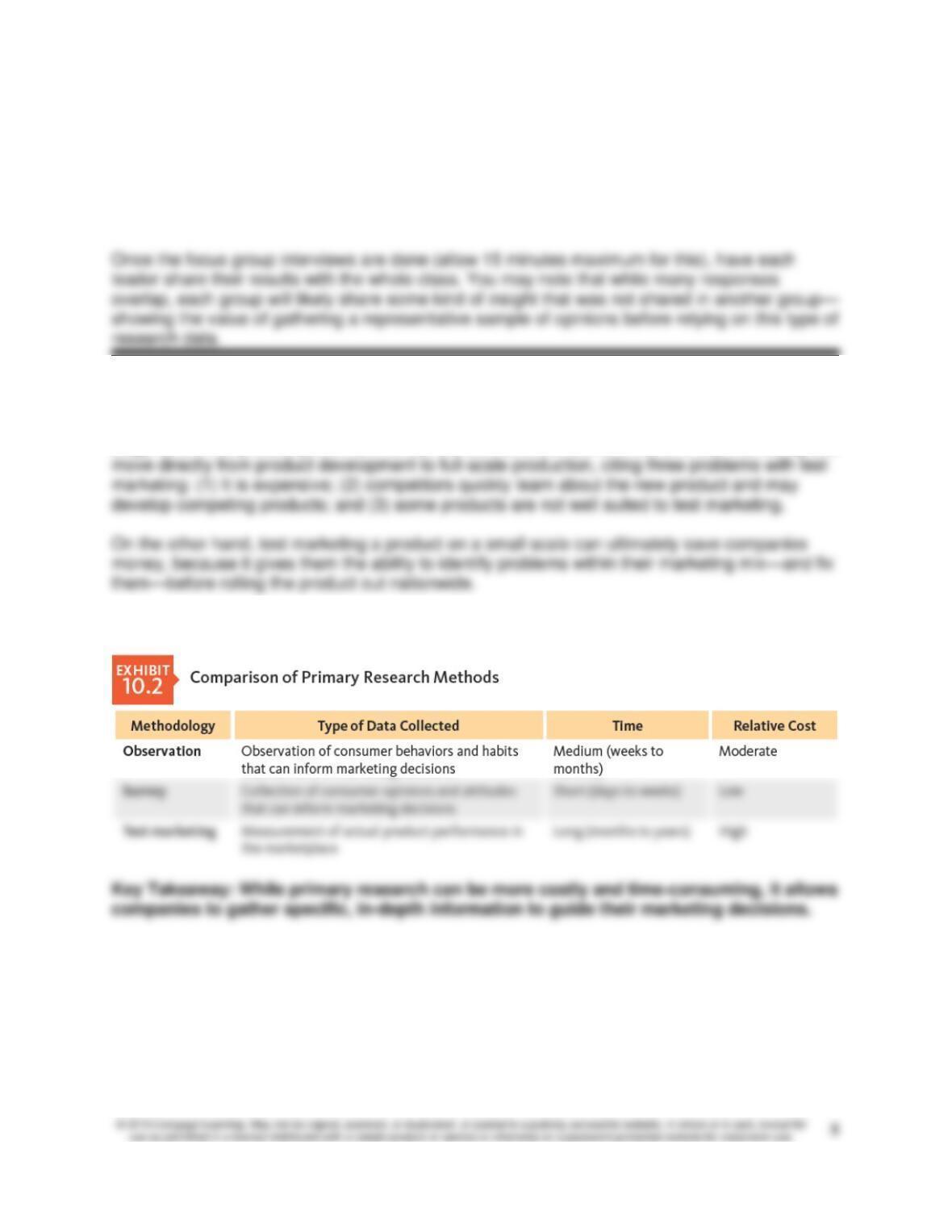
PRESENTATION VISUAL: MindTap Exhibit 10.2 comparing primary research methods
Estimated time: 10–30 minutes (depending on whether you facilitate the classroom activity)
10-4 Conducting International Market Research
As companies expand globally, they need to gather more knowledge about consumers in other
countries. Although marketing researchers follow the same basic steps for international studies
as for domestic ones, they often face some very different challenges. There are four
Chapter 10: Marketing Research
considerations for conducting marketing research in global markets: access to secondary data,
language differences, the global business environment, and data collection methods.
Access to secondary data
Classroom activity: Divide students into groups and ask them to brainstorm a product they’d
want to market globally. They are pretending they run a new company that sells that product;
they are not representing an existing brand.
Then, assign each group a country to research. They’ll try to discover whether that country is a
good prospect for their product. Suggest they use www.export.gov for their research, as it has a
wealth of information by country.
Language differences
When conducting international studies, companies must be prepared to deal with both language
and cultural differences, even when conducting simple surveys. Poorly translated research
questions can result in misleading data.
Global business environment
Data collection methods
Businesses may need to adjust their data collection methods for primary research in other
countries, because some methods do not easily transfer across national frontiers. Face-to-face
interviewing, for instance, remains the most common method for conducting primary research
outside the United States.
Chapter 10: Marketing Research
Estimated time: 10–40 minutes (depending on whether you facilitate the classroom activity)
10-5 Technology in Marketing Research
Computer technology has significantly changed the complexion of marketing research in three
key ways.
Data Collection
In the past, all market research had to be conducted and tabulated manually, but no longer. As
mentioned earlier, the growing number of Internet users has spurred the growth of online
Discussion question: What data is collected by the college about students? Where is that data
stored? How is the data collected?
It can be useful to see how technology can accelerate and scale data collection, but doesn’t
necessarily automate all of it.
Example: Colleges collect grades that are stored in the registration system, but those grades
must be entered manually by instructors.
Data Reporting and Access
In the past, research organizations often compiled reports and sold them to marketers at very
Data Analysis
In the past, marketers had to manually interpret data to make marketing decisions, now
technology allows marketers to quickly process massive amounts of complex data that would be
impossible to interpret manually.
Chapter 10: Marketing Research
Data mining is a technique in which a user employs special software to search through
computerized data files to detect patterns. It focuses on identifying relationships not obvious to
marketers—in a sense, answering questions that marketing researchers may not even have
thought to ask.
Key Takeaway: Technology has made marketing research faster and allows for insights
that weren’t previously possible.
Estimated time: 15 minutes
10-6 Classifying Data as Primary or Secondary
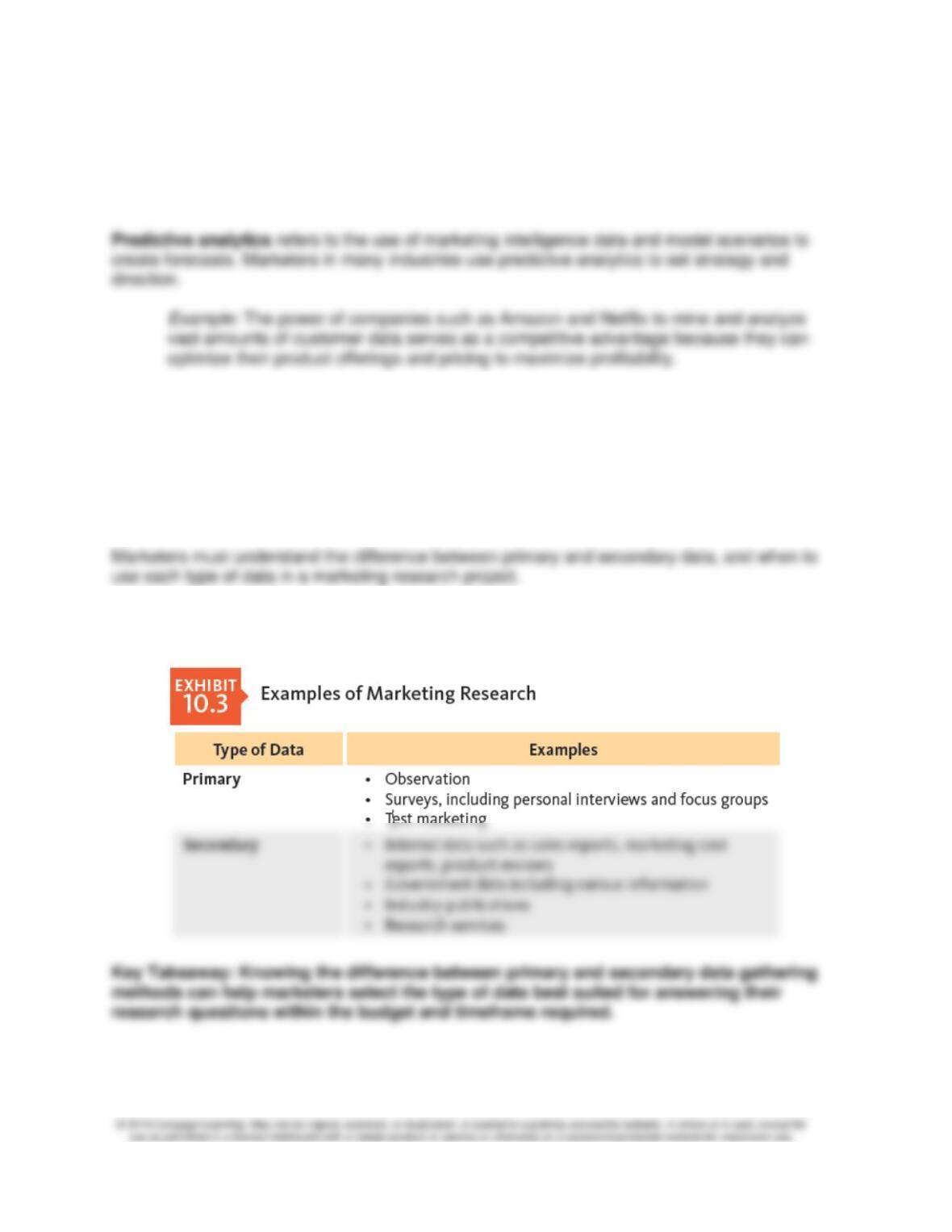
PRESENTATION VISUAL: MindTap Exhibit 10.3 showing examples of primary and
secondary data
Estimated time: 25–30 minutes
Chapter 10: Marketing Research
LEARN IT TODAY . . . USE IT TOMORROW
VIGNETTE AND ACTIVITY
The opening vignette for Chapter 10 discusses Netflix, the streaming entertainment company.
The vignette notes how Netflix makes use of the data they collect in order to make programming
decisions.
Note: Answers to the chapter-ending activity can be discussed in class after the activity
due date.
Market Research at Netflix
As Netflix looks to expand its offerings and grow to new markets, the company would like to
conduct market research to help guide decisions in these areas. To ensure the validity of their
research results, Netflix would like to use a broad mix of secondary and primary data sources.
Help them categorize the data they have collected, or plan to collect.
Scenario 1
Noting the popularity of reality and competition television shows such as Survivor on CBS, The
Voice on NBC, and The Bachelor on ABC, Netflix would like to create an original series to
compete with network offerings. Netflix executives are unsure which type of show would appeal
to Netflix subscribers—a dating show, skill-based competition, or something else? Please help
researchers classify the data they have collected as primary or secondary.
• Video recordings of focus groups Netflix conducted in three of the company’s largest
Answers:
• Video recordings of focus groups Netflix conducted in three of the company’s largest
Chapter 10: Marketing Research
Scenario 2
Netflix has expanded its subscription streaming service to Canada, France, Mexico, and Japan.
The company would like to expand to China and needs to conduct market research there in
order to determine the appropriate subscription fee and best type of programming for Chinese
consumers. Please help researchers classify the data they have collected as primary or
secondary.
• Chinese income, education level, and population data from the World Bank
Answers:
• Chinese income, education level, and population data from the World Bank (secondary)
• Results from the Chinese Marketing and Media Study collected from Sinomonitor, a media
Scenario 3
As the single largest supplier of original kids’ content, Netflix CEO Reed Hastings is considering
expanding the company’s offerings to include video games. For an additional per-month
subscription fee, Netflix would offer unlimited game play on more than 20 games. By partnering
• Demographic information for video game players from Gamer Newz, an industry publication
• Observation data from an arcade near Netflix headquarters in Los Gatos, California
Answers:
• Demographic information for subscribers with children’s profiles on Netflix (secondary)
Chapter 10: Marketing Research
Scenario 4
Executives at Netflix are reviewing the company’s first quarter results. Profits have remained
mostly flat from the previous quarter, but executives are more concerned about declining
viewership statistics. They are fearful that if this number continues to decline, Netflix customers
may cancel their subscriptions. Executives have tasked the Netflix marketers with the job of
determining what has caused the decline in viewership. Classify the following information as
primary or secondary data.
• Netflix subscription and viewership data from the last four quarters
• Results from an e-mail survey sent to Netflix subscribers who had declining viewership rates
• Results from previously compiled exit surveys, sent to Netflix customers who cancel their
subscriptions
• Data from Nielsen’s television rating report, published monthly
Answers:
• Netflix subscription and viewership data from the last four quarters (secondary)
Chapter 10: Marketing Research
ADDITIONAL HOMEWORK/CLASSROOM ACTIVITIES
The Marketing Research Process
Purpose: To help students apply the marketing research process.
Estimated Class Time: About 20 minutes
Preparation/Materials: You may want to copy the scenario and challenge (below) for each
student.
Exercise: After you have reviewed the material on the marketing research process, divide your
class into small groups and distribute the scenario outlined below:
Scenario: You and your partners are the owners of an upscale nightclub called Amnesia
Nights on Sunset Boulevard in Hollywood, California. When you opened the club two
research.
The Challenge: You and your team have ten minutes to develop your ideas for
marketing research by responding to the following questions:
• What primary and secondary information would you seek? Why?
• Who would be your research subjects? Why? How would you find them?
Questions for Reflection:
• Which steps of the marketing research process differ based on the target audience?
• Does product category affect the marketing research process? If so, how?
Chapter 10: Marketing Research
Primary Research Methods
Purpose: To demonstrate a useful projective research technique.
Background: While gathering information through traditional marketing research methods
Relationship to Text: Primary Research Methods
Estimated Class Time: About 10 minutes
Exercise: Ask your students to brainstorm a list of five to ten different automobile makes and
models that they know and like. Then, request five volunteers and invite them to the board. Ask
Questions for Reflection:
• How valid are projective techniques?
• How could you use these methods in conjunction with other types of research?
Internet Exercises
Focus groups. Visit each of the websites listed below. Each discusses the proper way to
organize and conduct a focus group. After reviewing the material, prepare a brief report on the
subject.

Chapter 10: Marketing Research
retailer. What types of marketing research services could a firm like Nielsen provide to your
company? What are some of the benefits?
Note: Students must visit Nielsen’s website and take a note of the services offered by them.
They may analyze and identify the services that Nielsen can provide a small online retailer. The
potential benefits, insights, solutions, tools, and support need to be documented and presented
by the students.
Chapter 10: Marketing Research
KEY TERMS
Marketing research: The process of collecting and using information for marketing decision
making.
Exploratory research: Seeks to discover the cause of a specific problem by discussing the
problem with informed sources both inside and outside the firm, and by examining data from
other information sources.
Interpretive research: A method in which a researcher observes a customer or group of
customers in their natural setting and interprets their behavior based on an understanding of the
social and cultural characteristics of that setting.
Focus group: A small group of individuals in one location to discuss a subject of interest.
Test marketing: A marketing research technique that involves introducing a new product in a
specific geographic area and then observing its degree of success.
Big data: The data that originates in unprecedented volume and at unprecedented speed from
the world around us.