
Instructor Manual
Lamb/Hair/McDaniel, MKTG 13E, 9780357127810; Chapter 10: Product Concepts
Table of Contents
Purpose and Perspective of the Chapter …………………………………………………………………………. 2
Cengage Supplements …………………………………………………………………………………………………… 2
Learning Outcomes ……………………………………………………………………………………………………….. 3
Complete List of Chapter Activities and Assessments ……………………………………………………… 3
Key Terms ……………………………………………………………………………………………………………………… 4
What’s New in This Chapter ……………………………………………………………………………………………. 6
Chapter Outline …………………………………………………………………………………………………………….. 6
Discussion Questions …………………………………………………………………………………………………… 15
Additional Activities and Assignments …………………………………………………………………………… 17
Additional Resources ……………………………………………………………………………………………………. 22
External Videos or Playlist ……………………………………………………………………………………………………….. 22
Appendix …………………………………………………………………………………………………………………….. 23
Generic Rubrics ……………………………………………………………………………………………………………………… 23
Standard Writing Rubric …………………………..……………………………………………………………………………… 23
Standard Discussion Rubric ……………………………………………………………………………………………………… 24
Purpose and Perspective of the Chapter
The purpose of this chapter is to define product. A product is anything, desired or not, that
a person or organization receives in an exchange. The basic goal of purchasing decisions is
to receive the tangible and intangible benefits associated with a product. Consumer
products are classified into four categories: convenience products, shopping products,
Packaging has four functions related to products: containing and protecting products;
promoting products; facilitating product storage, use, and convenience; and facilitating
recycling and reducing environmental damage. In addition to brand piracy, international
marketers must address a variety of concerns regarding branding and packaging, including
choosing a brand name policy, translating labels and meeting host-country labeling
Cengage Supplements
The following product-level supplements provide additional information that may help you
in preparing your course. They are available in the Instructor Resource Center.
• Transition Guide (provides information about what’s new from edition to edition)
• Educator’s Guide (describes assets in the platform with a detailed breakdown of
Learning Outcomes
The following learning outcomes are addressed in this chapter:
10-1 Define the term product.
10-2 Classify consumer products.
10-3 Define the terms product item, product line, and product mix.
Complete List of Chapter Activities and Assessments
For additional guidance refer to the Teaching Online Guide.
Chapter
Learning
Objective
PPT slide
Activity/Assessment
Duration
Certification
Standard
N/A
MindTap: Why Does
Brand Loyalty Matter to
Me?
5 minutes
BUSPROG:
Reflective
Thinking
DISC: Customer
10–1 – 10–
2
MindTap: Learn It 10-1
and 10-2: What is a
Product and Types of
Consumer Products
10 minutes
BUSPROG:
Analytic
DISC: Product
Instructor Manual: Lamb/Hair/McDaniel, MKTG 13E, 9780357127810; Chapter 10: Product Concepts
Branding and Packaging
and Product Warranties
DISC:
Promotion
10–1 – 10–
7
MindTap: Assignment
25 minutes
BUSPROG:
Analytic
DISC:
Marketing Plan
10–1 – 10–
7
MindTap: Case Activity
15 minutes
BUSPROG:
Analytic
DISC: Strategy
10-2
14
Knowledge Check 1 in
5 minutes
BUSPROG:
Communication
DISC: Product
10-3
25
Group Activity 1 in PPT
25-30 minutes
BUSPROG:
Communication
DISC: Product
10-4
37
Knowledge Check 2 in
PPT
10 minutes
BUSPROG:
Communication
DISC:
Communication
Promotion
10-6
51
Knowledge Check 3 in
5 minutes
BUSPROG:
Promotion
[return to top]
Key Terms
brand equity: the value of a company or brand name.
brand loyalty: consistent preference for one brand over all others.
co-branding: placing two or more brand names on a product or its package.
convenience product: a relatively inexpensive item that merits little shopping effort.
express warranty: a written guarantee.
family branding: marketing several different products under the same brand name.
persuasive labeling: a type of package labeling that focuses on a promotional theme or
logo; consumer information is secondary.
planned obsolescence: the practice of modifying products so those that have already
been sold become obsolete before they actually need replacement.
private brand: a brand name owned by a wholesaler or a retailer.
product: everything, both favorable and unfavorable, that a person receives in an
exchange.
service mark: a trademark for a service.
shopping product: a product that requires comparison shopping because it is usually
more expensive than a convenience product and is found in fewer stores.
What’s New in This Chapter
The following elements are improvements in this chapter from the previous edition:
• New examples of knockoff branding
• New packaging examples
Chapter Outline
In the outline below, each element includes references (in parentheses) to related content. “LO
CH–##” refers to the chapter learning outcome; “PPT Slide #” refers to the slide number in the
PowerPoint deck for this chapter (provided in the PowerPoints section of the Instructor Resource
Center); and, as applicable for each discipline, accreditation or certification standards (“DISC”).
Introduce Chapter 10 and review the learning outcomes. (PPT Slide 2).
1. What Is a Product? (LO 10-1, PPT Slide 3, DISC: Product)
2. Types of Consumer Products (LO 10-2, PPT Slide 7, DISC: Product)
a. Products can be classified according to their intended use. Business products
are used to manufacture other goods or services, to facilitate an organization’s
b. Convenience Products: A convenience product is a relatively inexpensive item
c. Shopping Products: A shopping product requires comparison shopping
because it is usually more expensive than a convenience product and is found in
d. Specialty Products: A specialty product is a particular item for which
consumers search extensively and are very reluctant to accept substitutes.
Specialty products are often promoted using selective, status-conscious
e. Unsought Products: An unsought product is unknown to the potential buyer
or a known product that the buyer does not actively seek. New products fall into
3. Product Items, Lines, and Mixes (LO 10-3, PPT Slide 15, DISC: Product)
a. Most companies sell a variety of things. A product item is a specific version of a
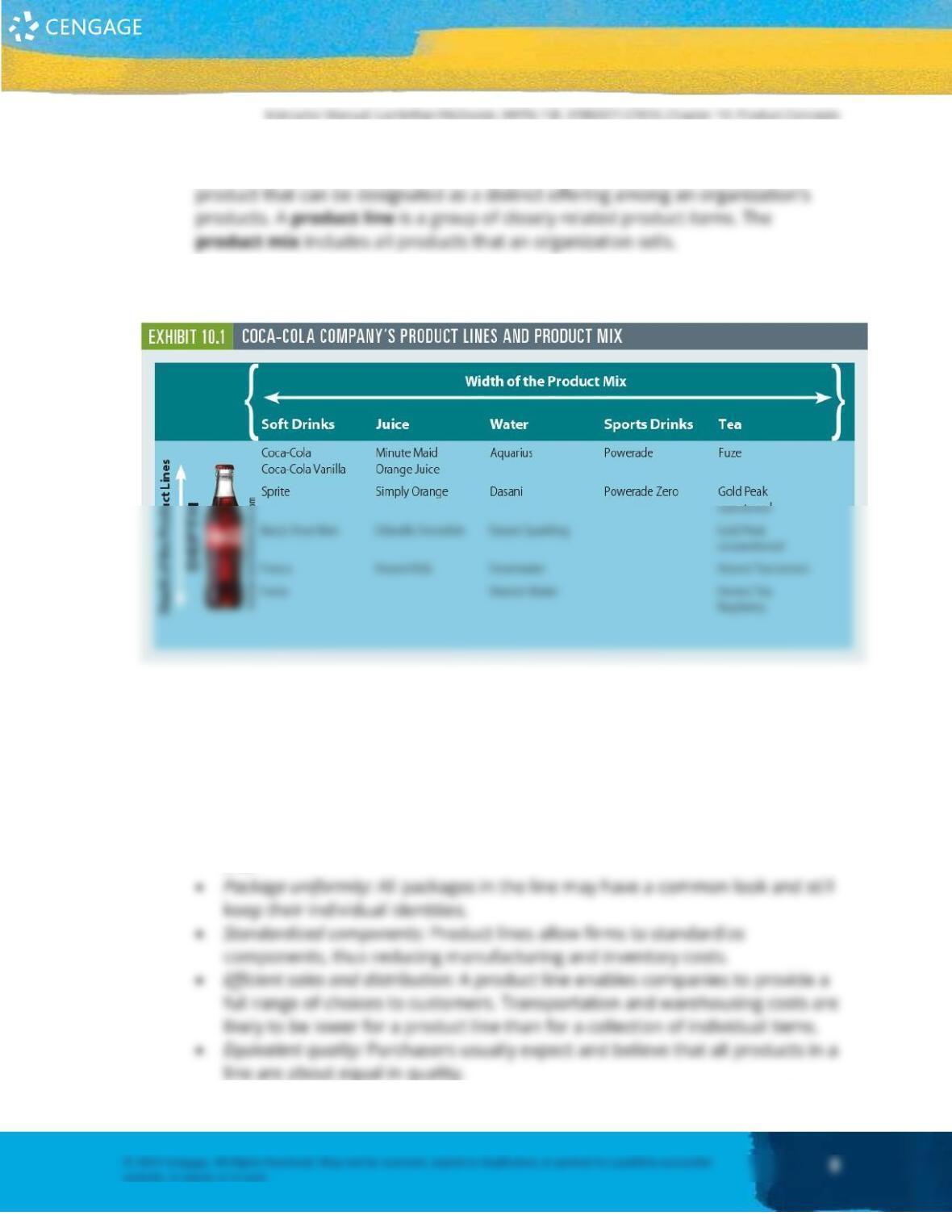
PRESENTATION VISUAL: Exhibit 10.1 Coca-Cola Company’s Product Lines
and Product Mix
b. Exhibit 10.1 provides an excellent example of a product mix that is both wide
and deep. The product items in each product line can be distinguished further
by container sizes and shapes. Each size and each container are separate
product items. Product lines and even entire product mixes often share some
marketing strategy components:
• Advertising economies: Product lines provide economies of scale in
advertising. Several products can be advertised under the umbrella of the
line.
c. Product mix width is the number of product lines an organization offers. Firms
d. Product line depth is the number of product items in a product line. Firms
increase the depth of their product lines to:
• Attract buyers with different preferences
• Even out seasonal sales patterns
e. Adjustments to Product Items, Lines, and Mixes: Over time, firms change
product items, lines, and mixes to take advantage of new technical or product
developments or to respond to changes in the environment. They may do so by
modifying or repositioning products, or extending or contracting product lines.
f. Product Modification: Product modification involves changing one or more of a
product’s characteristics.
• Quality modification – a change in a product’s dependability or durability to
g. Planned obsolescence is the practice of modifying products so those that have
already been sold become obsolete before they actually need replacement.
(Example: cell phones)
h. Repositioning: Marketers use repositioning to change consumers’ perceptions of
a brand. They are motivated to do so because of changing demographics,
declining sales, changes in the social environment, and competition.
Example: Weight Watchers has rebranded itself as WW and overhauled its
i. Product Line Extensions: A product line extension involves adding additional
products to an existing product line in order to compete more broadly in the
industry. Product lines can be overextended when:
4. Branding (LO 10-4, PPT Slide 27, DISC: Promotion)
a. Branding is the main tool marketers use to distinguish their products from those
of a brand that cannot be spoken.
b. Benefits of Branding: Branding has three main purposes:
• Product identification – branding allows marketers to distinguish their
products from all others.
o Brand equity is the value of a company or brand name. A brand that has
high awareness, perceived quality, and brand loyalty among customers
• Repeat sales – consumers identify products they wish to buy again and avoid
those they do not.
o Brand loyalty is a consistent preference for one brand over all others.
• New-product sales – having a well-known and respected company and brand
name is useful when introducing new products.
c. Branding Strategies: Manufacturers’ Brands Versus Private Brands: The brand
name of a manufacturer is called a manufacturer’s brand, or sometimes a

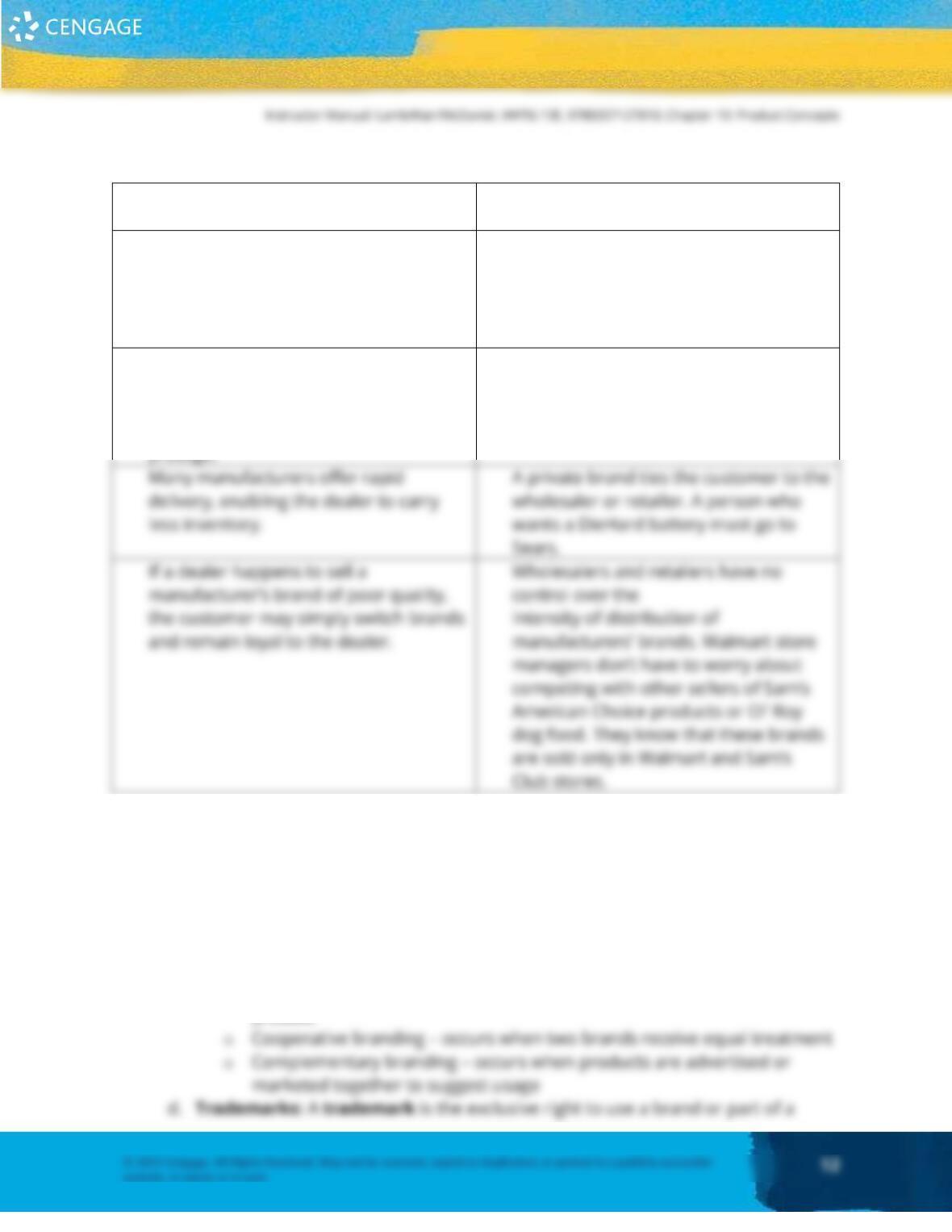
PRESENTATION VISUAL: Exhibit 10.3 Comparison of Manufacturer’s and Private
Brands from the Reseller’s Perspective
Key Advantages of Carrying
Manufacturers’ Brands
Key Advantages of Carrying
Private Brands
Heavy advertising to the consumer by
manufacturers such as Procter &
Gamble helps develop strong consumer
loyalties.
A wholesaler or retailer can usually
earn higher profits on its own brand. In
addition, because the private brand is
exclusive, there is less pressure to mark
down the price to meet competition.
Well-known manufacturers’ brands,
such as Kodak and Fisher-Price, can
attract new customers and enhance the
dealer’s (wholesaler’s or retailer’s)
dog food. They know that these brands
Club stores.
A manufacturer can decide to drop a
brand or a reseller at any time or even
become a direct competitor to its
dealers.
• Individual Brands Versus Family Brands: Individual branding occurs when
different brand names are used for different products. Family branding is
the practice of marketing several different products under the same brand
name.
• Co-Branding: Co-branding is placing two or more brand names on a product
or its package. A combination of brand names can enhance the prestige or
perceived value of a product. Three common types of co-branding include:
o Ingredient branding – identifies a branded part that makes up the