brand. A service mark is a trademark for a service. Parts of a brand or other
product identification may qualify for trademark protection, including sounds,
shapes, colors, designs, catch phrases, and abbreviations. The Digital Millennium
Copyright Act (DMCA) explicitly applies trademark law to the digital world.
Trademark protection typically lasts for 10 years. Trademark violations carry
steep penalties.
• Companies that fail to protect their trademarks face the possibility that their
product names will become generic. A generic product name identifies a
world.
5. Packaging (LO 10-5, PPT Slide 38, DISC: Promotion)
a. Packaging Functions: The functions of packaging are:
• Containing and Protecting Products: Physical packaging contains products that
• Promoting Products: Packaging identifies the brand, lists the ingredients,
specifies features, and gives directions. It differentiates a product from
competing products and may associate a new product with a family of other
Example: Coca-Cola introduced the Diet Coke It’s Mine program, which
featured millions of unique package designs for the brand. The company
Instructor Manual: Lamb/Hair/McDaniel, MKTG 13E, 9780357127810; Chapter 10: Product Concepts
• Facilitating Storage, Use, And Convenience: Wholesalers and retailers prefer
packages that are easy to ship, store, and stock on shelves. They also like
packaging that protects products, prevents spoilage or breakage, and
b. Labeling: Labeling generally takes one of two forms:
• Persuasive labeling – a type of package labeling that focuses on a
promotional theme or logo; consumer information is secondary
• Informational labeling – a type of package labeling designed to help
consumers make proper product selections and lower their cognitive
dissonance after the purchase
Example: The Nutritional Labeling and Education Act of 1990 mandated that
• Greenwashing: Greenwashing occurs when a product or company attempts to
give the impression of environmental friendliness whether or not it is
environmentally friendly. As consumer demand for green products escalated,
6. Global Issues in Branding and Packaging (LO 10-6, PPT Slide 48, DISC: Promotion)
a. When planning to enter a foreign market with an existing product, a firm has
three options for handling the brand name:
• One brand name everywhere – useful when the company markets mainly
b. Global packaging needs must also be considered. Three aspects of packaging
that are especially important in international marketing include:
• Labeling – ingredient, promotional, and instructional information must be
properly translated on labels
7. Product Warranties (LO 10-7, PPT Slide 52, DISC: Product)
a. A warranty is a confirmation of the quality or performance of a good or service
It protects the buyer and gives essential information about the product. An
express warranty is a written guarantee, whereas an implied warranty is an
[return to top]
Discussion Questions
You can assign these questions several ways: in a discussion forum in your LMS; as whole-
class discussions in person; or as a partner or group activity in class. A generic discussion
rubric is provided in the Appendix.
1. Discussion: (LO 10-1, PPT Slides 5-6) Duration 5-10 minutes.
a. Look closely at the definition of the word “product” – everything, both favorable and
unfavorable, that a person receives in an exchange. Ask students:
• What favorable things might you receive in an exchange?
2. Discussion: (LO 10-2, PPT Slides 10-13) Duration 5-10 minutes.
a. Lead students on a discussion of products with the following:
• What are some examples of convenience products that you buy regularly?
• What are some examples of shopping products—both homogeneous and
heterogeneous?
3. Discussion: (LO 10-7, Slide 53) Duration 5-10 minutes.
a. Lead students on a discussion of warranties by asking the following:
• Describe any experiences you have had in purchasing products with warranties.
• What types of warranty did your examples include?
[return to top]
Additional Activities and Assignments
A generic discussion and writing rubric is provided in the Appendix.
1. Activator Exercise: The Power of Brand Loyalty (LO 10-4)
Purpose: For students to understand the concept of brand equity and loyalty.
Classroom Format: Individual journaling, then class discussion (Estimated Time: 20-
30 minutes)
1. Ask student to individually journal about the following:
• Identify three to five products or brands that you are loyal to. Even if you
generally don’t regard yourself as brand loyal, it’s likely there are several
products that you tend to buy over and over so that you don’t constantly
have to reassess the alternatives.
2. Once students have journaled this individually, ask them to share their
results in small groups. Then, have a few students share with the class.
Online Format: Discussion board with posted response from each student
(Estimated Time: 15-25 minutes)
Provide students with the following writing prompt:
Identify three to five products or brands that you are loyal to. Even if you
generally don’t regard yourself as brand loyal, it’s likely there are several products
that you tend to buy over and over so that you don’t constantly have to reassess
the alternatives.
Additional questions for a classroom or discussion board: What are some of the
common reasons people are brand loyal? Is it the product? Habit? Based on others’
buying habits?
Result: Students will likely see that the more brand loyal they are to a product, the
2. Class activity (LO 10-1)
Format: This activity can be facilitated in both a classroom and an online
environment. Instructions for how to facilitate the activity in the classroom and
online are provided below. (Estimated time: 5-15 minutes)
Classroom Format: Divide students into small groups of three or four. Instruct
3. Class activity (LO 10-4)
Format: This activity can be facilitated in both a classroom and an online
environment. Instructions for how to facilitate the activity in the classroom and
online are provided below. (Estimated time: 10-15 minutes)
Classroom Format: In small groups, have students go to the homepage for five
brands. Ask them to distinguish between the brand name and the brand mark. Then
Online Format: If you’re delivering your course online, you can have students do
this on their own and have them post their answers in a discussion board. Use the
following prompt to facilitate this activity:
Go to the homepage for two brands. Distinguish between the brand name and the brand
4. Class activity (LO 10-5)
Format: This activity can be facilitated in both a classroom and an online
environment. Instructions for how to facilitate the activity in the classroom and
online are provided below. (Estimated time: 15-25 minutes)
Classroom Format: Divide the class into groups of three or four. Instruct students
to use the Internet to find at least two examples of each of the following: persuasive
labeling, informational labeling, and greenwashing. Ask students to share their
findings with the class, and help them identify some of the common characteristics
of each type of labeling.
Online Format: If you’re delivering your course online, you can have students do
5. Additional activity: What’s in a Brand Name? (LO 10-4)
Purpose: To emphasize the varied origins of effective brand names.
Background: A surprising number of students are planning to start their own
Format: This activity can be facilitated in both a classroom and an online
environment. Instructions for how to facilitate the activity in the classroom and
online are provided below.
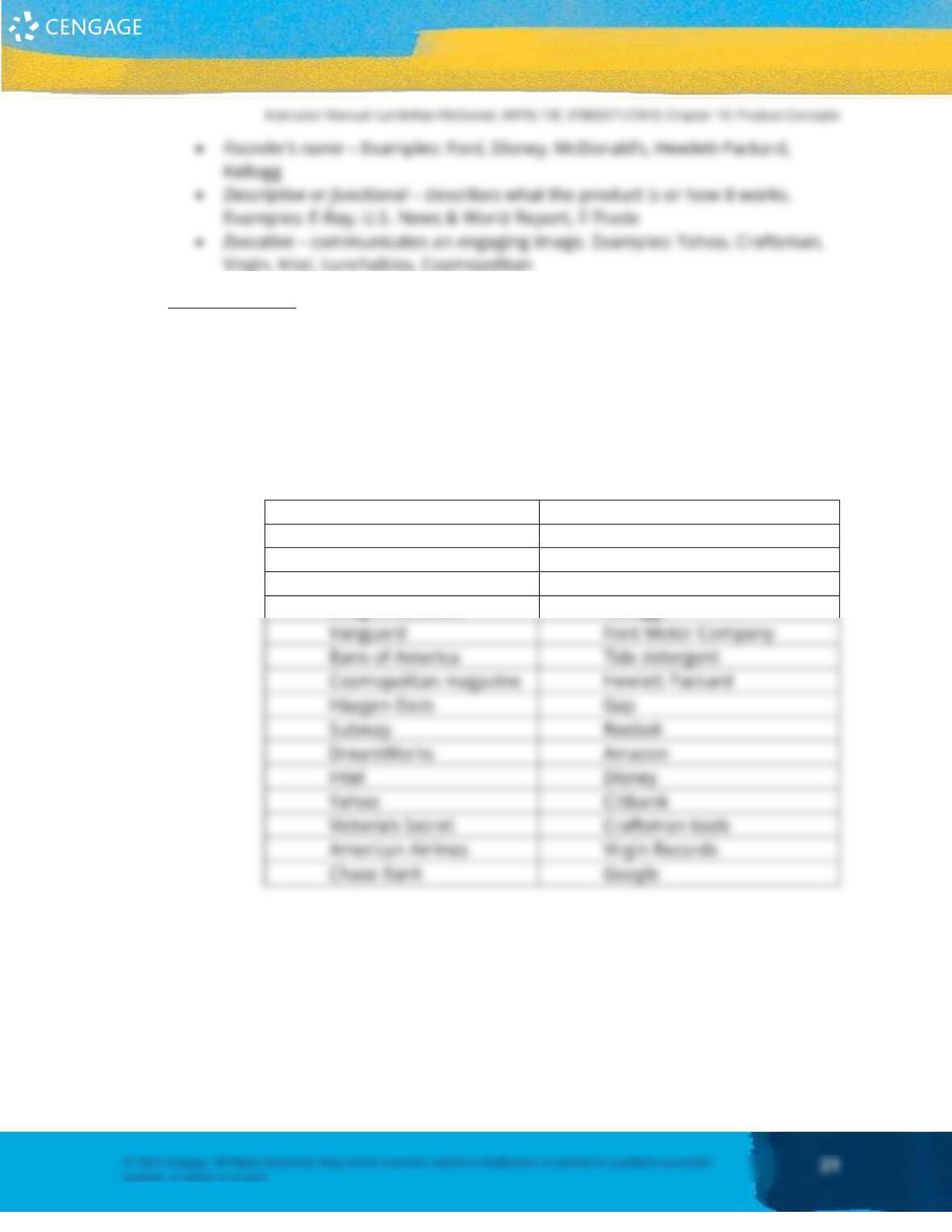
Classroom Format: Divide the students into groups of four or five. Give them the
Lunchables
Southwest Airlines
Dave’s Killer Bread
Nike
McDonald’s
Apple
Dove Skincare Products
Dell
Weight Watchers
Kellogg
Vanguard
Ford Motor Company
Bank of America
Tide detergent
Cosmopolitan magazine
Hewlett Packard
Häagen-Dazs
Gap
Subway
Reebok
DreamWorks
Amazon
Intel
Disney
Yahoo
Citibank
Victoria’s Secret
Craftsman tools
American Airlines
Virgin Records
Chase Bank
Google
Students seem to love this exercise, perhaps for its relevance to their own business
plans. Categories that typically emerge include the following:
• Location-based – refers to either the area-served or the place of origin.
Examples: Southwest Airlines, Bank of America
Online Format: Discussion board with posted response from each student
(Estimated Time: 15 minutes)
1. Use the following prompt to facilitate this activity in a discussion board:
Look at the list of brand names in the table and find a way to extrapolate or
organize them into different categories. Use additional brand names to flesh out
your organizational system. Also include in your post at least three new brand
names of your own.
Lunchables
Southwest Airlines
Dave’s Killer Bread
Nike
McDonald’s
Apple
Dove Skincare Products
Dell
Weight Watchers
Kellogg
Vanguard
Ford Motor Company
Bank of America
Tide detergent
Cosmopolitan magazine
Hewlett Packard
Häagen-Dazs
Gap
Subway
Reebok
DreamWorks
Amazon
Intel
Disney
Yahoo
Citibank
Victoria’s Secret
Craftsman tools
American Airlines
Virgin Records
Chase Bank
Google
2. Have students respond to their classmates’ posts and offer constructive
feedback on their organizational systems and brand name ideas. Ask them to
add more ideas of their own.
Additional Questions for Reflection:
• Can a brand name fall into more than one category? What are some examples
(e.g., E-Bay is both descriptive and evocative)?
6. Online Research activity: Brand Equity (LO 10-4)
Several sources compile lists each year of the world’s most valuable brands. Two are
Bloomberg Businessweek magazine and a consulting firm called Brand Finance. Visit
Additional Resources
External Videos or Playlist
Appendix
Generic Rubrics
Providing students with rubrics helps them understand expectations and components of
assignments. Rubrics help students become more aware of their learning process and
progress, and they improve students’ work through timely and detailed feedback.
Customize these rubrics as you wish. The writing rubric indicates 40 points and the
discussion rubric indicates 30 points.
Standard Writing Rubric
Criteria
Meets Requirements
Needs Improvement
Incomplete
Content
The assignment clearly and
comprehensively
addresses all questions in
the assignment.
The assignment partially
addresses some or all
questions in the
assignment.
The assignment does not
address the questions in
the assignment.
0 points
7 points
0 points
Research
The assignment is based
upon appropriate and
adequate academic
literature, including peer
reviewed journals and
other scholarly work.
5 points
The assignment is based
upon adequate academic
literature but does not
include peer reviewed
journals and other
scholarly work.
3 points
The assignment is not
based upon appropriate
and adequate academic
literature and does not
include peer reviewed
journals and other
scholarly work.
Standard Discussion Rubric
Criteria
Meets Requirements
Needs Improvement
Incomplete
Participation
Submits or participates in
discussion by the posted
deadlines. Follows all
assignment. instructions
for initial post and
responses.
Does not participate or
submit discussion by the
posted deadlines. Does not
follow instructions for
initial post and responses.
3 points
Does not participate in
discussion.
0 points