CHAPTER 1
An Overview of Strategic Marketing
TEACHING RESOURCES QUICK REFERENCE GUIDE
Resource
Location
Purpose and Perspective
IRM, p. 1
Lecture Outline
IRM, p. 2
Discussion Starters
IRM, p. 8
Class Exercise
IRM, p. 10
Chapter Quiz
IRM, p. 12
Answers to Application Questions
IRM, p. 15
Answers to Internet Exercise
IRM, p.17
Answers to Developing Your Marketing Plan
IRM, p. 18
Comments on the Cases
IRM, p. 19
Video Case 1.1
IRM, p. 19
Case 1.2
IRM, p. 20
Examination Questions: Essay
Testing CD
Examination Questions: Multiple-Choice
Testing CD
Examination Questions: True-False
Testing CD
PowerPoint Slides
PURPOSE AND PERSPECTIVE
The purpose of this chapter is to give students an overview of strategic marketing and provide a general
framework for studying the field of marketing. First, we present a definition of marketing and explore
each element of the definition in detail. This exploration defines key marketing concepts including
customers, target market, the marketing mix, the exchange process, value-driven marketing, relationship
marketing, and the marketing environment. Because we believe that an understanding of the marketing
2 Chapter 1: An Overview of Strategic Marketing
LECTURE OUTLINE
I. Defining Marketing
A. Marketing is the process of creating, distributing, promoting, and pricing goods, services, and
ideas to facilitate satisfying exchange relationships with customers and to develop and maintain
II. Marketing Focuses on Customers
A. As the purchasers of the products that organizations develop, promote, distribute, and price,
customers are the focal point of all marketing activities.
B. The essence of marketing is to develop satisfying exchanges from which both customers and
marketers benefit. Both customer and marketer expect to gain something of value from the
exchange.
C. Organizations generally focus their marketing efforts on a specific group of customers, or target
market.
D. Marketing Deals with Products, Distribution, Promotion, and Price
1. Marketing is more than simply advertising or selling a product; it involves developing and
2. These activities—product, distribution, promotion, and pricing—are known as the marketing
mix because marketers decide what type of each element to use and in what amounts.
1. The Product Variable
a. The product variable of the marketing mix deals with researching customers’ needs and
wants and designing a product that satisfies them.
meet customers’ needs and wants.
2. The Distribution Variable
a. Distribution helps a marketing manager make products available in the quantities desired
to as many target market customers as possible
Chapter 1: An Overview of Strategic Marketing 3
3. The Promotion Variable
a. The promotion variable relates to activities used to inform individuals or groups about an
organization and its products. It can be aimed at increasing public awareness of an
4. The Price Variable
a. The price variable relates to decisions and actions associated with establishing pricing
objectives and policies and determining product prices.
limit a marketing manager’s influence.
E. Marketing Creates Value
1. Value is a customer’s subjective assessment of benefits relative to costs in determining the
worth of a product (customer value = customer benefits – customer costs).
2. The process people use to determine value is not scientific.
3. In developing marketing activities, it is important to recognize that customers receive benefits
F. Marketing Builds Relationships with Customers and Other Stakeholders
1. Individuals and organizations engage in marketing to facilitate exchanges—the provision or
transfer of goods, services, or ideas in return for something of value.
2. Four conditions must exist for an exchange to occur:
4 Chapter 1: An Overview of Strategic Marketing
a. Two or more individuals, groups, or organizations must participate, and each must
possess something of value desired by the other party.
3. An exchange will not necessarily take place just because these conditions exist; marketing
activities can occur even without an actual transaction or sale. (Figure 1.2 depicts the
exchange process).
4. Marketing activities should attempt to create and maintain satisfying exchange relationships.
G. Marketing Occurs in a Dynamic Environment
1. The marketing environment, which includes competitive, economic, legal, regulatory,
technological, and socio-cultural forces, surrounds the customer and affects the marketing
mix. The effects of these forces can be difficult to predict.
2. The forces of the marketing environment affect marketers’ abilities to facilitate exchanges in
three ways:
1. Marketing environment forces can fluctuate quickly and dramatically.
2. Changes in the marketing environment produce uncertainty for marketers and at times hurt
III. Understanding the Marketing Concept
A. According to the marketing concept, an organization should try to provide products that satisfy
customers’ needs through a coordinated set of activities that also allows the organization to
achieve its goals.
1. Customer satisfaction is the major focus of the marketing concept.
a. An organization should focus on customer analysis, competitor analysis, and integration
of the organization’s resources to provide customer value and satisfaction, as well as
long-term profits.
Chapter 1: An Overview of Strategic Marketing 5
2. The marketing concept is not:
a. A second definition of marketing. It is a management philosophy guiding an
organization’s overall activities
B. Evolution of the Marketing Concept
1. The Production Orientation
a. The Industrial Revolution took place in the second half of the 19th century in the United
2. The Sales Orientation
a. During the first half of the twentieth century, competition increased and businesspeople
3. The Market Orientation
a. By the early 1950s, some businesspeople recognized they must produce what consumers
want, rather than make products and try to persuade customers that they need what is
produced.
C. To implement the marketing concept, a market-oriented organization must accept some general
conditions and recognize and deal with several problems.
1. Management must establish an information system to discover customers’ real needs and then
use the information to create satisfying products. Information systems can be expensive and
IV. Customer Relationship Management
D. Customer relationship management (CRM) focuses on using information about customers to
create marketing strategies that develop and sustain desirable customer relationships.
6 Chapter 1: An Overview of Strategic Marketing
2. At the most basic level, profits can be obtained through relationships in the following ways:
3. Implementing the marketing concept means optimizing the exchange relationship—the
relationship between a company’s financial investment in customer relationships and the
return generated by customers responding to that investment.
E. Relationship marketing refers to “long-term, mutually beneficial arrangements in which both
the buyer and seller focus on value enhancement through the creation of more satisfying
exchanges.”
1. Continually deepens the buyer’s trust in the company, and as the customer’s confidence
grows and this increases the organization’s understanding of the customer’s needs.
2. Relationship marketing strives to build satisfying exchange relationships between buyers and
C. Customer Lifetime Value
1. Increasing customer lifetime value requires identifying patterns of buying behavior and using
that information to focus on the most promising and profitable customers.
2. The ability to identify individual customers allows marketers to shift their focus from
targeting groups of similar customers to increasing their share of an individual customer’s
3. CLV is a key measurement that forecasts a customer’s lifetime economic contribution based
on continued relationship marketing efforts.
V. The Importance of Marketing in Our Global Economy
Chapter 1: An Overview of Strategic Marketing 7
A. Marketing Costs Consume a Sizable Portion of Buyers’ Dollars
1. About one-half of a buyer’s dollars goes to the costs of marketing.
2. It is important to know how this money is used.
B. Marketing Is Used in Nonprofit Organizations
1. Marketing is also important in organizations working to achieve goals other than ordinary
C. Marketing Is Important to Business and the Economy
1. Businesses must engage in marketing to survive and grow, and marketing activities are
businesses, help create a successful economy and contribute to the well-being of society.
D. Marketing Fuels Our Global Economy
1. Marketing is necessary to advance a global economy.
E. Marketing Knowledge Enhances Consumer Awareness
1. Marketing improves quality of life for customers.
G. Socially Responsible Marketing Can Promote the Welfare of Customers and Stakeholders
1. The success of our economic system depends on marketers whose values promote trust and
cooperative relationships in which customers are treated with respect.
interests of the general public and the natural environment.
H. Marketing Offers Many Exciting Career Prospects
1. Around 25 to 33 percent of all civilian workers in the United States perform marketing
activities.
2. Marketing knowledge and skills are valuable assets no matter what the field.
8 Chapter 1: An Overview of Strategic Marketing
DISCUSSION STARTERS
Discussion Starter 1: Customer Service
ASK: How many of you have ever experienced rejection or disappointment in a customer service
experience?
This question can lead to a discussion on good and bad customer service.
Discussion Starter 2: The Marketing Mix
(This discussion starter refers to the Emerging Trends in Marketing box: Netflix Alienates Its Target
Market, located in the text.)
ASK: Why is it important for marketers to consider their target market before changing parts of the
marketing mix like price and product?
If a firm is market oriented, it will want to meet the needs of its target market. Although customers do not
ASK: What could Netflix have done differently to keep customers satisfied? Will customers ever approve
of price increases?
Students should have a lot of ideas to answer this question. As consumers, they probably disapprove of
the rate increases and how Netflix interacted with its customers. However, it is important for students to
Chapter 1: An Overview of Strategic Marketing 9
Discussion Starter 3: The Exchange
ASK: Why is the exchange at the core of all marketing transactions? Why is it crucial to think marketing
is applicable to exchanges beyond buyers and sellers?
Students should understand that marketing is about the exchange of values between two parties to arrive
at mutually beneficial outcomes. If students are simply focused on buyers and sellers they will not be able
Discussion Starter 4: Socially Responsible Marketing
ASK: How do you feel marketing benefits society?
Be prepared for students to discuss the negative consequences of marketing activities, such as
negative self–image among teen girls and consumption beyond fiscal responsibility (unnecessary
10 Chapter 1: An Overview of Strategic Marketing
CLASS EXERCISES
Class Exercise 1: Great and poor customer service experiences (from your students’
perspectives)
The marketing concept, a firm’s market orientation, and customer relationship management all
revolve around putting the customer at the center of strategic marketing. The illustrations on pages 1
and 4 depict this customer-centric viewpoint. With the customer at the center, the heart of strategic
marketing revolves around providing outstanding customer service. Every beginning student in
marketing will have experience with both superior and inferior customer service.
Class Exercise 2: Taste Test
Conduct a blind taste test using Coke, Diet Coke, Coke Zero, and Mexican Coke. Disguise the brands
by pouring the beverages into unmarked cups, and have all students guess which is which. Keep track
of everyone’s guesses and then report back the results.
Class Exercise 3: Bottled Water
In 2010, bottled water consumption within the U.S. was around 28 gallons per person. As a beverage
category, bottled water represents $60 billion in global annual sales. This beverage category has grown at
an impressive rate. The success of this product represents a success for marketing. In this exercise we will
examine the reasons for its success.
1. Describe the target market for bottled water. How does bottled water create value for target market
consumers?

Chapter 1: An Overview of Strategic Marketing 11
Class Exercise 4: The Target Market is You
This group exercise examines the vast array of products for which college students represent the
primary target market.
Step 1: Brainstorm with the group a list of products that specifically target college students.

12 Chapter 1: An Overview of Strategic Marketing
CHAPTER QUIZ
1. Coca-Cola is aiming its Diet Coke Plus (with vitamins and minerals) at health-conscious customers.
These health-conscious customers represent Coke’s
a. audience.
b. sales alternative.
c. business group.
d. target market.
e. focus group.
2. Customer relationship management (CRM) focuses on using _______ about customers to create
marketing strategies that develop and sustain desirable customer relationships.
3. Marketers use the term _________ to describe establishing long-term, mutually satisfying buyer-
seller relationships.
a. relationship marketing
b. customer service
c. marketing management
d. exchange
e. utility
4. Developing the internal structure of a firm’s marketing unit relates to which of the following
marketing management activities?
a. Marketing control
b. Implementation
c. Organizing
d. Planning
e. Managing
Chapter 1: An Overview of Strategic Marketing 13
ANSWERS TO DISCUSSION AND REVIEW QUESTIONS
1. What is marketing? How did you define the term before you read this chapter?
The text defines marketing as the process of creating, distributing, promoting, and pricing goods,
the average person views marketing.
2. What is the focus of all marketing activities? Why?
Customers are the focal point of all marketing activities because they are the purchasers of the
3. What are the four variables of the marketing mix? Why are these elements known as
variables?
The marketing mix is the combination of activities that are planned, organized, implemented, and
4. What is value? How can marketers use the marketing mix to enhance the perception of value?
Value is a customer’s subjective assessment of benefits relative to costs in determining the worth of
distribution outlets.
5. What conditions must exist before a marketing exchange can occur? Describe a recent
exchange in which you participated.
For an exchange to take place, four conditions must exist. First, two or more individuals, groups, or
6. What are the forces in the marketing environment? How much control does a marketing
manager have over these forces?
The marketing environment, which involves uncontrollable factors that exist outside of the
7. Discuss the basic elements of the marketing concept. Which businesses in your area use this
philosophy? Explain why.
The marketing concept is an organizational philosophy that states that an organization should try to
provide products that satisfy customers’ needs through a coordinated set of activities that also allow
14 Chapter 1: An Overview of Strategic Marketing
8. How can an organization implement the marketing concept?
To implement the marketing concept, a marketing organization must first establish an information
9. What is customer relationship management? Why is it so important to “manage” this
relationship?
Customer relationship management focuses on using information about customers to create
10. Why is marketing important in our society? Why should you study marketing?
Marketing is important in our society because it provides employment for many people and helps
sell products that address stakeholder needs. This, in turn, generates profits essential to the survival
Chapter 1: An Overview of Strategic Marketing 15
ANSWERS TO APPLICATION QUESTIONS
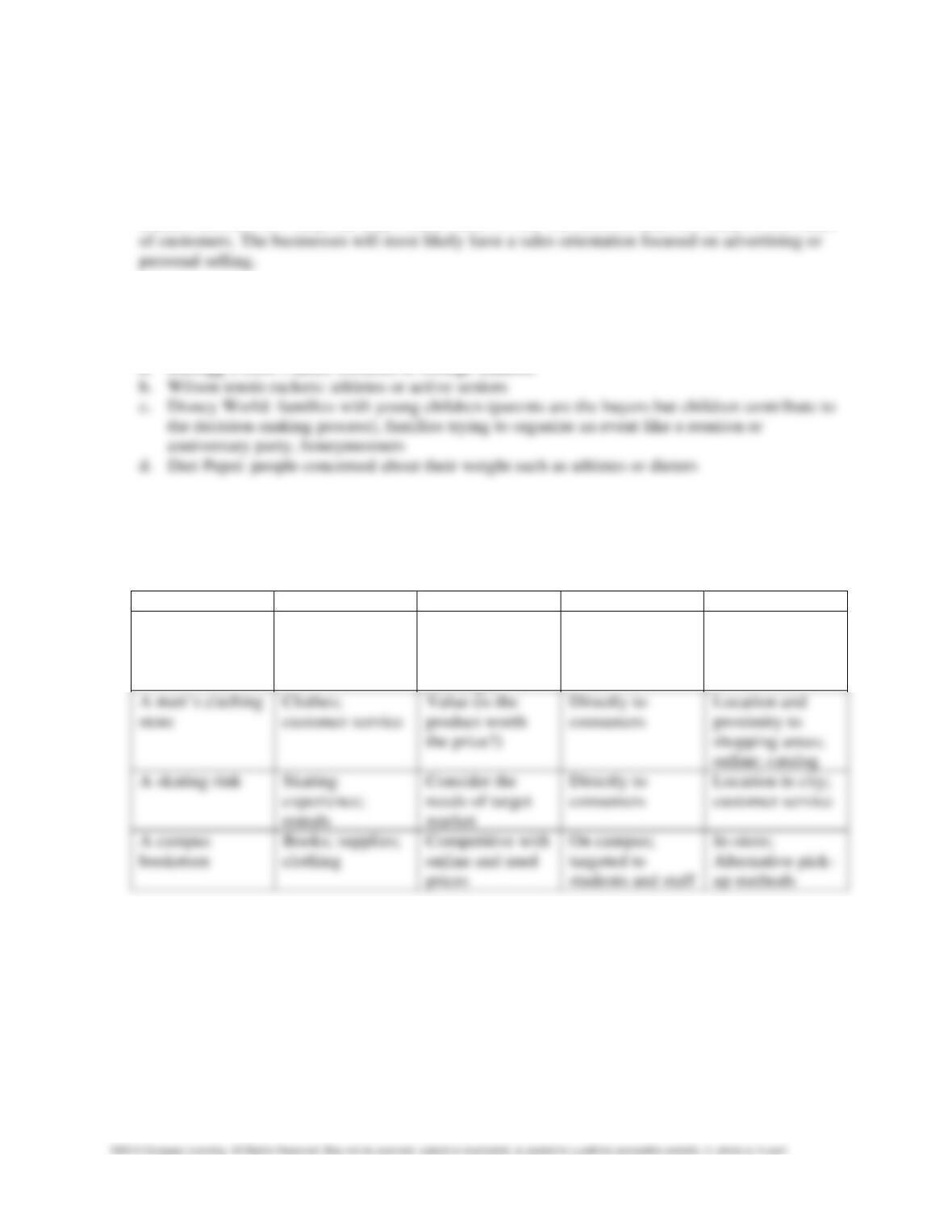
1. Identify several businesses in your area that have not adopted the marketing concept. What
characteristics of these organizations indicate nonacceptance of the marketing concept?
Student answers will vary, but they should focus on how the business does not focus on the needs
2. Identify possible target markets for the following products:
Student responses will vary, but they should be able to support their answers. Potential answers
include:
a. Kellogg’s Corn Flakes: children or college students
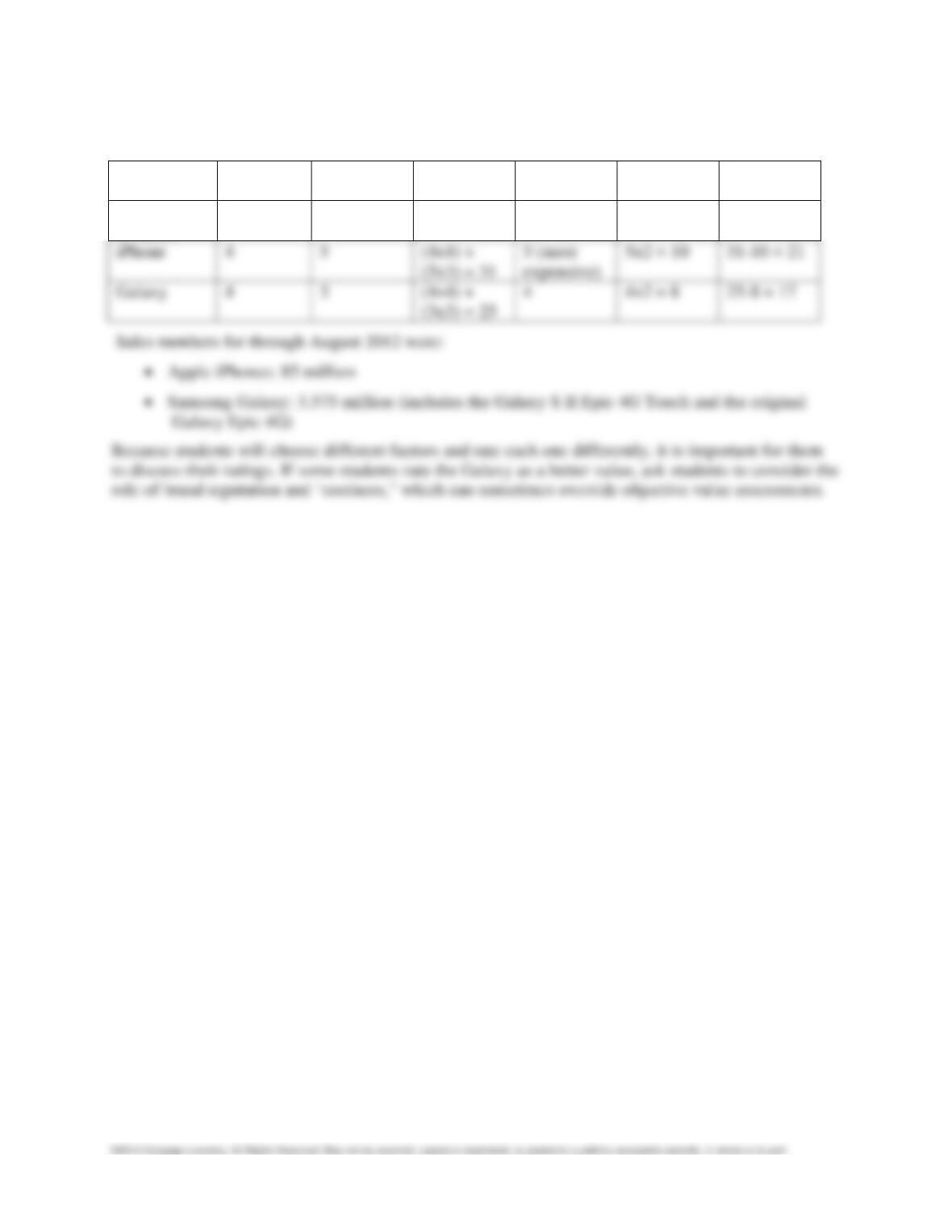
3. Discuss the variables of the marketing mix (product, price, promotion, and distribution) as
they might relate to each of the following:
Student responses will vary, but they should be able to support their answers. Students could use
a table like the one below as they answer the question. Potential answers include:
Product
Price
Promotion
Distribution
A trucking
company
The service of
shipping
Competitive with
other shipping
options including
air freight
Business to
business
Locations
nationwide
store
customer service
product worth
the price?)
consumers
proximity to
shopping areas;
A skating rink
Skating
experience;
rentals
Consider the
needs of target
market
Directly to
consumers
Location in city;
customer service
bookstore
clothing
online and used
targeted to
Alternative pick–
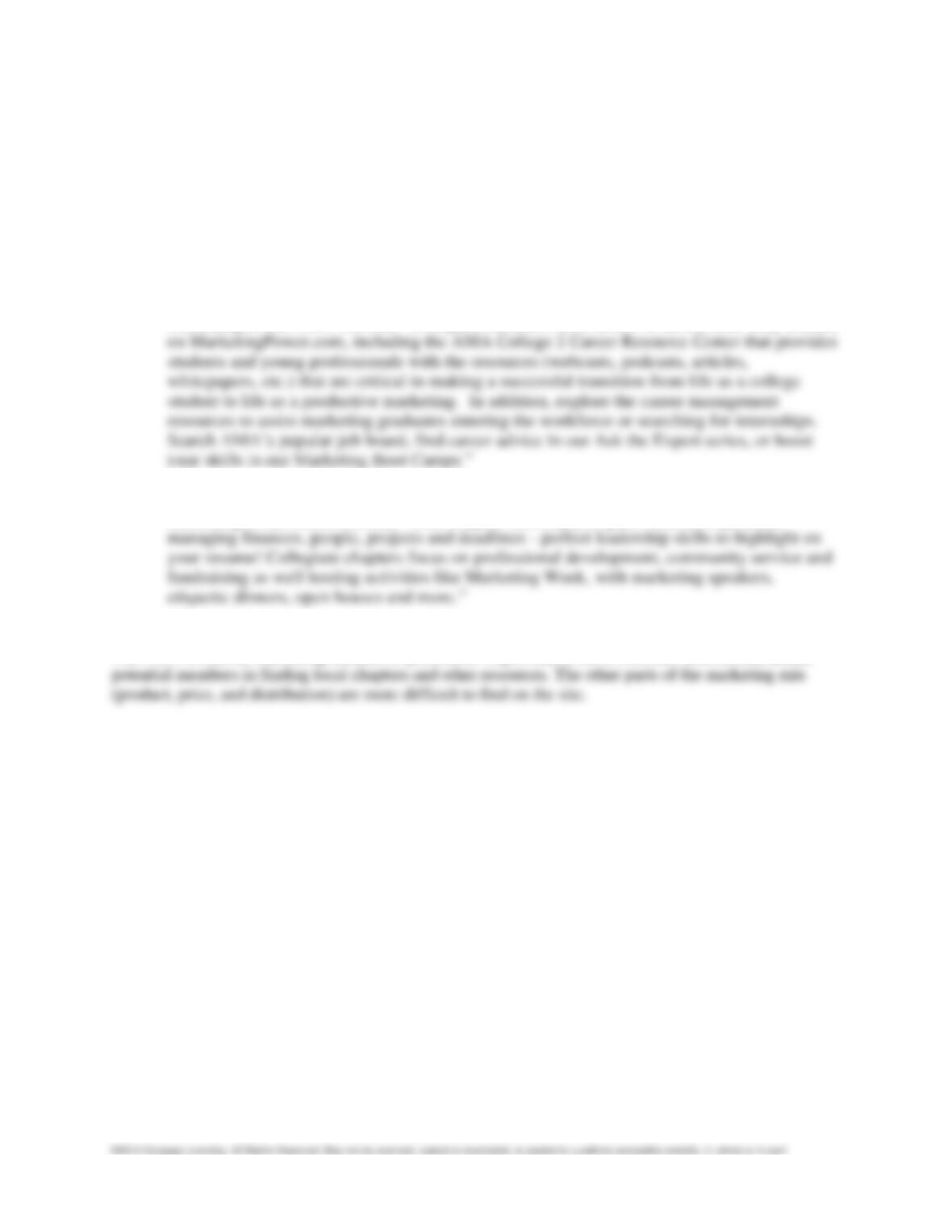
4. There are seemingly hundreds of different cell phones available on the market today. How
do consumers choose? The answer is simple: consumer value. Compare the value of an
Apple iPhone and a Samsung Galaxy smart phone. Begin by identifying the benefits and
costs that you consider when evaluating cell phones— factors such as ease of texting, ‘cool’
look and feel, or purchasing price. Assign a weighting coefficient to each factor which
reflects its importance to you. You could use 0–5, for example, with 0 meaning no
importance whatsoever and 5 meaning absolutely important. Using the equation
Value=Benefits/Costs, calculate the value for the iPhone and the Samsung Galaxy. Do these
results match actual cell phone sales for the two products?
16 Chapter 1: An Overview of Strategic Marketing
Students can make a table such as the one below to compare the two products. They can use +/–
signs to indicate where each characteristic is a benefit or a cost.
Ease of
use (+)
Look and
feel (+)
Total
Benefits
Price (-)
Total
Costs
Total
Value
Importance
of factor
x4
x3
x2
Chapter 1: An Overview of Strategic Marketing 17
ANSWSERS TO INTERNET EXERCISE
The American Marketing Association
The American Marketing Association (AMA) is the marketing discipline’s primary professional
organization. In addition to sponsoring academic research, publishing marketing literature, and
organizing meetings of local businesspeople with student members, it helps individual members to
find employment in member firms. Visit the AMA website at http://www.marketingpower.com.
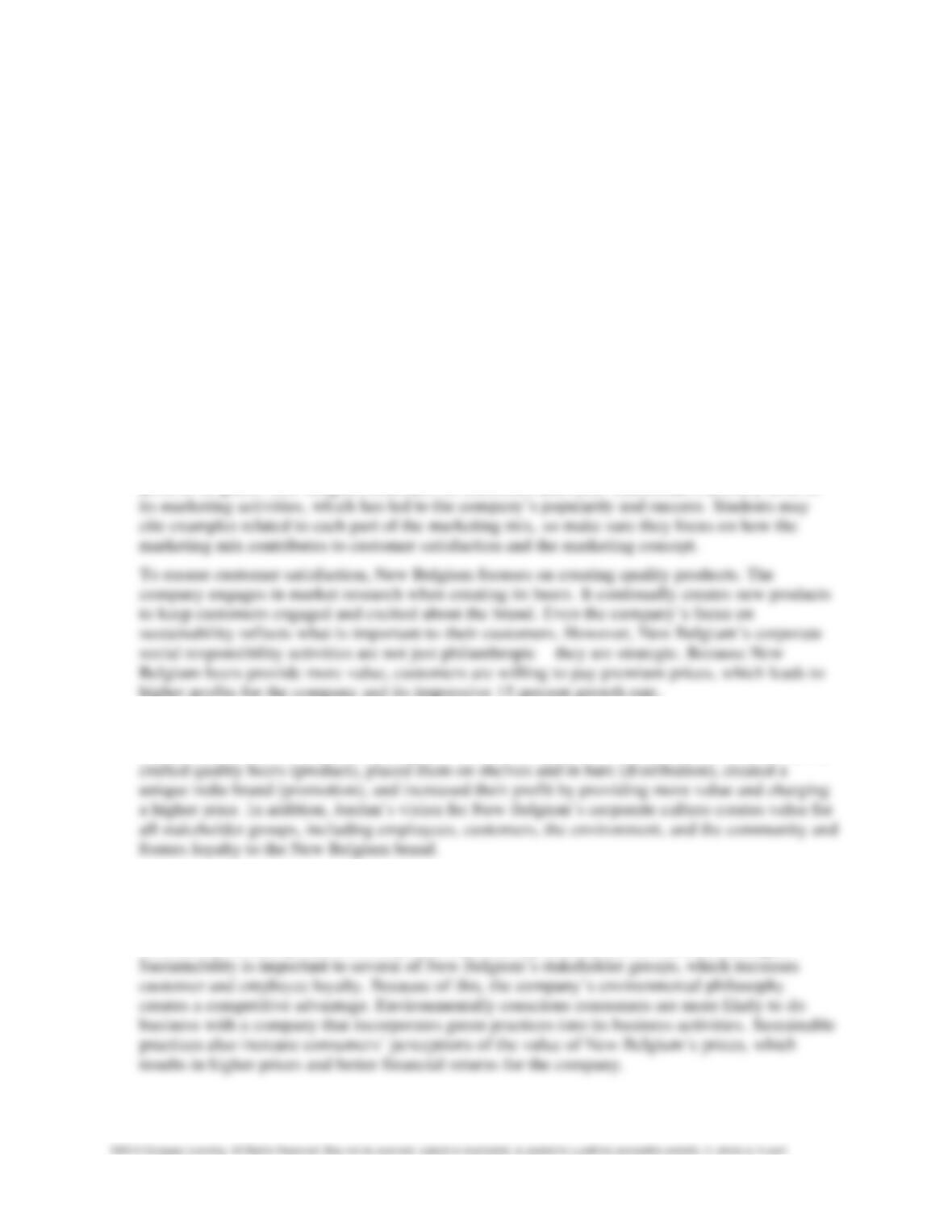
a. What type of information is available on the AMA website to assist students in planning
their careers and finding jobs?
According to the AMA website, “Collegiate members have access to all member-only content
b. If you joined a student chapter of the AMA, what benefits would you receive?
According to the AMA website, “Your chapter will help you gain valuable experience
c. What marketing–mix variable does the AMA’s Internet marketing effort exemplify?
The AMA’s Internet marketing focuses on promotion. It provides a list of member benefits and assists

18 Chapter 1: An Overview of Strategic Marketing
ANSWERS TO DEVELOPING YOUR MARKETING PLAN
The Interactive Marketing Plan exercise can be found at www.cengagebrain.com.
1. Discuss how the marketing concept contributes to company’s long-term success.
The marketing concept is a managerial philosophy that states that an organization should try to
satisfy customers’ needs through a coordinated set of activities that also allows the organization to
2. Describe the level of market orientation that currently exists in your company. How will a
market orientation contribute to the success of you new product?
Students must first identify a company (either their employer or another company with which they are
3. What benefits will your product provide to the customer? How will these benefits play a role in
determining the customer value of your product?
Students must explain what specific benefits their new product will provide to customers. As an
Chapter 1: An Overview of Strategic Marketing 19
COMMENTS ON THE CASES
VIDEO CASE 1.1: CRUISING TO SUCCESS: THE TALE OF NEW
BELGIUM BREWING
Summary
This case illustrates how New Belgium Brewing’s market orientation has helped the company grow from
a small business to America’s third largest brewery. Since its founding, New Belgium has emphasized the
importance of meeting the needs of its many stakeholder groups, and that philosophy continues to guide
the company’s marketing activities. While students may be familiar with the company’s corporate social
responsibility activities, it is important for them to realize that those activities are part of the company’s
marketing strategy and thus its profitability.
Questions for Discussion
1. How has New Belgium implemented the marketing concept?
According to the marketing concept, an organization should try to provide products that satisfy
customers’ needs through a coordinated set of activities that also allow the organization to
achieve its goals. New Belgium considers its customers and other stakeholders at every level of
higher profits for the company and its impressive 15 percent growth rate.
2. What has Kim Jordan done to create success at New Belgium?
Kim Jordan created a unique marketing mix for New Belgium. Under her direction, the company
3. How does New Belgium’s focus on sustainability as a core value contribute to its corporate
culture and success?
Sustainability has been a major part of the company’s vision since its founding. For this reason,
NBB strives to incorporate environmental responsibility directly into its business strategies.
20 Chapter 1: An Overview of Strategic Marketing
CASE 1.2: CAMPBELL’S WANTS TO SHOW YOU THE VALUE OF
SOUP
Summary
This case focuses on how consumers perceive the value of Campbell’s Soup and how the company uses
marketing to increase the value of its products. Because value is a subjective assessment of a product’s
worth, marketers can change variables in the marketing mix to increase a product’s value. For several
years, Campbell’s has been promoting the health benefits of its soups, but now the company is shifting its
marketing strategy to focus on taste.
Questions for Discussion
1. Evaluate Campbell’s success in implementing the marketing concept.
Student answers will likely focus on the changes Campbell’s is making to its marketing strategy.
If a company effectively implements the marketing concept, it will provide products that satisfy
customers’ needs through a coordinated set of activities that also allow the organization to
2. How would you define Campbell’s target market for soup?
The target market is a specific group of customers that a company wishes to attract through its
marketing efforts. In the past, Campbell’s targeted consumers looking for an inexpensive and
3. How is Campbell’s trying to increase the customer’s perceived value of its soup?
Campbell’s is responding to decreasing sales (a form of consumer feedback) by changing its
marketing strategy. First, the company adjusted the distribution and promotion variable of its