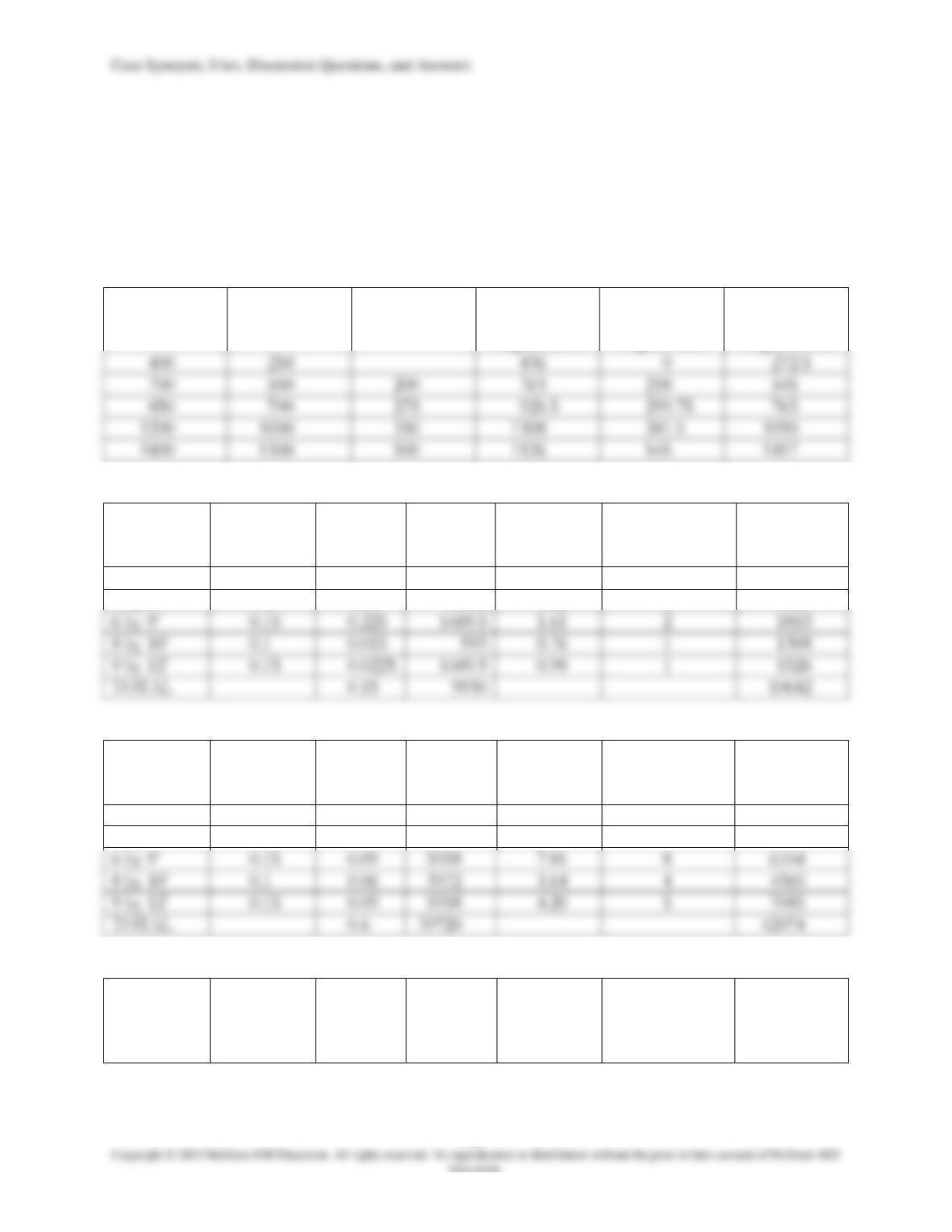
• Column 6 is the adjusted number of SKUs. Naturally, the buyer cannot purchase 4.56 rugs.
So adjustments are made, both up and down, to whole numbers. In this case, we adjusted
upward to 5 units.
• Column 7 is the adjusted cost for the silk 3 by 5 rugs. It is the adjusted number of SKUs
(Column 6) times the adjusted cost from Exhibit 1—5 times $436 = $2,180.
• The total open-to-buy used was $66,326.50, which is slightly above, but certainly within a
reasonable range of the estimate of $66,200.
Exhibit 1 – Cost Information
SILK
COST
WOOL
COST
COTTON
COST
SILK
COST
ADJUSTED
WOOL
COST
ADJUSTED
COTTON
COST
ADJUSTED
250
700
275
1000
350
1308
1300
500
1526
Exhibit 2 – Assortment Plan for Silk Rugs
SIZES
% OF
SALES
SILK %
SILK $
SILK
UNITS
SILK UNITS
ADJUSTED
SILK $
ADJUSTE
D
3 by 5’
0.2
0.03
1986
4.56
5
2180
4 by 6’
0.4
0.06
3972
5.21
5
3815
6 by 9’
0.15
0.225
1.61
2
1853
9 by 12’
0.15
0.0225
0.98
1
1526
0.15
9930
10682
Exhibit 3 – Assortment Plan for Wool Rugs
SIZES
% OF
SALES
WOOL
%
WOOL $
WOOL
UNITS
WOOL
UNITS
ADJUSTED
WOOL $
ADJUSTE
D
3 by 5’
0.2
0.12
7944
29.15
30
8175
4 by 6’
0.4
0.24
15888
29.15
30
16350
6 by 9’
0.15
0.09
5958
7.81
8
8 by 10’
0.1
0.06
3972
3.64
4
4360
0.6
39720
42074
Exhibit 4 – Assortment Plan for Cotton Rugs
SIZES
% OF
SALES
COTTO
N %
COTTO
N $
COTTON
UNITS
COTTON
UNITS
ADJUSTED
COTTON
$
ADJUSTE
D

3 by 5’
0.2
0
0
0.00
0
0
4 by 6’
0.4
0.1
6620
30.37
30
6540
6 by 9’
0.15
0.0375
2482.5
8.28
2398
8 by 10’
0.1
0.025
1655
4.34
1907.5
9 by 12’
0.15
0.0375
2482.5
4.56
2725
0.2
Back to cases
CASE 24 – Preparing a Merchandise Budget Plan
Synopsis: This is a difficult case for students to grasp, but we think it is well worth the trouble
because it illustrates the relationship between the sales forecast, the seasonality pattern,
Use:
Chapter 11 Managing the Merchandise Planning Process
Student Instructions
Your assignment is to assist Jim in the preparation of a merchandise budget plan. First, fill
Adjustments to percentage distribution of sales by month.
Adjustments to stock/sales ratios
I. Sales forecast
The sales forecast is simply last year’s sales X 1.19 to account for the 19 percent increase in sales
II. Adjustments to percentage distribution of sales by month
Students shouldn’t take a simple average of the past three years because it assumes that all years are
equally important in forecasting next year. They also might want to use the most current year, which
III. Stock-to-Sales ratios
Given the GMROI and gross margin plans, the projected average stock-to-sales ratio is 1.58.
The industry averages from the NRF are given, but each month needs to be adjusted so that they
average 1.58. First, we must make the adjustment to the March, April, and May stock-to-sales ratio.
Since we have a sales increase in March which wouldn’t be reflected in the NRF figures, the stock–
to-sales ratio would be slightly decreased from the industry average given by the NRF, and likewise
CASE 25- Kroger and Fred Meyer: Sourcing Products in a Global
Marketplace
Synopsis: The Kroger Company is among the largest food retailers in the United States, and
operates more than 2,700 stores under nearly two dozen store-brand names.
Use:
Chapter 12 Buying Merchandise
Discussion Questions
1. What factors would you list than need to be evaluated in making a decision to source
products overseas? Make a list of pros and cons and explain what the pressures are that
impel manufacturers and retailers to not source products domestically.
The pros will center around cost savings. The cons will include complex logistics, investment in
2. Based on the information given, how long do you estimate it will take to import these
lamps? Create a set of target dates for each step in this process that will enable these
products to arrive in time for the planned advertising date and selling period.
Back to cases
CASE 26 – American Furniture Warehouse Sources Globally
Synopsis: Show how retailers can reflect and respond to values expressed by their
consumer base through the merchandise they buy. Enumerate ways that the
Uses:
Chapter 5: Retail Market Strategy
Chapter: 12 Buying Merchandise
Discussion Questions
1. Factories in many developing nations have lower cost structures, but that is often
attributable to fewer benefits and lower wages for workers. What are the ethical trade-
offs for retailers and shoppers when merchandise is sourced from countries in which
labor practices fall short of standards Americans deem acceptable? Do shoppers really
care about workers halfway across the globe, or are they more concerned about how
many dollars are flowing out of their own pockets?
Ethical trade-offs include:
• Sending jobs and business to another country
2. The world is our marketplace. AFW employs global sourcing, uses many negotiating
tactics, and shifts channel tasks to keep its costs as low as possible. Enumerate the tactics
AFW uses to keep its prices low. What other strategies and tactics could a furniture retailer
use to hold the line on retail prices?
Tactics AFW uses to keep prices low:
3. What criteria should AFW use when deciding whether to see a new vendor? How might it
apply some of its best practices with its biggest vendors to new, smaller vendors? What
strategies or innovations could it employ to stretch the productivity of its buying staff?
Criteria for seeing a new vendor:
• The vendor appears to offer merchandise that suits their target market—its taste level,
design aesthetic, price point, etc.

Back to cases
CASE 27 – How Much for a Good Smell?
Synopsis: Upscale gift store needs to set a price for potpourri. The case takes students through
several seasons at Courtney’s gift shop. The focus is on one particular item, a best seller
Use:
Chapter 13 Generate discussion of the issues that need to be considered in pricing an item
including what demand will be at various price levels.
Discussion Questions
1. What prices caused Courtney’s new charges?
$9.95—the same price as last year even though the cost has gone up.
2. Which price would result in the highest profit?
Price/unit
Cost/unit
GM/unit
Unit sales
Profit
$9.95
$5.50
$4.45
750
$3337.50
12.50
5.50
7.00
400
2800.00
Price/unit
Cost/unit
GM/unit
Unit sales
Profit
$5.50
$7.00
300
$2100.00
5.50
4.45
300
1335.00
600
3435.00
3. What other factors should Courtney’s consider?
Some other factors Courtney’s needs to consider in estimating demand are:
a. Changes that might be occurring in customer tastes and styles. Will the demand continue to
rise or are fewer customers going to be interested in potpourri this year compared to last?
4. What price would you charge, and how many units would you order?
This question makes students recognize the interrelationship between pricing and demand. It
also illustrates why stores tend to buy more merchandise than they think will be sold and then
Back to cases
CASE 28 – See It! Scan It! Buy It! Shortening the Path to Purchase with
Mobilbuy’s Technology
Use:
Chapter 3 Illustration of the growth of mobile retailing
Chapter 14 Examines the complications involved when introducing an app.
.
Discussion Questions
1. Taking the perspective of the retailer, what are the advantages and disadvantages of
adopting each of the Mobilibuy functionalities? As a retailer, would you adopt the
Mobilibuy system? If so, for which feature?
Advantages of Mobilibuy’s system for retailers:
Retailers who adopt Mobilibuy’s application benefit from two main advantages:
simplifying the mobile purchase process, and (potentially) increasing the conversion rate
of their advertising campaigns.
1. First, by integrating the retailer’s app into Mobilibuy’s system, retailers facilitate the
mobile purchase process for the consumer: instead of searching within the retailer’s
2. Second, retailers invest a lot of money in advertising their products, hoping to support
brand image as well as trigger product purchases. However, the consumer may forget
seeing the ad by the time he or she is at the relevant store or is shopping online. Even if
the consumer remembers seeing the ad, by the time he or she has the opportunity to go
Additionally, retailers may also benefit from the following features of the Mobilibuy
technology:
– Aisle extension: Mobilibuy’s system can be used to manage limited shelf space. With
Mobilibuy’s app, retailers enable consumers to scan and purchase products that they
don’t keep at their physical store or are currently out of stock. This feature reduces the
likelihood that customers will look for the missing product elsewhere and can increase
customer satisfaction and loyalty.
Mobilibuy’s app disadvantages for retailers:
There are a few significant disadvantages for retailers who wish to adopt the Mobilibuy
technology.
Mainly, new technology adoption involves a process of market education.
In the case of “scan and buy,” consumers are required to change their purchase behavior –
by instantly acting upon advertisements they see (by scanning them) and making mobile
purchases. However, some consumers might not be convinced the app offers them
significant added value compared to the available alternatives of offline/online shopping.
Moreover, consumers might experience usage and psychological barriers that will keep
them from downloading and using the app.
2a. What are the advantages and disadvantages of Mobilibuy’s technology for
consumers? As a consumer, would you download the app? Explain your decision.
2b. How can Mobilibuy, and retailers who adopted its technology, encourage the
app’s download and usage by consumers?
2a. Advantages for consumers:
The app (whether integrated in the retailer’s system, or Mobilibuy’s app) improves and
shortens the mobile path to purchase. It reduces search time, provides consumers with
access to the relevant product information, without having to scroll through many pages,
and offers them the opportunity of spontaneous purchase and instant gratification, while
Disadvantages for consumers:
First, consumers who use the app might get confused about which ad is scannable and
which is not. After scanning a few advertisements and realizing that some of them are not
supported by the app, a consumer might decide to remove the app or quit using it.
Second, the app doesn’t improve on any of the following limitations of the mobile purchase
process: small display or poor quality image on mobile screens; difficulty in comparing
between different products; or more generally, not being able to consult with salespeople
1. Add a “scan and buy” message on each scannable advertisement to increase awareness
of the app and prevent confusion regarding unscannable ads.
2. Incentives – offer discounts or free deliveries on products that have been scanned and
purchased through the app.
3. How could the app affect consumers’ decision-making process?
The app potentially reduces the need for information search and competitor evaluation. It
increases spontaneous purchases and provides instant gratification. The app turns the
mobile device from a medium for providing information into a virtual store, and helps
retailers influence the consumers’ buying process.
To summarize, retailers that use the Mobilibuy platform thus can influence the purchase
process by
– Triggering need recognition (through social networks or advertising).
– Leading consumers to the information they need to purchase, which reduces
Back to cases
–
CASE 29 – Promoting a Sale
Use:
Chapter 14 Illustrates factors that need to be considered in developing a communications program.
Discussion Questions
1. Knowing that the company wants a mixed-media ad campaign to support this event,
prepare an ad plan for the general merchandise manager that costs no more than
$40,000.
The firm could use a mix of direct mail (flyers), TV advertising, Radio advertising, and
Newspaper advertising.
The direct-mail flyers would cost the firm $10,000. For the electronics products sale, the
classical station with the wealthy audience could be selected since this audience may be more
willing and able to buy higher priced electronics goods. The costs of radio advertising on the
2. Work out the daily scheduling of all advertising.
Saturday
Direct-mail flyer arrives
Sunday
Monday
Tuesday
Wednesday
Radio advertising
Thursday
Radio advertising
Friday
Radio advertising
TV advertising
Radio advertising
Newspaper ad
TV advertising
Radio advertising
Newspaper ad
TV advertising
Radio advertising
3. Work out the dollars to be devoted to each medium.
Direct mail to charge customers
$10,000
24 TV spots
12,000
TV ad production
12,000
2 half pages
4. Justify your plan.
The direct mail, four-color flyer to 80,000 charge-card customers appears to be very cost
effective based on information in the case. If 3 percent of the 80,000 customers respond by
going to the store and half of the customers visiting the store buy a $300 consumer electronic
product, the direct mail campaign will generate sales of $360,000—more than one-third of the
target sales.
Back to cases