Chapter 1: Marketing—The Art and Science of Satisfying Customers
CHAPTER SUMMARY AND LEARNING OBJECTIVES
LO 1.1 Summarize how marketing creates value through the four types of utility.
The goal of any marketing effort is to boost utility: the power of a good or service to satisfy the
needs and wants of consumers. The four types of utility include form, time, place, and
ownership.
LO 1.2 Describe the four variables of the marketing mix.
Marketing strategy begins by identifying a target audience. Then marketers combine the
marketing mix variables of product, price, distribution, and promotion to satisfy the needs of the
target audience.
LO 1.3 Contrast the focus of marketing activities during the five eras of marketing
LO 1.4 Explain how relationship marketing can move customers up the loyalty ladder.
LO 1.5 Differentiate the six categories of marketing.
As marketing has evolved into an organization-wide activity, its application has broadened to
include product, person, place, cause, event, and organization marketing.
LO 1.6 Identify the eight functions of marketing physical goods.
Marketers must utilize the full set of marketing functions to build and maintain lasting
LO 1.7 Given a description of a company’s marketing mix, classify the elements of the
marketing mix and the category of marketing.
Chapter 1: Marketing—The Art and Science of Satisfying Customers
ACTIVATOR EXERCISE: Bringing value to customers
Purpose: To orient students to how companies bring value to society through goods and
services.
Time: 20–30 minutes, depending on format.
Activity: Divide students into groups and have them follow these steps:
• Pick a good or service that didn’t exist 30–50 years ago. You may want to assign goods
or services to ensure that students groups don’t pick the same thing. Examples:
Smartphones with turn-by-turn directions, online banking, Facebook, etc.
• After the groups have discussed amongst themselves, have them present to the class.
Each presentation will only take a few minutes.
Possible discussion questions: What prompted these goods or services to be created?
Compared to 30–50 years ago, was there a steady stream of better products that led the current
version—or was this a sudden innovation that changed everything? What do you think the next
innovation for this type of product will look like and how will it change our lives?
Chapter 1: Marketing—The Art and Science of Satisfying Customers
LECTURE OUTLINE
1-1 What Is Marketing?
Marketing is the process for creating, communicating, and delivering value to customers.
Ultimately, it’s that value customers are paying for, whether it’s a product that performs a
particular function or one that provides customers a particular feeling.
Form utility is created when the company converts raw materials into finished goods and
services.
Example: Soda makers mix just the right amounts of flavoring, sweeteners, and
carbonation to deliver appealing drinks.
The transfer of title to goods or services at the time of purchase creates ownership utility.
Example: When you buy a TV and take it home, or when you buy an airline ticket and fly
Classroom activity: The purpose of this activity is to facilitate student introductions and social
interaction on the first day of class.
Ask students to find one fellow student they have not yet met. Each partner has 2–3 minutes to
answer the following questions for their partner:
1. What is your name and where do you work (if working)?
Then ask students to introduce their partners to the class, including the above information they
learned. Allow 1–2 minutes per group, depending on size of class.
Chapter 1: Marketing—The Art and Science of Satisfying Customers
Discussion questions: Ask students of a purchase they made recently that disappointed them.
Key Takeaway: Designing and marketing products that satisfy the wants and needs of
consumers is the foundation for marketing.
Estimated time: 20–30 minutes
1-2 Elements of Marketing Strategy
The basic elements of a marketing strategy consist of:
1. The target market.
After marketers select a target market, they direct their company’s activities toward profitably
PRESENTATION VISUAL: MindTap Exhibit 1.2 showing the four variables on the outside
with target market in the middle
Product refers to a good, service, or idea. But “product” is a broader concept that also
encompasses other aspects of the consumer’s purchase. Product strategy may involve
decisions about:
● customer service
Example: Starbucks believes in superior customer service; its “baristas” are specially
Price is the method of setting profitable and justifiable prices. One of the many factors that
influence a marketer’s pricing strategy is competition.
Example: While Starbucks has always charged premium prices, the company moderated
Chapter 1: Marketing—The Art and Science of Satisfying Customers
If the economy is booming, consumers generally have more confidence and are willing to shop
more frequently and pay more for goods. But when the economy slows, consumers look for
bargains—they want high quality at low prices.
Classroom activity: In groups, have students choose a few common products that people in
the group have purchased recently. Then have students discuss the most they’d be willing to
pay for that type of product, including why they would pay that amount (assuming they had the
money to afford it).
After the group sharing time, have a few students share with the whole class.
Marketers develop distribution strategies to ensure that consumers find their products in the
proper quantities at the right times and places.
Examples: Starbucks is building an increased number of drive-through and express
stores. It also distributes bottled drinks and K-cups through grocery outlets.
Discussion question: What are some examples of promotions you’ve seen just today? This
could include video, audio, outdoor ads, mobile ads, etc.
Key Takeaway: The four variables of the marketing mix are often called the 4 Ps of
marketing: product, price, place, and promotion.
Estimated time: 15–25 minutes
Chapter 1: Marketing—The Art and Science of Satisfying Customers
1-3 Five Eras of Marketing History
Marketing has been viewed and practiced differently over the decades. The five eras in the
history of marketing:
1. production era
2. sales era
PRESENTATION VISUAL: MindTap Exhibit 1.3 about the five eras of marketing history
The production era reached its peak during the early part of the twentieth century, when
production shortages and intense consumer demand ruled the day. Henry Ford’s mass–
production line exemplified this orientation. Ford’s famous statement, “They [customers] can
have any color they want, as long as it’s black,” reflected the prevalent attitude toward
marketing.
Relationship marketing builds on the marketing era’s customer orientation by developing long–
term, value-added relationships over time with customers and suppliers.
Building on the relationship era, marketers now routinely use the Internet and social networking
sites to connect with consumers. This represents our current social era of marketing.
Discussion question: Are all industries living in the social era, or do some seem resistant to
Key Takeaway: Marketing has steadily moved from being producer-oriented to customer-
driven.
Estimated time: 10–15 minutes
Chapter 1: Marketing—The Art and Science of Satisfying Customers
1-4 From Transaction-based Marketing to Relationship Marketing
Traditional marketing strategies focused on attracting customers and closing deals. Today’s
marketers realize that attracting new customers is no longer enough. It’s even more important to
establish and maintain satisfying relationships that turn one-time buyers into loyal repeat
customers.
Classroom activity: In small groups, have students pick a product and try to calculate the
potential lifetime value of a customer. They will do this in several steps.
Estimate how much profit the company makes per transaction with each customer.
It’s not important that students have accurate numbers, only that they understand lifetime value.
This will help them relate to why companies put so much effort into retaining customers, and
why they might lose money on the first few transactions to win a new customer.
Relationship marketing gives a company new opportunities to gain a competitive edge by
PRESENTATION VISUAL: MindTap Exhibit 1.4 showing the loyalty ladder
Relationship building begins early in marketing. It starts with determining what customers need
and want, then developing high-quality products to meet those needs. This is how companies
Discussion question: What’s a company or brand that you follow on social media? What
company or brand sends you emails? In what ways does this keep you loyal as a customer?
Chapter 1: Marketing—The Art and Science of Satisfying Customers
When companies can convert indifferent customers into loyal ones, they generate repeat sales.
Key Takeaway: The cost of maintaining existing customers is far below the cost of
finding new ones, making these loyal customers extra valuable and the investment in
relationship marketing worth it.
Estimated time: 15–25 minutes
1-5 Categories of Marketing
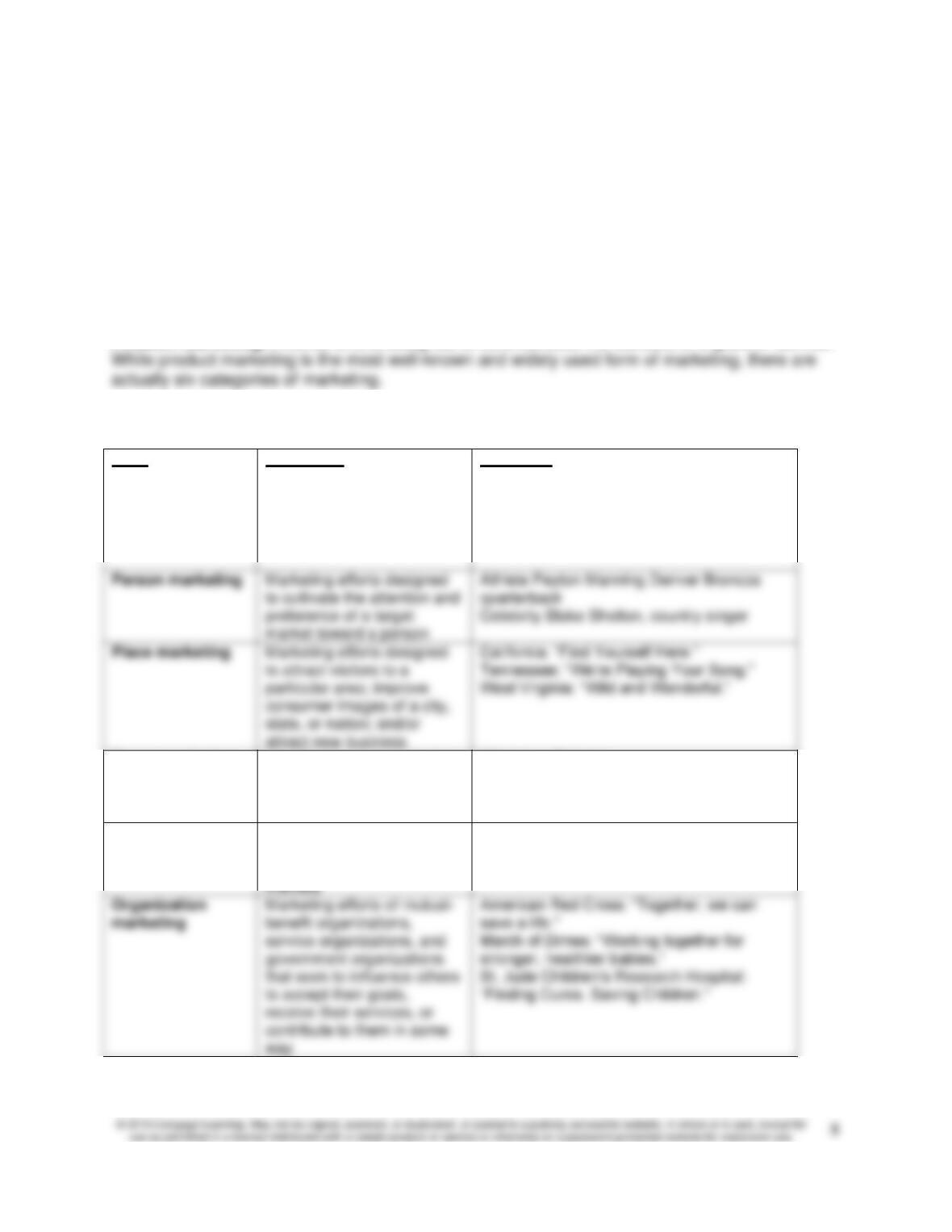
PRESENTATION VISUAL: MindTap Exhibit 1.5 about the six categories of marketing
Type
Product
marketing
Objectives
Marketing efforts designed
to communicate the benefits
of good or service and
persuade target consumers
to buy
Examples
Subaru: “Love. It’s what makes a Subaru a
Subaru.”
Geico: “15 minutes will save you 15% on car
insurance.”
Nike: “Just do it.”
Person marketing
Marketing efforts designed
Athlete Peyton Manning Denver Broncos
particular area; improve
consumer images of a city,
state, or nation; and/or
Cause marketing
Identification and marketing
of a social issue, cause, or
idea to selected target
markets
“Click it or Ticket.”
“Refill, not landfill.”
Event marketing
Marketing of sporting,
cultural, and charitable
activities to selected target
markets
to accept their goals,
receive their services, or
contribute to them in some
way
“Finding Cures. Saving Children.”
Tokyo 2020 Summer Olympics
American Diabetes Association’s Tour de
Cure
Chapter 1: Marketing—The Art and Science of Satisfying Customers
Discussion question: Ask the class for a few additional examples of each category. This can
be done as a class, or first in small groups.
The six categories of marketing can often overlap.
PRESENTATION VISUAL: MindTap Exhibit 1.6 illustrating overlap of marketing
categories for the above example
Discussion question: Ask class for a few additional examples of overlaps between these
marketing categories
Key Takeaway: While product marketing is the most well-known and widely used form of
marketing, there are actually six categories of marketing.
Estimated time: 15–20 minutes
1-6 Eight Functions of Marketing Physical Goods
On average, half of the costs involved in a tangible product—such as a pair of Gap jeans or
Classroom activity: In small groups, have students select a product. Pretending they are
manufacturers of that product, have them make a list of all functions and factors they must
consider in order to make sure they can profitably make the product available to customers at
the time, place, and price that customers want. Don’t include the actual production process, but
everything that needs to take place before and after the actual product.
Chapter 1: Marketing—The Art and Science of Satisfying Customers
PRESENTATION VISUAL: MindTap Exhibit 1.7 showing the eight universal functions of
marketing physical goods
Key Takeaway: You can think about marketing as a chain of connections between a firm
and its customers. Each of the eight links in the chain represents a unique function.
Marketers have the best opportunity to build and maintain lasting relationships when
each link in the chain is strong and fits well with the others.
Estimated time: 20–30 minutes
1-7 Analyzing Marketing Strategy
As discussed in the opening and closing vignettes of the chapter, Vineyard Vines primarily
targets young people, especially college students, who value a fun, sporty lifestyle and will stay
loyal to the brand for decades.
Product Strategy
• Vineyard Vines expanded its product line from menswear to clothing for women and
Pricing Strategy
• Vineyard Vines is a premium-priced brand when compared to other casual clothing
brands.
Distribution Strategy
• The brand is distributed through company-owned stores, other upscale retailers, and
online.
Promotion Strategy

Chapter 1: Marketing—The Art and Science of Satisfying Customers
Classroom activity: In small groups, ask the students to select a company or brand (or assign
Key Takeaway: Successful customer-driven organization begins by defining its target
market, formulating a cohesive strategy that integrates the four variables of the
marketing mix in a way that best serves the target market.
Estimated time: 10–25 minutes
Chapter 1: Marketing—The Art and Science of Satisfying Customers
LEARN IT TODAY…USE IT TOMORROW VIGNETTE AND ACTIVITY
The opening vignette for chapter 1 introduces students to Vineyard Vines, maker of workplace
apparel that promotes “a carefree lifestyle image many people want to adopt”. By describing the
company’s products and approach, students are asked to ponder the types of value Vineyard
Vines brings to customers, and to spot how the company uses the marketing mix to deliver this
value. The concepts of value and the marketing mix relate to the first two learning objectives for
this chapter and form a foundation for the entire course.
Note: Answers to the chapter ending activity can be discussed in class after the activity
due date.
Product Strategy
For product strategy, one option is to introduce a line of pet accessories: in particular, dog coats
and sweaters. The items would be made of premium wool in colors that match the firm’s most
popular clothing styles.
Which option should you recommend?
#1: That’s correct! Premium dog coats and sweaters fit well with the brand’s fun, outdoorsy
Distribution Strategy
For distribution strategy, one option is to sell Vineyard Vines clothing in Walmart. As the largest
retailer in the United States, Walmart would make the brand available to a larger, more diverse
group of potential customers than Vineyard Vines currently reaches—and at huge discounts.
What’s the most promising distribution approach?
Chapter 1: Marketing—The Art and Science of Satisfying Customers
#1: Distributing Vineyard Vines clothing in Walmart would not fit the brand’s upscale image or
Pricing Strategy
An economist friend urges you to consider cutting the price of all Vineyard Vines products by
20%. This would make the brand affordable to a large cross section of leisure clothing buyers,
which your friend believes would boost sales.
Which pricing option is best?
#1: Cutting the price of all products would make the brand more affordable, but would also
Promotion Strategy
Vineyard Vines has never done much advertising. But now that the firm is so successful, your
promotion budget is large enough to support an ad campaign.
What’s your promotion recommendation?
#1: Correct! While the audience for campus advertising is limited, college students are a key
target market for your company. These ads would reinforce the relationships the brand already
has with its campus advocates.
Chapter 1: Marketing—The Art and Science of Satisfying Customers
ADDITIONAL HOMEWORK/CLASSROOM ACTIVITIES
Person Marketing Activity
Purpose: To demonstrate the prevalence and power of person marketing in pop culture.
Relationship to Text: Person Marketing
Estimated Class Time: About 15 minutes
Exercise: Brainstorm with your class a list of high-profile people who need an image makeover
(essentially celebrities who are in trouble). Encourage them to consider athletes, actors,
musicians, entertainers, and politicians who have legal problems, substance abuse issues, or
Questions for Reflection:
• What are the unique challenges to person marketing?
Place Marketing Activity
Purpose: To stimulate student thinking about the potential impact of place marketing.
Background: Over the past 10 years, place marketing has blossomed, as a growing number of
Relationship to Text: Place Marketing
Estimated Class Time: About 15–20 minutes
Chapter 1: Marketing—The Art and Science of Satisfying Customers
Exercise: Divide your class into small groups and challenge them to develop a plan to lure
businesses and tourists to the city of their choice. Questions to consider (and you might want to
write these on the board):
• What would their slogan be?
Encourage your students to push the envelope in creative thinking and innovative ideas. Then
reconvene as a class for brief presentations of the slogans and the plans. To bolster the
competitive spirit, you may want to ask the class to vote on the best package.
Questions for Reflection:
• Is place marketing a good way to spend taxpayer dollars? Why or why not?
Social Marketing Activity
Purpose: To emphasize the importance of social marketing in today’s market.
Relationship to Text: Social Marketing
Estimated Class Time: About an hour
Exercise: Divide your class into groups and ask each group to pick a public service message
Questions for Reflection:
• How can social marketing help marketers build relationships with their customers?
• Discuss possible products, services, or ideas which cannot be effectively marketed

Chapter 1: Marketing—The Art and Science of Satisfying Customers
Internet Research Activity—Event Marketing
The Westminster Kennel Club runs the nation’s largest dog show. Go to the event’s website.
Chapter 1: Marketing—The Art and Science of Satisfying Customers
KEY TERMS
Utility: The power of a good or service to satisfy the wants and needs of consumers.
Marketing: The process for creating, communicating, and delivering value to customers.
Product: A good, service, or idea.
Price strategy: The method of setting profitable and justifiable prices.
Distribution: Decisions involving modes of transportation, warehousing, inventory control, order
processing, and selection of marketing channels
Seller’s market: When there are more buyers for fewer products.
Buyer’s market: When there are more products than people willing to buy them.
Relationship marketing: The development, growth, and maintenance of long-term, cost-
effective relationships with individual customers, suppliers, employees, and other partners for
mutual benefit.
Mobile marketing: Marketing messages sent to wireless devices, such as phones and tablets.
Social marketing: The use of online social media as a communications channel for marketing
messages.
Chapter 1: Marketing—The Art and Science of Satisfying Customers
Place marketing: Efforts designed to attract visitors to a particular area; improve consumer
images of a city, state, or nation; and/or attract new business.
Cause marketing: Identification and marketing of a social issue, cause, or idea to selected
target markets.