Chapter 01
Marketing in Today’s Business Milieu
1-1
LEARNING OBJECTIVES
LO 1-2 Define what marketing and marketing management really are and how they contribute
to a firm’s success.
LO 1-4 Recognize the impact of key change drivers on the future of marketing.
CHAPTER OUTLINE
I. WELCOME TO MARKETING MANAGEMENT
II. MARKETING MISCONCEPTIONS
Chapter 01
Marketing in Today’s Business Milieu
1-2
A. Behind the Misconceptions
i. Marketing is Highly Visible by Nature
B. Beyond the Misconceptions and Toward the
Reality of Modern Marketing
III. DEFINING MARKETING
Chapter 01
Marketing in Today’s Business Milieu
1-3
A. Value and Exchange are Core Marketing Concepts
B. A New Agenda for Marketing
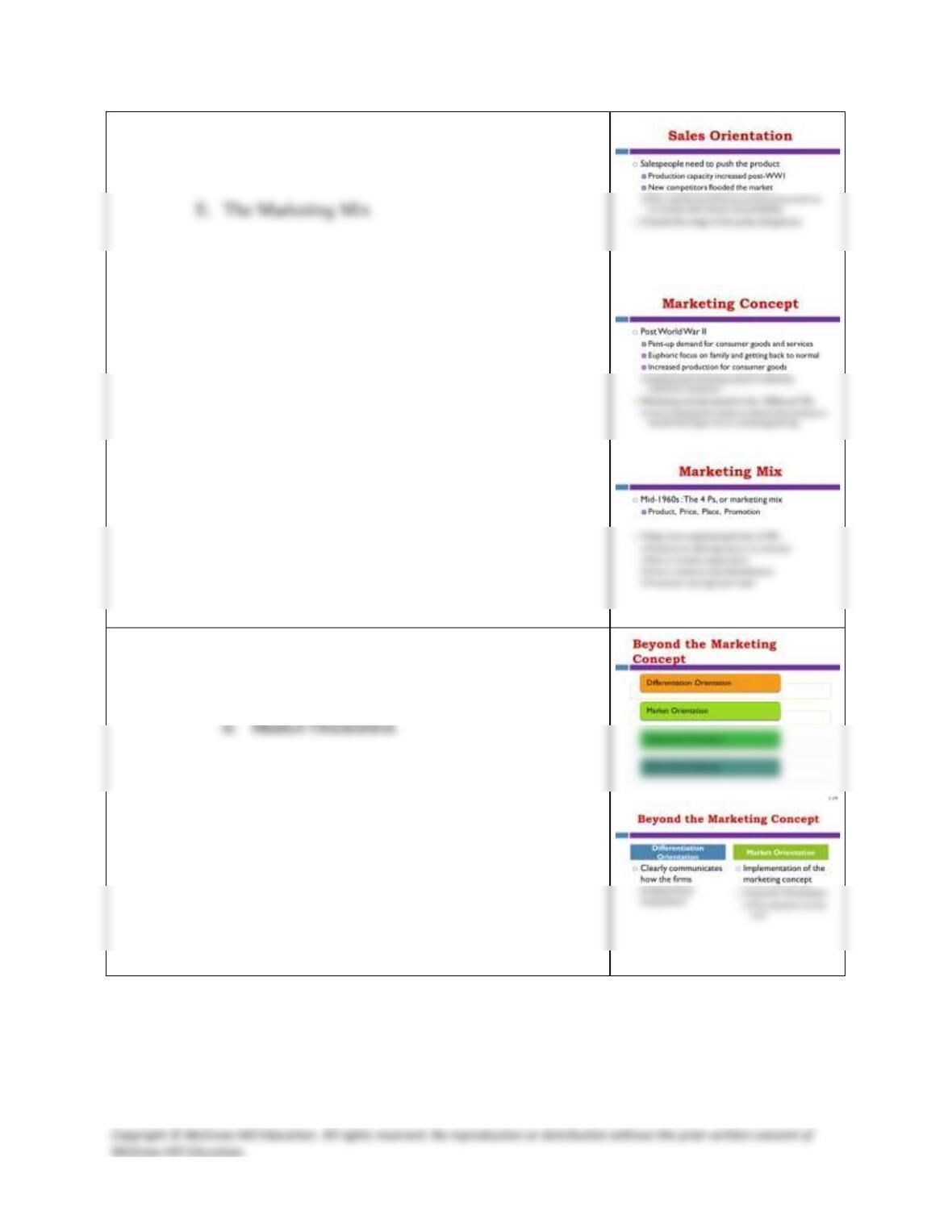
IV. MARKETING’S ROOTS AND EVOLUTION
A. Pre-Industrial Revolution
B. Focus on Production and Products
Chapter 01
Marketing in Today’s Business Milieu
1-4
C. Focus on Selling
D. Advent of the Marketing Concept
F. Post-Marketing Concept Approaches
i. Differentiation Orientation
Chapter 01
Marketing in Today’s Business Milieu
1-5
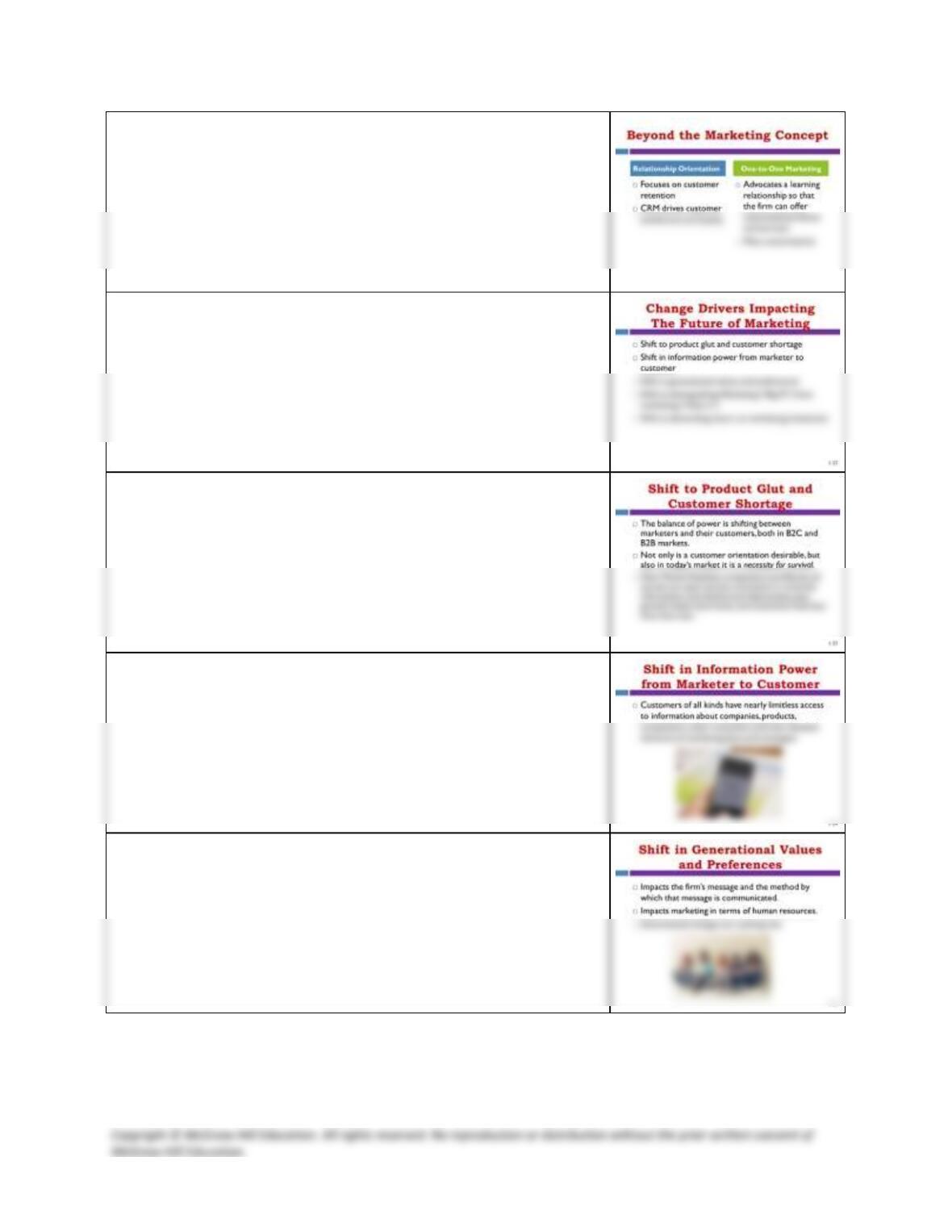
iii. Relationship Orientation
iv. One-to-One Marketing
V. CHANGE DRIVERS IMPACTING THE FUTURE OF
MARKETING
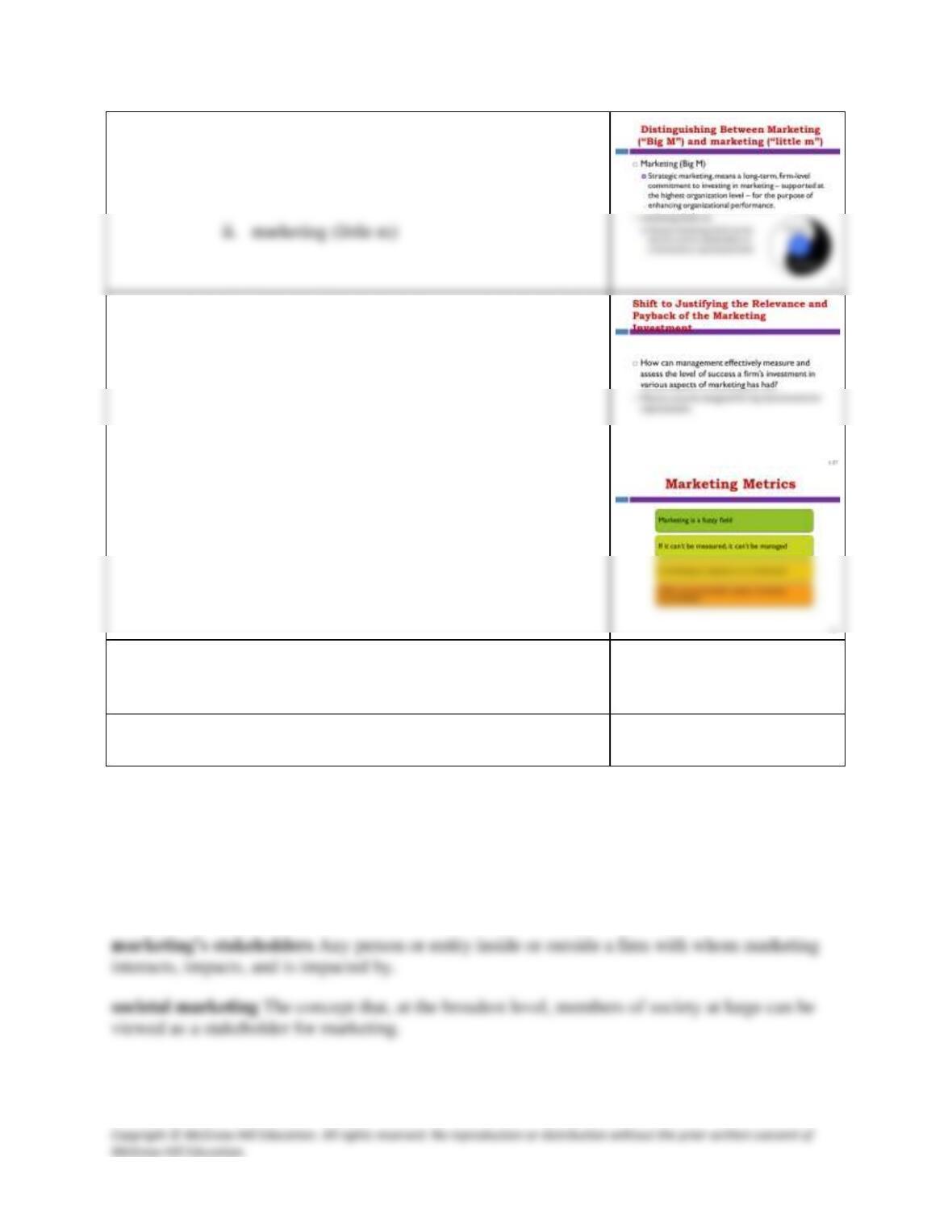
A. Shift to Product Glut and Customer Shortage
B. Shift in Information Power from Marketer to
Customer
C. Shift in Generational Values and Preferences
Chapter 01
Marketing in Today’s Business Milieu
1-6
D. Shift to Distinguishing Marketing (Big M) from
marketing (little m)
i. Marketing (Big M)
E. Shift to Justifying the Relevance and Payback of
the Marketing Investment
VI. YOUR MARKETING MANAGEMENT JOURNEY
BEGINS
VII. SUMMARY
KEY TERMS
marketing management The leading and managing of the facets of marketing to improve
individual, unit, and organizational performance.
Chapter 01
Marketing in Today’s Business Milieu
1-7
sustainability Business practices that meet humanity’s needs without harming future
generations.
value A ratio of the bundle of benefits a customer receives from an offering compared to the
costs incurred by the customer in acquiring that bundle of benefits.
exchange The giving up of something of value for something desired.
marketing mix (4Ps of marketing) Product, price, place, and promotion—the fundamental
elements that comprise the marketer’s tool kit that can be developed in unique combinations to
set the product or brand apart from the competition.
customer-centric Placing the customer at the core of the enterprise and focusing on investments
in customers over the long term.
differentiation The target marketing approach that involves developing different value offerings
Chapter 01
Marketing in Today’s Business Milieu
1-8
strategic marketing The long-term, firm-level commitment to investing in marketing—
supported at the highest organization level—for the purpose of enhancing organizational
performance.
market creation Approaches that drive the market toward fulfilling a whole new set of needs
that customers did not realize was possible or feasible before.
marketing (little m) The dimension of marketing that focuses on the functional or operational
level of the organization.
APPLICATION QUESTIONS
1. Consider the various marketing misconceptions introduced in this chapter.
a. Pick any two of the misconceptions and develop a specific example of each from your
own experience with firms and brands.
• Catchy and entertaining advertisements — or perhaps the opposite, incessant and
boring advertisements.
• Pushy salespeople trying to persuade someone to buy it right now.
b. How will it be beneficial for a new marketing manager to understand the misconceptions
that exist about marketing?
Effective marketing management isn’t about buzzwords or quick fixes. In today’s
business milieu, the reality of marketing is that it is a central function and set of
c. Can you come up with some other marketing misconceptions of your own – ones that are
not addressed in the chapter?
1-9
2. In the chapter we make a strong case for the relevance of Peter Drucker’s key themes today,
even though much of his writing was done decades ago. Do you agree that his message was
ahead of its time and is still relevant? Why or why not? Assume you are the CEO of a firm
that wants to practice a market orientation. How will Drucker’s advice help you to
accomplish this goal?
Peter Drucker’s key themes included a business built around the customer with resources
and processes aligned to maximize customer value. He also believed that marketing is the
central core of the firm, and it should therefore be the concern and responsibility of the
3. Put yourself in the role of a marketing manager – from this perspective, do you agree with
the concepts of societal marketing and sustainability? Why or why not? How does a focus
on sustainability affect the marketing manager’s role and activities? Identify two
organizations that you believe do a great job of paying attention to sustainability and present
the evidence that leads you to this conclusion.
Marketing’s stakeholders include any person or entity inside or outside a firm with whom
marketing interacts, impacts, and is impacted by. At the broadest conceptual level, members
of society at large can be viewed as a stakeholder for marketing – a concept called societal
marketing.
Sustainability refers to business practices that meet humanity’s needs without harming future
generations.
2
Chapter 01
Marketing in Today’s Business Milieu
1-10
4. Review the section on change drivers and select any two within the set that you want to focus
on. Pick an organization of your choice and answer the following questions:
a. In what ways do each of the change drivers impact the firm’s ability to successfully do
marketing?
b. How is the firm responding to the change drivers in the way it approaches its business?
What should it be doing that it is not doing at present?
c. What role do you believe the marketing manager has in proactively preparing for these
and future change drivers?
Students will provide various answers. Here is information that should be used to inform
their responses:
Five key areas of shift, or change drivers, are:
• Shift to product glut and customer shortage.
5. In the chapter you learned that harmonious performance of Marketing (big M) and marketing
(little m) within a firm can lead to greater levels of success. Why is this true? What does it
mean that these two need to be “harmonious?” What would be some likely negative
consequences if they were out of sync?
Specific programs and tactics aimed at customers and other stakeholder groups tend to
emanate from marketing (little m).
3
However, marketing (little m) always needs to be
Chapter 01
Marketing in Today’s Business Milieu
1-11
Marketing (Big M) and marketing (little m) should be quite naturally connected within a
firm, as the latter tends to represent the day-to-day operationalization and implementation of
MANAGEMENT DECISION CASE
From Clydesdales to Talking Frogs: Budweiser’s Strategic Adaptability Keeps It a Winner
This case provides an opportunity to reinforce several key principles that are covered in this
introductory chapter. While the case is largely focused on advertising tactics, there are
examples of strategic marketing that can be discussed as well. A key idea to emphasize is that
brands that survive as long as Budweiser have done so by regularly updating the various
Questions for Consideration
1. Over the course of its history, Budweiser marketing responded to major regulatory and
cultural changes such as Prohibition and the changing role of women in society. What other
changes are either happening now or are on the horizon to which today’s marketing managers
at Budweiser should respond? What should that response be?
An issue of particular relevance to undergrads is underage drinking and abuse of alcohol on
college campuses. Anheuser Busch could respond with either specific social responsibility
Chapter 01
1-12
2. In this account of Budweiser’s history there is evidence of both “Big M” marketing and
examples of “little m” marketing. Which of these two types of marketing do you think is
Budweiser’s greater strength? Support your answer with examples to demonstrate your
understanding of these concepts.
“Big M” marketing (or strategic marketing) is focused on an understanding of markets,
competitors, and other external forces, coupled with attention to internal capabilities, while
“Little m” marketing is tactical in nature and serves the firm and its stakeholders at a
functional or operational level. Budweiser marketing has been very strong at the tactical
level, with a constant flow of innovative advertising and special events like the use of the
3. The most recent threat to Budweiser’s dominance is the microbrewery craze, which has
created (or resulted from) a set of more discriminating beer drinkers, not so different from
wine aficionados. One approach Budweiser has taken in their commercials is to make fun of
these enthusiasts. Do you believe that this is an effective strategy? Why or why not? What
alternative communication or product innovation strategies (if any) should be considered to
reach this segment?
Making fun of competitors (and their customers) could help reinforce the level of
commitment of Budweiser’s most loyal customers and could cause more marginal customers
to think twice about switching to microbrews. It is less likely to “convert” microbrew fans to
Chapter 01
Marketing in Today’s Business Milieu
1-13
brand under the Anheuser Busch family brand. This could lead to a discussion about the risk
of cannibalization of the current Budweiser products by the new product line.
SUGGESTED VIDEO
Making a Market: Vosges Haut-Chocolat (5:25 minutes)
Description: Vosges Haut-Chocolat is a chocolate brand seeking to make consumption of their
chocolate a luxury experience which has grown along with the market for high-end chocolate.
The video discusses how Vosges has created a cohesive marketing strategy focused on luxury
and innovation.
1. Vosge has chosen a premium/luxury positioning strategy. What are the pros and cons of this
marketing approach for Vosge?
Through pricing, packaging and store layout, Vosge signals that their product is something
special. This approach can attract a class of customer who cares about status and peer
acceptance and can afford to pay Vosge’s premium prices, providing the company with
2. What aspects of Vosge’s marketing strategy supports their experience/storytelling approach?
What are the risks to this strategy as they expand their distribution network to non-company-
owned stores?
It appears that the company supports storytelling/experience building through their website,
other forms of advertising, through very specific décor in their company owned stores,
through sampling, and through selection/training of personnel to be good storytellers. With
3. Review the 4-step creative process that the CEO uses to develop a new product and the
messaging to support it. How could this process be applied to other consumer products?
Chapter 01
Marketing in Today’s Business Milieu
Choose a product in a completely different industry and apply the process to develop a basic
creative strategy.
4 step creative process
1) fall in love with beauty, curiosity or a cause
3) take action (most important)
4) create the experience
While storytelling will not be appropriate for every product, there are simple stories that
can be told about many products. Step 1 could be focused on a benefit of interest to the
target market. In step 2, the fulfillment of that benefit is connected logically (or