Case Synopsis, Uses, Discussion Questions, and Answers
CASE 9 – The Decision-Making Process for Buying a Bicycle
Synopsis: The Sanchez family buys three bicycles—one for their daughter, one for their son, and
one for the father. This case illustrates the steps customers go through when buying a
bicycle for their children and themselves. It can be used to discuss the stages in the
buying process, the factors affecting the purchase decision, and how the purchase
decision differs depending on the buyer’s knowledge and needs.
Discussion Questions
1. Outline the decision-making process for each of the Sanchez family’s bicycle purchases.
The stages in the decision process shown in Exhibit 4-2 are listed down the left-hand column
below. Then the event associated with each of the three bicycle purchases is associated with each
of the stages. As indicated in the text, not every purchase decision goes through all of the steps.
Students should also recognize that more time might be taken at specific stages than others.
Step in Buying Process
Daughter
Son
Father
Store Choice
Need
Recognition
(4) $100 from
grandparents for
bicycle
(1) $200 from
grandparents for
bicycle
(6) buying bike
for Miguel; walks
by convenient
bicycle shop
Information Search
(5) look on the
Internet; call store
(4) saw Target ad
(2) external
search, magazines
2. Compare the different purchase processes for the three bikes. What stimulated each
of them? What factors were considered in making the store choice decisions and
purchase decisions?
The process for both son and daughter were stimulated by the monetary gift from their
For the daughter, using the Internet and calling stores selling bikes and locating the store with
the lowest prices made the store decision. Note that they were surprised that Kmart had the bike
at a lower price than Toys “R” Us and Walmart. Price and a blue color were the principal
considerations in selecting a bike.
3. Construct a multiattribute model for each purchase decision. How do the attributes
considered and importance weights vary for each decision?
Attribute
Importance Weights
daughter
son
father
Price
10
6
7
Color
10
10
1
Flexible setup
–
–
9
Weight
4
7
9
Durability
3
10
9
Brand name
–
–
6
Back to cases
CASE 10 – Home Depot: Opportunities and Challenges in China
Synopsis: Home Depot failed in its expansion to China once before, but things have changed and
so has their approach. A decade later, Home Depot is reconsidering the market in order
to regain first mover advantage.
Discussion Questions
1. Discuss the elements of adaptability and global culture as they relate to successful global
retailing. How should Home Depot adapt its business model and marketing strategy for
success amid China’s environmental complexities?
Home Depot’s failure in its initial entry into China in 2006 illustrated the importance of culture
adaptation in foreign markets. As asserted in the case, China’s cultural environment is complex;
inadequate or insensitive positioning in the market can threaten a retailer’s potential for success.
Home Depot demonstrated such inadequacy when the company moved to implement its do-it-
yourself (DIY) model in China. The company has been intrinsically and outwardly tailored to the
Students can offer a variety of examples for how Home Depot can tailor its retail strategy above
and beyond the following:
▪ Dense populations in city regions result in smaller living spaces—appliances can be
adapted through size reduction and increased versatility.
2. Perform a SWOT analysis to determine whether or not Home Depot should reenter the
Chinese market. Exhibit 5-5, “Indicators of the Potential, Support, and Risk in
International Markets,” should be useful for pinpointing some of the issues to consider
in your SWOT.
In determining the attractiveness of the China market for Home Depot’s re-entry, students
should consider and assess the company’s strengths and weaknesses and the relation between
these internal elements and the external context of opportunities and threats in the China
market. From the case, students can draw on some of the following information to support their
Weaknesses
Home Depot’s most developed customer base remains the DIY clientele, a market not present
in China. The services facet geared towards DIFM is still developing, and challenges of quality
management are amplified with the company’s extension of third-party contractors for service
EXTERNAL ELEMENTS s
Opportunities
There are several considerations for assessing China’s market opportunity for the retailer,
including elements of country support and potential. Some examples offered in the case include:
▪ China’s large and growing economy and rising middle-class populations offer an
expansive and opportunistic market.
▪ Rising per-capita income in the coastal regions offers identifiable geographically
concentrated upper-class target market populations.
▪ Competitive landscape is fragmented with low market share percentages dispersed
among predominately domestic competitors.
Threats
All of China’s external elements pose a potential threat to the retailer’s success; open for
discussion. Some specific examples discussed in the case include the following:
▪ Cultural barriers—views on manual labor: Manual labor is associated with lower-income
classes and has a negative connotation in Chinese culture.
▪ Social class structures—role division, Confucian ideologies: Members of social classes
should conform to his or her proper role in society to contribute to the whole.
Performing roles of another class would be a deviation of social norms.
Back to cases
CASE 11– Parisian Patisserie “Maison Ladurée” Goes Global
Synopsis: Ladurée, a famous French pastry company, is known worldwide for its macarons but
only recently has entered the U.S. market. This entry has produced not only
opportunities but also challenges for this company. In particular, this case focuses on
questions related to appropriate locations, types of retail ownership, and ideal target
markets.
Uses:
Chapter 2 Provides an example of a specialty store retailer. Discuss the types of ownership.
Chapter 3 Discusses the use of the Internet as a retailing channel for the company.
Discussion Questions:
1. What is Ladurée’s target market and retail strategy in the United States?
Ladurée, an upscale pastry brand, targets high-income, well-educated customers and fashion-forward
buyers (mostly women) who can afford to pay high prices for luxury food and enjoy both good food
in particular and quality products in general.
2. Explain the reasons Ladurée owns its stores in some countries and uses franchising with
local licensees in others.
Business in a foreign country always entails risk. Some countries are riskier than others, so operating
franchises with a local retailer is sometimes a better option than trying to assume all the risk and
going it alone.
such as flavors that may be less or more popular in a certain area; and (4) in some countries, such as
India, legislation makes it difficult for a foreign business to operate without a partnership with a
local retailer (more than 90 percent of Indian retailing consists of small family-owned stores).
However, companies such as Benetton and Domino’s that sell goods under a single brand or
through franchisees have been free to set up stores with Indian partners, and since 2012, even these
3. Which type(s) of retailing format(s) and location(s) is (are) best suited to match Ladurée’s
marketing strategy in the United States?
Retailing
formats/location
Advantages
Disadvantages
Specialty stores
– Enough space to have a deep
assortment: pastries, macarons, and
additional products (e.g., fragrances,
candles, bags)
– High costs: rent, store layout,
salespeople
Pop-up stores
– Creates buzz: spreads the image of
Ladurée around big cities in a cost-
effective way (rent and wages only for a
short period of time)
Upscale malls
– Attracts dwellers from the surrounding
area with different leisure products and
services (e.g., apparel, electronics, books
and music, food courts)
– High rent and long lease
– High occupancy costs
– Food courts that can compete
with Ladurée’s store
– Draws customers who did not plan to
come into a Ladurée store
– Traffic and nature of customers known
–Large trade area that fits Ladurée’s target
market
– Strong mall management control
over operations
– Not possible to park in front of a
store (not convenient, takes time to
go to one specific store).
Stores within upscale
department stores
(Neiman Marcus.
– Pleasing ambiance; Ladurée surrounded
by high-end products
– Draws in customers who represent
-High rent/expenses
-Loss of control for marketing,
assortment
4. Could Ladurée sell its products online? Why or why not?
It could sell products online, though it needs premium transportation capabilities, because pastry
products are perishable goods that need specific transportation facilities (freezers, anti-bacterial).
Even if the price would be somewhat more expensive because of extra transportation costs,
customers seemingly should be willing to pay for something really special, and Ladurée’s products
are special.
Ladurée has two options if it wants to sell its products online:
– Follow the same shipping process as in Australia (i.e., products frozen and shipped from
Switzerland), and then, instead of delivering them to the stores, the company could use a
– Open a pastry lab in the United States. Macarons could not be made in the United States,
because Holder wants them prepared in France, but Ladurée could provide a new facility to

CASE 12 – Retailing in India: The Impact of Hypermarkets
Synopsis: The shift from local mom-and-pop stores to more organized retail outlets is happening
very quickly in India. It is embraced by many consumers despite the cultural and legal
considerations associated with hypermarkets. The challenge lies in understanding what
those consumers want and how to get it to them.
Uses:
Chapter 1 Example of the retail industry evolving globally
Chapter 2 Differences in retail formats in India and the U.S.
Discussion Questions
1. How might a hypermarket located in India appeal to consumers and orient them to
shopping in larger stores?
– It will be hard initially for a large retailer to initially attract consumers who have shopped in
mom-and-pop stores their entire lives in India due to traditions of not living beyond their
means.
– The layouts of the stores are direct contradictions to the local vendors that older generations
of Indians have purchased their goods from.
2. Is the Indian government’s willingness to spend $500 billion to improve the nation’s
infrastructure good news for international retailers? Why or why not?
– If the Indian government is willing to spend so much money to improve the capabilities of
the country, they are expressing their commitment to hypermarkets and organized retailing
in general.
– It is important to realize that the commitment from the government is only the first step.
Massive changes to a nation’s infrastructure will take years to accomplish. International
retailers have to be willing to deal with much inefficiency at first in order to be successful.
3. Identify the main changes that mark Indian consumers. How can international retailers
learn more about India’s youthful demographic?
– Indian consumers are becoming more concerned with style and quality as opposed to price.
– As the incomes of Indian consumers increase, purchases of non-food related items increases,
which is good news for international retailers.
– More than half of India’s population is under the age of 25. This Indian demographic has
grown up exposed to a more advance culture than generations before it. It seems inevitable
that India’s cultural tastes will change.
Back to cases
CASE 13 – Diamonds from Mine to Market
Synopsis: The retail jewelry industry has been affected by concerns over the source of diamonds.
Blood diamonds, often called conflict diamonds, are mined in war torn African countries
by rebels to fund their conflict. The rebels grossly abuse human rights, often murdering
and enslaving the local populations to mine the diamonds. Jewelry retailers have had to
respond to the issues raised by human rights groups.
Use:
Chapter 4 Buying behavior for diamonds
Discussion Questions
Before you assign this case you could ask students if they have seen the movie Blood Diamond. You could ask them
to share their reactions to the movie and see if they are aware of the Kimberley Process. Did the movie raise awareness
about how diamonds can fuel conflict?
1. How important is it for consumers to buy conflict-free diamonds? Why?
– Students will express different points of view on this subject.
2. What could the jewelry industry do to inform diamond customers about buying conflict-
free gems and about the Kimberley Process?
– Did the film Blood Diamond help to increase public awareness?
– The diamond industry has spent millions of dollars on public relations campaigns on this
topic. Has this been effective?
3. Select a retail jewelry store in your area to visit. Is its policy on conflict diamonds posted
anywhere, such as in the store or on the company’s website? Ask store personnel the three
questions posed at the end of the case. . What did you learn from the web page and store
visit?
– You could divide the class up by the different major diamond retailers so that pairs or teams
of students visit different companies.
CASE 14 – Starbucks’s Expansion into China
Synopsis: This case examines Starbucks’s expansion strategy into China. Focusing on the marketing
mix elements (product, promotion, price, and place) and human resources, Starbucks’s
success in China is revealed over years since the decision to concentrate in China in
Uses:
Chapter 4 Adapting the marketing mix to reach different consumer segments
Discussion Questions
1. Prepare a SWOT analysis based on the case to support Starbucks’s expansion plans in
China. Based on your SWOT analysis, what recommendations would you make to
Starbucks’s CEO with regard to the market development growth strategy for this
country?
SWOT Analysis for Starbucks’s Expansion into China
Strengths (Keep/Maintain)
– Recognized global brand
– Quality product – premium coffee
– “Western coffee experience”
– Offers a comfortable environment for
patrons
– Lessons learned from rapid expansion in
the U.S. over the past 40 years
Weaknesses (Improve)
– Large company with many other growth
opportunities
– Forced to close underperforming stores in
the U.S. after rapid expansion
– Lacking knowledge of the China market
– Products may not appeal to local tastes
– High prices for an emerging market
– Great service provided
Opportunities (Take advantage of)
– Brand loyalty
– New market segments
– New products for local tastes
Threats (Manage)
– Growing competition, cheaper coffee –
Costa Coffee, McDonalds, etc.
– Culture of tea drinkers
Based on the above SWOT Analysis regarding Starbucks’s expansion into China, a positive
recommendation would be provided to the CEO of Starbucks to move forward with continued
growth in this emerging market. When reviewing the strengths of the company, it is apparent that
Starbucks has many internal characteristics that will ensure successful additional locations in China.
The quality product, well-recognized brand, past experience with international expansion, and
relationships with established business partners in China can help the company to be triumphant in
China. In addition, Starbucks has well-trained employees that it can leverage in China to ensure that
new employees understand the Starbucks culture. In addition, Starbucks has demonstrated
successful international growth in over 40 countries.
2. Give examples of how Starbucks was successful upon entering the China market. Please
– Recognized different cultures in China – joined forces with three regional partners
– Partnerships and joint-ventures allowed insights into tastes and preferences of Chinese
population
– Smart market entry strategy – selected high-visibility and high-traffic locations
3. Compare Starbucks’s U.S. and Chinese strategies. What are the similarities and
differences? What generalities can you glean from this analysis to help the company
expand into other global marketplaces? Please use the case and the following article to
frame your response.
– “Starbucks’ Quest for Healthy Growth: An Interview with Howard Schultz,” McKinsey
Quarterly 2 (2011), pp. 34–43, https://www.mckinsey.com/global-themes/employment-
and-growth/starbucks-quest-for-healthy-growth-an-interview-with-howard-schultz
As of 2012, Starbucks had 10,787 United States locations and 6,216 international coffee shops in 40
countries. Growth in the United States has dramatically slowed and the company is focused on
remodeling old locations and developing international markets. Brazil, China, India, and Vietnam are
some of the key countries where Starbucks plans to expand.
stayed intact. Starbucks also relied on local business partnerships and joint ventures to enter the
country and gain an understanding of the local tastes and preferences in China. Starbucks was able
to reach the local Chinese tea drinking culture by proactively advertising products tailored to this
region. Lastly, Starbucks prepared growth plans for its target markets to ensure disciplined growth
and avoid past problems encountered with hasty growth.
Back to cases
CASE 15 – Tiffany and TJX: Comparing Financial Performance
Synopsis: Tiffany & Co. operates as a high-end specialty retailer worldwide. It is mostly known for
its exquisite jewelry, but also has additional luxury items in its product assortment. TJX
Uses:
Chapter 6 Financial Strategy
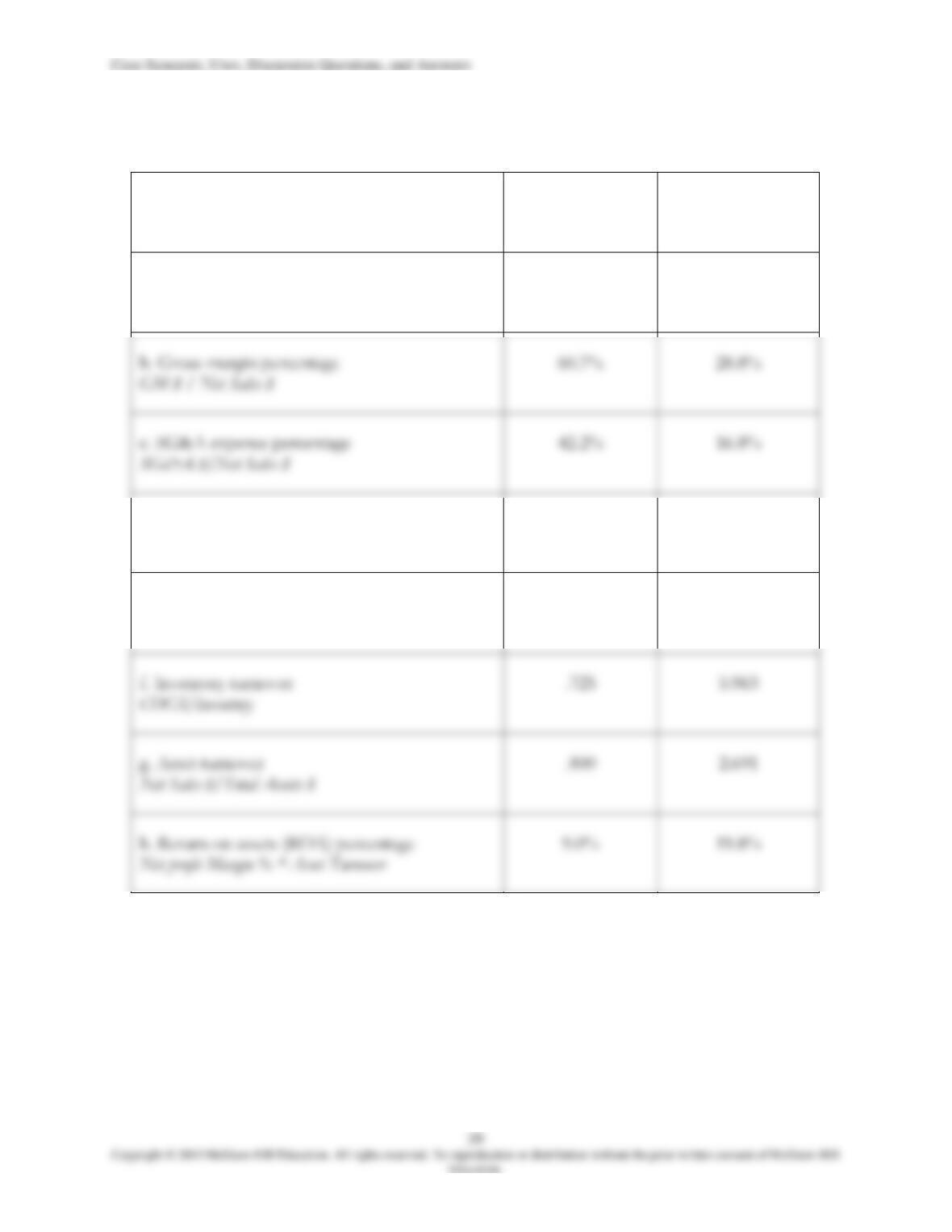
1. Calculate the following for both Tiffany & Co. and TJX using data from the abbreviated
income statements and balance sheets in Exhibit 1.
Financial Indicator
Formula Reference
Tiffany & Co.
TJX
a. Cost of goods percentage
COGS $/ Net Sales $
39.3%
71.2%
c. SG&A expense percentage
42.2%
16.8%
d. Operating profit margin percentage
(Op.Profit $/Net Sales $) or (GM% – SG&A%)
18.5%
12.0%
e. Net profit margin (after taxes) percentage
Net Profit $/Net Sales $
11.3%
7.4%
f. Inventory turnover
g. Asset turnover
Net Sales $/Total Assets $
h. Return on assets (ROA) percentage
Net profit Margin % * Asset Turnover
9.0%
19.8%
2. For a-h, compare and contrast the calculated financial figures for Tiffany & Co. and
TJX, then analyze and discuss why the percentages and ratios differ for the two retailers.
a. Cost of Goods Sold (COGS) is the amount retailers paid for the products sold including
shipping and distribution center costs. The higher the COGS compared to Net Sales, the lower
the Gross Margin. The lower the COGS compared to Net Sales the higher the Gross Margin.
b. Gross Margin is the profit that retailers make on the merchandise they sell. Tiffany & Co.
has a 60.7% Gross Margin and TJX had a 28.8% Gross Margin. Therefore Tiffany had a
significantly higher percentage gross margin (profit on the merchandise) that they sold. Retailers
like TJX and other off-price retailers like Ross Stores and other discount retailers, like Walmart,
Target, etc.,. typically have lower gross margins than most specialty stores including Tiffany.
This is because the strategy for discount stores is to offer merchandise at lower prices with less
offered in terms of service and ambiance in order to price their product lower. Retailers such as
Tiffany that have built a strong high-quality brand image often find that their customers are less
c. SG&A Expense % The largest SG&A expenses for retailers typically is salary and wages.
SG&A also includes rent, utilities, advertising, and supplies. In looking at Tiffany & Co., one
can see how its SG&A expense (42.2%) would be much higher than TJX stores (16.8%). Tiffany
stores are typically in very high rent locations, and Tiffany’s advertising would be more
specialized image advertising than the more mass marketed advertisements of TJX. Tiffany &
d. Operating Profit Margin is Gross Margin percent less SG&A percent. Tiffany & Co.’s.
Operating Profit Margin (18.5%) is higher than TJX’s (12.0%) because Tiffany & Co.’s
significantly higher gross margin more than offsets Tiffany& Co.’s much higher SG&A expense
percent.
e. Net Profit Margin (after taxes): Tiffany’s Net Profit Margin (or Net Income after Taxes) is
at 11.3% whereas TJX is at 7.4%. Again, Tiffany’s higher Gross Margin is a significant factor in
positively impacting its profit after taxes.