Case Study Teaching Notes
CASE NOTES: MARKETING PLASTIC RESINS: GE AND BW
Note: As described earlier, this case, when combined with
Automotive Headlamps II
and
Makrolon: The High-Tech Material
combine to demonstrate:
• The different views competitors can have of their markets
Synopsis
This case presents what we believe to be many unique study opportunities. While it
involves real companies, students are unlikely to find any information via Internet or
other data searches about the outcome, thus requiring some really thoughtful analysis
of the information provided in the case. Borg-Warner Chemicals was a profitable,
separate SBU of Borg-Warner Corporation, a major manufacturer of transmissions,
Learning Objectives
• Recognize that marketing channel design changes over the product life
cycle.
• Recognize that different market segments may require a very different
Case Study Teaching Notes
Case Analysis
There are really four logical outcomes of this analysis, only two of which students will
identify easily. These two outcomes are:
1) Supporting the BW position and recognizing distributors as a valid marketing
To entice students to look beyond these two obvious solutions, I point out that there
is at least “one solution, perhaps an opportunity, in Exhibit C3–1.” Here are those
possibilities.
3) If students support BW and believe it has the correct channel for plastic resins,
and they understand the value of industrial distributors, they should see the
possibility of another distributor. Though simplified from the real situation, the
4) The fourth outcome is the acquisition of BW Chemicals by GE Plastics. Without
the buyout/refinancing of BW, this would not have been a likely scenario.
Discussion Questions
The discussion questions at the end of the case are designed to be thought
provoking for students rather than specifically answered in their written analysis. By
discussing these questions among group members (or if individual assignments, it may
be appropriate to devote part of a class to an exchange of ideas) students often
discover details that they might not otherwise see.
1. From the information provided, describe the market environment
as viewed
by
GE and BW. Are both views the same (consistent with each other), or are they
view do you feel is more useful?
Case Study Teaching Notes
2. Consider customer needs as viewed by GE and BW. Do they see needs as being
the same? Are they segmenting the market the same? Have they targeted the
same segments? Are they interested in the same market?
Obviously, these competitors have not segmented the market in the
3. Does selection of target markets impact channel design?
This is obviously a major learning objective of the case. The fact that BW
4. From what you can discern in this case, describe and compare the goals of BW
and GE.
a. How do their goals impact their channel structure?
b. Do their goals impact how they view the market? Are their views
realistic?
c. It may be of assistance to consider how their goals and market view
compare to others in the market, such as DuPont. Are certain channel
structures more suited to certain goals?
A hard-line answer to this question would be that GE saw customers
Case Study Teaching Notes
5. Consider the service mix BW and GE intend to provide. Relate these services to
promotion strategy and marketing functions. Is the mix of services consistent
with their and/or your view of customer needs?
The GE service was strongly slanted towards larger customers,
6. What role does the FMD specialist play in the marketing organization of GE?
What potential conflicts do you see in the dual field structure of GE (having
both field market development personnel and field salespeople in sales
territories)? Consider all viewpoints–the custom molder, the plastics end user,
and the individuals serving as either FMDs or salespeople.
In Chapter 11−particularly the development and uses of the Marketing
• Custom molders found less flexibility when contracting to provide
components to a customer who had worked with GE. Particularly
prior to the time when specifying influences developed “or
Case Study Teaching Notes
CASE NOTES: AUTOMOTIVE HEADLAMPS II
THE PARADIGM SHIFT FROM STANDARDIZED GLASS SEALED BEAMS TO
TODAY’S PLASTIC CUSTOM DESIGNS
Note: As described earlier, this case, when combined with
Marketing Plastic Resins:
BW vs. GE
and
Makrolon: The High-Tech Material
combine to demonstrate:
• The different views competitors can have of their markets
Synopsis
This case provides an excellent basis for discussions of:
• How innovations are viewed differently by different stakeholders
How innovations are viewed differently by different stakeholders
Competitive pressures in the automotive industry push manufacturers to keep styling
and design fresh and innovative. It was a natural evolution for Ford to move to plastic
This case was originally presented as “Automotive Headlamps” in our first business–to-business
marketing book. After several semesters of classroom use, the case has been re–written to clear up
Case Study Teaching Notes
The difference between Market Ownership and market share leadership
GE Lamp was the market share leader in lighting – most all types. Certainly in the
automotive market, GE Lamp either supplied the major share of headlamps (Ford,
Disruptive versus incremental innovation
How marketing myopia can cause a major supplier to lose significant business at a
major customer
GE Lamp grossly underestimated the Ford determination to innovate forward lighting.
After some initial joint development (which GE had successfully completed long before
Case Analysis−What really happened
Ford did go ahead with the project. They “drafted” Sylvania, a supplier that was eager
to enter the automotive headlamp business and saw this as a major opportunity.
Faced with the demand of a major customer that they work with a third party, GEP
Case Study Teaching Notes
Ford became convinced that they had a leading competitive advantage. Now, the door
was open, and proliferation came quickly. Ford began designing and specifying
“aerodynamic headlamps” on their new models. Included were the first generation
Taurus and Sable (one of Ford’s most effective new vehicle platforms in current
times), the Tempo and Topaz compacts, Windstar minivans, and many to follow.
Harder and more durable coatings for lenses were also developed and implemented.
Innovation Leads to Industry Structural Change
Of particular note is that the change from glass sealed beams to plastic replaceable
bulb headlamps caused a structural change in the headlamp supplier community.
Though GEP benefited significantly, GE Lamp did not embrace the ideas of either
halogen bulbs or plastic construction⎯despite being first with the plastic unit on the
1980 Lincoln! As a result, GE went from being the dominant supplier of automotive
headlamps in the U.S. to a small player⎯with essentially no OEM business, and a
declining share of the aftermarket.
Case Study Teaching Notes
Today, vehicle-specific plastic headlamps with replaceable lamp capsules are the norm
on most vehicles throughout the world. At a recent meeting of the IDSA (Industrial
Design Society of America), a panel of automotive design managers concurred that
today’s automotive designs have de-emphasized the grille, and emphasized unique
headlamp designs, which have become the “eyes” and more of the “face” that gives
the vehicle its character. Plastics have made this possible.
Key Factors of Success
There were several key factors that led to this success. Among them were:
• The operating premise of the key GEP people involved was that such innovation in
the creation of new applications for the company’s products
was expected,
necessary, desirable, possible and would be rewarded
; (GEP had a culture of
etc.), purchasing⎯plus SAE, DOT and NHTSA;
• Refusing to take “no” (or “we don’t do it that way,” or “you can’t change that”) for
an answer;
• Following up and addressing every objection;
• Determining the real benefits to the customer, and to whom, within the customer
organization;
Case Study Teaching Notes
• Citing both the benefits and limitations openly, and addressing both;
• Identifying, recruiting, supporting and working closely with a champion at the
vehicle manufacturer (an advanced engineering manager involved with lighting);
Lessons Learned
• Dedicated resources, committed to their goal can achieve it.
• Conventional wisdom is conventional, but not necessarily wise.
• Assumptions are to be constructively challenged.
• “It can’t be done” can be overcome with “Why not?” and “We can.”
Case Study Teaching Notes
CASE NOTES: MAKROLON: THE HIGH-TECH MATERIAL
Synopsis
In 2001, having experienced other companies such as Intel, Microsoft and Gore-Tex
gain market success through Ingredient Branding, Bayer AG opted to apply this
Suggested Assignment Questions
Since the industry is currently restructuring itself, the instructor is advised to become
familiar with current developments to prepare for the “what happened” part of the
case. The following questions could be used:
1) What was the original motivation behind Bayer’s decision to launch the
Teaching purpose
This case can be taught effectively to business bachelor, MBA or executives in
marketing courses that stress brand decisions, particularly in business-to-business
marketing, but also High-Tech Marketing, or Marketing of Innovations.
The specific teaching objections include:
• To explore the challenges associated with building and managing an Ingredient
Brand. The case analyzes the situation of the chemical industry and elaborates
Case Study Teaching Notes
Situation Analysis
Many students are familiar with the success of the Ingredient Branding campaign of
Intel and have the tendency to assume that success is possible for every industry and
TN Figure 1 Requirements for InBrands
Requirements for InBrands
⚫ The performance of the ingredient is substantial to the
function of the final product.
In the Intel Ingredient Branding example, many outside experts were critical of the
success of their innovative marketing concept. The same could be said for Makrolon;
in this case, the inside management showed strong resistance, since a chemical
From its invention in 1953 until today, polycarbonates have become a major part of
people’s lives. They are widely used in the modern chemical industry and have very
unique features:
Case Study Teaching Notes
These features distinguish it from commodity plastics like PVC (polyvinyl chloride) or
PU (polyurethane). The uniqueness may have inspired the management to define
In which areas was Makrolon successful?
Bayer AG was marketing Makrolon for almost 50 years as an industrial product when
they decided to choose an Ingredient Branding concept. The concept was applied in
the following selected areas:
Creating a unique selling proposition:
There is no doubt that Makrolon created a notable awareness in the market with the
three selected product areas shown above. The case states that 31% awareness in
Value Chain Enhancement:
The case particularly highlights the example of the UVEX Winter Holding, a company
that is very well known to the final customer through its sports division, which
manufactures and distributes sunglasses, goggles and helmets for skiing, cycling and
Case Study Teaching Notes
Issue Analysis
By August 2006, before the global financial crisis (the case was written in 2007), Bayer
AG had one of its best years. The turnover grew over €20 billon and Makrolon Science
Division had net external sales for the first time of more than €10 billion (see Appendix
Fig 2). A major part of this turnover was generated by Makrolon. However, when oil
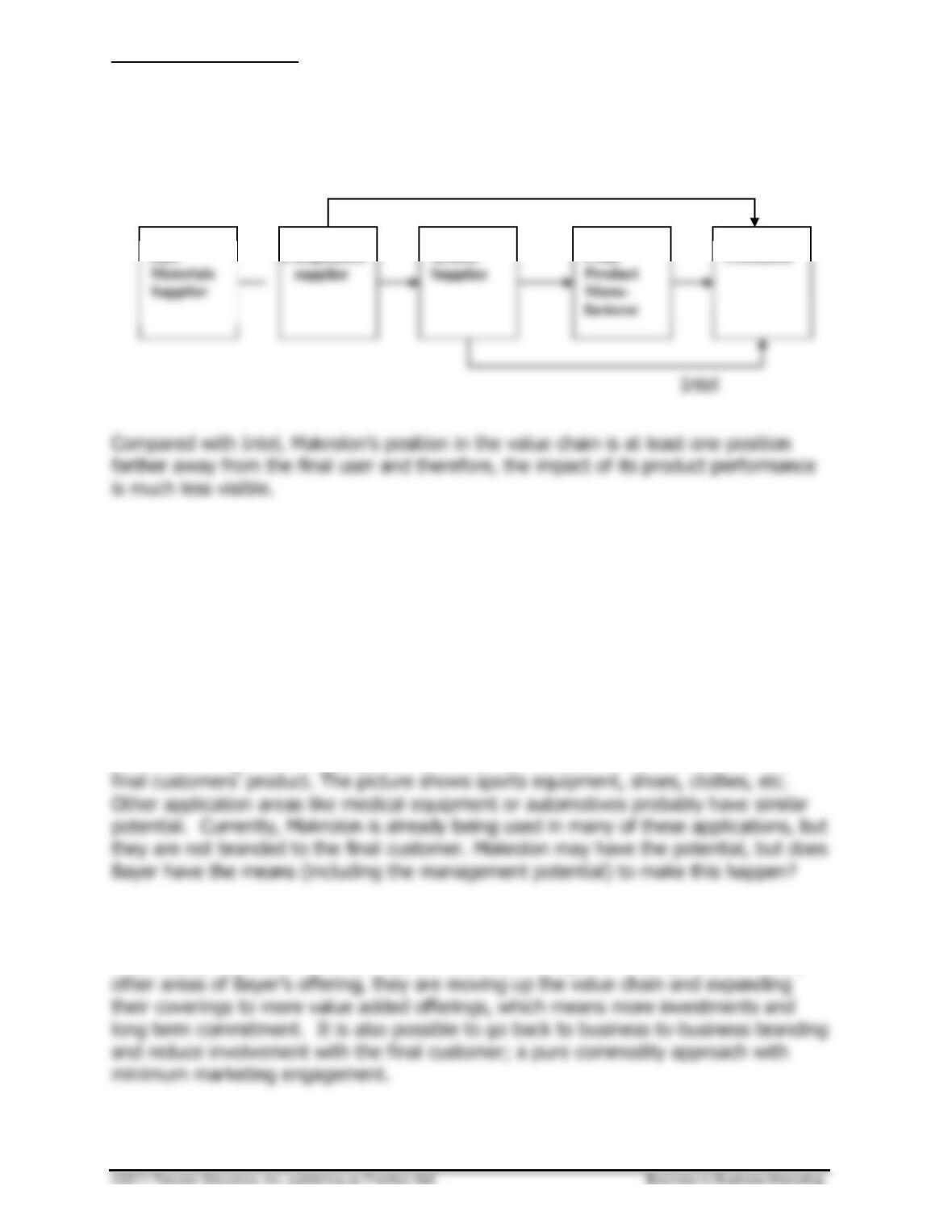
Makrolon’s Value Chain Position:
As stated before, Makrolon enhanced the value creation for its customers in only a few
cases. When students analyze the usage of polycarbonates in their day-to-day
Case Study Teaching Notes
TN Figure 2 Value Chain Position Makrolon
Options Under Consideration
After evaluating the internal and external factors for the support of the Ingredient
Branding program, there appears to be two extreme options for the Bayer Material
Science Division: (1) step up the Ingredient Branding efforts, (2) look for alternative
roads to success.
Step up Ingredient Branding efforts:
As shown in Fig. 6 of the case, there are ample possibilities to use Makrolon in the
Other options for consideration:
In principle, there are numerous options that the management can pursue. In many
Makrolon
Case Study Teaching Notes
What Should Bayer Material Science Do?
By now, students should recognize that any decision regarding branding to the final
customer needs specific knowledge about value chain dynamics and the likelihood that
What Happened?
After the case was written, Bayer Material Science made the decision to abandon its
entire ingredient branding efforts to the final customer and cut all marketing
Case Study Teaching Notes
CASE NOTES: SENSACON INCORPORATED
High Technology Evolves to High Volume
“Capstone Case”
Sensacon is a composite of the continuing examples throughout the textbook. Starting
in Chapter 8, the development and growth of the fictitious company are used as
examples of the application chapter material in the real world. The reader is led
At the end of the case composite, Allen Chen, the new CEO of Sensacon, challenges
his team with the question “What are your ideas on how to defend our brand and
grow the company significantly and what future challenges face Sensacon?”
The case composite stops with this challenge. However, in the chapters, the Sensacon
story continues. Any plan addressing the challenge of the new CEO should contain
elements of the following:
• Re–branding for better identity. The brand name “SensorSUV” is not very
• Channel development, including channel member education, to meet the
needs of the OEM, service, and aftermarket accessory market segments
(dual distribution) is essential. Students may be surprised at the amount of
Case Study Teaching Notes
• Promotions: Chapter 15 discusses some of the promotional needs of
Sensacon. Sensacon’s use of trade shows and PR have been important to

Case Study Teaching Notes