Case Studies to accompany
Business-to-Business Marketing: Analysis and Practice
By Robert P. Vitale, Joseph J. Giglierano, and Waldemar Pfoertsch
Authors’ Comments
It probably comes as no surprise to many instructors that using case studies,
particularly in undergraduate courses, is more of a challenge than it once was.
Notwithstanding this, we continue to believe that case studies that present real-world
situations for student analysis and discussion are an excellent instructional tool.
We do not necessarily subscribe to what may be known as “standard operating
procedure” in case analysis. Too often, when a student completes a first reading of a
Consumer Perspective of Students
It is very difficult, at least initially, for students to view circumstances as other than
the ultimate consumer. Not only is there difficulty breaking away from the mindset of
The “Newness” Of The Case
We continue to hear from many of our case-oriented colleagues of the difficulty
finding appropriate new cases for business-to-business marketing. We tend to believe
Case Study Teaching Notes
With regard to older cases, here is a list of some that we have found useful−you will
likely recognize some of them.
• Dominion Motors and Controls
This is an excellent case to demonstrate the influence of external
stakeholders and the impact of standards organizations on product
Author’s Solution Is Not The Only Solution
Your experiences may provide a different perspective than that of the author’s. You
may want to emphasize different aspects of the case. An older case may have an
Technology versus Purses and Shoes
Students can find the somewhat technical nature of many business-to-business cases
intimidating. A student once remarked “can’t we have cases about things we know
about, like purses and shoes instead of chemicals and motors?”
To help defer this bias, reinforce the value aspect and solution potential of
the product/offering rather than the technology that makes it valuable.
Case Study Teaching Notes
©2011 Pearson Education, Inc. publishing as Prentice Hall Business-to-Business Marketing
Teaching Notes Included in This Manual
A full discussion is provided for each case in the textbook. Below is a summary of the
topics and issues that can be addressed with each case. Note that, as mentioned
LastMile Corporation–Choosing a Development Partner
Issues: Crossing the Chasm
B2B e-commerce in China: the Strength of Alibaba.com
Issues: Strategic plan implementation throughout an organization
Dow Corning Success in China
Issues: Business to Business branding
Marketing Plastic Resins: BW and GE
Issues: Marketing channel design changes over the product life cycle
Competitive advantage through field market development and
Note: This case, when combined with
Automotive Headlamps II
and
Makrolon:
The High-Tech Material
combine to demonstrate
• The different views competitors can have of their markets
Case Study Teaching Notes
Automotive Headlamps II (Revised for academic clarity)
Issues: Disruptive versus incremental innovation
How innovation is viewed differently by different stakeholders
How Marketing Myopia prevented a major supplier from
Makrolon: The High-Tech Material
Issues: Ingredient branding in the consumer market of a mature industrial
product
Branding a product without major differentiated attributes that
were available from several sources
Sensacon, Incorporated
This is the capstone case for the book, combining many elements from many
chapters.
Case Study Teaching Notes
CASE NOTES: LASTMILE CORPORATION
Synopsis
The founder of LastMile Corporation, Tom Sherman, is pondering how to bring new
products to market under conditions of scarce resources for development and launch.
Case Questions
What are the other alternatives that LastMile could look at that would
create a working relationship between Midwest Technologies and LastMile?
There is a range of possibilities for working with large partner, rather than
licensing the technology to them. LastMile could arrange a contract to provide
What are the advantages and disadvantages of these alternatives?
The advantages and disadvantages of the licensing-only option are spelled out
in the case. So, too, are the advantages and disadvantages of receiving
Case Study Teaching Notes
Licensing
With development funding from Midwest, licensing has some attraction to it.
ownership of the technology, but would have limited growth potential.
Joint Venture
If a joint venture is considered, LastMile should recognize the need to continue
Acquisition
In an acquisition, LastMile would lose a good measure of control over the
direction of the technology. However, the money obtained would be
What are the objectives that LastMile would like to accomplish out of such a
partnership?
LastMile is looking to grow fairly rapidly. To be a player in this emerging
market, they will need to achieve a larger size than they are now.
Case Study Teaching Notes
What counter proposal(s) would you recommend?
What Happened?
In reality, the real company represented by Midwest in this fictitious case acquired the
Case Study Teaching Notes
CASE NOTES: B2B E-COMMERCE IN CHINA: THE STRENGTH OF
ALIBABA.COM
Synopsis
In 2007, Alibaba.com had its initial public offering (IPO) at the Hong Kong Stock
Exchange. The company raised 1.33 billion HKD, the second largest investment
offering since the IPO of Google. High hopes from the investment community have
Suggested Assignment Questions
1. Does the “bird cage” theory, when applied to China’s Internet policy, constitute a
serious threat to the development of the B2B e-commerce industry?
Teaching Objectives
The case is suitable for MBA-level or advanced undergraduate courses on marketing
strategy and communication. It has been used successfully in executive training
courses devoted to business-to-business marketing. Finally, instructors will find the
case useful for illustrating the opportunities and challenges found in the Chinese
market of the past few years, when business structures and legal frameworks were
changing rapidly, and market dynamics were hard to predict.
Specific teaching objectives include:
⚫ To establish the importance of developing an integrated marketing plan, one that
Case Study Teaching Notes
Situation Analysis
Business Environment:
In the last 35 years, China has undergone dramatic economic and technological
changes. Its political leaders are committed to the goal of catching up and achieving a
With its 1.3 billion people and huge differences of economic wealth in the various
areas of the country, the Internet is an important tool for the liberation from
geographical constraints within and outside China. Since government institutions seem
Internet technology is a good example of how quickly and efficiently technology
adoption occurs in China. Despite its initially rudimentary telecommunication network
Business Model:
With modest start-up investment, Alibaba established its presence through word-of–
mouth communication. The company easily integrated into the existing business
activities of many small- and medium-sized Chinese companies. By offering free
Case Study Teaching Notes
transactions, it appealed to the low-cost mentality of the local market environment.
Step by step, Jack Ma transferred various Internet technologies to the Chinese market
The battle with eBay illustrates clearly the commitment and dedication for market
leadership.
Why was Alibaba so successful?
The goal and following success to achieve this kind of category leadership was without
precedent in China. How did Jack Ma make it happen? Students should be able to
identify several factors and conditions that enabled his success.
1) Market immaturity–Internet technologies and market could not reach China until
its entry into WTO. Only after this time was the country forced to enable free flow
of information. Major telecommunication infrastructure investments had to be
Problem Analysis
By 2008 (the time the case was finalized), Alibaba had established itself as the leading
Internet service provider in China. Working within the strict government controlled
Case Study Teaching Notes
Customer demand versus revenue development:
Part of the problem has to do with Alibaba’s growth. The expansion was enormous
The downside of cooperation with partners:
The company’s strength was, without a doubt, the cooperation with its partners.
Alibaba signed up various credit card and pay-system providers and established a
Involvement with the government:
Since Jack Ma had already worked for the government, he knew and understood the
So what should Alibaba do?
By now, students should recognize that any decision regarding the business model
should be viewed in the larger context of the business situation. Alibaba needs to
figure out what kind of business model they should pursue to secure long-term
sustainability of its venture.
As difficult as this problem may appear, it is important to recognize that it is not
uncommon. During the Internet hype in the industrialized world, many companies
experienced similar situations with a few survivors and many failures. So what are the
options to establish a sustainable business model for the future?
⚫ The foremost issue is the maintenance of the customer relationship. The
number of buyers and sellers has to continuously increase to accelerate the
Case Study Teaching Notes
What did Alibaba do?
After the case was written, Alibaba changed its business model and introduced a
premium membership fee for “gold suppliers.” Suppliers identified as “gold” according
to their sales volume, had to pay a percentage of their revenues. The membership
was voluntarily, but Alibaba strongly promoted it. A gold member could maximize their
exposure with priority listings, they had exclusive access to buyers’ contact details,
and the latest buying leads. Alibaba offered them real-time performance analysis of
Case Study Teaching Notes
CASE NOTES: DOW CORNING SUCCESS IN CHINA
Synopsis
In 2008, Dow Corning was one of the largest providers of silicon products in the
world, and the market leader in China. With its dual branding strategy, they had
managed to escape commoditization and provide multiple channel access for their
Suggested Assignment Questions
The class assignment could be to develop a list of issues that the management is
facing as it aspires to expand market presence and maintain strong brand leadership.
This will involve elaborating on brand management options and deciding how to
execute in a multi-channel environment.
Challenges for the company would include the following questions:
1. How should Dow Corning make good use of its two brands to grasp the China
market to sustain its long-term growth?
Case Study Teaching Notes
Teaching Purpose
The case is suitable for MBA-level or advanced undergraduate courses on marketing
communications and branding, particularly for business-to-business marketing classes.
It also has been used successfully in executive training courses devoted to industrial
marketing. Finally, instructors may find the case useful for illustrating the challenges
of management in China in the last few years, when brand building was still a
relatively new management concept, business-to-business marketing was just
evolving, and competing on price was a major way to gain market access. Specific
teaching objectives include:
• To explore the challenges associated with building and managing a business–to–
business brand. The case details the strategic planning behind the development
Situation Analysis
The sales of the specialty chemicals giant Dow Corning grew during 40 years from its
early beginning in 1943 to 2003 to about U.S. $ 2.6 billion (see Exhibit 7). With the
introduction of the Xiameter brand in 2001, the company almost doubled its revenues
to about U.S. $ 5 billion.
Case Study Teaching Notes
©2011 Pearson Education, Inc. publishing as Prentice Hall Business-to-Business Marketing
After the initial success in the early 2000’s, net income slowed down and stayed stable
between 2006 and 2007, mainly due to intensive investments.
The introduction of the Xiameter brand caught its competitors by surprise and was not
duplicated by competitors such as GE Silicones or Wacker Chemie. None of them were
What was the motivation for Dow Corning to introduce the Xiameter brand?
Generally speaking, there are number of reasons companies build multiple brands. For
business-to-consumer brands it is a common practice to cater to different consumer
needs; industrial companies favor corporate brands. Dow Corning was already the
market leader; it had a competitive product and it had strong relationships with many
OEM partners. So why did the management create the Xiameter brand?
• The need to drive demand. Dow Corning served many industries, and for each
• The need to create branding differences and not to cannibalize existing
business. Because industry applications were in different stages of the lifecycle,
different customers had very different needs, and this could even be true within
one customer. The Intel Corporation in Seattle needed strong engineering
support for its newest chip applications and also needed large product
quantities for its mass production outsourced to China.
Case Study Teaching Notes
Students should recognize that brand creation and brand maintenance are like the two
sides to one coin. By providing two brands with different value propositions,
management has to make sure that they are distinctly different and create different
values in the various segments.
Why was the dual branding so successful?
As stated before, the decision to establish a second brand beside an established
successful existing brand was without precedent in industrial markets, particularly for
a specialty chemical manufacturer. How then, could Dow Corning make it happen?
Students should be able to identify several factors that enable this management
success.
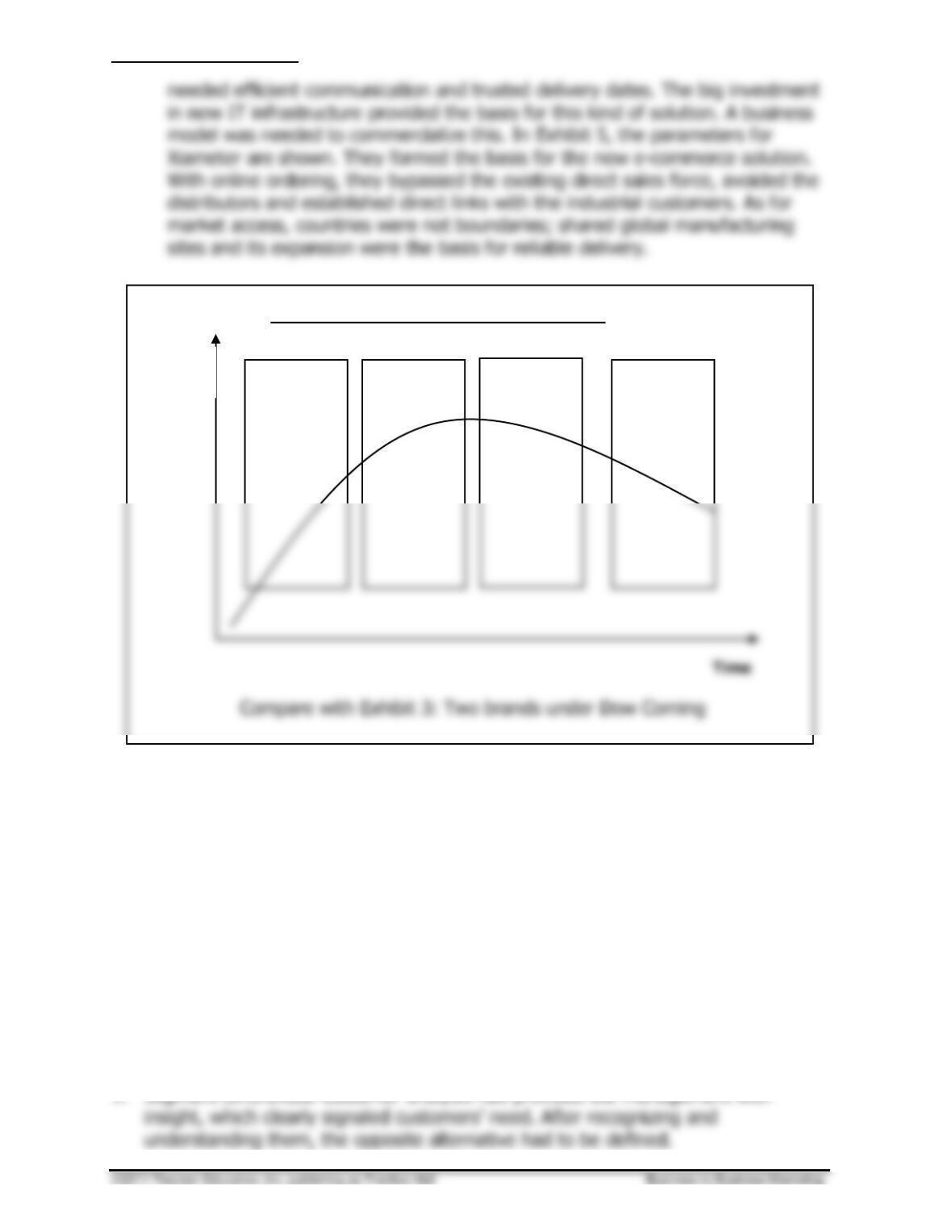
Innovative
Solutions
Proven
Solutions
Cost-
Efficient
Solutions
Market-
driven
Price
Volume
TN Figure 1: Segmentation and Lifecycle
Case Study Teaching Notes
2.
Business Model Clarity
–Identifying is one thing and delivering is another.
3.
Brand communication
–Not only customers but everybody needs to know the
4.
Strong brand leadership
–Since Dow Corning was a very engineering driven
5.
Different brand promises
–Finally, students should recognize that Xiameter, as part
Problem Analysis
By 2008 (the time the case was staged), Xiameter had established itself as an
independent brand of Dow Corning company, and was a leading supplier in China.
Given this, what was the key problem confronting Xiameter’s marketing team in 2008?
Not too many students may identify the problem since the success of the dual
branding strategy was so impressive. However, the problems are indirectly visible.
Changing segments:
Ironically, part of the problem came through the newly established segmentation
selection. In Exhibit 4, the brand differences between the two brands are displayed
Commitment of organizational support and marketing communication:
Emerging markets like Brazil and China were not as affected by the global financial
Case Study Teaching Notes
Raw material prices were cut and local second-source suppliers emerged. Especially in
Options Under Consideration
Given Xiameter’s marketing challenges, what are the options the company is currently
considering? Based on the information in the case, the company appears to be
considering two changes to its marketing strategy:
Expand base level offering:
Since the bulk of the volume of silicone is needed by high quantity operations, and
efficient delivery channels have been established, customers who could benefit from
Enhance Dow Corning to a premium brand:
Innovative solutions always need costly engineering support; high prices are thus
justified. The establishment of the Xiameter brand was only possible with the increase
What happened?
After the case was written, Dow Corning made the decision to expand its investment
in China and broaden the scope of the Xiameter brand. They authorized additional