Theories of Motivation
Content Theories
Many of the theories of motivation developed by behavioral scientists over the past 75
years use simple content models that describe how and why people are motivated to
Process Theories
The second major thrust in motivation theories was the development of process models.
Process theories and their models explain the dynamic process (as opposed to the static
“snapshots” of content theories) of how people make choices under certain types of
Vroom proposed his preference-expectancy theory in 1964.2 Vroom’s work formed
the basis for one of the better known process theories, the Porter and Lawler model,
which is one of the most widely accepted process models of motivation available today.
Porter and Lawler extended Vroom’s work by examining more closely the traits and
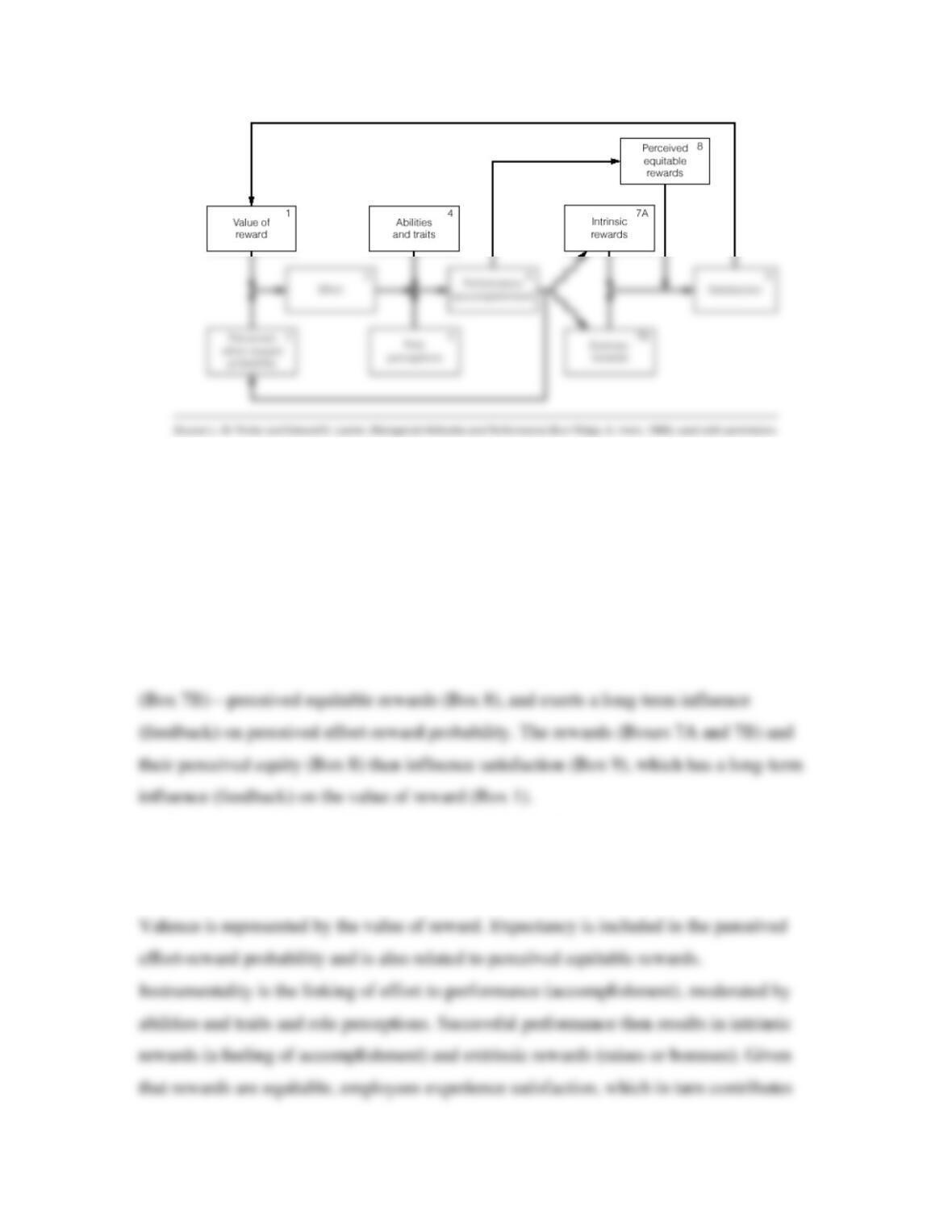
Figure 1 Porter and Lawler Model
The Porter and Lawler model is shown in Figure 1. The flow of this model indicates
that effort (Box 3) is dependent on value of reward (Box 1) and perceived effort-reward
probability (Box 2). Effort leads to performance (Box 6), which is affected by the
abilities and traits (Box 4) and the role perceptions (Box 5) of the individual.
Performance (Box 6), in turn, influences actual rewards—intrinsic (Box 7A) or extrinsic
Components of the model are expectancy (which includes performance-outcome
expectancy and effort-performance expectancy), instrumentality (the combination of
abilities, traits, and role perceptions), and valence (preference for anticipated outcomes).
to renewal of the motivation cycle. The model states that, depending on the actions of
management, the expectations of employees, and the actual outcomes, a certain quantity
and quality of employee motivation is present in an organization. Porter and Lawler’s
model, while more complex than content models, accounts for the process dynamics that
content models lack.
The debate between process and content theories of motivation centers on which
theory is a more accurate representation of human motivation. Obviously, they represent
two views of the same reality. The content approach provides a simple, static
Environmentally–Based and Other Motivation Theories
New theories of motivation are being developed and may have implications for
motivating employees to make quality products and quality decisions. Some of the
categories for these theories include environmentally-based theories (such as Skinner’s
Goleman’s “emotional intelligence” theory8 is one of the newest social learning/self-
efficacy theories now under development.
It is impossible to completely divorce leadership from motivation. Leaders
establish the motivational climate, so they must also respond when or if the climate
becomes de-motivating. One of the newest and most publicized of the emerging
leadership and motivation theories is called the Emotional Intelligence Theory9.
Goleman defined five components of emotionally intelligent leaders: 1) Self-Awareness,
2) Self-Regulation, 3) Motivation, 4) Empathy, and 5) Social Skill. His premise is that
there has been too much reliance on the rational side of leadership in leadership research
studies and training done over the years. While his theory is focused on leader behavior,
In his recent book10, Goleman and his colleagues summarized research that had been
done on aspects of emotional intelligence. They stated the impact that leadership can
have in this way:
When leaders drive emotions positively … they bring out everyone’s best. We call this
effective resonance. When they drive emotions negatively … leaders spawn
dissonance, undermining the emotional foundations that let people shine. Whether an
organization withers or flourishes depends to a remarkable extent on leaders’
effectiveness in this primal emotional dimension.
In an article leading up to the theory tested by the research in their book11, Goleman
Applying Motivation Theories to TQ
As an example of how the Porter and Lawler model might apply in TQ, suppose that a
bank decides to install a statistical process control system in its check-clearing
department. It performs the activities of planning the new system, organizing the
workforce, and training employees to use the new system. The bank even trains clerical
workers in the details of recording information clearly and accurately. However, the bank
model could be used to trace out the flaws in the motivating process. The model shows
that the bank’s system has a deficiency in perceived effort-reward probability and,
perhaps, value of reward as well. Thus, if employees do not perceive a high effort-reward
probability or do not see a high value in the rewards that are given, they will not apply
In this example, the value of the reward (Box 1 in the Porter and Lawler model in
Figure 1), and the perceived effort-reward probability (Box 2) work in conjunction with
intrinsic rewards, extrinsic rewards, and perceived equitable rewards (Boxes 7A, 7B, and
8) to produce motivated effort (Box 3), performance (Box 6), and satisfaction (Box 9).
Thus, the attention to the details of job design can have a significant impact on the quality
level in a work setting.
Bowditch and Buono suggested that an integrated theory of motivation, such as that
under development with social learning/self efficacy theories, could be developed by
considering the types of behavior in a group of people that are of interest to
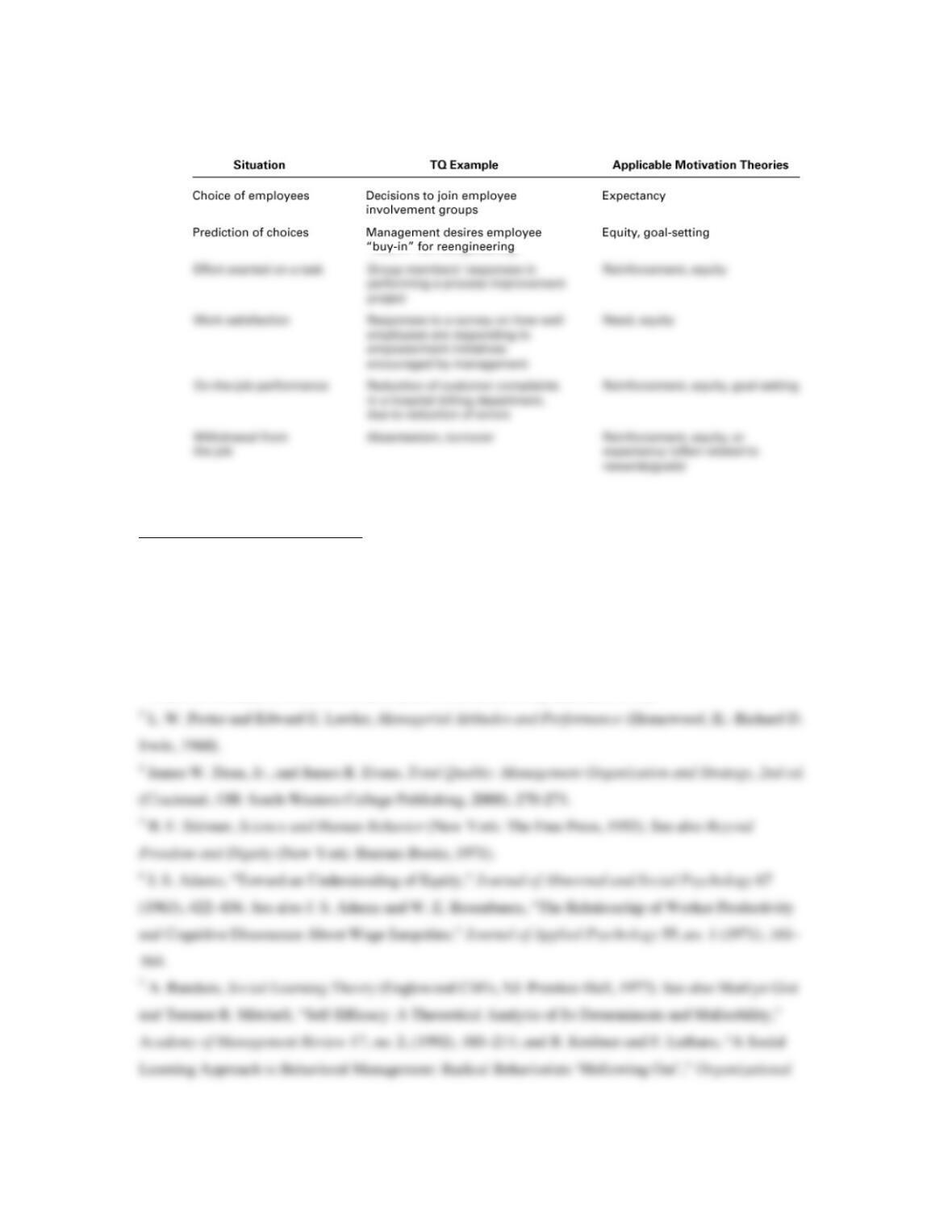
Table 1 Applying Motivation Theories to TQ
1 See, for example, Abraham Maslow, “A Theory of Human Motivation,” Psychological Review 50, no. 4
(July 1943), 370–396; Abraham Maslow, Motivation and Personality (New York: Harper & Row, 1954); F.
Herzberg, B. Mausner, and B. Snyderman, The Motivation to Work, 2d. ed. (New York: John Wiley and
Sons, 1959); Douglas McGregor, The Human Side of Enterprise (New York: McGraw–Hill, 1960); and D.
C. McClelland, Assessing Human Motivation (Morristown, NJ: General Learning Press, 1971).
2 Victor H. Vroom, Work and Motivation (New York: John Wiley and Sons, 1964).

Dynamics 13, no. 2 (1984), 47–65. Also see R. A. Snyder and Ronald R. Williams, “Self Theory: An
Integrative Theory of Work Motivation,” Journal of Occupational Psychology 55 (1982), 257–267.
8 Daniel Goleman. “What Makes a Leader?” Harvard Business Review, November/December, 1998, 93–
102. and Daniel Goleman. Working With Emotional Intelligence (New York: Bantam Books, 1998).