The Deming Prize
The judging process for the Deming Prize is rigorous. After an initial application is
accepted as eligible for the process, the company must submit a detailed description of its
quality practices. Sorting through and evaluating a large number of applications is an
extraordinary effort in itself. Based on review of the written descriptions, only a few
companies believed to be successful in CWQC are selected for a site visit. The site visit
consists of a company presentation, in-depth questioning by examiners, and an executive
session with top managers. Examiners visit plants and are free to ask any worker any
More than 150 companies have won a Deming Prize, including the seven largest
Japanese industrial corporations. Some winners of the Deming Prize include Toyota
Motor Company, Ltd., NEC IC/Microcomputer Systems, Shimizu Construction
Company, Ltd., and the Kansai Electric Power Company. Toyota has captured nearly 10
percent of the world’s automotive market. NEC has earned a reputation for exceptional
quality in a diverse set of electronics areas. Shimizu Construction is one of the top five
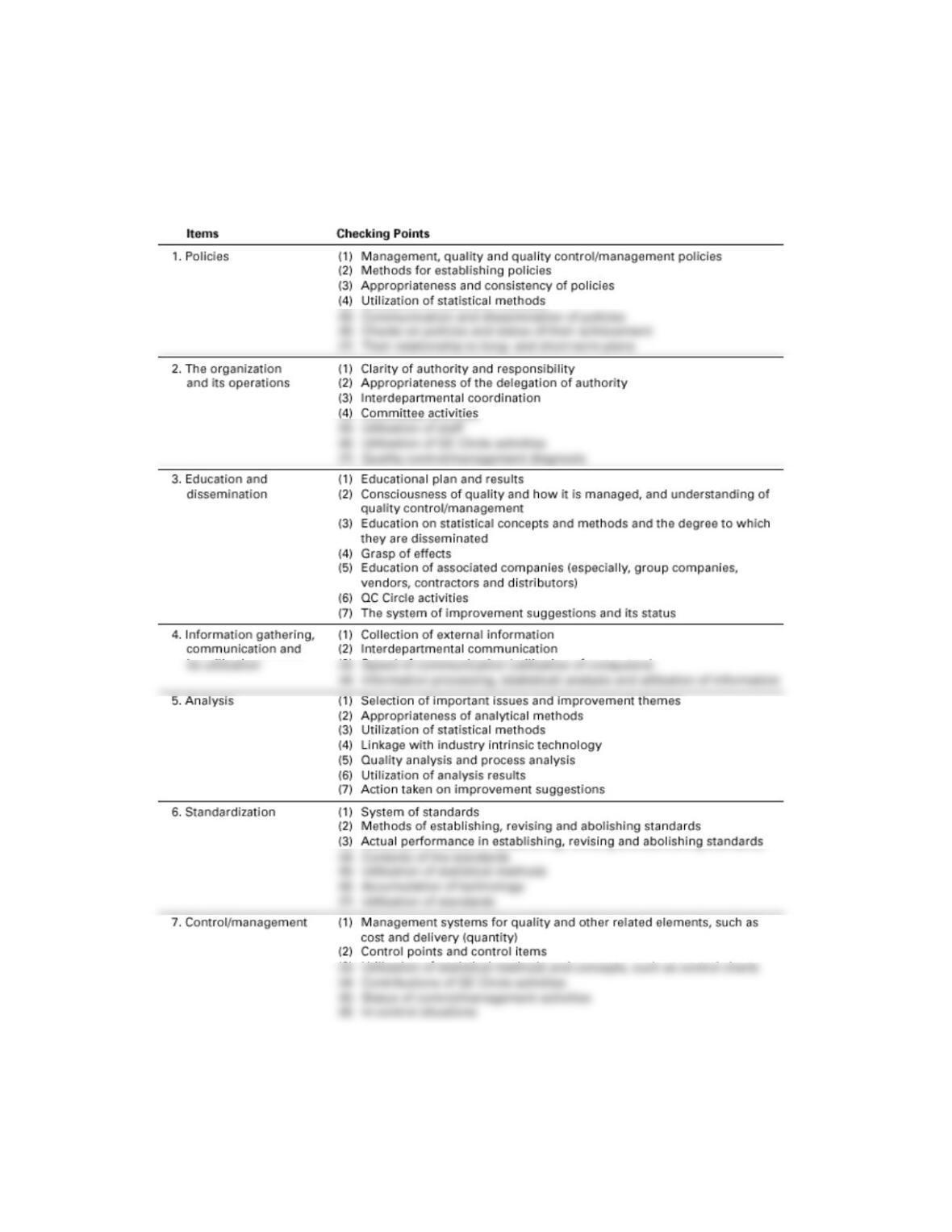
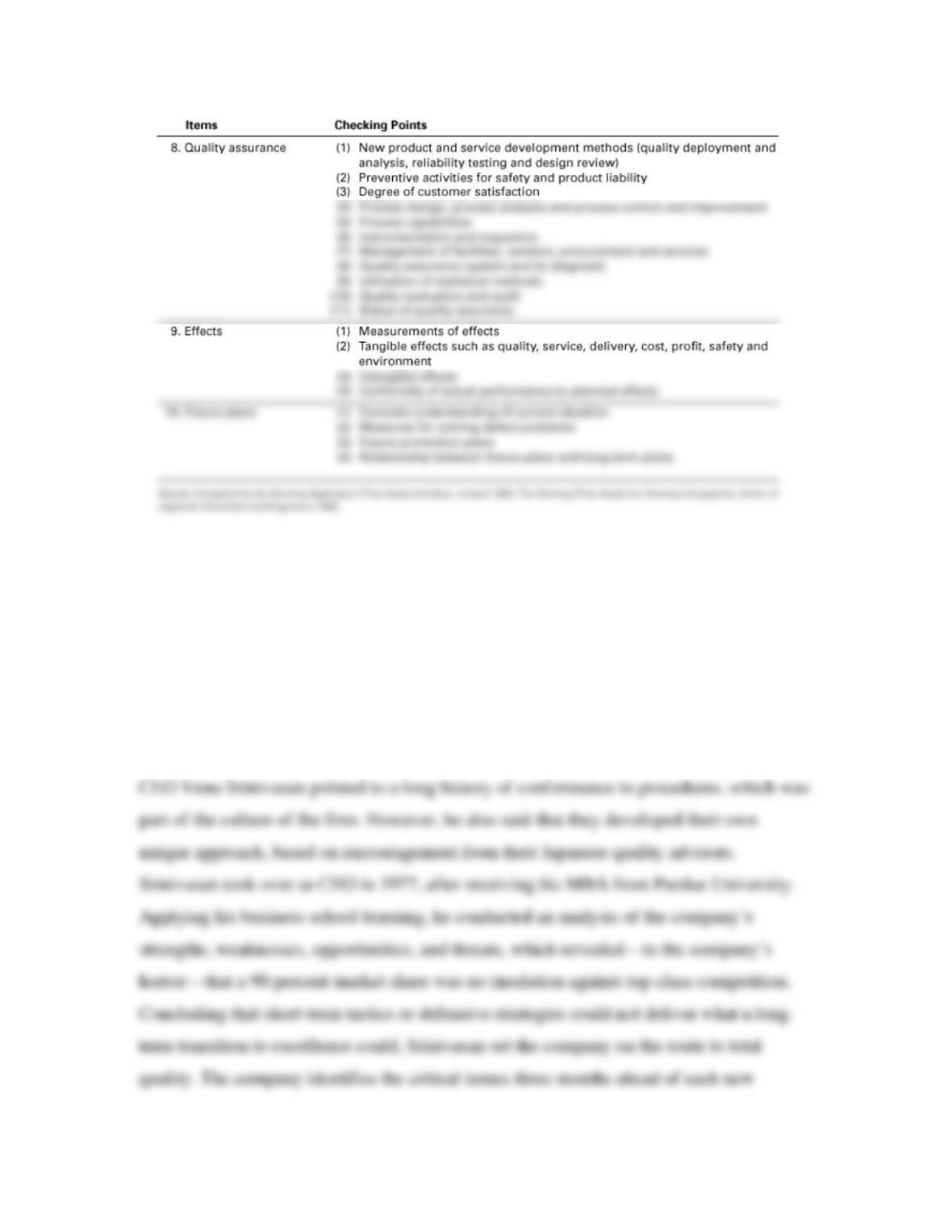
The Deming Application Prize Checklist, below, shows the detailed policy
categories and “checking points.”
The Deming Application Prize Checklist
Next is a short profile of Sundaram-Clayton, a Deming Prize winner.
Sundaram-Clayton (S-C) is a manufacturer of air-brake systems and castings,
headquartered in Chennai, India, and is part of an Indian industrial group called TVS–
Suzuki. S-C became India’s first-ever winner of the Deming Prize for Overseas
Companies. In discussing how and why S-C adopted a Japanese type of quality system,
financial year. The three most important issues are chosen and communicated to
everyone in the company. Workers spend a minimum of 45 hours a year on classroom
training, well above the industry average of 4 hours, starting with how and why to keep
machines and the shop floor clean using the Japanese “5 Ss”: seiri (clearing up), seiton
The following profiles Florida Power and Light, the first US winner of the Deming Prize.
Florida Power and Light (FPL) is one of the largest electric utilities in the United States.
Its territory covers 27,650 square miles, about half of Florida, and services a population
of 5.7 million people. FPL has about 15,000 employees, operates 13 plants, 397
substations, and more than 53,000 miles of transmission and distribution lines.
During the 1970s the company was forced to increase utility rates repeatedly because
of increasing costs, slower sales growth, and stricter federal and state regulations. The
“Policy deployment” was the driving force behind the QIP program. Policy
deployment (see Chapter 6) is a method that takes corporate vision and determines
priority issues that will make the vision a reality. For FPL, the issues involved improving
reliability, customer satisfaction, and employee safety while keeping costs in control.
Each department was then responsible for developing plans to improve in these areas.
Once plans were determined, their status was checked regularly to make sure they were
on schedule. Each department was limited to working on no more than three items that
had the most influence on their department’s performance, but the work on these was
expected to be done in great detail.
One illustration of how QIDW was used was the development of a computer system
for processing customer trouble calls. In the system, the computer first checks to find out
if the customer has been disconnected for nonpayment, then begins to locate places and
devices that may be malfunctioning, and routes the call through a dispatcher to a
troubleshooter. A repairperson heading to the scene may have a diagnosis before arrival.
The information is stored in a database to be used for future improvement planning.
their employees and play a more active role as coaches and cheerleaders. As line
employees have become more skilled in diagnosing and solving problems, issues that
once required management attention are now handled by line employees. Problems are
dealt with on a factual basis, not with intuition. All employees have developed a much
broader view of the company and more flexibility in dealing with customers.
The management system has also changed. Customer satisfaction has become the
focus of attention rather than cost control. Management reviews check on improvement
progress monthly. Goals are now long term, but progress checks are frequent. Managers
review progress with better statistical insight, recognizing that variation will exist, but
seek to rid the system of common causes. Cross-functional teams are used to carry out
large-scale improvement projects. Finally, the budget is integrated with quality
improvement.
After the Deming Prizei
Although winning the Deming Prize in 1989 was an honor of which the company and its
employees were very proud, a number of employees were feeling that the quality
improvement program, intensified by the Deming challenge, had become mechanical and
inflexible. In fact, the bureaucratic features that had developed in the process were
becoming barriers to continuous improvement in many instances.
and the company; eliminating many of the formal management reviews; no longer
requiring a structured problem-solving process, but emphasizing continuous
improvement and solutions that benefited the company and its customers; continuing to
train all employees in the problem-solving process so they would have the appropriate
tools and speak a common language; and dispersing the quality organizations within the
Five years after winning the Deming Prize, FPL still had an unwavering commitment
to quality initiatives, which was noted by Dr. Noriaki Kano of the Union of Japanese
Scientists and Engineers, after observing presentations from 11 FPL business units. Dr.
Kano, who had served as a counselor to FPL since 1986, was “pleasantly surprised” that
FPL has simultaneously reduced costs and improved quality. Kano noted that recent
improvements were based on skills developed through QIP practices. For example, one
i This section is adapted from “A Status Report on FPL’s Improvement Activities Four Years After
Receiving the Deming Prize,” “Quality at Work,” FPL Today 2, no. 1 (Spring 1993), and “Quality Effort