Quality Cost Indexes
Index numbers increase managers’ understanding of the data, particularly how conditions
in one period compare with those in other periods. A simple type of index is called a
relative index, computed by dividing a current value by a base period value. Sometimes
the result is multiplied by 100 to express it as a percentage. As an example, consider the
following direct labor costs per quarter for a manufactured product:
Quarter Cost
1 $1500
2 1800
3 1700
Costs and prices are often sensitive to changes in the firm. For example, if the number of
units produced in each quarter differs, comparisons of direct labor costs are meaningless.
However, a measure such as cost per unit would provide useful information for
managers.
Quality costs themselves provide little information, since they may vary due to such
factors as production volume or seasonality. Thus, index numbers can more effectively
analyze quality cost data. Some common measurement bases are labor, manufacturing
cost, sales, and units of product. Each is described here.
• Labor Base Index Quality cost per direct labor hour represents a typical quality
cost index that is easily understood by managers. Accounting departments can
• Cost Base Index Quality cost per manufacturing cost dollar is a common index in
this category. Manufacturing cost includes direct labor, material, and overhead
costs that are usually available from accounting departments. Cost-based indexes
• Sales Base Index Quality cost per sales dollar is a popular index that appeals to
top management. However, this measure is rather poor for short-term analysis,
• Unit Base Index A common measure in this category is quality costs per unit of
production. This simple index is acceptable if the output of production lines is
similar; however, it is a poor measure if many different products are made. In
such a case, an alternative index of quality costs per equivalent unit of output is
often used. To obtain this index, different product lines are weighted to
approximate a standard or “average” product that is used as a common base.
All of these indexes, although used extensively in practice, have a fundamental
problem. A change in the denominator can appear to be a change in the level of quality or
productivity alone. For instance, if direct labor is decreased through managerial
improvements, the direct labor-based index will increase even if quality does not change.
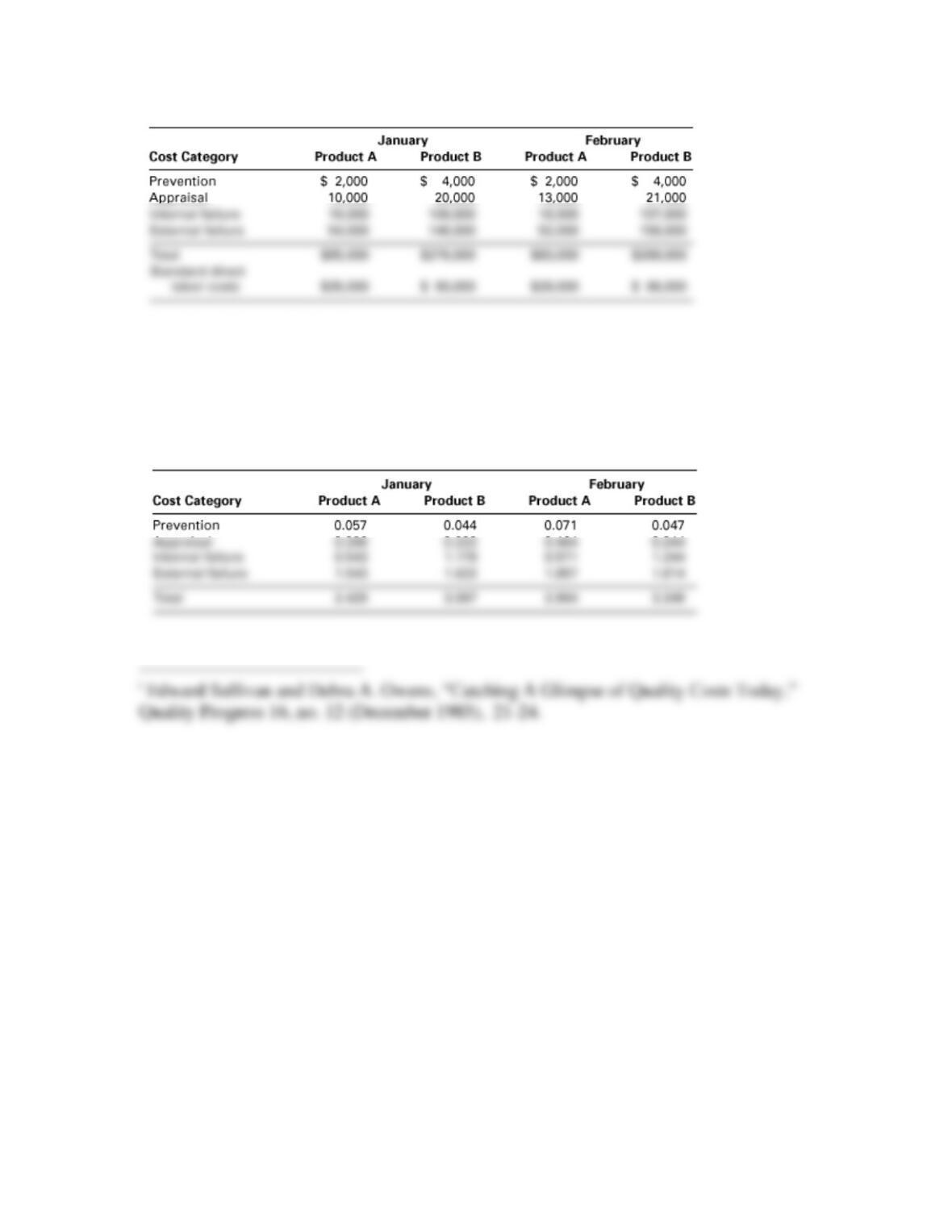
A total quality cost index is
Total quality cost index = total quality costs/direct labor costs
Alternatively, individual indexes can be computed by category, product, and time period,
and are summarized in the following table: