PART A
SUGGESTIONS FOR TEACHING
STRATEGIC MANAGEMENT

2
SUGGESTIONS FOR TEACHING STRATEGIC MANAGEMENT
Strategic management … Business policy … Strategy. Whatever its name, it’s typically considered a “capstone”
course in most business schools. Its primary job is to examine a business firm as a whole and to integrate the various
functional disciplines. It generally includes industry analysis and competitive strategy with a healthy dose of SWOT
analysis. It may also include corporate governance and/or social responsibility and ethics, depending upon the
instructor. The course is generally expected to take a practical view of how business corporations actually function
“in the real world.” Nevertheless, there are many ways to teach strategic management. Some people are strong
proponents of “the case method.” Others argue that simulations are the best method of giving students a “hands-on”
understanding of strategic decision making. A number of instructors also use experiential exercises, group projects,
and audio-visual presentations. Very few, if any, argue for a straight lecture/discussion type of strategy course at the
undergraduate and master’s level. Each approach, however, has its strengths and weaknesses.
The Case Method
The most popular as well as the most perceived effective approach to teaching strategic management is the case
method. Its strengths include a real-world orientation (believed to generate student involvement) and the ability to
focus on developing decision-making skills by taking an integrative and conceptual, yet action-oriented approach.
Possible Course Syllabus and Outlines
A number of policy instructors, including us, have a strong bias in favor of 75-minute classes meeting twice a week.
Open class discussion or oral presentations of complex strategy cases usually require at least an hour’s worth of
time. Given the usual rigmarole involved in starting and ending a class, it is very difficult to handle a case well in a

3

4
SAMPLE COURSE SYLLABUS
COURSE TITLE: STRATEGIC MANAGEMENT
————————————————————————————————————
Class Times & Location:
Course Web Site:
Instructor Information:
Office & Office Hours:
————————————————————————————————————
COURSE DESCRIPTION:
This course serves as a cohesive map for strategic management. It is designed to integrate the
COURSE OBJECTIVES
By the end of the course, students should be able to understand the basic elements of planning
and implementing strategy.
RESOURCES
COURSE COMPONENTS
EXAMS: A designated number of exams and a final exam will test students’
understanding of the materials discussed in class and in the assigned readings.
5
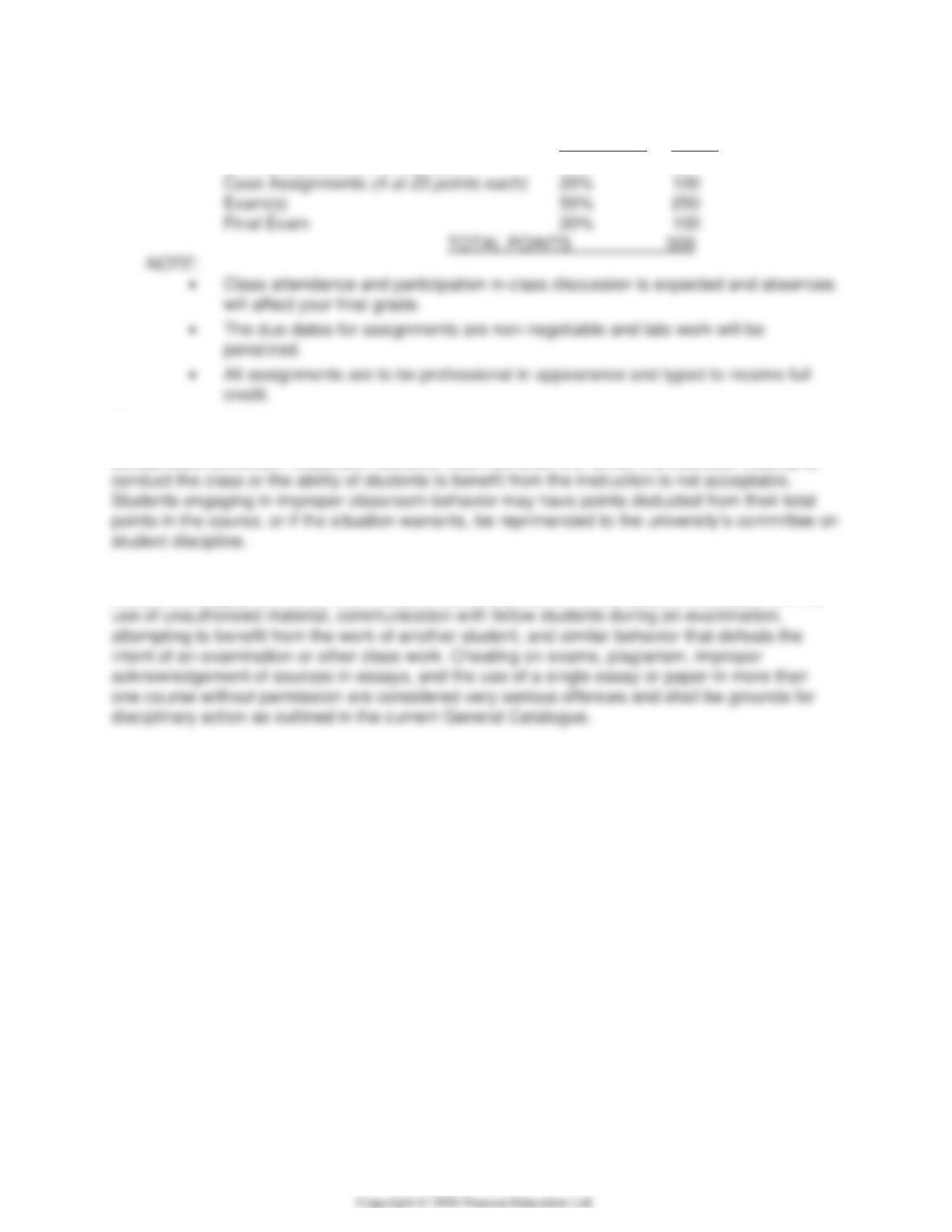
GRADING
Percentage Points
In-Class Exercises/Participation 10% 50
COURSE POLICIES
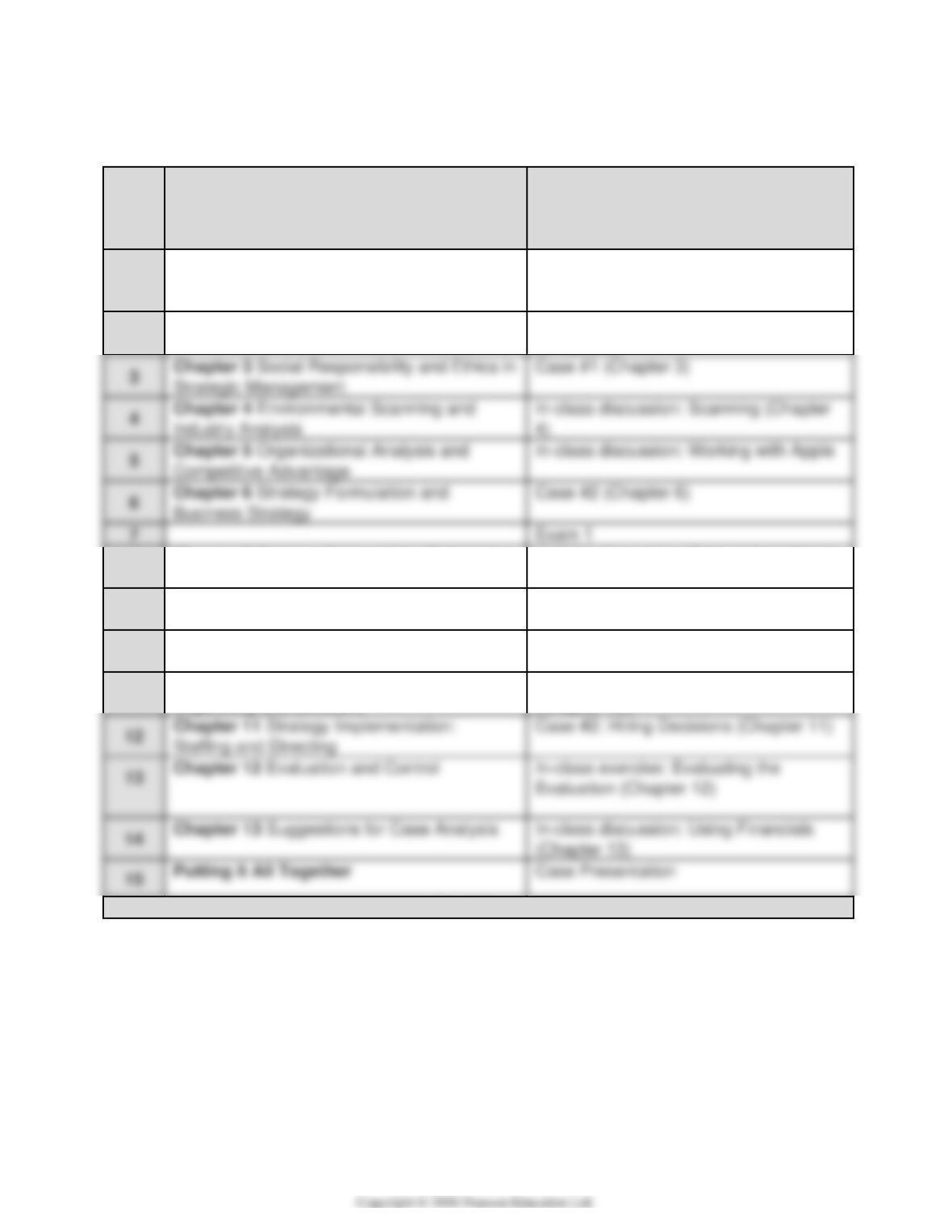
CLASSROOM BEHAVIOR: Classroom behavior that interferes with either the instructor’s ability to
ACADEMIC HONESTY AND APPEALS: Students are expected to maintain the highest standards of
academic integrity. Behavior that violates these standards is not acceptable. Examples are the
6
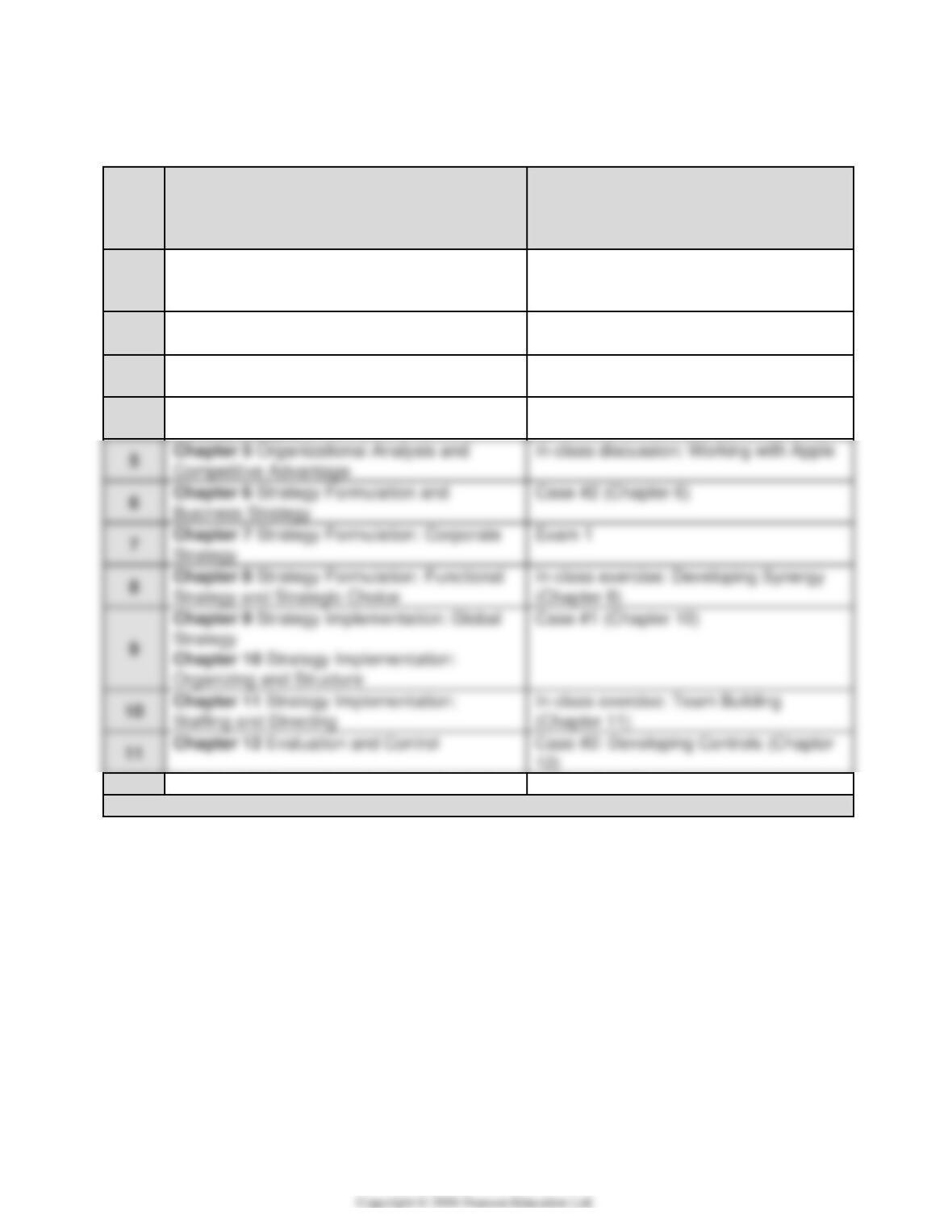
COURSE OUTLINE 16-WEEK COURSE: SEMESTER
Week
Assigned Reading
Generic Activities—see
MyManagementLab for actual
activities that correspond with this
text
1
Chapter 1 Basic Concepts of Strategic
Management
Module Management Strategy
In-class discussion: Strategy (Chapter 1)
2
Chapter 2 Corporate Governance
In-class exercise: Building Constraints
(Chapter 2)
3
Chapter 3 Social Responsibility and Ethics in
Strategic Management
Case #1 (Chapter 3)
4
Chapter 4 Environmental Scanning and
Industry Analysis
In-class discussion: Scanning (Chapter
5
Chapter 5 Organizational Analysis and
6
Chapter 6 Strategy Formulation and
Business Strategy
Case #2 (Chapter 6)
Exam 1
8
Chapter 7 Strategy Formulation: Corporate
Strategy
In-class discussion: Corporations Need
Direction (Chapter 7)
9
Chapter 8 Strategy Formulation: Functional
Strategy and Strategic Choice
Case #1 (Chapter 8)
10
Chapter 9 Strategy Implementation: Global
Strategy
In-class discussion: Successful
Expatriates
11
Chapter 10 Strategy Implementation:
Organizing and Structure
In-class exercise: Team Building
(Chapter 10)
12
Chapter 11 Strategy Implementation:
Staffing and Directing
Case #2: Hiring Decisions (Chapter 11)
14
(Chapter 13)
Final Exam
7
COURSE OUTLINE 12-WEEK COURSE: SEMESTER
Week
Assigned Reading
Generic Activities—see
MyManagementLab for actual
activities that correspond with this
text
1
Chapter 1 Basic Concepts of Strategic
Management
Module Management Strategy
In-class discussion: Strategy (Chapter 1)
2
Chapter 2 Corporate Governance
In-class exercise: Building Constraints
(Chapter 2)
3
Chapter 3 Social Responsibility and Ethics in
Strategic Management
Case #1 (Chapter 3)
4
Chapter 4 Environmental Scanning and
Industry Analysis
In-class discussion: Scanning (Chapter
4)
5
Chapter 5 Organizational Analysis and
Competitive Advantage
In-class discussion: Working with Apple
6
Chapter 6 Strategy Formulation and
Business Strategy
Case #2 (Chapter 6)
7
Chapter 7 Strategy Formulation: Corporate
Exam 1
8
Chapter 8 Strategy Formulation: Functional
Strategy and Strategic Choice
In-class exercise: Developing Synergy
(Chapter 8)
Chapter 9 Strategy Implementation: Global
Organizing and Structure
Staffing and Directing
(Chapter 11)
12)
12
Chapter 13 Suggestions for Case Analysis
Putting It All Together
Final Exam