Instructor’s Manual
9-1
CHAPTER NINE
The Use of Budgets in Planning and Decision Making
This chapter examines the use of budgets in planning and decision
making. In particular, it examines sales budgets, production budget,
Key Concepts
• Budgets must start with a top-down strategic plan that guides and
integrates the whole company and its individual budgets.
• Budgets are future oriented and make extensive use of estimates and
forecasts.
• Accurate cash flow projections are critical if a company is to pay its
employees, suppliers, and creditors on a timely basis.
• Preparing budgeted, or pro forma, financial statements allows
managers to determine the effects of their budgeting decisions on the
Instructor’s Manual
Learning Objectives
LO1— Describe the budget development process, behavioral implications of
budgeting, advantages of budgeting, and the master budget.
LO4— Prepare budgets for material purchases, direct labor, manufacturing
overhead and selling and administrative expenses.
LO5— Explain the importance of budgeting for cash and prepare a cash receipts
budget, a cash disbursements budget, and a summary cash budget.
Lecture Outline
A. Introduction
1. Budgets are plans dealing with the acquisition and use of resources
over a specified time period. Managers use budgeting for planning,
operating, and controlling activities.
o Planning is the cornerstone of good management and
requires the development of objectives and goals for the
Instructor’s Manual
9-3
performance and the use of budgets for performance
evaluation purposes.
2. The concept of budgeting for cash is tied back to the operating
cycle. The operating cycle focuses on cash flow, beginning with the
B. The Budget Development Process (LO1)
1. Some companies start their budget process on the basis of last
year’s numbers, whereas others employ zero-based budgeting.
Zero-based budgets require managers to build budgets from the
o Participation in the Budget Development Process:
Participatory budgeting starts with departmental heads and
then flows up through middle management and finally to
o Regardless of the specific process used, budget
development must be guided by a strategic plan that
focuses attention on the company as a whole and
integrates individual budgets.
Instructor’s Manual
2. Behavioral Implications of Budgeting
o Conflicts arise when budgets are used for both planning
and control. If managers are evaluated and compensated
3. Advantages of Budgeting
o The budgeting process encourages communication
throughout the organization.
o The budgeting process encourages management to focus
on the future.
o The budgeting process can help management identify and
4. The Master Budget
o The master budget consists of an interrelated set of
Instructor’s Manual
9-5
o The master budget starts with forecasting sales and
sheet.
C. The Sales Budget (LO2)
1. Budgets are future oriented and make extensive use of estimates
and forecasts. The sales forecast and the sales budget are the start
2. The usual starting point in sales forecasting is last year’s level of
sales. Other factors and information sources typically used in sales
forecasting are as follows:
o Historical data, such as sales trends for the company,
Key Concept
Budgets must start with a top-down strategic plan that guides and integrates
the whole company and its individual budgets.
Instructor’s Manual
3. The size and complexity of the organization will often determine the
complexity of the sales forecasting system.
4. Some companies will use elaborate econometric planning models
and regression analysis to forecast sales volume. Others may use
5. As all other budgets are based on sales forecasts, it is important to
estimate sales with as much accuracy as possible. A small error in
6. Companies use operating budgets to plan for the short term—
usually one year or less and sales budget is one of the most
important operating budgets.
D. Production Budget (LO3)
The sales forecast (budget) is the starting point in the production budget.
Once the sales budget is prepared, the next step in the budgeting process
for manufacturing companies is preparation of production budget.
Key Concept
Instructor’s Manual
9-7
1. Production budget is used to forecast how many units of product to
produce in order to meet the sales projections.
2. If a minimum level of finished-goods inventory is desired to be held
3. A basic format of production budget is as follows:
Sales forecast (in units)
+ Desired ending inventory of finished goods
= Required production
E. Material, Labor, Overhead, and Selling and Administrative Expense Budgets
(LO4)
Preparing budgets for material purchases, direct labor, overhead, and
selling and administrative expenses is critical because these budgets often
require companies to commit to expenditures months in advance.
Key Concept
Key Formula
Required production = Budgeted sales +(−) Increase (Decrease) in
finished-goods inventory
Instructor’s Manual
Once the production budget is completed, the next budget to be
prepared is the material purchases budget. The starting point of
the material purchases budget is production budget.
o Material purchases budget is used to project the dollar
o The basic format of a material purchases budget is as
follows:
Raw materials needed to meet the required production budget
= Raw materials to be purchased
2. Direct Labor Budget
As with the material purchases budget, the direct labor budget
starts with the production budget. However, because labor cannot
be accumulated as raw materials can, no adjustments need to be
made for beginning and ending inventory.
o Direct labor budget is used to project the dollar amount of
Instructor’s Manual
9-9
3. Manufacturing Overhead Budget
o Manufacturing overhead budget is used to project the
dollar amount of manufacturing overhead needed for
production.
4. Selling and Administrative Expense Budget
o A selling and administrative expense budget includes
variable expenses, such as commissions, and fixed costs,
Key Concept
Preparing budgets for material purchases, direct labor, overhead, and
selling and administrative expenses is critical because these budgets
often require companies to commit to expenditures months in advance.
Instructor’s Manual
F. Cash Budgets (LO5)
1. Why Focus on Cash?
o Many managers consider managing cash flow to be the
single most important consideration in running a successful
business. After all, cash, not income, pays the bills.
o The timing of cash inflows and outflows is critical to the
overall planning process.
a. When cash inflows are delayed because of the
extension of credit to buyers, there may not be
o Cash budgeting forces managers to focus on cash flow
and to plan for the purchase of materials, the payment of
creditors, and the payment of salaries.
2. The Cash Receipts Budget – Sales
The first cash budget that must be prepared is the cash receipts
budget for sales.
o Cash receipts budget is used to project the amount of cash
9-11
3. The Cash Disbursements Budget – Manufacturing Costs
The cash disbursements budget for manufacturing costs includes
cash outflows resulting from payments to suppliers for materials,
cash outflows for salaries and other labor costs, and cash outflows
for overhead expenditures.
o Cash disbursements budget is used to project the amount
of cash to be disbursed during the budget period.
labor + disbursements for manufacturing overhead.
4. Summary Cash Budget
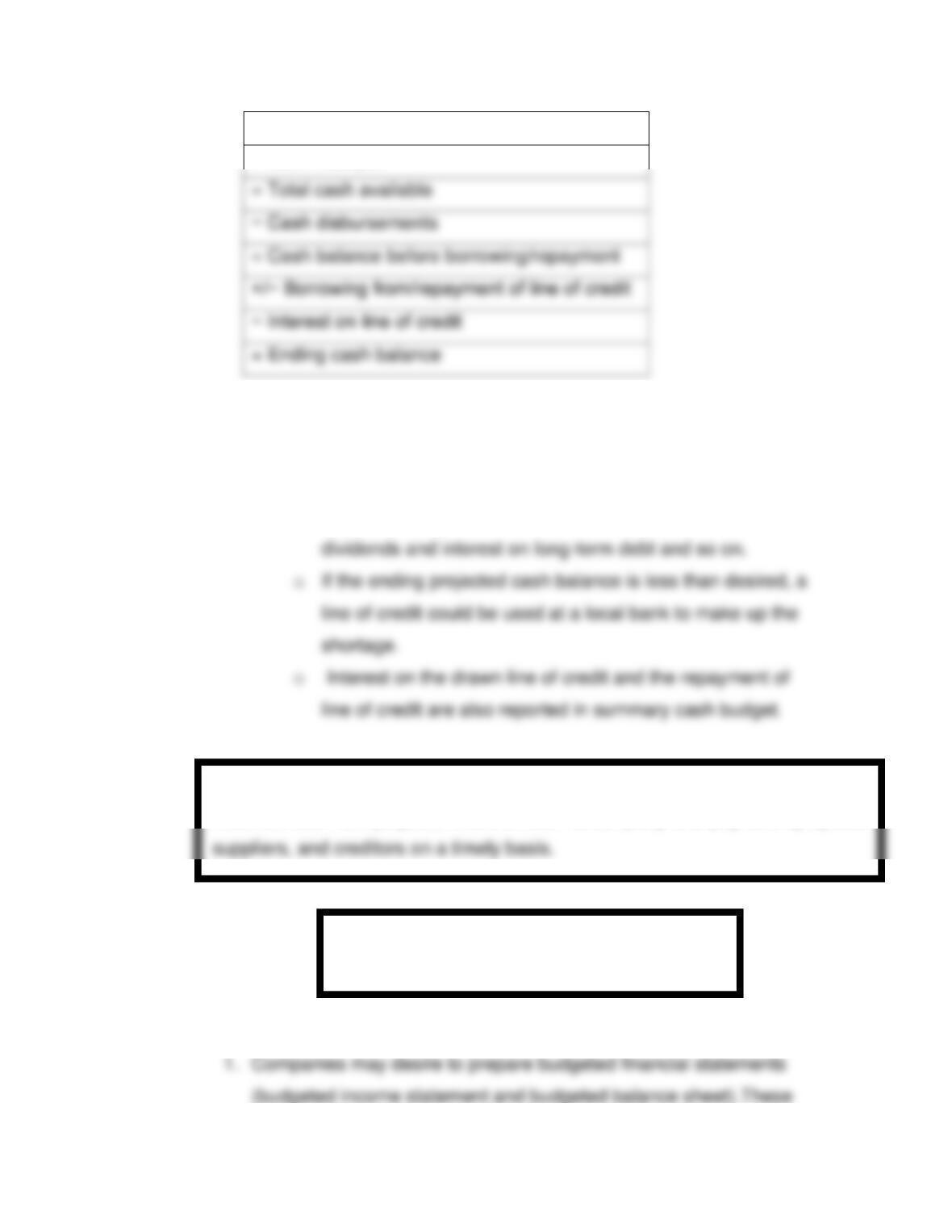
A summary cash budget shows cash receipts and cash
disbursements, along with any required borrowing or repayments
made during the month. A basic summary cash budget is prepared
in the following format:
Instructor’s Manual
9-12
Beginning cash balance
+ Cash receipts
o Receipts primarily include cash receipts from sales.
o Disbursements generally include disbursements for
manufacturing costs, selling and administrative costs,
income taxes, purchase of fixed assets, payments of
G. Budgeted Financial Statements (LO6)
Key Concept
Accurate cash flow projections are critical if a company is to pay its employees,
Making It Real:
The Pains and Gains of Budgeting
= Total cash available
= Cash balance before borrowing/repayment
= Ending cash balance
Instructor’s Manual
are used both for internal planning purposes and to provide
information to external users. The budgeted financial statements
are often called pro forma financial statements.
o Preparing budgeted, or pro forma, financial statements
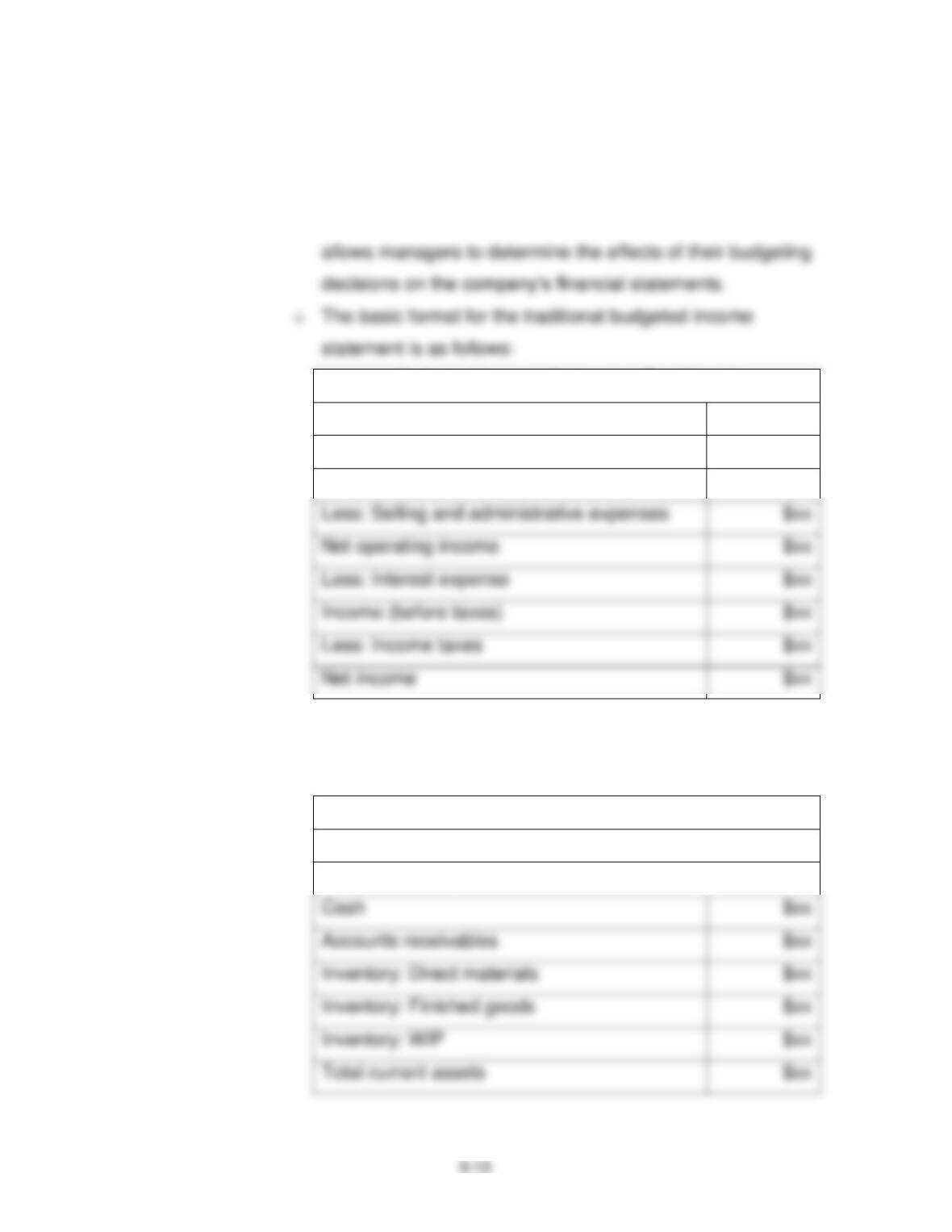
Budgeted Income Statement (Traditional)
Sales
$xx
Less: Cost of goods sold
$xx
Gross Margin
$xx
Less: Selling and administrative expenses
Net operating income
Less: Interest expense
Income (before taxes)
Less: Income taxes
Net income
$xx
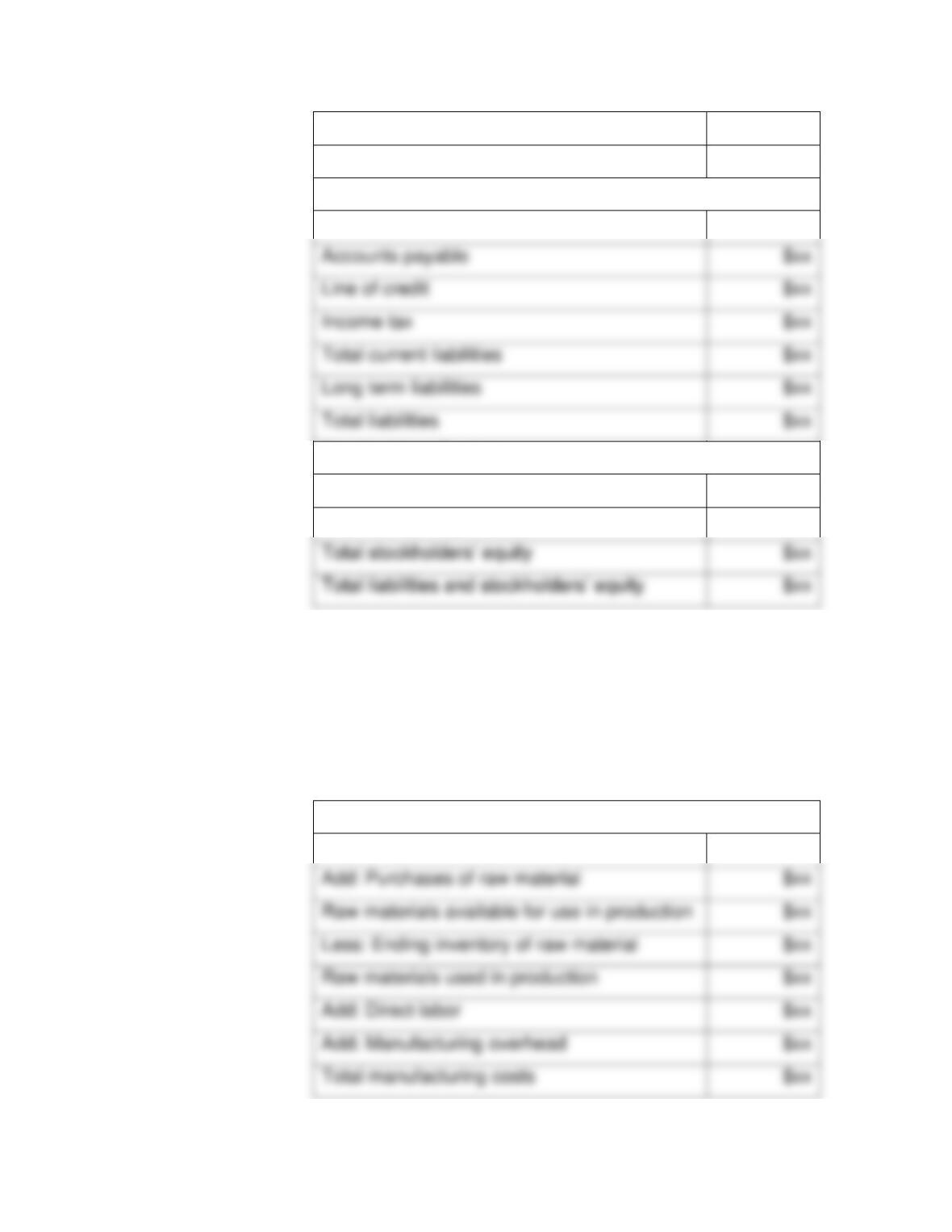
o The basic format for the budgeted balance sheet is as
follows:
Budgeted Balance Sheet
Assets
Current assets:
Cash
$xx
Accounts receivables
$xx
Inventory: Direct materials
$xx
Inventory: Finished goods
$xx
Inventory: WIP
$xx
Total current assets
$xx
Instructor’s Manual
9-14
Fixed assets (net of depreciation)
$xx
Total assets
$xx
Liabilities and Equity
Current liabilities:
Stockholders’ Equity:
Common stock
$xx
Retained earnings
$xx
$xx
$xx
2. Companies also prepare schedules of budgeted cost of goods
manufactured and the cost of goods sold to facilitate preparation of
budgeted financial statements.
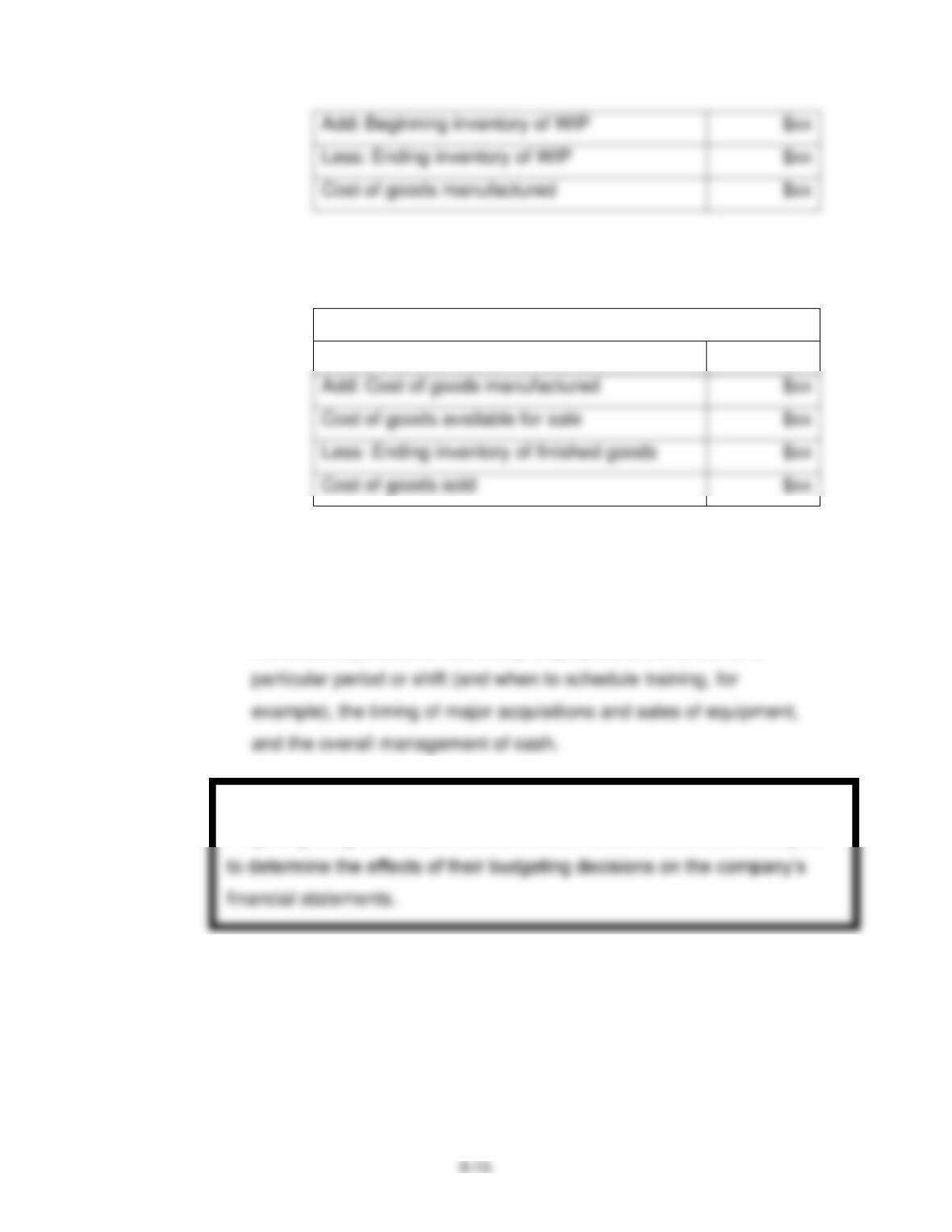
o The basic format for the schedule of budgeted cost of
goods manufactured is as follows:
Budgeted Cost of Goods Manufactured (Absorption)
Beginning inventory of raw material
$xx
Add: Purchases of raw material
$xx
Raw materials available for use in production
$xx
Less: Ending inventory of raw material
$xx
Raw materials used in production
$xx
Add: Direct labor
$xx
Add: Manufacturing overhead
$xx
Total manufacturing costs
$xx
Accounts payable
$xx
Line of credit
$xx
Income tax
$xx
Total current liabilities
$xx
Long term liabilities
$xx
Total liabilities
$xx
Instructor’s Manual
Add: Beginning inventory of WIP
$xx
Less: Ending inventory of WIP
Cost of goods manufactured
$xx
o The basic format for the schedule of cost of goods sold is
as follows:
Budgeted Cost of Goods Sold (Absorption)
Beginning inventory of finished goods
$xx
Add: Cost of goods manufactured
$xx
Cost of goods available for sale
Less: Ending inventory of finished goods
$xx
Cost of goods sold
3. The set of operating budgets and budgeted financial statements
form an interrelated set of planning tools that are vital for managers’
decisions affecting the number of units to produce, the amount of
materials to purchase, how many employees to schedule for a
H. Budgets for Merchandising Companies and Service Companies (LO7)
The budgeting process for merchandising and service companies is similar
to that for manufacturing companies, with a few important differences.
Key Concept
Preparing budgeted, or pro forma, financial statements allows managers
Instructor’s Manual
1. Service companies prepare revenue budget. Although they do not
2. As labor cost represents a significant portion of a service
company’s total costs, the main focus of budgeting for service
companies will often be the labor budget.
3. Overhead is another important area of concern for service
4. Merchandising companies are not involved in manufacturing the
5. Although merchandising companies will prepare a sales budget,
they will not prepare budgets for production, direct material
6. In addition, many merchandising companies hold some level of
7. The preparation of selling and administrative expense budgets,
cash budgets, and budgeted financial statements in merchandising
companies is similar to that in manufacturing companies.
I. Static versus Flexible Budgets (LO8)
1. Static budgets are set at the beginning of the period and remain
constant throughout the budget period.
Instructor’s Manual
9-17
o Static budgets are useful for planning and operating
purposes, but not suitable for control activities.
than budgeted costs.
o The fact that a company’s actual costs are lower than
those budgeted under static conditions does not
necessarily mean that the company (or its employees) was
efficient. This can be shown if flexible budget is used for
comparison.
2. Flexible budgets take differences in cost owing to differences in
Key Concept
Flexible budgets are based on the actual number of units produced rather
than the budgeted units of production.
Key Concept
Flexible budgets are based on the actual number of units produced
rather than the budgeted units of production.

Instructor’s Manual
End-of-Chapter Material
Brief exercises, exercises, problems, and case based on different learning
objectives have been provided at the end of the chapter. These-end-of chapter