
Chapter 09 – Human Resource Management: Getting the Right People for Managerial Success
9-1
9
Chapter
Human Resource Management:
Getting the Right People for Managerial Success
Major Questions the Student Should Be Able to Answer 2
Mapping the Class: Chapter Outline 3
Overview of the Chapter 5
Classroom Outline 7
CHAPTER CONTENTS
Chapter 09 – Human Resource Management: Getting the Right People for Managerial Success
9-2
9.1 Strategic Human Resource Management
9.3 Managing an Effective Workforce: Compensation & Benefits
MAJOR QUESTION: What are the various forms of compensation?
9.4 Orientation, Training, and Development
9.6 Managing Promotions, Transfers, Disciplining, & Dismissals
MAJOR QUESTION: What are some guidelines for handling promotions, transfers,
disciplining, and dismissals?
9.7 The Legal Requirements of Human Resource Management
MAJOR QUESTIONS THE STUDENT SHOULD BE ABLE TO ANSWER
Chapter 09 – Human Resource Management: Getting the Right People for Managerial Success
9-3
9.1 Strategic Human Resource Management
• Human Resource Management: Managing an Organization’s Most Important
9.2 Recruitment and Selection: Putting the Right People into the
Right Jobs
9.3 Managing an Effective Workforce: Compensation & Benefits
• Wages or Salaries
9.4 Orientation, Training, and Development
9.5 Performance Appraisal
• Performance Management in Human Resources
9.6 Managing Promotions, Transfers, Disciplining, & Dismissals
• Promotion: Moving Upward
9.7 The Legal Requirements of Human Resource Management
• Labor Relations
9.8 Labor-Management Issues
• How Workers Organize
MAPPING THE CLASS: CHAPTER OUTLINE

Chapter 09 – Human Resource Management: Getting the Right People for Managerial Success
9-4
9-5
9.1 Strategic Human Resource Management
Human resource management consists of the activities managers perform to
9.2 Recruitment and Selection: Putting the Right People into the
Right Jobs
Applicants may be recruited from inside or outside the organization. The task of
9.3 Managing an Effective Workforce: Compensation & Benefits
9.4 Orientation, Training, and Development
Three ways newcomers are helped to perform their jobs are through orientation,
9.5 Performance Appraisal
A performance appraisal, which is to assess employee performance and provide
subordinates, customers, or oneself. Feedback may be formal or informal.
9.6 Managing Promotions, Transfers, Disciplining, & Dismissals
Managers manage employee replacement actions by promoting, transferring,
9.7 The Legal Requirements of Human Resource Management
OVERVIEW OF THE CHAPTER

Chapter 09 – Human Resource Management: Getting the Right People for Managerial Success
9-6
Four areas of human resource law any manager needs to be aware of are labor
9.8 Labor-Management Issues
There is a process by which workers get a labor union to represent them, and a
Chapter 09 – Human Resource Management: Getting the Right People for Managerial Success
9-7
The Manager’s Toolbox: Soft Skills & Social Graces: Boosting Your Advantage in
the Hiring World
Your soft skills or professional behavior, even before you interview, can impact whether
or not you get hired. You want to dress for success, even if you are at a casual event or
Possible Topics for Discussion:
• Which of the activities described above do you need to work on? How will you
go about doing it?
• Does the fact that your social media presence is easily searchable, able to be
Section 9.1 discusses human resource management, which consists of the activities
managers perform to plan for, attract, develop, and retain an effective workforce.
Planning the human resources needed consists of understanding current employee
needs and predicting future employee needs.
CLASSROOM OUTLINE
9.1 Strategic Human Resource Management (pp. 262-265)
How do effective managers view the role of people in their organization’s
success?
Chapter 09 – Human Resource Management: Getting the Right People for Managerial Success
9-8
ProQuest Document ID: 1684996576
Possible Topics for Discussion:
• Discuss what companies should do to make their employees feel like they are
the firm’s most important assets.
Major Idea Outline:
A. Companies such as Google believe happy people are more productive, and
they offer many services, perks and incentives to their employees, such as on–
site doctors, an onsite gym, free snacks and compensation incentives.
perform to plan for, attract, develop, and retain an effective workforce.
2. Although talking about people as “resources” may seem to downgrade
them to the level of material or financial resources, people are an
organization’s most important resource.
3. At many companies, human resources have become part of the strategic–
management process.
SELF-ASSESSMENT 9.1 (p. 263)
Chapter 09 – Human Resource Management: Getting the Right People for Managerial Success
Assessing the Quality of HR Practices
Go to connect.mheducation.com and take Self-Assessment 9.1.
Student Questions:
1. How did you rate the quality of the company’s HR practices?
2. Based on your responses, what advice would you give the senior HR leader
about how to improve its HR practices? Be specific. What are the
consequences of having poor-quality HR practices? Explain.
Generally, an HR leader should make sure that employees receive formal
misconduct at the workplace.
Additional Activities:
You can also consult the Connect Instructors Manual for the post-assessment activity
and corresponding PowerPoint slides used for this Self-Assessment in Connect. In
the class as a whole.
4. Human capital is the economic or productive potential of employee
knowledge, experience, and actions.
a. Attracting, retaining and developing talented workers is sometimes
5. A knowledge worker is someone whose occupation is principally
concerned with generating or interpreting information, as opposed to
manual labor.
Chapter 09 – Human Resource Management: Getting the Right People for Managerial Success
9-10
6. Social capital is the economic or productive potential of strong, trusting,
and cooperative relationships.
a. This includes goodwill, mutual respect, cooperation, trust, and
C. Planning the Human Resources Needed
1. Strategic human resource planning consists of developing a
2. To plan for the future, you must understand what today’s staffing picture
looks like. This requires doing a job analysis and preparing a job
description and job specification.
a. The purpose of job analysis is to determine, by observation and
analysis, the basic elements of a job.
Chapter 09 – Human Resource Management: Getting the Right People for Managerial Success
9-11
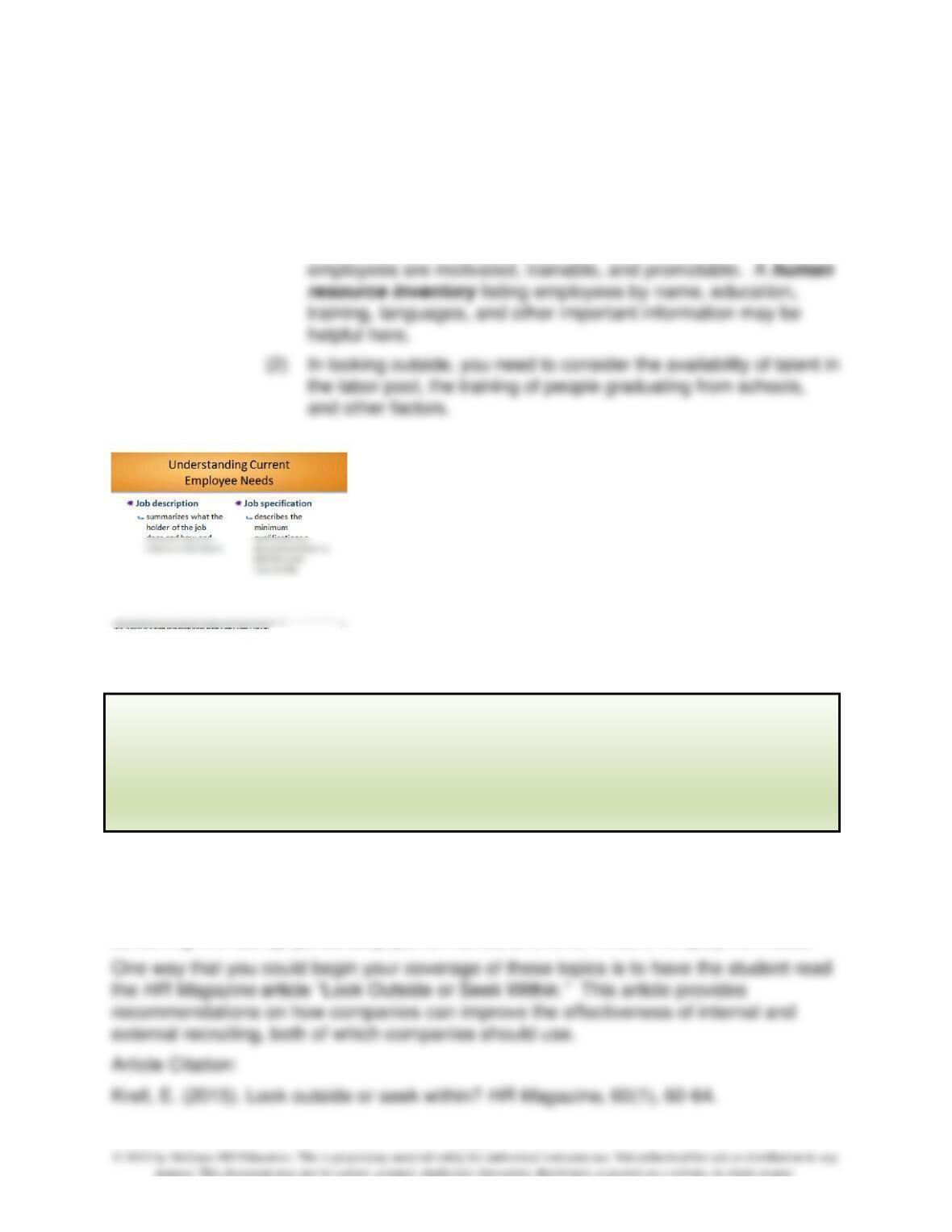
b. After the job analysis is complete, you write a job description and a
job specification.
(1) The job description summarizes what the holder of the job
does and how and why he or she does it.
3. Predicting future employee needs means you must be knowledgeable
Chapter 09 – Human Resource Management: Getting the Right People for Managerial Success
9-12
a. You must understand the organization’s vision and strategic plan so
that the right people can be hired to meet the future strategies and
work.
b. You can recruit employees from either inside or outside the
organization.
(1) In looking at those inside, you need to consider which
Section 9.2 discusses the task of recruiting individuals from within or outside the
company. This task is enhanced by such tools as reviewing candidates’ application
forms, resumes, and references; doing interviews, either structured or unstructured; and
screening with ability, personality, performance, and other kinds of employment tests.
9.2 Recruitment & Selection: Putting the Right People into
the Right Jobs (pp. 266-273)
How can I reduce mistakes in hiring and find great people who might
work for me?
Chapter 09 – Human Resource Management: Getting the Right People for Managerial Success
9-13
ProQuest Document ID: 1641935860
Possible Topics for Discussion:
• Think back to the last job interview that you had. Describe the type of interview
questions that were used and critique how effective you believe the questions
were in determining if you were the ideal candidate for the position.
recruitment.
Major Idea Outline:
A. Recruitment: How to Attract Qualified Applicants
1. Recruiting is the process of locating and attracting qualified applicants for
jobs open in the organization – those whose skills, abilities and
characteristics are best suited to your organization.
2. Internal recruiting means making people already employed by the
organization aware of job openings.
3. External recruiting means attracting job applicants from outside the
organization.
4. Which external recruiting methods work best?

Chapter 09 – Human Resource Management: Getting the Right People for Managerial Success
9-14
a. The most effective source are employee referrals.
b. E-recruitment tools such as “dot-job” web sites, membership
SELF-ASSESSMENT 9.2 (p. 267)
Assessing Your Person-Job Fit
Go to connect.mheducation.com and take Self-Assessment 9.2.
Student Questions:
1. What is your level of fit?
Student responses will differ based on assessment results. Some students
2. Whether you have high or low fit, what are the main causes for your level of
fit? Explain.
3. What questions might you ask a future recruiter to ensure a higher level of
person-job fit? Be specific.
It is important to tell the recruiter what your needs are so that there is a good
job fit. Questions to ask include: Does this job match my background (skills,
abilities and talents), or is this the right type of work for me?
Additional Activities:
You can also consult the Connect Instructors Manual for the post-assessment activity
Chapter 09 – Human Resource Management: Getting the Right People for Managerial Success
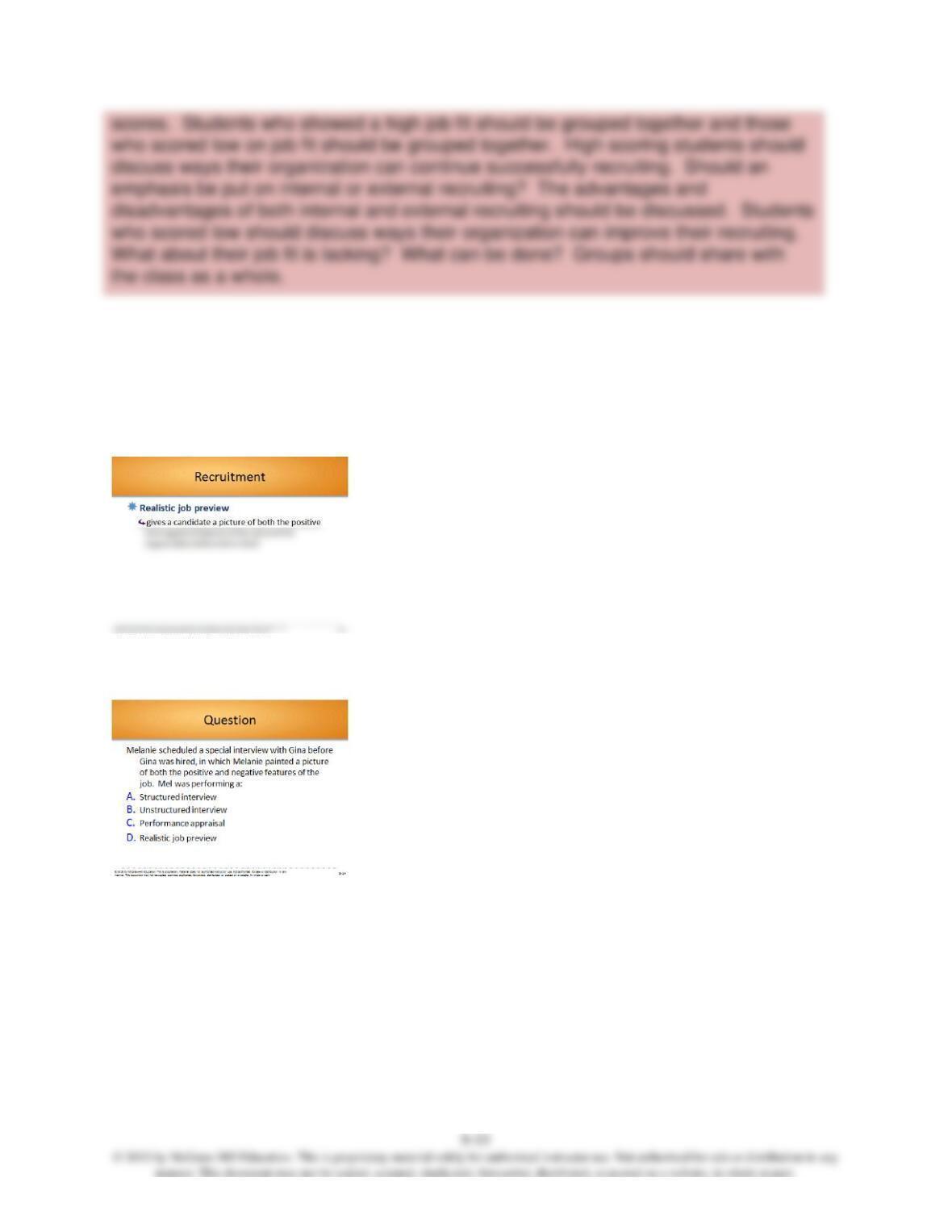
5. A realistic job preview gives a candidate a picture of both positive and
negative features of the job and organization before he or she is hired.
a. This recruiting technique is very effective at reducing turnover within
30 to 90 days of employment.
(Correct answer is D)
B. Selection: How to Choose the Best Person for the Job
1. The selection process is the screening of job applicants to hire the best
candidate.
Chapter 09 – Human Resource Management: Getting the Right People for Managerial Success
9-16
2. Background Information: Application Forms, Résumés, and Reference
Checks
a. Application forms and résumés provide basic background information
about job applicants such as citizenship, education, work history and
certifications.
Interactive Classroom Material:
PRACTICAL ACTION: Would You Lie Like This on Your Resume? (p. 268)
This Practical Action discusses lies people put on their resumes, including lying about
education, employment history, ages, salaries, job titles, criminal background and
immigration status.
YOUR CALL
What past events are you most worried potential employers will find out about
you? What can you do to put them in a better light?
Additional Activities:
One way that you could build on this Practical Action is to show the students the video

Chapter 09 – Human Resource Management: Getting the Right People for Managerial Success
9-17
order to land a job. Consider using the following discussion questions:
Assume that you are applying for a position and you want to “glorify” some of the
responsibilities you had as an intern last summer. To what extent do you think it is
appropriate to make it sound like you had more interesting responsibilities than
you did or accomplished more than you actually did?
Some of the individuals profiled in the 20/20 segment made up entire job histories.
Interactive Classroom Material:
PRACTICAL ACTION: Applying for a Job? Here Are Some Mistakes to Avoid (p.
269)
There are several mistakes that job candidates often make in initial interviews. Some
tips include (1) Be prepared for the interview. Know the company and the job you’re
applying for, and take time to practice questions and answers. (2) Dress right and
YOUR CALL
What kind of advice do you see here that you wished you’d followed in the
past?
Student responses will differ based on past experiences. Many will feel as if they
Additional Activities:
One way that you could build on this Practical Action is to have the students read the
USA Today article “35 Costly Job Search Mistakes You Might Still Be Making.” This
Chapter 09 – Human Resource Management: Getting the Right People for Managerial Success
9-18
Based on the advice in this article, what adjustments should you make in how you
use cover letters?
Discuss how showing up too early to an interview might be a bad strategy.
How can you make it apparent in the hiring process that you have thoroughly
researched the position and the company?
Group Exercise #1: Choosing the Best Person for the Job
There is a group exercise available at the end of this manual that provides students
with the opportunity to gain further knowledge of the selection process.
Exercise Objectives
3. Interviewing: Unstructured, Situational, & Behavioral-Description.
a. Interviewing is the most commonly used employee-selection
technique and these interviews can take place face-to-face, by
videoconference, phone, or via the Internet.
questions:
Chapter 09 – Human Resource Management: Getting the Right People for Managerial Success
9-19
e. The structured interview involves asking each applicant the same
questions and comparing their responses to a standardized set of
answers. There are two types:
Interactive Classroom Material:
PRACTICAL ACTION: The Right Way to Conduct an Interview (pp. 270–271)
This Practical Action provides some suggestions for effective interviewing, including
defining your needs, reviewing the applicant’s resume, writing out interview questions,
following a three-scene interview scenario and writing a short report after the
interview.
YOUR CALL
What additional questions would you like to ask a job applicant so as to get the
best candidate?
You may want to also ask the candidate if he or she has failed at something. How
Additional Activities:
One way that you could build on this Practical Action is to have the students read the
HR Magazine article “Cool and Competent.” This article describes the competency–
Chapter 09 – Human Resource Management: Getting the Right People for Managerial Success
9-20
Group Exercise #2: Practicing Your Interview Skills
There is a group exercise available at the end of this manual that provides students
with the opportunity to practice interviewing skills.
Exercise Objective
4. Employment Tests: Ability, Personality, Performance, Integrity and Others
a. Employment tests are legally considered to consist of any procedure
used in the employment selection decision process.
b. Ability tests measure physical abilities, strength and stamina,
d. Personality tests measure personality traits such as adjustment,
energy, sociability, independence and need for achievement.
(1) The most famous personality test is the Myers-Briggs Type
Indicator.
f. When appropriate, the organization can also use drug testing,
polygraph, genetic screening, and handwriting analysis.
g. Two important legal considerations about any test are its reliability
and its validity.