Chapter 09 – Motivation
9-21
Lecturer Enhancer 9.1
MOTIVATION AND CREATIVITY
In a large studio at the headquarters of Hallmark Cards Inc., Robert Hurlburt bent over a potter’s wheel.
Sabbaticals like Hurlburt’s are only one way that Hallmark tries to help workers be creative. Staffers can
desert Hallmark’s midtown Kansas City headquarters for a downtown loft, where teams of writers and
artists get away from phones to exchange ideas. They may spend days in retreat at a farm in nearby
Kearney, Missouri, taking part in fun exercises like building birdhouses.
Some go farther afield, sent by the company on trips overseas to soak up atmosphere and culture. Not all
Controlling Hallmark’s creative staff of about 700 is the responsibility of Marita Wesley-Clough, a 20-
year company veteran who was named director of creative strategy about a year ago. Wesley-Clough
sounded like the philosophy major she was in college as she tried to explain her job, describing herself
alternately as a shepherd, a midwife and a water bearer. “It’s sort of like catching the wind,” she said.
“The road to creative strategy isn’t a clear one.”
LECTURE ENHANCERS
Chapter 09 – Motivation
9-22
Hallmark perennially ranks high on lists of the best U.S. companies to work for. Despite massive
restructuring to improve efficiency, writers and artists still seem to have a great time. However, the
competitive pressure that is typical of any business exists at Hallmark. Each card’s success is rated
through surveys and information gathered by electronic cash registers, and the staff knows exactly how
well their work is doing.
Lecturer Enhancer 9.2
MASLOW’S FURTHER STUDY OF MOTIVATION
Anyone who has taken Psychology 101 knows about Abraham Maslow’s Hierarchy of Needs. People,
Maslow found, strive to fulfill progressively higher levels of need, from nourishment, safety, love, and
esteem to “self–actualization.”
It’s less well known that Maslow, in the early 1960s, also delved deeply into management and economics.
Setting up shop in a southern California electronics plant, he produced a journal that applied the concept
of self-actualization to both the workplace and the marketplace. “This is by far Maslow’s best book,” says
Peter Drucker, perhaps the foremost management authority today. “It had an enormous impact on me.”
Yet after a limited run, Maslow’s book slipped into obscurity.
What made Maslow’s book so special—and why did it vanish? In 1962, a few years after postulating the

Chapter 09 – Motivation
9-23
Lecturer Enhancer 9.3
RECOGNITION: MAKING HEROES
1. Deliver recognition and reward in an open and publicized way. If not made public, recognition
loses much of its impact and defeats much of its purpose.
3. Tailor recognition and reward to the unique needs of the people involved. Have several recognition
4. Deliver recognition in a personal and honest manner. Avoid providing recognition that is too
“slick” or overproduced.
5. Strive for a clear, unambiguous, and well-communicated connection between accomplishments and
6. Recognize recognition. That is, recognize people who recognize others for doing what is best for
the company.
2. Mention an employee’s outstanding work or ideas during your staff meetings or at meetings with
your peers and management.
4. Show a personal interest in the development and career of an employee after a special achievement
by asking them how you can help them take the next step.
Chapter 09 – Motivation
9-24
Notes for Topics for Discussion and Action
DISCUSSION
1. Discuss why two people with similar abilities may have very different expectancies for performing at a
high level.
Expectancy is a person’s perception about the extent to which effort (an input) will result in a certain level
of performance. Two people with similar abilities may have very different expectancies for performing at
2. Describe why some people have low instrumentalities even when their managers distribute outcomes
based on performance.
Instrumentalities include perceptions that people have about the extent to which performance at a certain
3. Analyze how professors try to promote equity to motivate students.
MANAGEMENT IN ACTION
Chapter 09 – Motivation
9-25
Professors try to promote equity to motivate students by establishing standards of performance in their
4. Describe three techniques or procedures that managers can use to determine whether a goal is
difficult.
A goal is what a person is trying to accomplish through his or her efforts and behavior. Difficult goals are
hard but possible to attain.
5. Discuss why managers should always try to use positive reinforcement instead of negative
reinforcement.
Positive reinforcement gives people outcomes they want when they perform behavior that contributes to
ACTION
6. Interview three people who have the same kind of job (such as salesperson, waiter/waitress, or
teacher), and determine what kinds of needs each is trying to satisfy at work.

Chapter 09 – Motivation
9-26
(Note to the instructors: Students’ answers may vary.)
A requirement or necessity for survival and well-being is called a need. People are motivated to obtain

Chapter 09 – Motivation
9-27
Copyright © 2017 McGraw-Hill Education. All rights reserved. No reproduction or distribution without the prior written consent of McGraw-Hill
Education.
One waitress is training to be a manager, and is trying to fulfill the need to improve her skills and
abilities, and engage in meaningful work. This kind of need can be categorized as an esteem need in
Maslow’s hierarchy.
7. Interview a manager in an organization in your community to determine the extent to which the
manager takes advantage of vicarious learning to promote high motivation among subordinates.
(Note to the instructors: Students’ answers may vary.)
Social learning theory considers how learning and motivation are influenced by people’s thoughts and
beliefs and their observations of other people’s behavior. One component of this theory is vicarious
learning. This is a method by which people are motivated by observing other people perform a behavior
and be reinforced for doing so.
AACSB: Analytic
Diagnosing Motivation
Think about the ideal job that you would like to obtain upon graduation. Describe this job, the kind of
manager you would like to report to, and the kind of organization you would be working in. Then answer
the following questions:
1. What would be your levels of expectancy and instrumentality on this job? Which outcomes would have
high valence for you on this job? What steps would your manager take to influence your levels of
expectancy, instrumentality, and valence?
BUILDING MANAGEMENT SKILLS
Chapter 09 – Motivation
9-28
Expectancy is a person’s perception about the extent to which effort will result in a certain level of
performance. Instrumentality is a person’s perception about the extent to which performance at a certain
2. Whom would you choose as a referent on this job? What steps would your manager take to make you
feel that you were being equitably treated? What would you do if, after a year on the job, you experienced
underpayment inequity?
3. What goals would you strive to achieve on this job? Why? What role would your manager play in
determining your goals?
Chapter 09 – Motivation
9-29
Copyright © 2017 McGraw-Hill Education. All rights reserved. No reproduction or distribution without the prior written consent of McGraw-Hill
Education.
Managers may be entirely responsible for setting goals, or employees may participate in the setting of
goals to ensure acceptance and commitment to the goals. Regardless of whether specific, difficult goals
are set by managers, workers, or both together, they lead to high levels of motivation and performance.
Managers also contribute to goal setting by providing feedback about how employees are doing. This
feedback allows both managers and employees to determine progress, and helps them to reevaluate goals
when necessary.
4. What needs would you strive to satisfy on the job? Why? What role would your manager play in
helping you satisfy these needs?
5. What behaviors would your manager positively reinforce for you on this job? Why? What positive
reinforcers would your manager use?
6. Would there be any vicarious learning on this job? Why or why not?

9-30
7. To what extent would you be motivated by self-control on this job? Why?
8. What would be your level of self-efficacy on this job? Why would your self-efficacy be at this level?
Should your manager take steps to boost your self-efficacy? If not, why not? If so, what would these steps
be?
AACSB: Analytic
(Note to the instructor: Student responses to these questions will vary.)
1. Either individually or in a group, think about the ethical implications of closely linking pay to
performance.
2. Under what conditions might contingent pay be most stressful, and what steps can managers take to try
to help their subordinates perform effectively and not experience excessive amounts of stress?
MANAGING ETHICALLY

Chapter 09 – Motivation
9-31
Pay for performance should be something extra, compensation that is above and beyond basic wages and
AACSB: Ethics
Increasing Motivation
1. Discuss the extent to which you believe that you have a motivation problem in your stores.
The conclusion that there is a motivation problem in the stores is a likely one because it is apparent that
employees are capable of doing the work. The fact that customers receive quality service and treatment
2. Given what you have learned in this chapter, design a plan to increase the motivation of clerks to
provide prompt service to customers even when they are not being watched by a partner.
After determining whether the problem is due to understaffing, a plan for motivating clerks can be
3. Design a plan to increase the motivation of spotters to remove as many stains as possible even when
they are not being watched by a partner.
SMALL GROUP BREAKOUT EXERCISE

Chapter 09 – Motivation
9-32
4. Design a plan to increase the motivation of pressers to do a top-notch job on all clothes they press, no
matter how difficult.
An organizational behavior modification strategy may be implemented with the pressers. There may be a
reason why the pressers fail to do a top-notch job on all clothes. It may be that they are paid for the
number of garments they press, rather than the quality of work that they do. Their pay system should be
changed to reflect an emphasis on quality instead of quantity. A specific behavior could be identified,
AACSB: Analytic
It would appear that the analysts have little motivation to fill out the forms. There appears to be no
specific reward for filling out the forms, even though they contain important information on the
productivity of each person. You should talk to the analysts and find out why they are not filling out the
AACSB standards: Analytic
Case Synopsis: Bright Future in Sales? Millennials Are Hesitant
BE THE MANAGER
WALL STREET JOURNAL CASE IN THE NEWS
Chapter 09 – Motivation
lower-ranking members identifying prospects and developing early interest, someone else
running through the specs on highly technical products, and field reps negotiating deals.
1. Why are some millennials unmotivated by the prospect of a job and career in sales?
2. From an expectancy theory perspective, what steps can managers take to make sales
positions attractive and motivating for millennials?
3. From a need theory perspective, what steps can managers take to make sales positions
attractive and motivating for millennials?

9-34
4. From a learning theory perspective, what steps can managers take to make sales positions
attractive and motivating for millennials?
AACSB: Analytic
There are no Manager’s Hot Seat Exercises for this Chapter
MANAGER’S HOT SEAT (MHS)
SUPPLEMENTAL FEATURES
Chapter 09 – Motivation
9-35
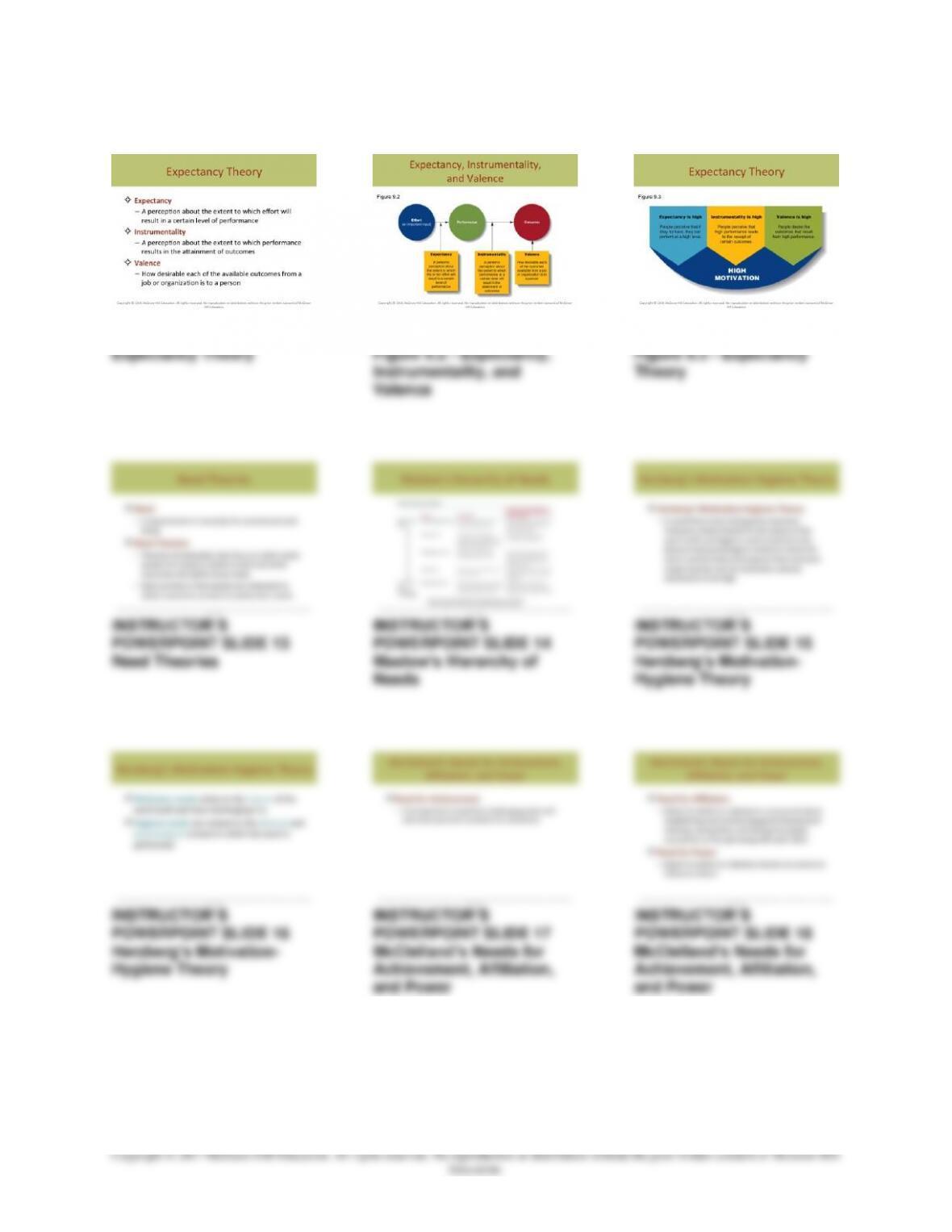
These Instructor’s PowerPoint slides can be used to supplement the lecture material.
INSTRUCTOR’S
POWERPOINT SLIDE 4
The Nature of Motivation
INSTRUCTOR’S
POWERPOINT SLIDE 5
The Nature of Motivation
INSTRUCTOR’S
POWERPOINT SLIDE 6
The Nature of Motivation
INSTRUCTOR’S
POWERPOINT SLIDE 7
Figure 9.1 – The Motivation
INSTRUCTOR’S
POWERPOINT SLIDE 8
Expectancy Theory
INSTRUCTOR’S
POWERPOINT SLIDE 9
Question?
INSTRUCTOR’S POWERPOINT SLIDES
Chapter 09 – Motivation
9-36
INSTRUCTOR’S
POWERPOINT SLIDE 10
INSTRUCTOR’S
POWERPOINT SLIDE 11
INSTRUCTOR’S
POWERPOINT SLIDE 12
Chapter 09 – Motivation
9-37
INSTRUCTOR’S
POWERPOINT SLIDE 19
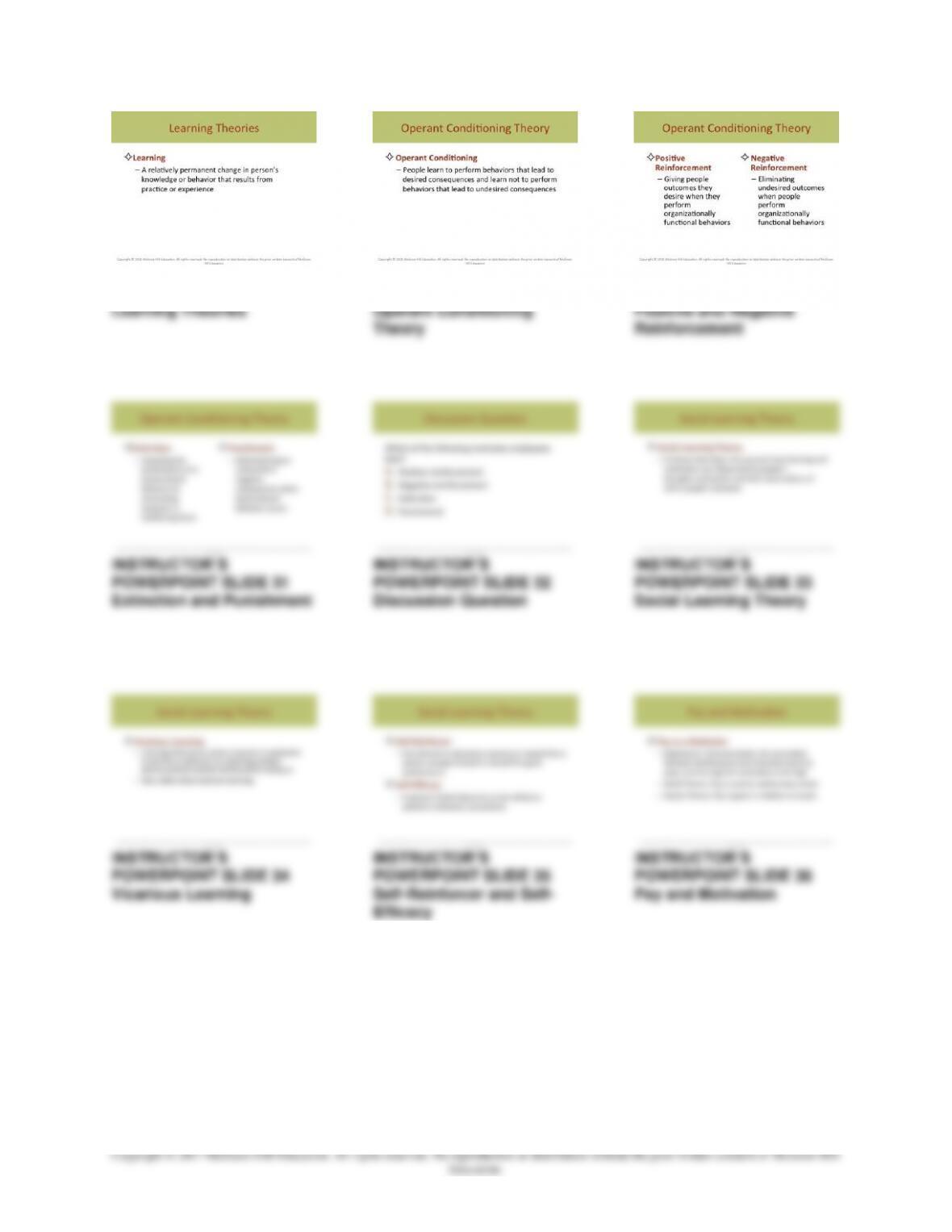
Equity Theory
INSTRUCTOR’S
POWERPOINT SLIDE 20
Equity Theory
INSTRUCTOR’S
POWERPOINT SLIDE 21
Table 9.2 – Equity Theory
INSTRUCTOR’S
POWERPOINT SLIDE 22
Equity Theory
INSTRUCTOR’S
POWERPOINT SLIDE 23
Equity and Justice in
Organizations
INSTRUCTOR’S
POWERPOINT SLIDE 24
Learning Theories
INSTRUCTOR’S
POWERPOINT SLIDE 25
Goal-Setting Theory
INSTRUCTOR’S
POWERPOINT SLIDE 26
Learning Theories
INSTRUCTOR’S
POWERPOINT SLIDE 27
Question?
Chapter 09 – Motivation
9-38
INSTRUCTOR’S
POWERPOINT SLIDE 28
INSTRUCTOR’S
POWERPOINT SLIDE 29
INSTRUCTOR’S
POWERPOINT SLIDE 30
Efficacy

Chapter 09 – Motivation
INSTRUCTOR’S
POWERPOINT SLIDE 37
Pay as Motivator
INSTRUCTOR’S
POWERPOINT SLIDE 38
Merit Pay and Performance
INSTRUCTOR’S
POWERPOINT SLIDE 39
Salary Increase or Bonus?
INSTRUCTOR’S
POWERPOINT
SLIDE 40
Examples of Merit Pay Plans
INSTRUCTOR’S
POWERPOINT
SLIDE 41
Examples of Merit Pay Plans
INSTRUCTOR’S
POWERPOINT
SLIDE 42
Be the Manager
INSTRUCTOR’S
POWERPOINT
SLIDE 43
Topics for Discussion
INSTRUCTOR’S
POWERPOINT
SLIDE 44
Topics for Discussion
INSTRUCTOR’S
POWERPOINT
SLIDE 45
Topics for Discussion

Chapter 09 – Motivation
9-40
INSTRUCTOR’S
POWERPOINT
SLIDE 46
Topics for Discussion
INSTRUCTOR’S
POWERPOINT
SLIDE 47
Topics for Discussion