CHAPTER 9
MANAGING COMPENSATION
CHAPTER OUTLINE
9.1 What Is Compensation?
9.2 Strategic Compensation
9.2a Linking Compensation to Organizational Objectives
9.2c The Bases for Compensation
9.3 Compensation Design—The Pay Mix
9.3a Internal Factors
9.4 Job Evaluation Systems
9.4b Job Classification System
9.4d Work Valuation
9.5 Compensation Implementation—Pay Tools
9.5b The Wage Curve
9.5d Rate Ranges
9.6 Government Regulation of Compensation
9.7 Compensation Assessment
LEARNING OUTCOMES
1. Distinguish a strategic compensation program from one that is non-strategic.
3. Estimate whether or not a pay system is consistent within the firm as well as comparable
to industry standards and government laws.
2 Part 4: Implementing Compensation and Security
GENERATING INTEREST
Ask the following questions:
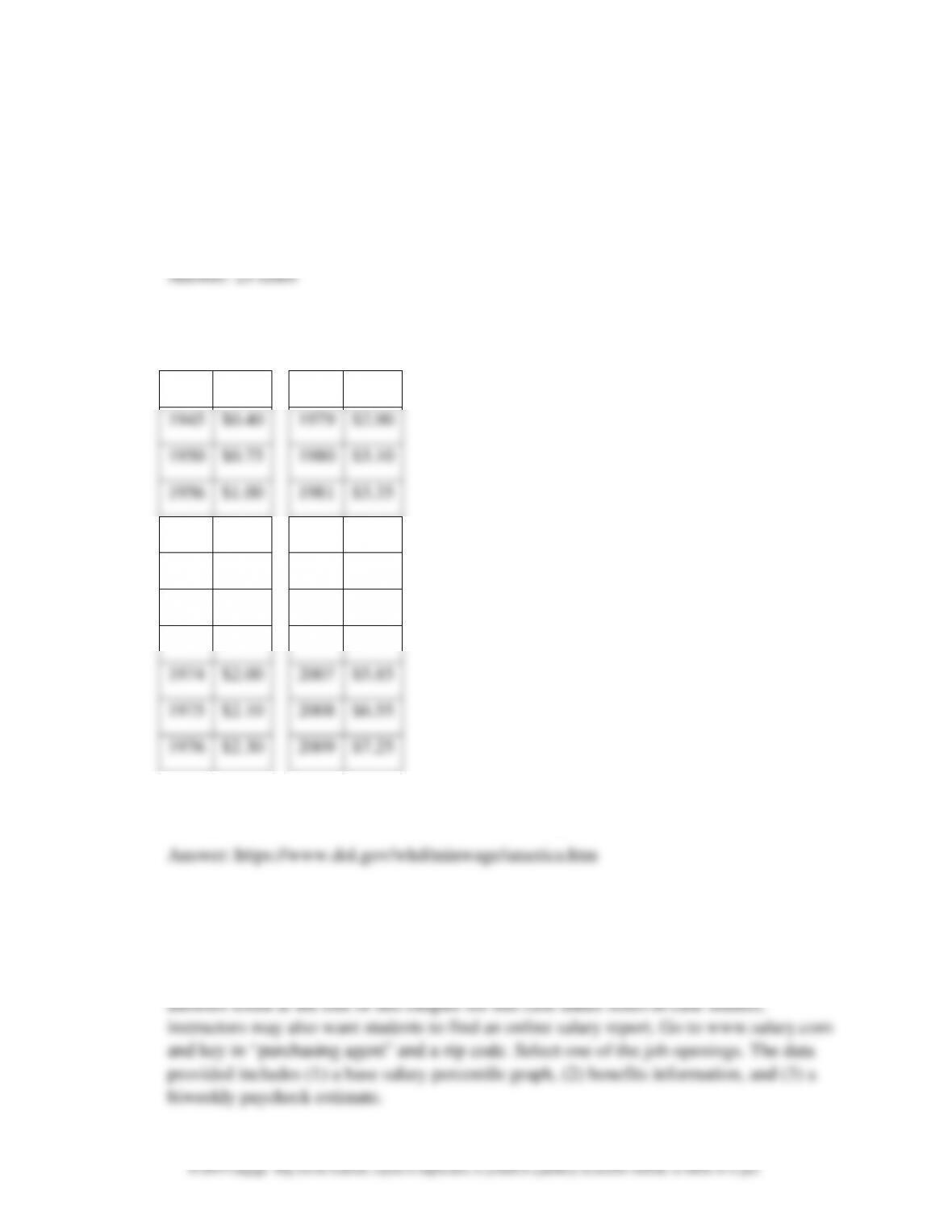
1. What was the first hourly federal minimum wage rate established by the Fair Labor
Standards Act in 1938?
2. What was the minimum wage the year you were born?
Answer: See the following table.
1939
$0.30
1978
$2.65
1945
$0.40
1979
$2.90
1950
$0.75
1980
$3.10
1956
$1.00
1981
$3.35
1961
$1.15
1990
$3.80
1963
$1.25
1991
$4.25
1967
$1.40
1996
$4.75
1968
$1.60
1997
$5.15
1974
$2.00
2007
$5.85
1975
$2.10
2008
$6.55
1976
$2.30
2009
$7.25
3. Does your home state have a different minimum wage law than the federal standard?
DEALING WITH TROUBLE SPOTS
Assign Case Study 1, “Pay Decisions at Performance Sports,” to help students relate to
the challenges associated with making pay decisions. In addition to the suggested
Chapter 9: Managing Compensation 3
LECTURE OUTLINE
Discussion Starter #1: The #Fightfor15 movement on Twitter and in the streets, many Americans
advocated a minimum wage increase of $15 per hour.
ANSWER: Students’ answers will vary. Starting pay can make a difference in whether or not someone
Compensation increases employee loyalty.
9.1 What Is Compensation? Figure 9.1
Figure 9.2
Compensation has three components:
• Direct compensation: employee wages and salaries, incentives, bonuses, and
commissions
Teaching Tip: Use Figure 9.1 to discuss the different types of compensation. Ask students to give
examples of indirect and nonfinancial compensation.
Organizations tell their employees what is important based on how they align the
components of compensation.
Teaching Tip: Use Figure 9.2 to discuss compensation alignment. Ask students to describe how
compensation may be aligned at different organizations: financial services, an animal rescue
organization, and a restaurant.
9.2 Strategic Compensation Figure 9.3
Figure 9.4
Strategic compensation is the compensation of employees in ways that enhance
Chapter 9: Managing Compensation 5
Expectancy Theory and Pay
The expectancy theory of motivation predicts that a worker’s level of motivation
Teaching Tip: Use Figure 9.3 to discuss how pay-for-performance and expectancy theory are related.
Ask students what will happen over time if an employee performs well but is not well rewarded.
Pay Secrecy
Secrecy can generate distrust in the compensation system, reduce employee
motivation, and inhibit organizational effectiveness. Companies maintain secrecy
Video Highlights #1: Section 9.2b: The Pay-for-Performance Standard
VIDEO: Japan Seeks Alternatives to Its Pay System (2:28)
This news article and accompanying video discusses how many companies in Japan are abandoning
9.2c The Bases for Compensation
Work performed in most private, public, and not-for-profit organizations is
traditionally based on hourly work. Hourly work is work paid on an hourly basis.
Teaching Tip: Use Figure 9.4 to discuss the types of positions that are exempt from overtime
provisions. Ask students to suggest examples of each category around the school.
EOC Discussion Question #1: Tomax Corporation has 400 employees and wishes to develop a
compensation policy to correspond to its dynamic business strategy. The company wishes to
employ a high-quality workforce capable of responding to a competitive business environment.
Suggest different compensation objectives to match Tomax’s business goals.
9.3 Compensation Design—The Pay Mix Figure 9.5
Pay is determined by a combination of internal and external factors.
© 2019 Cengage. May not be scanned, copied or duplicated, or posted to a publicly accessible website, in whole or in part.
9.3a Internal Factors
Internal factors include the following:
• The organization’s compensation strategy
• The worth of a job
Compensation Strategy
Employers should set pay policies that reflect the following:
• The internal wage relationship among jobs and skill levels
• The external competition
Worth of a Job
Organizations without a formal compensation program generally base the worth
of jobs on the subjective opinions of people familiar with the jobs. Organizations
with formal compensation programs are more likely to rely on a system of job
evaluation. Today, compensation professionals believe that a job’s value should
be based on the total value delivered to the organization.
Employee’s Relative Worth
Employee performance can be recognized and rewarded through promotions and
various incentive systems. Merit raises should be determined by an effective
performance appraisal system so that only deserving employees are given merit
raises.
Employer’s Ability to Pay
Pay levels are limited by earned profits and other financial resources available to
employers. An organization’s ability to pay is determined in part by the
9.3b External Factors
Major external factors that influence pay rates include labor market conditions,
area pay rates, cost of living, collective bargaining, and legal requirements.
Chapter 9: Managing Compensation 7
Labor Market Conditions
The labor market reflects the forces of supply and demand for qualified labor
within an area.
Area Pay Rates
A formal pay structure should provide rates that are in line with those being paid
by other employers for comparable jobs within the area. Wage surveys provide
external pay equity.
Cost of Living
Because of inflation, compensation rates must be adjusted upward periodically to
help employees maintain their purchasing power. The consumer price index
Collective Bargaining
Labor unions bargain collectively over compensation. Real wages are wage
increases larger than rises in the consumer price index, that is, the real earning
power of wages.
Discussion Starter #2: Since employees may differ in terms of their job performance, would it not
be more feasible to determine the wage rate for each employee on the basis of his or her relative
worth to the organization? Explain.
EOC Discussion Question #2: Since employees may differ in terms of their job performance,
would it not be more feasible to determine the wage rate for each employee on the basis of his or
her relative worth to the organization? Explain.
9.4 Job Evaluation Systems Figure 9.6
Organizations formally determine the value of jobs through the process of job evaluation.
Job evaluation is a systematic process of determining the relative worth of jobs to
© 2019 Cengage. May not be scanned, copied or duplicated, or posted to a publicly accessible website, in whole or in part.
9.4a Job Ranking System
9.4b Job Classification System
9.4c Point System
The point system is a quantitative job evaluation procedure that determines the
The Point Manual
The point manual is a handbook that contains a description of the compensable
factors and the degrees to which these factors may exist within the jobs.
Using the Point Manual
9.4d Work Valuation
9.4e Job Evaluation for Management Positions
Management positions are more difficult to evaluate but point plans for executive
and managerial employees operate like those for other employees. The Hay
Teaching Tip: Use Figure 9.6 to discuss the factors in the Hay evaluation profile.
9.5 Compensation Implementation—Pay Tools Figure 9.7
Figure 9.8
© 2019 Cengage. May not be scanned, copied or duplicated, or posted to a publicly accessible website, in whole or in part.
9.6 Government Regulation of Compensation Figure 9.10
Compensation implementation is subject to state and federal regulations. A majority of
states have minimum wages. Most states also regulate hours of work and overtime
payments.
Wage and Hour Provisions
Minimum wage rate applies to the actual earning rate before any added overtime
Minimum Wage and Pay Compression
Pay rate compression is compression of pay between new and experienced employees
caused by the higher starting salaries of new employees; also, the differential between
hourly workers and their managers. The reasons for pay rate compression are usually
more market based than government based. The following guidelines can minimize pay
rate compression:
• Reward high-performance and merit-worthy employees with large pay increases.
Child Labor Provisions
Minimum wage makes it more difficult for high school students and young adults to find
jobs because employers do not want to pay workers without experience the same rate as
adults with experience. Age 16 is the basic minimum age required for employment.
Pay Equity Provisions
Although laws protect employees against pay discrimination, it still occurs.
Teaching Tip: Use Figure 9.10 to discuss rate and gender pay inequality. Ask students if they have
experienced inequality in pay.
Chapter 9: Managing Compensation 11
Video Highlight #2: Section 9.6: Government Regulation of Compensation
VIDEO: Apple Says It Now Pays All U.S. Employees Equally, Regardless of Sex or Race (0:40)
EOC Discussion Question #3: Describe the basic steps in conducting a wage and salary survey.
What are some factors to consider? One of the objections to granting wage increases on a
9.7 Compensation Assessment Figure 9.11
After a compensation system is up and running, its effectiveness is vitally important in
linking compensation with strategy. An effective compensation system will (1) help the
Teaching Tip: Use Figure 9.11 to review an example of a compensation scorecard. Ask students how
this example scorecard provides transparency for an organization.
Discussion Starter #3: What is a compensation scorecard and how does it help align a company’s
strategy with its compensation system?
ANSWER: The compensation scorecard collects and displays the results for all the measures that a
company uses to monitor and compare compensation among internal departments or units. While
EOC Discussion Question #4: What is a compensation scorecard and how does it help align a
company’s strategy with its compensation system?
12 Part 4: Implementing Compensation and Security
HRM EXPERIENCE
Why This Salary?
1. This question can be answered by referring students to the factors affecting the wage mix
as discussed in the chapter. Some jobs are paid more because they have more worth (e.g.,
they are more important) to the employer. The job of airline pilot is worth more to an
2. Factors that may account for the difference among wages/salaries for the identical
occupation in the same organization include worth of the employee (e.g., an employee’s
3. An employer’s compensation strategy, worth of the job to the organization, and the
ANSWERS TO END-OF-CHAPTER DISCUSSION QUESTIONS
1. To obtain a high-quality workforce, Tomax will want to pay wages above the market
rates. This policy will also help to reduce turnover while maintaining among employees a
2. One of the main points in this question is that jobs should be organized as much as
possible to fit the needs of an organization; its employees, in turn, should be placed in